

AI Deepfake Detection: How It Works and When to Trust It

You're looking at a video that feels off, but you can't afford to guess. Maybe it's a protest clip a reporter is about to publish, a video call where a finance lead hears a familiar executive voice, or a piece of submitted evidence that could shape a legal decision. In each case, AI deepfake detection is less about spotting “fake-looking” content and more about deciding how much trust a clip deserves.
That distinction matters because a detector rarely gives you a clean yes or no. It gives you a risk signal, then asks you to weigh that signal against the source, the file history, and the cost of being wrong. That's why a modern workflow needs more than a single score, and why it helps to start with choosing a secure chat tool when your team is already handling sensitive media and private verification.
The practical question is simple. Which signals matter, what do they reveal, how reliable are they under real conditions, and how do you use the result without over-trusting it? A 2025 evaluation of CLIP-based detectors found strong results after tuning to familiar domains but no meaningful zero-shot generalization to unseen generation methods, which reinforces a basic rule: one model alone is rarely enough.
What AI Deepfake Detection Actually Does
A journalist gets a video from a source at 9 p.m. The clip looks plausible, the voice sounds familiar, and the file has already been forwarded twice. A fraud analyst faces a different pressure point, a video call that appears to come from a CFO asking for an urgent transfer. A lawyer sees a submitted recording and has to decide whether it belongs in the record at all. In all three cases, the detector is not the judge, it's one witness in a larger review.
Detection is a layered inspection
A good system checks frame-level visuals, audio, motion over time, and metadata because each one can expose a different part of the manipulation. Visual analysis looks for frame-by-frame anomalies. Audio forensics looks for synthetic speech traces or sync problems. Temporal checks ask whether motion, blinking, and head movement stay believable across the full clip. Metadata inspection looks at file origin, encoding history, and signs of recompression or editing.
That layered approach exists for a reason. The benchmark history matters here. FaceForensics++, introduced by Rossler and colleagues in 2019, contains more than 1,000 manipulated videos made with DeepFakes, Face2Face, FaceSwap, and NeuralTextures, and XceptionNet scored 96.36% on DeepFakes but only 52.04% on NeuralTextures, averaging 81.39% (benchmark summary). The lesson is blunt. A detector can look excellent on one manipulation style and stumble on another.
A score is not a verdict
That's why a confidence score should be read as a probability of concern, not a declaration of truth. A high score means the clip deserves scrutiny, not automatic rejection. A low score means the clip may be cleaner than average, not that it's authentic beyond doubt.
Practical rule: treat detection output like a triage note. It should tell you where to look next, not replace the rest of the authentication process.
For teams deciding how to handle suspicious media, the workflow should always ask four questions. What signals drove the score. What kind of manipulation seems likely. How much could compression or reposting have distorted the file. And what other evidence can confirm or contradict the detector's result. That frame keeps the system useful without pretending it's omniscient.
The Four Core Signals Behind Detection
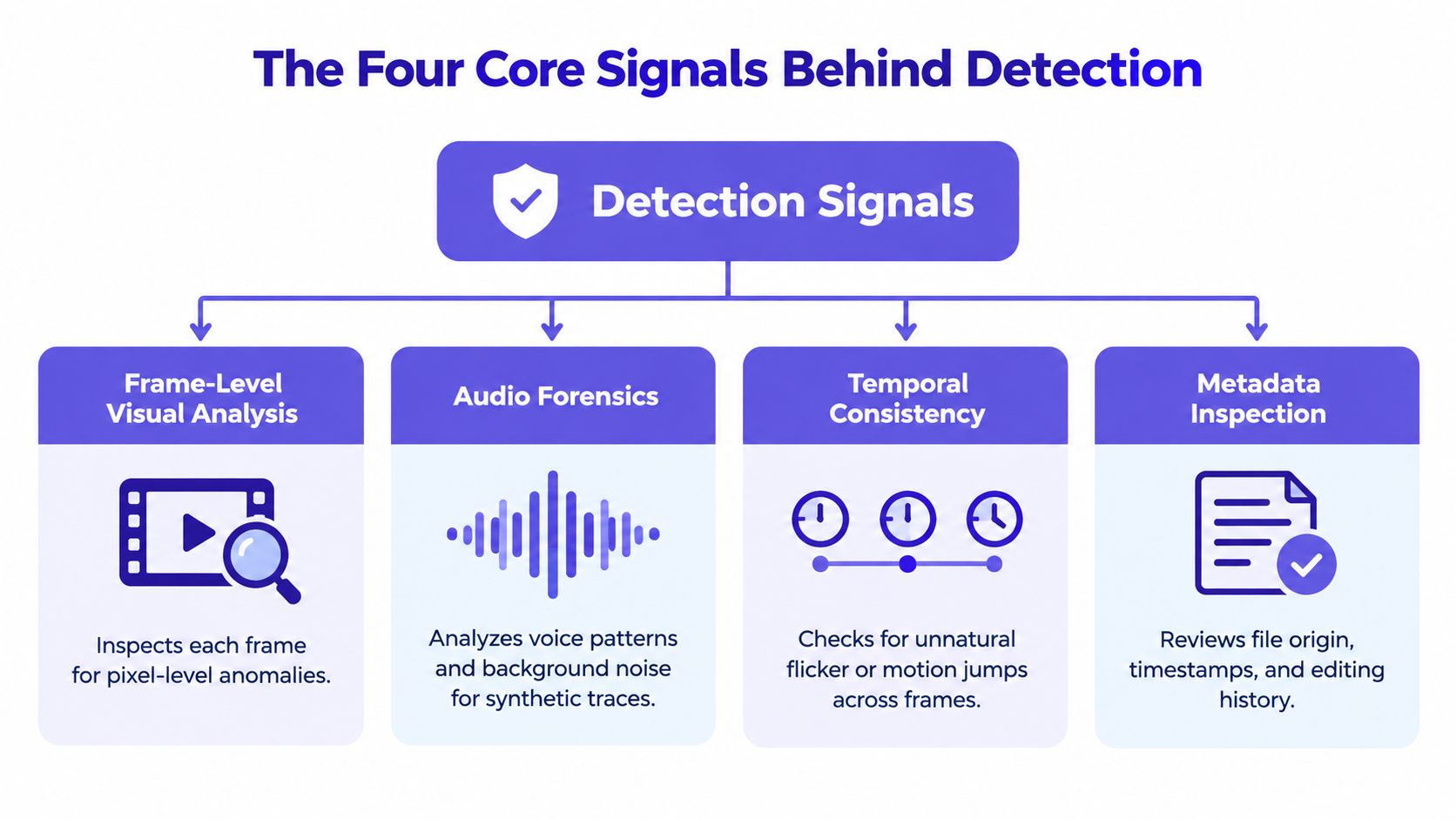
The easiest way to understand detection is to think of it as four separate inspections running at once. Each one catches different evidence, and each one has blind spots. When teams mix them, they get a stronger answer than any single check can deliver.
Frame-level visual analysis
Frame analysis looks at each image inside the video and asks whether the pixels behave like a real camera captured them. That includes tiny texture inconsistencies, boundary issues around the face, and odd blending where the head meets the background. It's good at picking up manipulation traces left in individual frames, especially when the generator leaves subtle artifacts.
It misses more when the clip is heavily compressed or when the fake is clean enough to avoid obvious pixel-level defects. That's why frame checks are useful, but not enough on their own. They can tell you that something looks unusual in a given image, but they can't always explain whether the cause is synthetic generation, poor lighting, or a messy upload chain.
Audio forensics and temporal consistency
Audio forensics listens for signs that sound was generated or altered. That can include unnatural spectral patterns, voice cloning traces, or lip-sync mismatch where the mouth and the audio drift apart. Temporal analysis then asks whether motion across the whole clip remains stable. Blinking, head turns, and facial motion should feel continuous, not jerky or oddly regular.
The most common mistake is treating these as the same signal. They're not. A clip can have decent-looking frames but weak sync. It can also have passable audio with motion that doesn't flow naturally across time. Together, those two checks are much harder to fool than either one alone.
A privacy-first system can combine these checks without storing the underlying upload, which matters when the file itself may be sensitive evidence or a private internal communication.
Metadata inspection
Metadata is the file's paper trail. It can reveal codec, bitrate, device signatures, timestamps, or signs that the clip was re-encoded after recording. That doesn't prove a fake by itself, but it often tells you whether a video has been handled, converted, or passed through a platform that may have stripped useful forensic detail.
When these four signals line up, the report gets stronger. When they disagree, the disagreement itself is useful. That's the point, a good detector doesn't just produce a score, it shows which kind of evidence drove the result and where uncertainty remains.
Common Fingerprints and Artifacts Detectors Look For
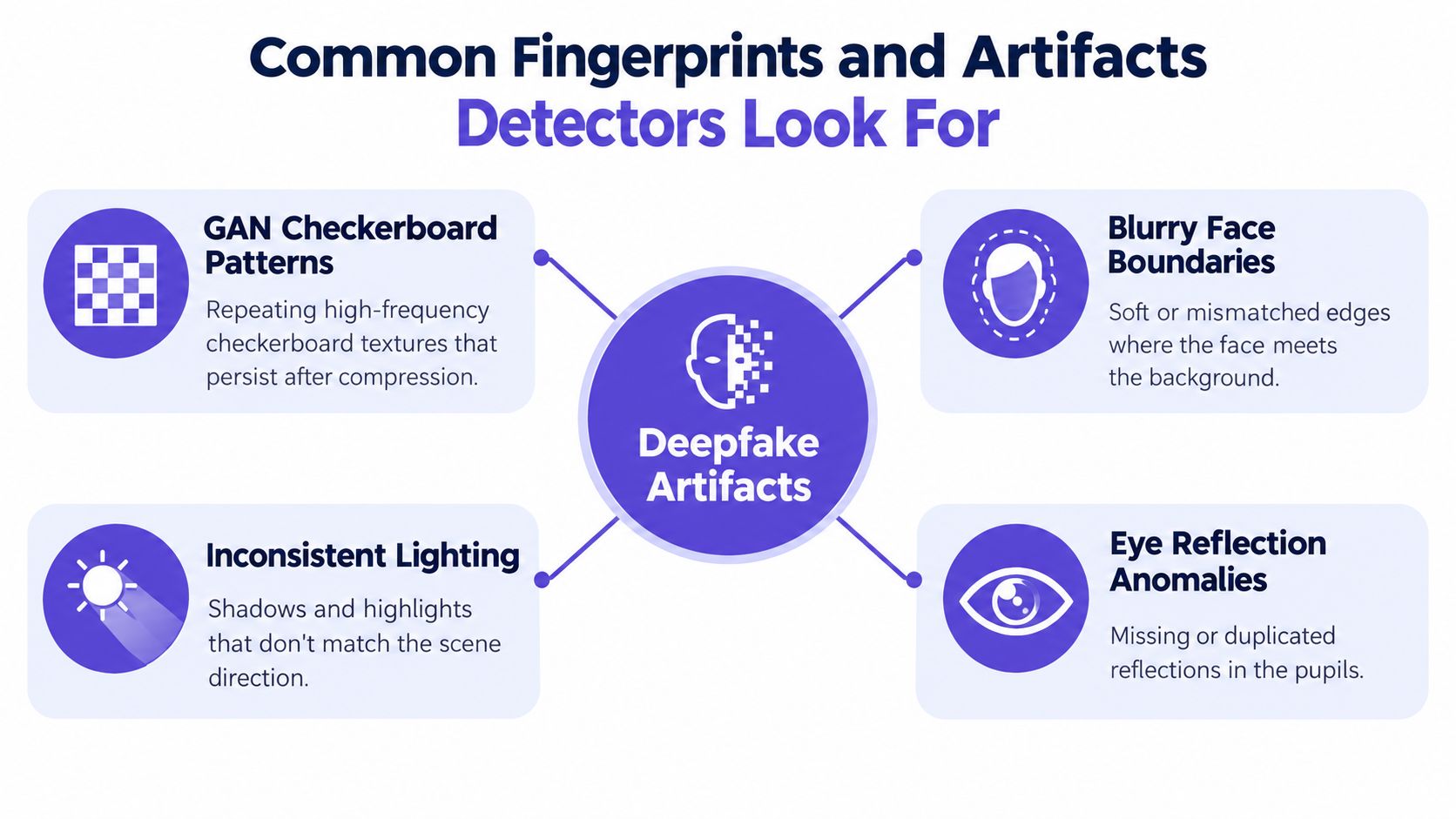
The word “artifact” sounds abstract until you connect it to a visual cue you can imagine. A detector is often looking for the digital equivalent of fingerprints left behind by generation, editing, or recompression. Some are loud, others are faint, and the most convincing fakes are built to avoid the obvious ones.
What those fingerprints look like
GAN fingerprints often show up as repeating textures that look a bit like a faint grid or checkerboard. They may survive compression unevenly, which makes them more visible in some copies than others. Diffusion-generated content can look smoother, but the smoothness can come with slight mismatches in skin, hair detail, or flat regions that should have more natural variation.
Audio anomalies are less visible but often easier to explain. If background noise suddenly feels too clean, or the frequency pattern looks flattened in a way real recording gear wouldn't usually create, that's a clue. It's not proof. It's a clue that the sound may not have been captured in one ordinary pass.
Motion and lighting often betray the edit
A manipulated face can move a little too neatly while the rest of the scene behaves normally. That mismatch matters. You may see jitter around the face boundary, blink patterns that feel unnatural, or lighting that doesn't match the direction of the room's shadows. These are the kinds of clues that make a clip feel “off” even when the subject looks convincing at first glance.
Encoding irregularities are the other big tell. Recompression can leave a trail in file structure, frame size, or bitrate patterns that suggest the media has been reshaped multiple times. That's one reason the DeepFake Detection Challenge dataset, which contains 119,146 videos with 19,154 authentic and 99,992 manipulated clips from 3,426 volunteers, became a major stress test for the field (DFDC dataset). Large, messy datasets force detectors to face a wider range of real manipulation types.
The hard part isn't learning to spot one artifact. It's learning how many artifacts disappear once a clip has been resized, compressed, or repackaged for social media.
For hands-on reading about the visual side of these cues, a useful companion piece is fingerprint features, especially if you're comparing different output styles across tools or vendors.
How Detector Performance Is Measured
Vendor claims usually lead with a single number, and that is where buyers get misled. Accuracy sounds clean, but it hides the tradeoff between missed fakes and false alarms. In deepfake work, those two mistakes do not cost the same thing, so they should not be treated the same way.
The metrics that matter
Precision tells you how many flagged clips were suspicious. Recall tells you how many suspicious clips were caught. F1 score balances the two. False-positive rate matters when you cannot afford to keep flagging genuine material. Calibration matters when you want the score to mean the same thing across different upload conditions.
Accuracy alone can be especially deceptive when the classes are uneven. In a review of common benchmark datasets, UADFV includes 17,329 real frames and 16,991 fake frames, DF-TIMIT includes 34,003 real and 34,023 fake frames, and Celeb-DF-v2 contains 358,790 real frames versus 2,116,768 fake frames (benchmark review). In imbalanced data, a model can look better than it is if it learns to favor the larger class.
Out-of-distribution is where confidence breaks
Models often lose reliability when they leave their training environment. The same benchmark review reports that detectors commonly lose 10 to 15 percentage points when evaluated out of distribution, and white-box adversarial attacks can succeed at rates above 80%. That is why the threat model matters as much as the metric.
| Metric | What it measures | Why it matters |
|---|---|---|
| Accuracy | Overall correct predictions | Can hide weak performance on rare or costly cases |
| Precision | Share of flagged clips that are genuinely suspicious | Reduces false alarms |
| Recall | Share of suspicious clips that get caught | Reduces missed fakes |
| F1 score | Balance between precision and recall | Useful when both errors matter |
| False-positive rate | How often real clips are flagged | Critical for newsroom, legal, and fraud workflows |
| Calibration | Whether the score matches real-world risk | Keeps confidence meaningful across conditions |
For buyers comparing vendor claims, the right internal comparison point is not “Who has the highest number?” It is “Which tool stays honest under compression, unfamiliar generators, and adversarial pressure?” For a broader view of how large-scale stress testing works, the DeepFake Detection Challenge overview is a useful reference point.
Real-World Workflows That Rely on Detection
A newsroom receives a clip showing a public incident. The reporter doesn't publish on the detector alone. They check the source, compare the timing, look for corroborating footage, and then use the detector's result to decide whether the clip needs deeper review. That sequence matters because a single score can't tell you whether the uploader is credible, whether the clip has been trimmed, or whether the context matches the claims around it.
Newsrooms and fraud teams need speed plus verification
In an enterprise setting, a finance team may get a video message that appears to come from a senior executive. A detector can flag unusual audio, motion, or metadata, but the team still has to verify the request through an approved channel before anyone moves money. That's where the detector becomes useful, it narrows the question from “Should we trust this?” to “What kind of risk are we looking at, and who else needs to confirm it?”
The same logic applies to legal and law-enforcement workflows. A submitted clip isn't just content, it's evidence. If the file has been re-encoded, screen-recorded, or forwarded through a platform that stripped metadata, the detector can help explain what evidence was lost. The chain of custody still has to come from the records, not the score.
Evidence review needs a workflow, not a verdict
For teams that handle high-stakes material, detector output should sit inside a review path that includes source validation, file preservation, and escalation thresholds. That's why evidence review playbooks matter. A practical example is the Horus Intelligence evidence review playbook, which fits naturally alongside detector output when the goal is to preserve investigative discipline rather than just label content.
In high-stakes settings, the safest default is to treat the detector as a filter. It helps you decide what deserves human review, it doesn't replace that review.
This is also where turnaround time matters. If a newsroom or operations team has to decide fast, a delayed result can be nearly as unhelpful as no result at all. A good workflow keeps the automated check quick, but the human decision deliberate.
Limitations Every Operator Should Plan For
The biggest mistake operators make is assuming a strong lab result will survive contact with the real world. It often won't. Generators change, upload paths change, codecs change, and every one of those shifts can weaken the traces a detector relies on.
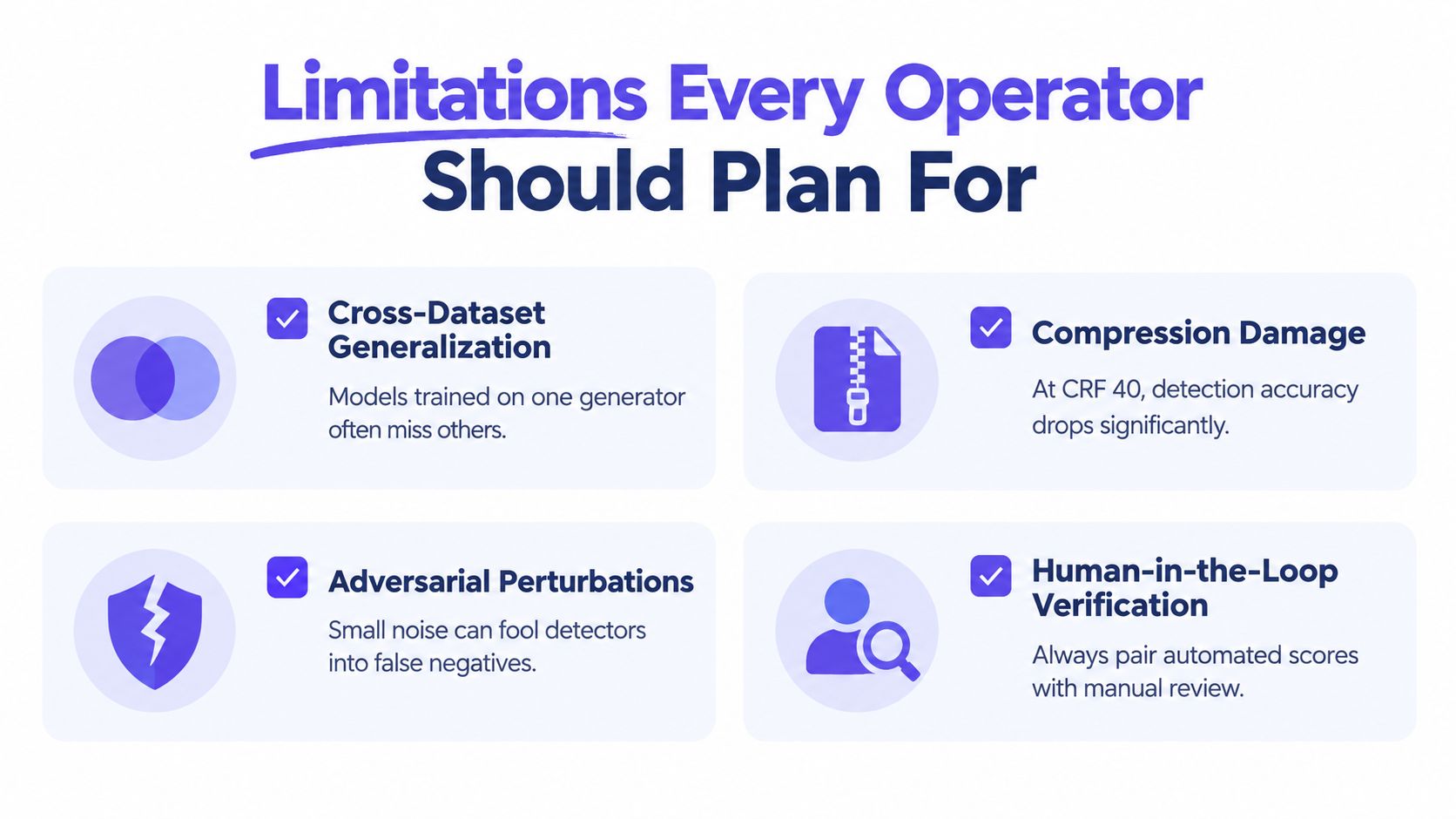
Generalization is the central risk
Cross-dataset generalization is the main technical problem. A detector trained on one generation pipeline can learn shortcuts, like codec patterns or alignment quirks, instead of manipulation evidence. A recent evaluation spanning 13 benchmarks found that training with paired real and fake samples from the same source video is essential for reducing shortcut learning and improving transfer to unseen datasets and generation methods (13-benchmark evaluation). That's a strong clue that matching source structure matters as much as model architecture.
Compression and adversarial noise break the clean story
Compression is not a side issue. In one cross-dataset study, at CRF 40, a multimodal framework retained 78.92% accuracy, while XceptionNet reached 54.68% and a transformer-based method reached 61.23% (compression study). That gap shows how quickly forensic traces can erode once a clip is heavily recompressed.
Authenticity is harder to prove than fakery
There's another operational blind spot. Proving a video is fake is not the same as proving a video is authentic. WITNESS's 2025 analysis makes the point clearly, because false positives become dangerous when detection is deployed at scale and the key issue is whether origin and chain of custody can be established, not just whether artifacts exist (WITNESS analysis). In practice, that means detection should support provenance, not replace it.
Operator's rule: if the file came through social platforms, screen recording, or aggressive recompression, assume the score is less stable and raise the threshold for automatic decisions.
For teams planning a purchase or a deployment, the right question is not “Can it detect a fake?” It's “How does it behave when the clip is unfamiliar, compressed, or intentionally adversarial?”
Best Practices for Selecting and Operating a Detector
Start with the environment, not the vendor. If your team handles newsroom clips, legal exhibits, finance approvals, or executive impersonation risks, the tool has to match those workflows. A detector that looks strong in a demo but fails on real uploads is a liability, not a safeguard.
Build a test matrix that reflects reality
Test across multiple generator families, identities, compression levels, lighting conditions, and source devices. Include older and newer synthesis methods. Separate training and testing identities. If you can, make sure the same source video doesn't leak into both sides of the evaluation, because shortcut learning can make results look better than they are.
The earlier benchmark history supports this approach. A detector that performs well on familiar manipulations can still miss an unseen generation family. That's why the test set should include social-media recompression, resizing, blur, low-bitrate footage, and videos that have already been handled by ordinary editing tools.
Ask about uncertainty and governance
Any serious procurement review should ask three direct questions. Does the vendor provide an inconclusive outcome. How is the confidence score calibrated. Does the platform store user uploads. Those answers tell you more about operational maturity than a glossy accuracy claim.
Procurement check: if the vendor can't explain how it handles out-of-distribution inputs, the model may look strong only because the test conditions are too narrow.
Make human review part of the design
The detector should trigger review thresholds, not bypass them. That's especially true for payments, evidence handling, and public-facing publishing decisions. Build audit trails, preserve original files when possible, and document false positives and false negatives so the system improves over time.
For teams comparing scoring logic, confidence score guidance is helpful because it reinforces the idea that a score is only useful when people know how to act on it. And for some teams, a privacy-first option such as AI Video Detector can fit that operating model because it analyzes uploaded video through frame-level analysis, audio forensics, temporal consistency, and metadata inspection without storing the video.
Putting It All Together for Real Decisions
The cleanest way to use detection is to treat it as a probabilistic risk signal inside an authentication workflow. The score tells you where to focus attention, but provenance, source checks, and chain-of-custody records tell you whether the content can be trusted. That's the difference between a useful forensic tool and a false sense of certainty.
For a journalist, that means no publish decision rests on the detector alone. For a fraud team, it means every suspicious call or clip needs an out-of-band confirmation step. For a lawyer or investigator, it means the file's handling history is part of the evidence, not an afterthought. In every case, the right output includes the possibility of inconclusive.
The four-signal model is the practical unit of analysis. Frame, audio, temporal, and metadata signals each contribute a different kind of evidence, and each one can fail under compression or distribution shift. When the tool explains which signal is driving the concern, operators can make a better judgment than they would from a bare score.
Use the detector to sort risk, not to settle truth. If a clip is important enough to publish, pay, or submit in court, verify it with independent records and documented review. If you need that process to hold up under pressure, pick a detector that is transparent about uncertainty, and build the human checks around it now, before the next suspicious video lands in your inbox.
If your team is reviewing suspicious media regularly, choose a detector that exposes its signals clearly, test it on your own file types, and document a human verification step for every high-stakes decision. Start by mapping your highest-risk workflows, then connect them to a privacy-first review process that preserves evidence, keeps confidence calibrated, and makes “inconclusive” an acceptable answer when the facts don't support certainty.


