

Fingerprint Features for Detecting AI Video

At 11:42 p.m., a 14-second video of a cabinet minister appears on social media. The minister seems to announce a policy reversal. An editor has less than one newsroom cycle to decide whether the clip deserves a warning, a follow-up, or publication before the morning briefing.
The obvious clues may be missing. The face looks natural, the voice matches, and the footage has already passed through a messaging app that resized and recompressed it. Fingerprint features become useful. Instead of asking whether a human can spot a strange eyelid or an awkward mouth shape, an analyst examines repeatable traces in pixels, noise, frequency bands, timing, metadata, and encoding.
Those traces don't function as a single smoking gun. They form a verification stack, where each signal supports, weakens, or complicates the others.
What Fingerprint Features Mean in AI Video Detection
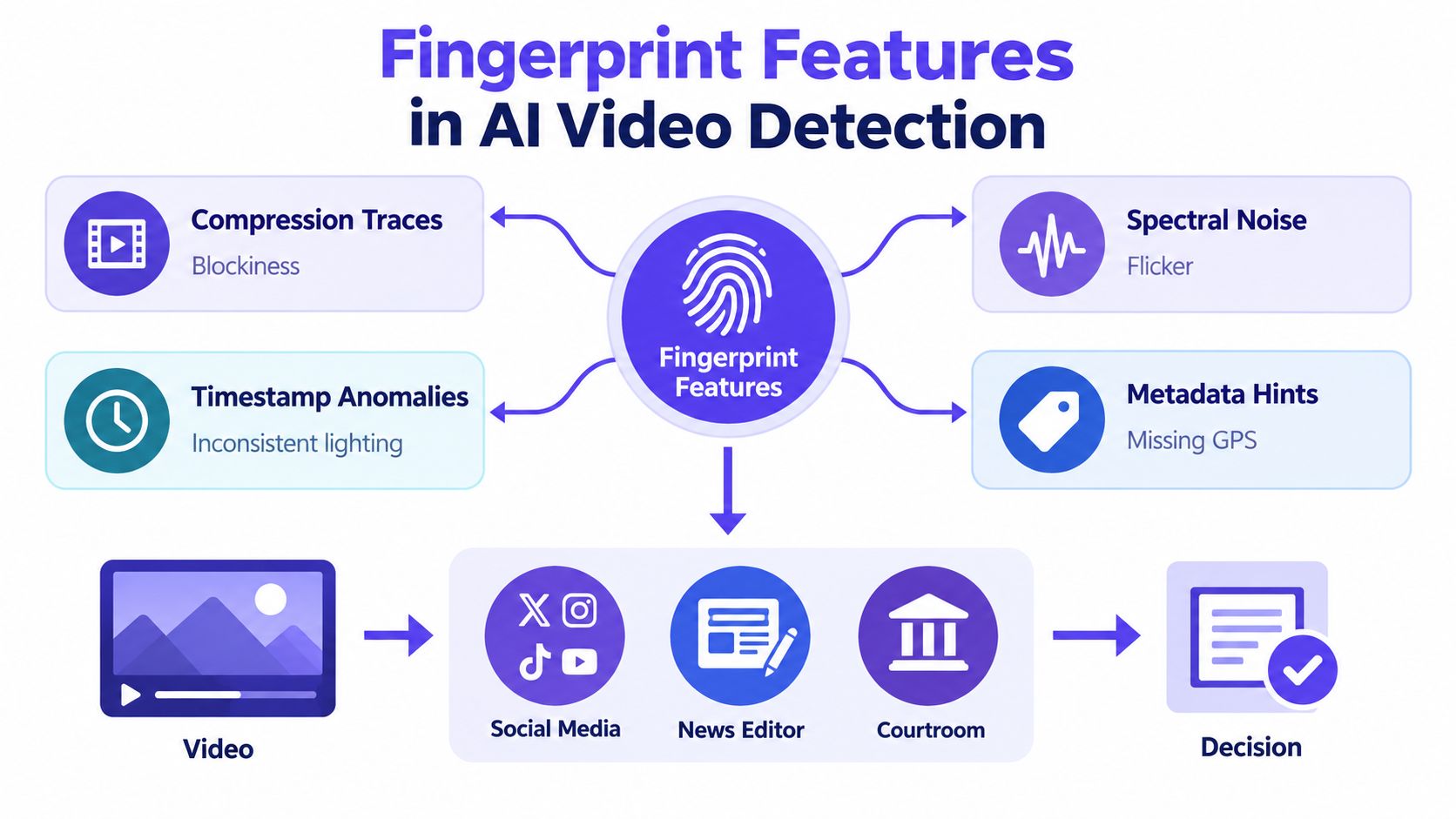
A fingerprint feature is a measurable pattern that can help describe how a video was captured, edited, compressed, or generated. A camera, codec, editing program, and generative model can each leave different traces behind. Some appear in the image's fine texture, some in the relationship between neighboring frames, and others in file metadata or encoding behavior.
The distinction between content clues and technical fingerprints matters. A content clue is visible or semantically understandable, such as poor lip synchronization, an unnatural hand, or lighting that changes across a face. A technical fingerprint may exist in pixel statistics or frequency distributions that viewers never consciously notice.
The main feature families
A practical detector can examine several families:
- GAN fingerprints: Regularities associated with convolutional generation and upsampling.
- Diffusion artifacts: Texture, denoising, and temporal patterns associated with iterative image or video synthesis.
- Sensor noise: Residual variation associated with a physical camera sensor and its processing pipeline.
- Compression traces: Evidence left by codecs, quantization, resizing, or repeated encoding.
- Spectral anomalies: Unusual energy patterns in frequency representations such as FFT, DCT, or wavelets.
- Metadata hints: Encoder details, timestamps, editing history, and other file-level clues.
No family answers the entire question. A compression trace may show that a clip was processed, but processing doesn't automatically mean fabrication. Sensor noise may support a known handset origin, but it becomes less informative if the file has been fully re-rendered. A spectral anomaly may justify closer review without proving which tool created the video.
Practical rule: Treat every fingerprint as evidence about the video's history, not as a standalone declaration of truth.
That approach resembles established biometric reasoning. Fingerprint analysis has long treated identification as a feature-correlation problem rather than a whole-image match. The field developed from Galton's study of ridge endings and bifurcations into a three-level taxonomy covering ridge flow, minutiae, and pore-level detail, as described in this technical history of fingerprint features. AI-video analysis follows a similar logic. It compares multiple surviving structures because copied, cropped, or recompressed media rarely preserves every clue equally well.
GAN Fingerprints and Diffusion Artifacts
GAN fingerprints and diffusion artifacts come from different generation processes, so analysts shouldn't expect them to look identical in a detector.
Generative adversarial networks commonly rely on convolutional operations and learned upsampling. Those operations can create recurring spatial regularities, especially in texture and color relationships. A detector might find periodic structure in mid-frequency components or repeated chroma behavior across frames. The signal can be subtle, and it may weaken after resizing or aggressive recompression.
Diffusion systems take a different route. They begin with a noisy representation and repeatedly denoise it toward an image or sequence. That process can produce unusually smooth high-frequency falloff, overly consistent micro-texture in skin or hair, or small temporal changes that don't behave like ordinary camera motion. A video generated from still images may also show a soft, recurring change across frames as the system maintains visual continuity.
Why frequency location matters
The detector's representation changes what it can see. GAN-related regularities may be easier to isolate in DCT mid-bands, while diffusion-related behavior may emerge more clearly in wavelet or other high-frequency analyses. That difference explains why a detector trained around one generation family can miss another, even when both outputs look convincing to a viewer.
| Signal | GAN Fingerprints | Diffusion Artifacts |
|---|---|---|
| Generation behavior | Convolutional synthesis and learned upsampling | Iterative denoising from a noisy representation |
| Common analytical focus | Periodic spatial regularities and mid-frequency structure | High-frequency rolloff and micro-texture consistency |
| Temporal concern | Repeated frame-to-frame generator patterns | Smooth or recurring changes across generated frames |
| Main detection risk | Older signals may weaken after re-encoding | Realistic texture can resemble ordinary denoising or post-processing |
The practical implication is model-family-aware classification. A system shouldn't ask only, “Does this video have a synthetic fingerprint?” It should ask which feature family is plausible, which transform exposes it, and whether the signal survives the file's distribution history.
For a deeper explanation of frequency-based clues, see this guide to spectral anomaly detection in AI video. The useful lesson is not that one band is always decisive. It's that different generation mechanisms leave different statistical footprints, and the detector must preserve that distinction.
Sensor Noise, Compression Traces, and Spectral Anomalies
These three families answer different provenance questions. Sensor noise asks whether the image carries traces associated with a physical capture device. Compression analysis asks what happened during encoding and distribution. Spectral analysis asks whether the image's energy is distributed in a way that looks unusual for the claimed source.
A camera sensor can leave a residual pattern through photo-response variation and color-filter-array processing. When analysts have a reference from a known device, that residual may help test whether a segment came from it. The evidence becomes weaker when a generative tool, editor, or platform re-renders the footage and replaces the original pixel structure.
Compression traces work at another layer. Codec decisions can create block boundaries, quantization behavior, motion residuals, and signs of repeated encoding. A video assembled from pieces may contain inconsistent compression histories. One region can look as if it passed through a different encoding path from the surrounding frame, although a mismatch still needs interpretation because ordinary editing workflows can produce similar effects.
Three independent evidence families
| Family | What It Fingerprints | Best At Detecting |
|---|---|---|
| Sensor noise | Camera-specific residual patterns and imaging-pipeline behavior | Whether footage is consistent with a known physical capture source |
| Compression traces | Codec processing, quantization, block behavior, and re-encoding history | Splicing, re-rendering, platform processing, and inconsistent encoding |
| Spectral anomalies | Energy distribution across spatial or frequency representations | Unusual texture formation, over-smoothing, and generated-image regularities |
Spectral analysis often serves as an early screening tool because it can reveal that an image's texture statistics deserve attention before an investigator knows the exact generator. It can't, by itself, establish intent or authorship. A denoised real recording, a heavily edited clip, and a synthetic clip may all alter frequency behavior.
The strongest operational design keeps the families separate until the system has measured them. If sensor evidence says “consistent with a handset,” compression evidence says “multiple encoding histories,” and spectral evidence says “unusual,” the result is not an automatic verdict. It's a structured reason to inspect the original file, compare provenance, and review the affected frames.
High-resolution capture matters in forensic imaging because degraded or partial evidence can erase useful detail. The FBI fingerprint recognition reference describes comparison as a correlation of surviving features rather than a simple whole-image match. AI-video analysts face the same constraint. The evidence they need may be present in the source, but absent after distribution.
How Fingerprint Features Are Extracted and Measured
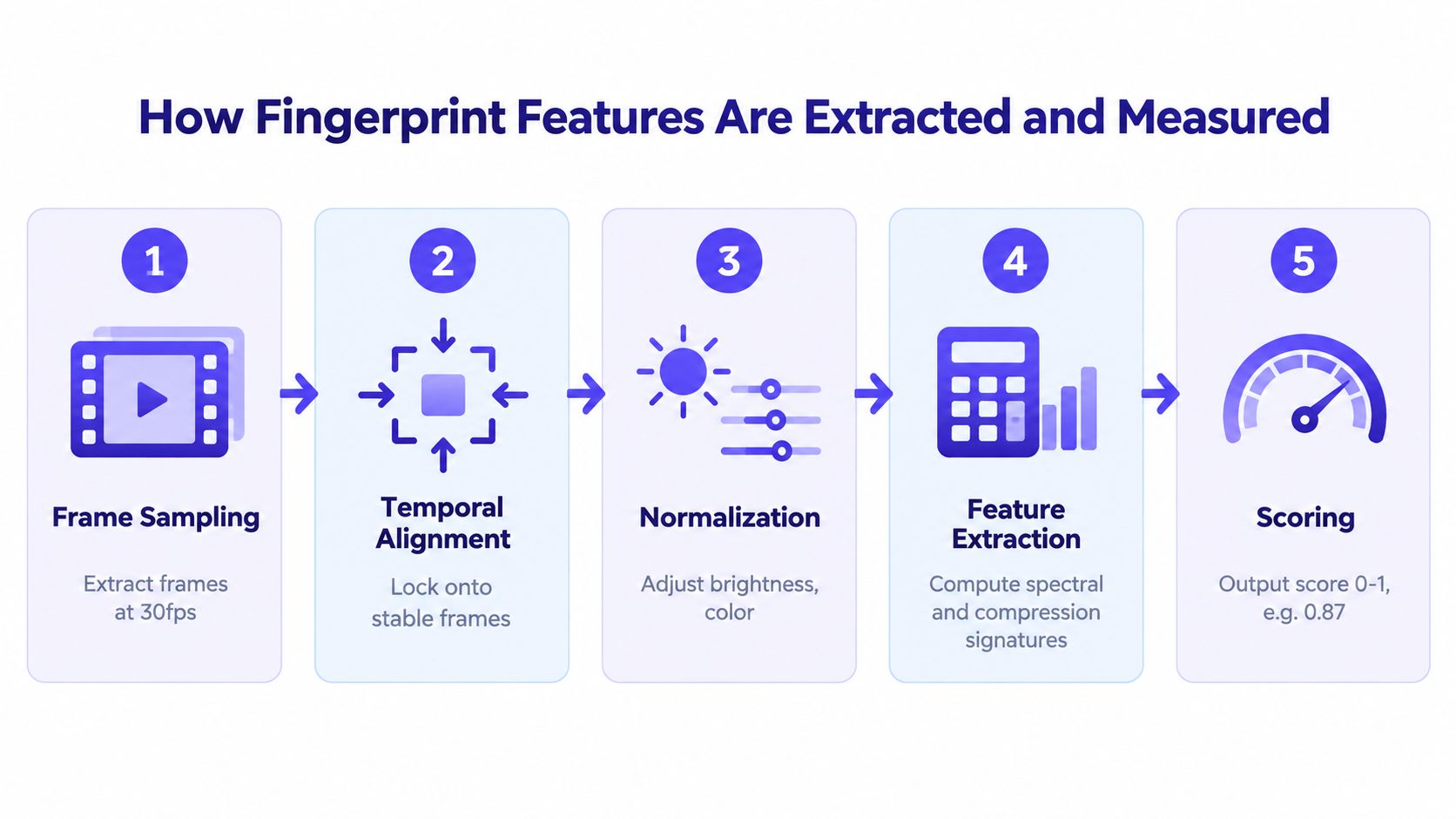
A detector turns a clip into measurements through a sequence of controlled operations. The purpose isn't to make the video look better. It's to prevent irrelevant differences, such as resolution or brightness, from overwhelming the signal being tested.
From frames to feature maps
The pipeline usually begins by sampling frames and aligning them over time. Alignment helps the system compare equivalent regions instead of mistaking ordinary camera motion for instability. The analyst may then normalize resolution, color representation, brightness, and other variables that can drift between files.
Next, the system computes feature maps. Spatial filters inspect local texture and edges. Frequency transforms reorganize the image so analysts can inspect where visual energy sits. Compression analysis examines block behavior and quantization effects, while temporal analysis compares how those measurements change from frame to frame.
The output can be a confidence score, a frame-level heatmap, or both. A score summarizes the model's assessment, while a heatmap shows where the strongest evidence appears. Neither output should be mistaken for a probability that a particular person created or manipulated the clip unless the system has been validated for that exact interpretation.
A worked example, without overclaiming
Consider a 12-second clip that produces repeated checkerboard-like structure in an FFT representation. On raw frames, a GAN-oriented confidence score reads 0.41. After normalization, the score rises to 0.87 because brightness, scale, and color differences no longer obscure the recurring pattern.
Those values illustrate a measurement workflow, not verified performance data or a universal threshold. The score means the detector found a stronger match to the feature pattern after preprocessing. It doesn't prove that a GAN created the clip, and it doesn't identify a specific model without supporting evidence.
For readers who want the mechanics behind transforms and frequency representations, this frequency-domain analysis guide offers relevant background. In production, teams should store the preprocessing settings, sampled frames, transform configuration, and model revision alongside the result. Otherwise, a later reviewer may be unable to reproduce the score or explain why it changed.
Why Multi-Signal Verification Beats a Single Fingerprint
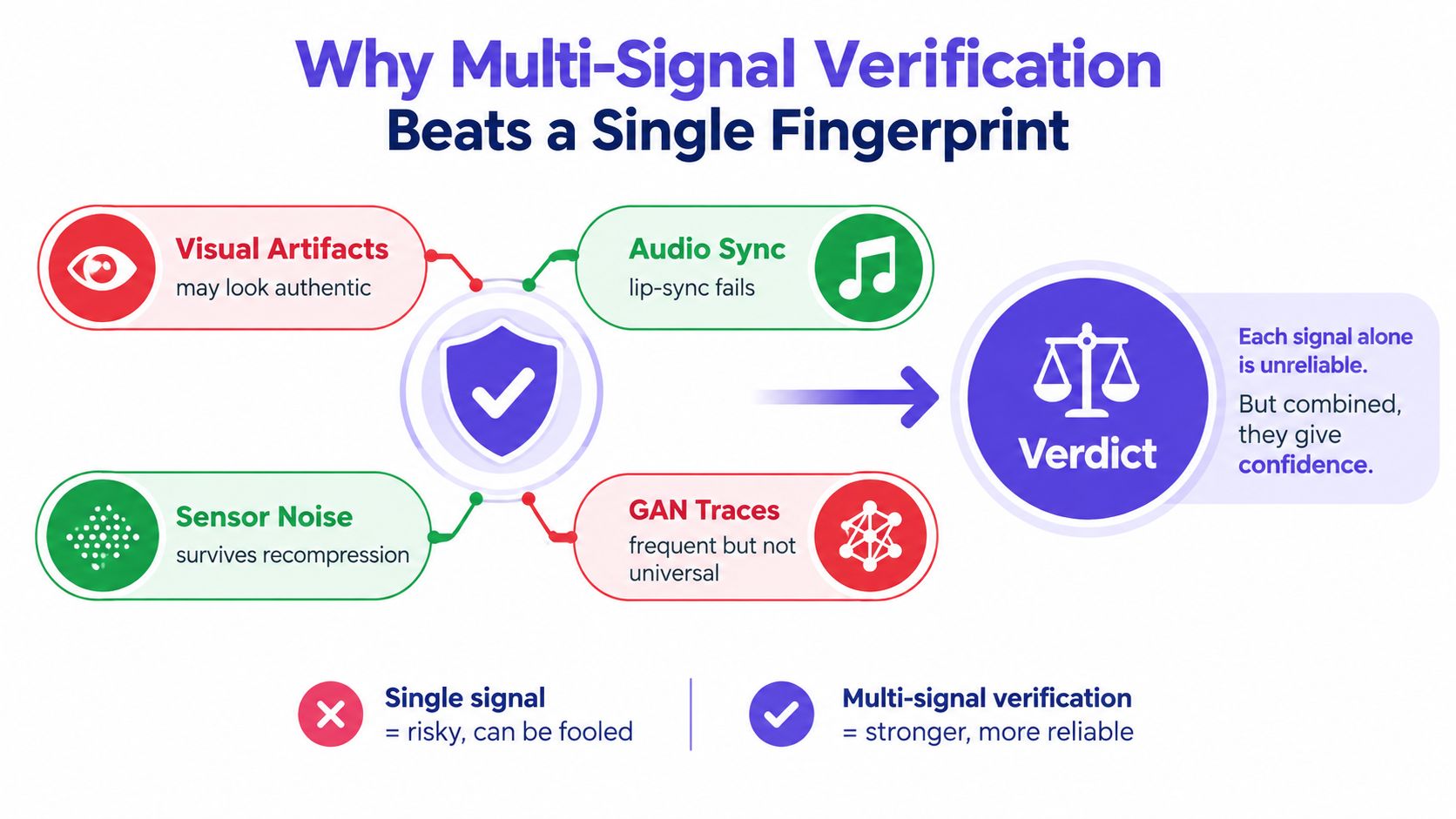
A single artifact can disappear, appear accidentally, or point to the wrong conclusion. A synthetic face may retain plausible sensor-like noise after a processing step, while a real clip may show unusual spectral behavior because an editor denoised it. Metadata can support provenance, but a file's metadata can also be stripped or rewritten.
Verification works better when analysts compare independent layers. A frame-level detector can inspect texture and facial landmarks. An audio check can examine synchronization and voice continuity. Temporal analysis can test motion consistency, and metadata inspection can compare timestamps, encoder information, and editing traces with the claimed source.
Think like a courtroom, not a guessing game
A courtroom rarely depends on one witness when independent records are available. Investigators compare testimony with CCTV, access logs, timestamps, and forensic findings. Video authentication should use the same discipline.
A strong verdict comes from agreement among signals that fail in different ways.
A practical stack can classify evidence by function:
- Visual evidence: Texture, landmarks, facial boundaries, and frame-level artifacts.
- Temporal evidence: Motion continuity, repeated patterns, and changes between adjacent frames.
- Audio evidence: Lip-sync alignment, acoustic consistency, and edits between speech segments.
- Provenance evidence: Metadata, file history, source claims, and signed content credentials where available.
- Context evidence: Upload history, original-source availability, and whether independent copies agree.
The system should also record disagreement instead of hiding it. If audio appears authentic but visual signals indicate regeneration, the correct result may be “requires review,” not “real” or “fake.” Weighting can reflect signal quality, source reliability, and the known distribution path, but those weights should be documented.
AI Video Detector is one example of a platform that combines frame-level analysis, audio forensics, temporal consistency, and metadata inspection for uploaded videos. Whether a team uses that product, an internal pipeline, or another service, the principle remains the same. Multi-signal verification reduces false confidence because each layer contributes a different kind of evidence.
Strengths, Limits, and Easy Ways Fingerprints Get Broken
Fingerprint features are useful because they can be fast, inspectable, and suitable for automated triage. A newsroom can flag suspicious frames before a specialist examines the entire clip. A developer can attach a heatmap to an investigation record. A reviewer can ask which signal fired instead of accepting an unexplained binary label.
The same properties create vulnerabilities. Fingerprints describe patterns in media, and ordinary processing can change those patterns.
| Failure mode | What breaks | Mitigation |
|---|---|---|
| Re-encoding | Codec traces, fine texture, and some generator signals may weaken or change | Compare multiple evidence families and preserve the earliest available file |
| Resizing or cropping | Spatial relationships and sensor residuals may no longer align | Train and test with realistic scale and crop variation |
| Adversarial perturbation | Small pixel changes can target the detector while leaving the video visually similar | Use robustness testing, ensemble models, and human review for consequential cases |
| Model drift | New generators may remove older artifacts or create unfamiliar ones | Refresh evaluation sets and retrain against current generation methods |
| Metadata loss | Provenance clues may disappear during platform processing | Treat metadata as supporting evidence, not the sole basis for a verdict |
What one fingerprint can and can't prove
A sensor pattern can support a claim about capture consistency. It can't prove that every frame was recorded by that camera. A compression mismatch can suggest compositing or repeated processing. It can't distinguish malicious editing from every legitimate export workflow.
A spectral anomaly can justify deeper analysis. It can't reliably identify a generator without a validated reference set. Likewise, the absence of a known GAN fingerprint doesn't establish authenticity. The clip may come from a different generation family, or distribution may have removed the relevant trace.
Review standard: “No detected fingerprint” means the tested signal wasn't found. It doesn't mean “verified real.”
High-stakes teams should preserve the original file, record the tool and model versions, and keep the raw outputs before interpretation. Human review remains important when the strongest signals disagree, when the source is incomplete, or when publication, litigation, or public safety depends on the result.
Practical Playbook for Newsrooms, Legal Teams, and Developers
Different teams need different workflows, but they share one requirement: preserve the evidence before explaining it. Download the earliest available file, calculate its hash, restrict unnecessary conversions, and record who supplied it and when. A later export may be easier to analyze, but it shouldn't replace the original.
Newsrooms
Use a staged process:
- Fast triage: Inspect compression and spectral signals, then mark suspicious frames for closer review.
- Deep analysis: Compare GAN, diffusion, temporal, audio, and frame-level findings.
- Publication decision: Check metadata, provenance credentials such as C2PA when available, and reverse-image results. Document what supports the conclusion and what remains uncertain.
A newsroom shouldn't publish a detector label without preserving the underlying evidence. If two major fingerprint families disagree, pause escalation rather than forcing a binary answer.
Legal teams
Legal review needs reproducibility. Keep the original hash, acquisition record, tool version, model revision, preprocessing settings, extracted feature vectors, confidence outputs, and a plain-language account of which families produced evidence.
The video evidence authentication guide is useful background for structuring that process. The central question is not merely whether a detector produced a high score. It's whether another qualified reviewer can understand how the result was generated and whether the source survived a defensible chain of custody.
Developers
Build auditability into the API rather than adding it after an incident. Store frame-sampling choices, temporal alignment results, normalization parameters, per-frame scores, heatmaps, and model revisions alongside the verdict.
Expose uncertainty and disagreement. A binary label hides the difference between weak evidence, strong evidence, and conflicting evidence. Set escalation rules in advance, and route cases to a human reviewer when the strongest two families diverge materially according to your validated policy.

Evidence habit: Log the raw signal first. Interpret it second.
Where Fingerprint Features Are Heading Next
Fingerprint detection is moving toward systems that combine provenance, media forensics, and learned representations rather than relying on one artifact family. Some generative workflows may attach signed origin information during creation. That could make authentication easier when the signature survives distribution, but it changes the question from “What artifact does this file contain?” to “Can this provenance claim be verified and trusted?”
Another direction is detection. A foundation-style detector can represent spatial texture, temporal motion, and audio behavior together. That matters for hybrid manipulation, where an operator may combine face replacement, voice synthesis, color grading, and ordinary editing. A single visual fingerprint may miss the interaction between those operations.
Standardized schemas could also help platforms compare evidence across vendors without exposing every model detail. Interoperability would make it easier to exchange feature descriptions, confidence information, and provenance records. It would also force teams to define what a score means and how much uncertainty it carries.
| Direction | What It Changes | Open Question for Operators |
|---|---|---|
| Signed generative provenance | Adds origin evidence alongside forensic traces | Can reviewers verify the signature after ordinary distribution and editing? |
| Joint spatial, temporal, and audio models | Handles manipulations that combine several modalities | How should teams explain a combined embedding in a legal or editorial review? |
| Shared fingerprint schemas | Enables cross-platform comparison of evidence | Which fields and confidence definitions can vendors standardize without exposing sensitive internals? |
Operators should track three risks as these systems mature. First, adversaries will study disclosed signals and target the most fragile ones. Second, closed detectors may be difficult to evaluate when their training data and decision rules remain private. Third, real-time upload screening may produce fast alerts without providing enough context for a responsible decision.
The durable principle is unchanged. Fingerprint features are strongest as corroborating evidence. Teams that combine them with provenance, temporal behavior, audio, metadata, and human judgment will be better positioned than teams searching for one artifact that settles every case.
When a suspicious clip reaches your desk, preserve the original file, run a multi-signal analysis, record the raw outputs, and escalate conflicting evidence before publication or legal use. Start with AI Video Detector to inspect frame, audio, temporal, and metadata signals, then document the evidence trail so another reviewer can reproduce your decision.
