

What Is Synthetic Media and Why It Matters in 2026

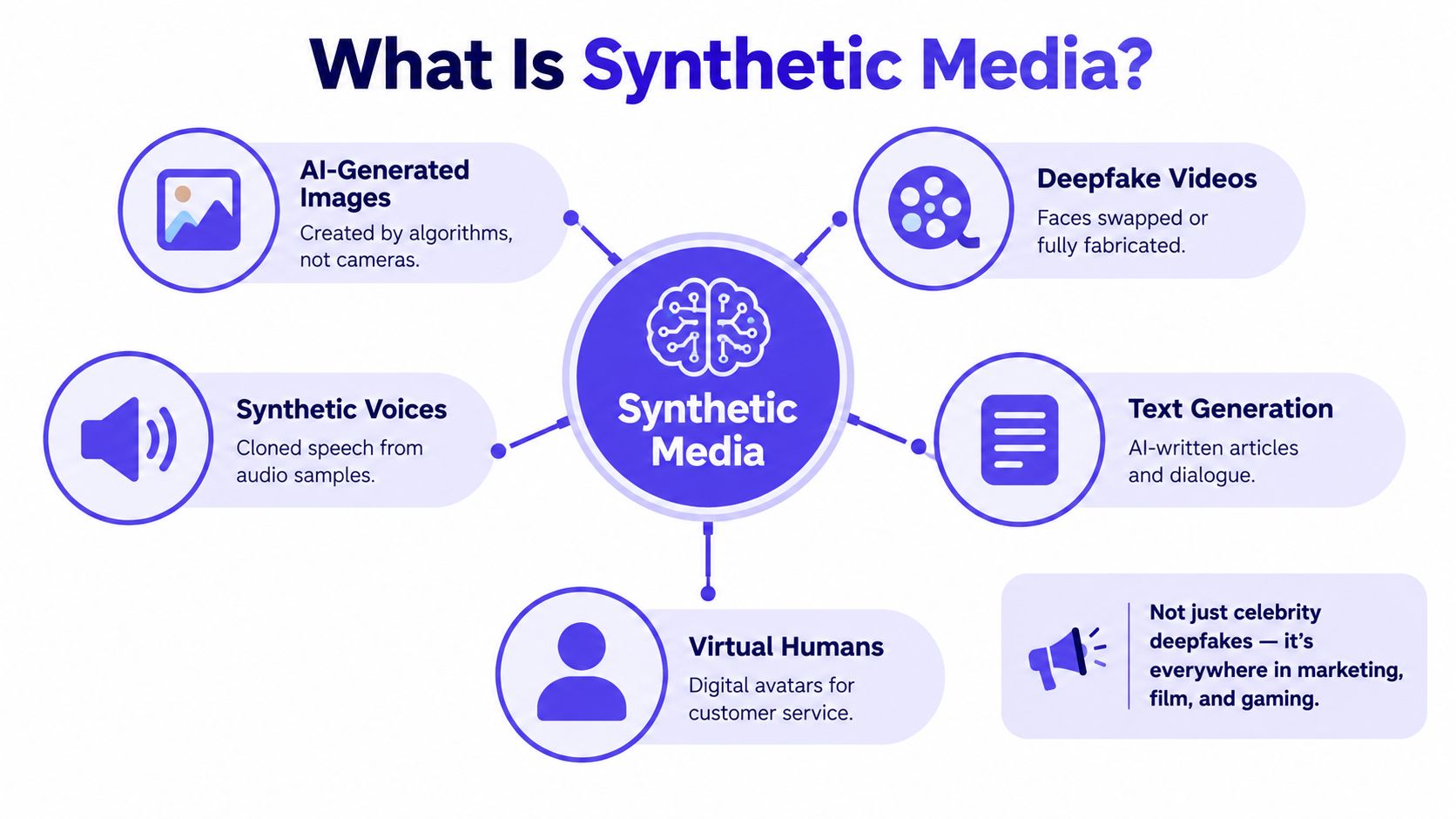
Synthetic media is AI-generated or AI-altered content, and it includes images, video, audio, avatars, and text. Deepfakes are one subset of that wider category, so not every synthetic asset is a malicious fake.
You've probably already seen it in a weird voice note, a polished video call, a cloned face in a viral clip, or a synthetic presenter in a marketing video, and that's why the question of what is synthetic media matters now. A useful starting point is to separate generation, manipulation, provenance, and context, because those are different problems with different checks.
A Plain-Language Definition of Synthetic Media
Synthetic media is any digital content that's generated or materially altered by algorithms, rather than captured straight from reality. That can mean a fully AI-made image, a cloned voice reading original text, a video where a face or mouth has been swapped, or a translated ad with synthetic lips that better match the new audio. The category is broad on purpose, because the risk isn't limited to celebrity impersonation or political hoaxes.
A newsroom editor, legal reviewer, or fraud analyst usually doesn't care whether the file came from a trendy app or a lab demo. They care whether the file still reflects what happened, who changed it, and whether the version they're seeing is the original. That's why synthetic media is best understood as an integrity problem, not just a visual one, and why teams need to ask what changed, where it changed, and whether the context still matches the file.
Why the narrower deepfake idea causes confusion
People often hear “deepfake” and think only of face-swaps. That's too narrow. Synthetic media also includes benign and disclosed uses, such as virtual presenters, voice synthesis for accessibility, automated localization, and generated advertising, all of which can be legitimate when they're disclosed and properly labeled.
The distinction matters in day-to-day verification work. A clip can be mostly genuine and still contain an AI-generated face, voice, or background that changes its meaning. In that sense, “synthetic” doesn't automatically mean “fake in the deceptive sense,” it means some part of the content was produced or altered with AI techniques, and that part may or may not be disclosed.
Practical rule: Treat synthetic media as a spectrum, not a verdict. A file can be authentic in origin, altered in meaning, and still be partially useful as evidence if you understand what was changed.
For readers who want a broader primer on generated content, this explainer on AI-generated content is a useful companion. In practice, publishers, legal teams, and enterprise security groups are already treating synthetic media as a routine verification issue, not a future curiosity.
A Short History from 1997 to Today
The roots of synthetic media go back much farther than the current AI wave. The 1997 Video Rewrite system showed that mouth motion could be altered so a different audio track fit the video, which is an early form of synthetic manipulation even though it predated today's generative boom. That history matters because it shows the basic problem is older than the latest tools, only faster and easier now.
The term “deepfake” came much later, generally tied to a Reddit community created in November 2017. Then, in 2018, public demonstrations showed that machine-learning systems could convincingly map one person's facial performance onto another person's face. Those milestones didn't create the trust crisis on their own, but they made deceptive video much more accessible.
Why this timeline matters for verification
The progression explains why modern authentication can't rely on a single visual cue. Synthetic media has moved from isolated experiments to a broader production stack that can blend real footage, AI-generated faces, synthetic voices, and altered backgrounds in one file. That means a reviewer has to inspect the file's visual, audio, temporal, and provenance signals together, not just decide whether the clip “looks off.”
The broader lesson is simple. The more realistic synthetic media gets, the less useful intuition becomes on its own.
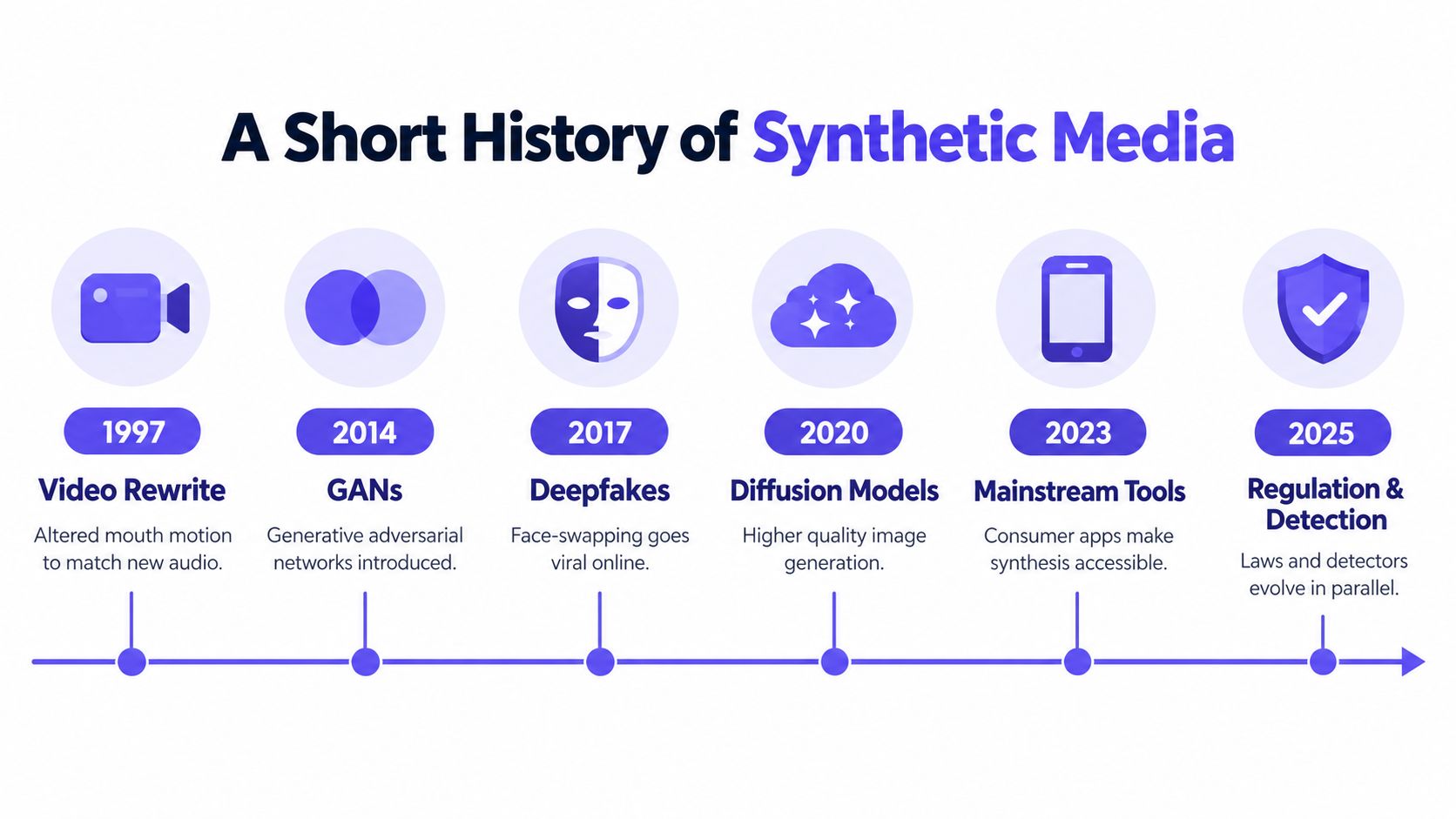
That's also why provenance systems and forensic detection emerged side by side. One helps document where a file came from, the other helps test whether the file's contents still line up with that history.
The Main Types of Synthetic Content
Synthetic media appears in five practical forms that teams routinely encounter. Each one has its own failure mode, so the right verification method depends on the type, not just the headline label.
Video, audio, image, text, and avatar formats
- Deepfake video: A face swap or full-body reenactment can make a person appear to say or do something they never did. A common benign use is film localization or performance editing, while the risk is executive impersonation, fabricated evidence, or political deception.
- Synthetic audio: Voice cloning can recreate a speaker's cadence and timbre from a short sample. It's useful for accessibility and localization, but it also supports vishing, ransom scams, and fake executive instructions.
- Synthetic images: AI-generated stills can create faces, scenes, product shots, or news-like visuals that never existed. They're often used in marketing or concept design, but they can also seed false identities or fake proof.
- Synthetic text: AI-written scripts, posts, comments, and articles can mimic a person's tone or produce huge volumes of persuasive copy. Benign uses include drafting and localization, while the risk is impersonation, spam, and disinformation.
- Synthetic avatars and virtual presenters: Digital humans and avatar tools can host training, customer service, or branded explainers. The upside is scale and consistency, but the risk is confusion when viewers assume the figure on screen represents a real person or event.
| Type | Typical Use | Detection Difficulty | Most Common Risk |
|---|---|---|---|
| Deepfake video | Reenactment, localization, fraud | High | Impersonation |
| Synthetic audio | Voice assistants, dubbing, accessibility | High | Voice fraud |
| Synthetic images | Ads, design, concept art | Medium | False identity or scene |
| Synthetic text | Drafting, support, content creation | Medium | Impersonation and misinformation |
| Avatars / virtual presenters | Training, service, marketing | Medium | Confusion over identity or disclosure |
Why each category needs a different check
A voice clone won't leave the same clues as a face swap. A generated image won't be caught by audio forensics. A synthetic article can be persuasive even if the attached image is genuine. That's why “synthetic media” is a category, not a single detection problem.
Practical rule: Match the check to the medium. If the file has sound, inspect sound. If it has motion, inspect motion. If it has provenance metadata, inspect provenance before you rely on appearance.
How Generators and Detectors Actually Work
Synthetic media systems don't all work the same way, but three approaches explain most of what people run into. GANs train two networks against each other, one generating content and the other trying to spot the fake, until the output gets convincing. Voice cloning models learn a speaker's timbre and rhythm from sample audio, then synthesize new speech in that voice. Diffusion models start from noise and gradually refine an image or video into a plausible result.
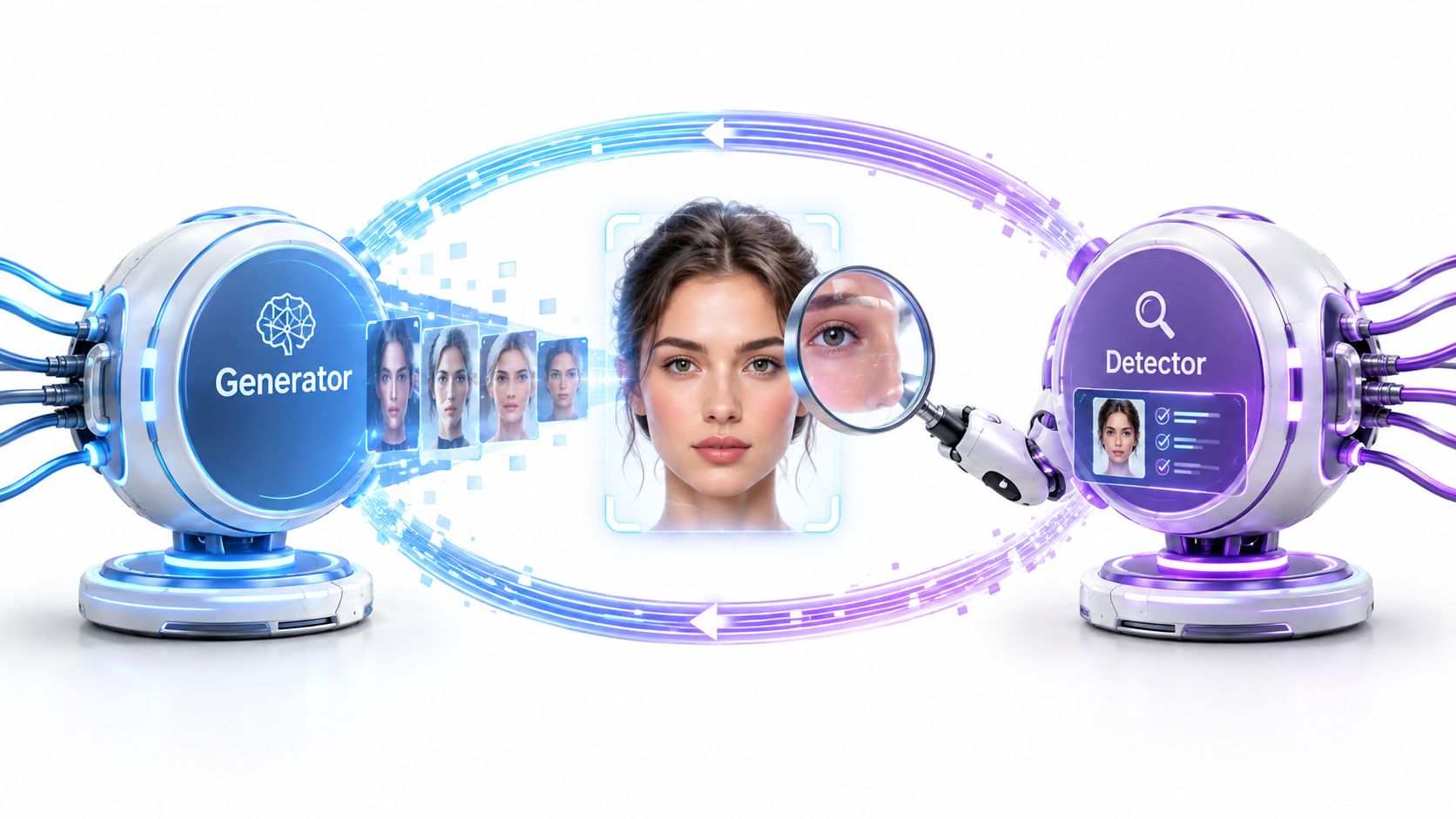
Those methods leave different fingerprints. GAN-style content often shows texture artifacts or small inconsistencies around facial regions. Voice synthesis can create spectral anomalies that a spectrogram reveals more clearly than the human ear. Diffusion-generated scenes can be visually strong while still producing odd motion or frame-to-frame instability in video.
Why a single cue rarely proves anything
A lifted eyebrow, a strange blink, or a slightly metallic voice can be a clue, but it isn't proof. Compression, platform transcoding, background noise, and low light can create their own distortions, which is why detector quality depends so much on the training data and the deployment environment. NIST notes that evaluation has to reflect the intended real-world distribution, because mismatch between lab conditions and social-media or enterprise clips can make performance look better than it really is, and a 2023 survey it reported found detector accuracy spanning 62%–99% and AUC spanning 82%–98% depending on data and evaluation design (NIST publication).
For practitioners, that means one visible artifact isn't enough. You need frame-level visual analysis, audio analysis, timing checks, and file-level inspection before you trust a verdict.
The training-data side matters too. For teams building or evaluating models, a resource such as rights-cleared training datasets is useful because the quality and legality of the source material affect both performance and governance.
Good forensics starts with the assumption that a file can be partly genuine and partly synthesized. That's more common than people think.
For a deeper look at the detector side, this guide on what AI detectors look for fits naturally with the technical details here. The practical takeaway is that generation and detection are locked in an arms race, so verification has to be layered.
Where Synthetic Media Is Already Causing Real Damage
The most common mistake is to treat synthetic media as a hypothetical future risk. Newsrooms already have to vet user-submitted footage under deadline pressure, courts already deal with altered recordings, enterprise security teams already face executive impersonation, and educators already need to check whether online training content is what it claims to be. In high-stakes settings, the question isn't whether the clip looks suspicious, it's whether the team can defend its decision when the cost of being wrong is asymmetric.
A 2020 peer-reviewed study on synthetic political video found that participants identified manipulated videos correctly in only about 50% of cases, which is roughly what you'd expect from random guessing (study on synthetic political video risk). That finding is the turning point for most professional workflows, because it shows human intuition alone can't carry the load.
Four places the risk becomes operational
In a newsroom, a shaky clip from a witness or bystander may arrive with no reliable chain of custody. In court, a recording may be mostly authentic but contain a manipulated segment that changes meaning. In an executive setting, a video call can seem legitimate even when one participant's face or voice is synthetic. In education, a lecture or training clip can be altered enough to change instruction while still looking polished.
None of those teams can afford to answer “real or fake?” as if it were a simple binary. They need to ask whether the file is original, whether it was altered, what kind of alteration happened, and whether the surrounding context matches the recording.
Synthetic media also creates reputational damage that comes from confusion itself. If an organization denies a real clip because it fears a fake, or accepts a fake because it appears polished, the harm lands either way.
Why a Single Signal Is Never Enough
One detector, one platform rule, or one expert glance can't settle most synthetic media questions. Detector performance can drop when tools move from lab data to real-world material, especially when the source footage is compressed, noisy, or materially different from the training set. A recent study also reported more than 85% false negatives against latent-diffusion deepfakes for tested state-of-the-art methods, which is a strong reminder that no single check is complete across all content types (deepfake detection technology).
That's where provenance changes the workflow. The C2PA specification binds an asset's history into signed manifests, using a cryptographic binding such as a hash and structured assertions about creation or opening (C2PA explainer). Provenance doesn't prove the content is true, but it does help answer who made a claim about the asset and whether the asset stayed bound to that claim.
Detection and provenance solve different problems
Detection asks whether the file appears manipulated or generated. Provenance asks where the file came from and whether its history is intact. Those are related, but they're not the same. A file can have clean provenance and still contain misleading content, or it can lack provenance and still be authentic.
That's why the strongest workflows combine both. You don't want a guess based on confidence alone, and you don't want a signature alone without forensic review.
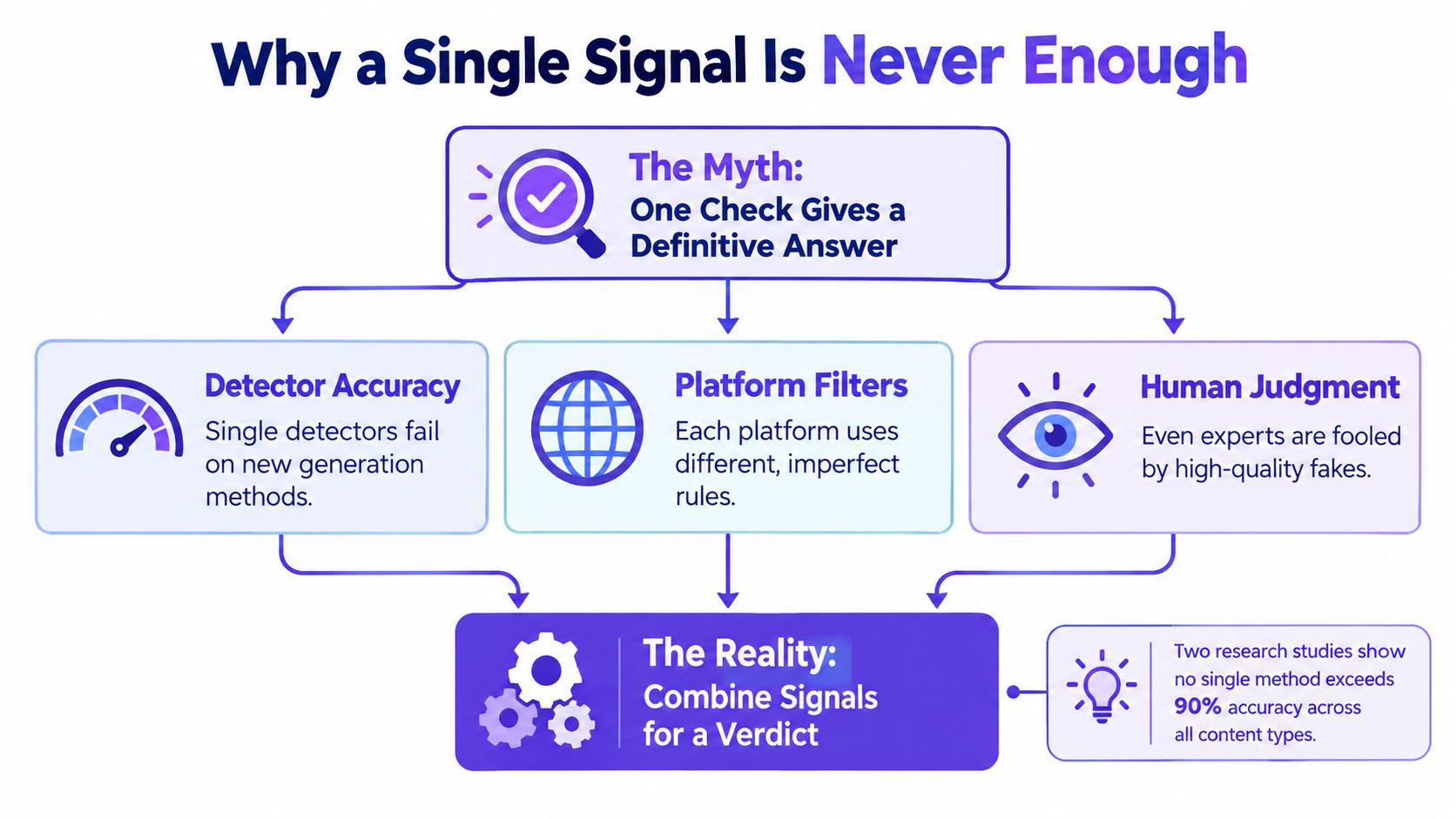
Practical rule: Treat confidence scores as triage, not proof. If the score is inconclusive, escalate to provenance checks, source verification, and human review.
A Layered Integrity Workflow You Can Apply Today
A practical workflow starts with file preservation. Don't transcode, re-export, or edit the asset before analysis, because each of those actions can destroy metadata or create new artifacts that blur the original signal. Once the original file is safe, inspect its provenance, metadata, and source history before you decide what the content means.
Then move to independent analysis. Check the video frames, the audio track, and the encoding details separately, because synthetic manipulation often leaves different clues in each layer. If the file has no provenance or the provenance doesn't match the stated origin, treat that gap as a verification problem, not a reason to skip analysis.
The questions that belong in every triage queue
- What was changed? Look for face swaps, voice edits, altered captions, or inserted backgrounds.
- Where was it changed? Determine whether the alteration is local, such as a mouth region or audio segment, or broader across the file.
- Is this the original file? Confirm whether you're examining the source or a repost, export, or screen recording.
- Does the context match? Check whether the location, date, participants, and surrounding event fit the claim attached to the media.
A useful data-gathering layer can help here. For instance, a web scraping API can support source-history checks by collecting the surrounding context, repost trail, and publication evidence that sit outside the file itself. That doesn't prove authenticity, but it strengthens the broader chain of review.
The key shift is mental as much as technical. Don't ask only whether the file is real or fake. Ask what part is synthetic, how much changed, and whether the rest of the evidence supports the same story.
How AI Video Detector Fits Into This Workflow
A dedicated verification tool belongs at the analysis stage, after the original file is preserved and before anyone treats the clip as trustworthy. AI Video Detector processes uploaded video in under 90 seconds and looks at four independent signals, frame-level analysis, audio forensics, temporal consistency, and metadata inspection, to estimate whether the content was AI-generated or manipulated (AI Video Detector). It supports MP4, MOV, AVI, and WebM files up to 500MB, and basic detection doesn't require signup.
The value of that design is separation. Frame analysis looks for GAN and diffusion artifacts, audio forensics checks for spectral anomalies, temporal checks look for motion discontinuities, and metadata inspection looks for encoding irregularities. A confidence score from that process is a triage signal, not a courtroom verdict, which is exactly how high-stakes teams should use it.
Where it fits and where it doesn't
AI Video Detector fits well for newsrooms vetting user-submitted clips, legal teams reviewing evidence, enterprise fraud groups screening video-call material, platform moderators sorting suspicious uploads, and educators checking course content. It doesn't replace provenance review, source validation, or human judgment. It complements them.
That's the right mental model for synthetic media in 2026. Use provenance to trace origin, forensic analysis to test the file, and context verification to confirm the story around it. When all three agree, you can move faster with more confidence. When they don't, you've found the place that needs escalation.
If you're responsible for footage, evidence, training content, or executive communications, build a layered review process now and test it on real examples from your own workflow. Start with the original file, check provenance, run multi-signal analysis, and compare the result against the surrounding context before you publish, file, or act.


