

Undetectable AI Review: A Guide to Spotting Synthetic Media

When people talk about an "undetectable AI review," what they're really asking is: Can AI-generated content completely fool the tools designed to catch it? The honest answer is that it's a constant cat-and-mouse game. Generative models get smarter at mimicking human creators, and in response, detection tools get better at spotting the tiny digital clues they leave behind.
So, is any AI content truly 100% undetectable? Not really. It’s more a question of how well it can slip past the latest generation of forensic checks.
The Hidden War Against Undetectable AI

There’s a quiet but intense conflict happening online between AI content generators and the systems built to sniff them out. This isn't just some technical squabble for engineers to worry about; it has real, tangible consequences for security, trust, and our basic understanding of what’s real. Synthetic media is no longer a niche issue—it’s popping up everywhere.
The Real-World Impact of Synthetic Media
The threat has moved from theory to reality. Just think about these high-stakes situations where authenticity is everything:
- Corporate Fraud: A finance team gets a call from someone who sounds exactly like their CEO, instructing them to wire millions to a new account. It’s a deepfaked voice. This isn't a movie plot; it's a real and growing threat that preys on our trust in familiar voices.
- Political Misinformation: A convincing video surfaces mid-election, showing a candidate making outrageous statements they never actually said. By the time it’s debunked, the damage to public trust is already done.
- Legal Tampering: A piece of video evidence is presented in court that seems to clear a defendant. Later, a forensic deep dive reveals subtle AI alterations, throwing the entire case into chaos.
These examples show exactly why the idea of ‘undetectable AI’ is so concerning. Professionals in journalism, law, and security depend on digital media being authentic. When you can no longer believe what you see, it cripples your ability to do your job.
The rise of 'undetectable AI' tools has ignited a fierce battle in the deepfake detection space, with the global AI Deepfake Detector market exploding from a modest USD 170 million in 2024 to a staggering projected USD 1,555 million by 2034.
The Need for a Frontline Defense
This escalating threat is why conducting a thorough undetectable AI review of the available detection tools isn't just a good idea—it's essential. The market's explosive growth is a direct reaction to this urgent demand.
In fact, with over 65% of businesses reporting deepfake-related security incidents in 2023, the need for reliable verification has never been greater. You can dive deeper into the market's explosive growth and its drivers at intelmarketresearch.com.
Tools like AI Video Detector are becoming that critical frontline defense. They offer a necessary layer of protection in a world where digital fakes are getting too good for the human eye to catch. This guide is designed to help you understand the tech, navigate the complexities, and make smart choices to safeguard your work.
How AI Generators Learn to Hide Their Tracks
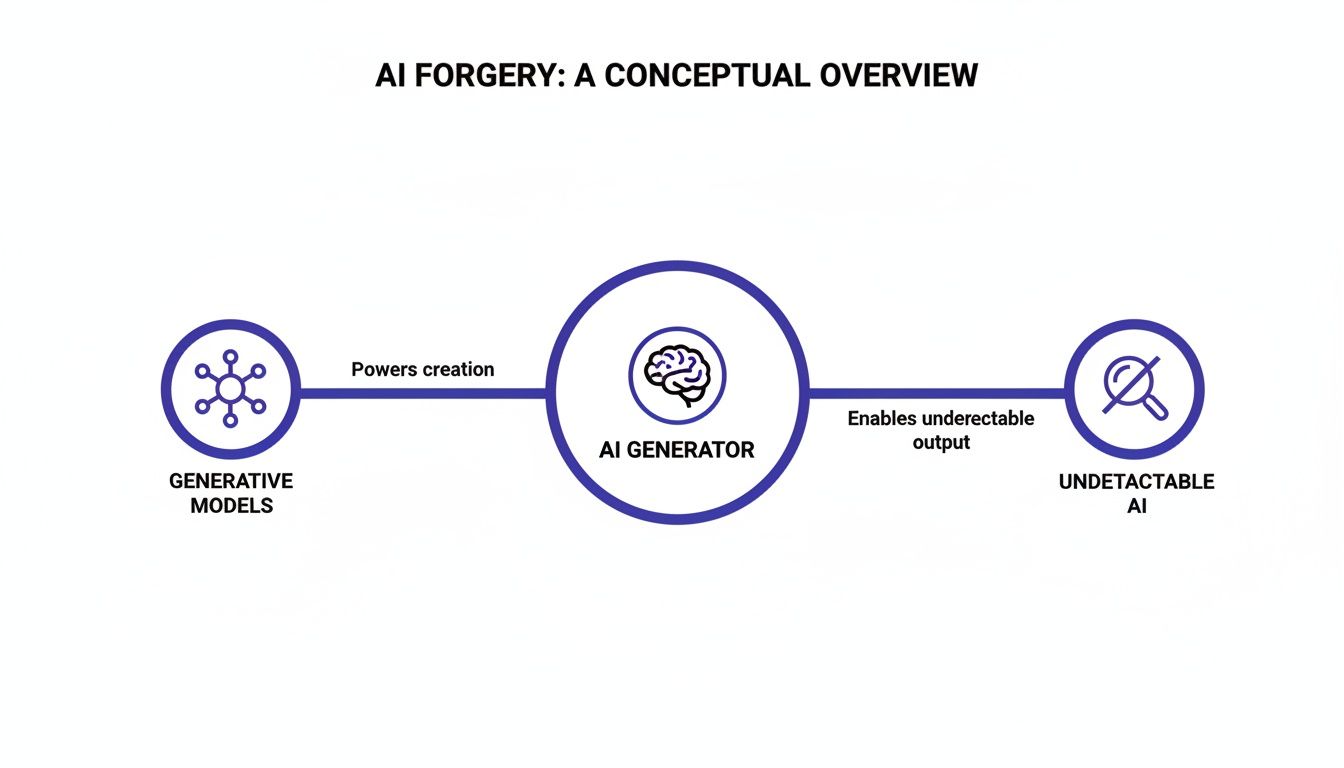
To understand how to spot a fake, you first have to appreciate how it’s made. The push toward "undetectable" AI content is essentially a high-stakes duel between a master forger and a brilliant art critic. The AI generator is the forger, constantly refining its techniques to create a masterpiece so convincing it fools even the sharpest eye.
Think of it this way: the art critic (the AI detector) learns to spot fakes by recognizing the forger's signature mistakes—an odd brushstroke here, a slightly off color there. In response, the forger doesn't just paint better. It studies the critic's methods and learns to avoid those specific errors. This relentless feedback loop is exactly how AI models improve.
The Forger and The Critic: A Digital Duel
At the heart of many early AI generators are Generative Adversarial Networks, or GANs. The name sounds complicated, but the forger-and-critic analogy holds up perfectly. A GAN is made of two competing neural networks:
- The Generator (The Forger): Its only job is to create synthetic data—in our case, video frames—that look as real as possible. It starts with digital static and slowly learns to shape it into something coherent.
- The Discriminator (The Critic): Its job is to tell the difference between the generator's fakes and real, authentic video frames. It's trained on a huge library of genuine content.
These two networks are locked in a constant battle. The generator makes a fake, and the discriminator calls it out. With every failure, the generator learns what not to do next time, getting just a little bit better at fooling its opponent. This process repeats millions of times, with the forger getting craftier until its work is nearly indistinguishable from the real thing.
A key insight from any undetectable AI review is understanding that generators aren't just creating random fakes. They are actively training against detection methods, learning to erase the very fingerprints that once gave them away.
From Digital Noise to Photorealism
More recent techniques like Diffusion Models take a different, but equally powerful, approach. Picture a crystal-clear photograph. A diffusion model works by systematically adding tiny bits of digital "noise" until the original image is completely scrambled.
Then, it learns how to reverse the process. By figuring out how to remove that noise step-by-step, the AI learns the fundamental patterns of what makes an image look real. When it's time to generate a new video, it starts with pure static and applies this "denoising" knowledge to sculpt a photorealistic scene from scratch.
This method is incredibly effective for creating high-fidelity images and videos that don't have many of the classic "tells" of older AI models.
Erasing the Telltale Signs
So, what specific tricks do these forgers learn to hide their tracks? They focus on eliminating the subtle, almost subconscious clues that humans and detectors rely on.
- Fixing Inconsistent Blinks: Early deepfakes often had subjects who blinked too often, too little, or in a weird rhythm. Modern generators are now trained on data that specifically includes normal human blinking patterns, making this a much less reliable signal.
- Smoothing Unnatural Lighting: AI-generated faces used to struggle with realistic lighting and shadows, often looking like they were "pasted" onto a scene. Generators now analyze the lighting of the source video to make sure any new elements blend in seamlessly.
- Cleaning Up Audio Artifacts: The human voice is incredibly complex. Early voice clones had a metallic, robotic quality or an unnatural cadence. Today's models meticulously learn the unique frequencies, pauses, and inflections of a target's voice, filtering out the robotic artifacts that expose a fake.
By mastering these details, AI generators aren't just creating fakes; they're performing a digital cover-up, meticulously wiping away the evidence of their own creation. This is precisely why a simple visual inspection is no longer enough.
The Forensic Pillars of AI Detection
Even the most convincing AI-generated video leaves a faint trail of digital breadcrumbs. While a video might easily fool the human eye, specialized tools can pick up on subtle forensic signals that are completely invisible to us. A proper undetectable AI review means we have to look past what we see and start digging into the data that actually makes up the video file.
A truly comprehensive detection process never relies on a single clue. Think of it like a detective building a case—they need DNA, fingerprints, and witness statements to be certain. By combining multiple, independent pillars of analysis, we can create a robust framework for spotting synthetic media with a high degree of confidence.
This process is a constant cat-and-mouse game. As generative models become more powerful, their output gets harder to distinguish from reality, making this multi-layered forensic approach more critical than ever.
Pillar 1: Pixel-Level Forensics
The first pillar is all about the building blocks of the video: the pixels. AI models, whether they're GANs or diffusion-based, put images together in a fundamentally different way than a physical camera sensor. This artificial process leaves behind microscopic artifacts—essentially, a digital fingerprint of the model that created it.
These fingerprints can show up as faint patterns in the image's digital "noise" or tiny inconsistencies in how colors are rendered from one frame to the next. Advanced detectors are trained to spot these unique signatures, which are nearly impossible for an AI generator to scrub clean without seriously degrading the video's quality.
Pillar 2: Audio Spectral Analysis
Our ears are surprisingly easy to trick, but the raw audio data tells a much more detailed story. The second pillar, audio spectral analysis, turns sound into a visual frequency map called a spectrogram. This lets a system literally "see" the audio and spot anomalies that human hearing would miss entirely.
For instance, an AI-cloned voice might contain unnatural frequency bands, lack the subtle background noise of a real environment, or have a repetitive, machine-like rhythm that becomes glaringly obvious on a spectrogram. It’s like finding a perfectly straight line in a natural forest—it just doesn't belong. You can dive deeper into how this works in our guide to forensic video analysis software.
When a deepfake speaks, it often lacks the rich, chaotic tapestry of frequencies found in a real human voice recorded in a real environment. The audio is often too clean, too perfect—and that perfection is itself a red flag for forensic tools.
Pillar 3: Motion and Temporal Analysis
The third pillar zeroes in on how things move and change over time within the video. AI generators have gotten incredibly good at creating static images, but they often stumble when it comes to the natural, fluid physics of real-world movement. Motion and temporal analysis is designed to catch these inconsistencies from one frame to the next.
A few common giveaways include:
- Unnatural Blinking: The person on screen might blink too often, not enough, or with a strange rhythm that doesn't feel human.
- Stiff Facial Movements: You might see a subtle "puppet-like" effect where the movement of a person's head doesn't quite sync up with their facial expressions.
- Background Flickering: Small, illogical changes or flickers can pop up in the background as the AI struggles to maintain consistency across thousands of frames.
Pillar 4: Digital Footprint Inspection
Finally, the fourth pillar examines the file itself—its metadata and compression patterns. Every digital video has a digital footprint that tells a story about where it came from. Videos generated by AI often have a completely different footprint than one recorded on a camera or smartphone.
This can include missing camera sensor data, strange encoding parameters, or compression artifacts that are hallmarks of a software-based creation process. These clues, hidden within the file's very structure, provide another powerful, independent signal that backs up the visual and audio analyses.
The table below breaks down how this modern, multi-layered approach stacks up against older, more basic methods that are easily fooled by today's sophisticated AI.
Modern vs. Basic AI Detection Methods
| Detection Method | What It Analyzes | Effectiveness Against 'Undetectable AI' | Example Tool Feature |
|---|---|---|---|
| Multi-Pillar Forensic Analysis | Pixels, audio spectrum, motion, and file metadata | High. By combining signals, it can detect subtle artifacts that single-method tools miss. | AI Video Detector's comprehensive scoring |
| Single-Signal Analysis | Usually just one visual element, like blinking or head movement | Low. Easily fooled by newer AI models that have been trained to fix these specific flaws. | Basic "deepfake checker" apps |
In short, relying on a single detection method is a recipe for failure. The most advanced forgeries are designed to beat simple checks, which is why a comprehensive analysis is the only reliable path forward.
This multi-layered approach is essential, especially given the sheer volume of synthetic content out there. Humans are hilariously outmatched; studies show we can spot high-quality 'undetectable AI' deepfakes only 24.5% of the time in video scenarios. With over 500,000 video and audio deepfakes flooding social media in 2024 alone, moderators are completely overwhelmed, which is why these multimodal systems are game-changers for professionals.
How to Put an AI Detector to the Test
Reading about AI detection theory is one thing, but you don't truly understand a tool until you've put it through its paces yourself. Rolling up your sleeves and running your own tests is the only way to see how a detector actually performs with different kinds of video. Let's walk through how you can conduct a real-world undetectable AI review.
The goal here is simple: cut through the marketing noise and get your own data. By throwing a mix of real and synthetic videos at the system, you'll get a gut feeling for what it can do, where it shines, and just as importantly, where it falls short. That’s how you make smart calls about the media you're dealing with every day.
Step 1: Build Your Video Test Library
First things first, you need a solid collection of videos to test. Your mission is to challenge the detector with as much variety as you can muster. Don't just grab one or two clips; the more diverse your sample set, the more you'll learn.
Here’s how to build a great test library:
- Gather Your Ground Truth: Start with videos you know for a fact are real. This could be a quick clip you shot on your phone or a news segment from a trusted source. These are your controls—the baseline for what's authentic.
- Find Some AI Fakes: Next, go on the hunt for AI-generated content. Social media is a goldmine for this, with creators constantly experimenting with the latest tools. You can also find great examples on websites that showcase what these new AI models are capable of.
- Mix Up the Quality: Make sure you have videos of all shapes and sizes. A pristine, high-resolution file has a lot more forensic data than a grainy, compressed video someone sent you on a messaging app. Testing both extremes shows you how the detector holds up when the evidence is faint.
Step 2: Upload and Scan
Once you've got your videos, it's time to upload them. Most modern tools, like AI Video Detector, have a simple, no-fuss interface. You just find the file on your device and kick off the scan.
The process is usually as simple as dragging and dropping your file.
A clean upload function means you can get right to the analysis without getting bogged down in complicated menus.
One critical point here is privacy. A trustworthy detector should process your video without ever storing it. This privacy-first approach is non-negotiable for professionals in newsrooms or legal teams who are often handling sensitive material. The analysis has to happen in a secure sandbox where your data is never saved or seen by anyone else. If you're working with links instead of files, our guide on how to convert a URL to MP4 for analysis explains how to do this securely.
Step 3: Make Sense of the Confidence Score
After the scan wraps up, you’ll get the results, usually centered around a confidence score. It’s crucial to understand that this score is a probability, not a final verdict. For instance, a result like "95% AI-Generated Probability" doesn't mean the video is 100% fake. It means the system found a ton of strong digital clues that are highly consistent with known AI generation techniques.
Knowing how to interpret this number is everything.
Think of a high confidence score as a big red flag that says, "Hey, you need to look closer at this." It’s a powerful piece of data meant to guide your judgment, not replace it. For a journalist, it's a signal to pause the story and do more digging. For a security team, it might be the trigger for a manual review.
Step 4: Dig into the Forensic Report
The score tells you what the detector thinks, but the forensic report tells you why. This is where you can see the specific digital fingerprints the system found. A good report breaks down its findings based on different types of analysis.
- Frame-Level Analysis: Did the report spot bizarre pixel patterns or the kind of digital noise that generative models like GANs often leave behind?
- Audio Forensics: Did it pick up on weird spectral artifacts or unnatural frequencies in the audio that you'd never hear with your own ears?
- Temporal Consistency: Did the system catch subtle flickering between frames, unnatural motion, or other weird inconsistencies over time?
- Metadata Inspection: Did the file’s digital history look fishy? Maybe it was missing the expected camera sensor data or had strange encoding information.
By digging into these details, you get the full story. A video might have perfectly normal audio but show glaring signs of pixel-level tampering. This level of detail is what separates a surface-level check from a truly thorough undetectable AI review and helps you build real trust in the tool's findings.
AI Detection in High-Stakes Scenarios

The ability to tell real from synthetic video isn’t just a technical party trick; it’s a critical necessity in a growing number of professions. When the stakes are high, getting it wrong can tank a legal case, spread viral misinformation, or even cost a company millions.
Let's dive into some real-world situations where AI detection is no longer optional—it's an essential part of the job. In these scenarios, professionals simply can't afford to be fooled. That's why a proper undetectable AI review of a video's origin is fast becoming standard procedure.
Verifying Breaking News for Newsrooms
Imagine a major protest unfolding. A journalist on the digital desk is swamped with user-submitted videos. One clip stands out: it appears to show a public official making a dangerously inflammatory statement. It’s already going viral, and the pressure to report on it is immense.
Before a single word is published, the team runs the video through an AI detector.
- The Problem: Publishing a deepfake wouldn't just be embarrassing; it would destroy the organization's credibility and could dangerously escalate public tensions.
- The Solution: The detector immediately flags the video with a 98% AI-generated probability. It highlights tell-tale signs like audio spectral anomalies and unnatural lip sync.
- The Outcome: The newsroom kills the story. Instead of spreading a malicious fake, they report on the attempted misinformation, reinforcing their commitment to accuracy and performing a valuable public service.
Authenticating Evidence for Legal Teams
In a high-profile corporate lawsuit, the opposing counsel presents a bombshell: a video that seems to show a key executive admitting to fraud during a video call. This one piece of evidence could sink the entire case. But the executive is adamant—the conversation never happened.
For legal and law enforcement teams, video evidence is no longer taken at face value. Forensic-grade analysis is now a standard part of due diligence, used to spot motion discontinuities and encoding irregularities that expose digital tampering.
The defense team gets to work, running the video file through a forensic AI detector. The system looks beyond the pixels, digging into the file’s underlying data structure. If you work in the legal field, you should understand the critical process of video evidence authentication.
The report is revealing. While the video looks clean on the surface, its metadata is missing standard camera and device identifiers. Even worse, it flags subtle pixel-level artifacts consistent with a diffusion model. This is exactly the proof the legal team needs to challenge the evidence, which is ultimately thrown out as inadmissible.
Preventing Executive Deepfake Scams
A multinational corporation’s security team is on high alert. One morning, the CFO gets a video call from someone who looks and sounds exactly like the CEO, who is supposedly traveling abroad. The "CEO" explains there’s an urgent, confidential acquisition and instructs the CFO to immediately wire $15 million to an offshore account.
The 'undetectable AI' arms race isn't just theory—it has flipped the fraud market on its head. Deepfake fraud cases skyrocketed an astonishing 1,740% in North America from 2022-2023. This is why enterprises now face 3,000% more deepfake bypass attempts, as detailed in deepfake market trend reports.
Luckily, this company had integrated real-time AI detection into its video conferencing software. The system instantly flags the incoming feed for temporal inconsistencies and audio artifacts, alerting the security team to a likely deepfake impersonation. The CFO ends the call, the fraudulent transfer is stopped, and a multi-million dollar disaster is averted.
Common Questions About AI Detection
Stepping into the world of AI-generated content can feel disorienting. As we wrap up this look at "undetectable AI," you probably have some questions about the tech, its real-world limits, and where things are headed. Let's clear things up with straightforward answers to the most common questions.
Can Any AI Video Be Truly 100% Undetectable?
That's the million-dollar question, isn't it? While generative AI is getting scarily good, creating a video that's completely invisible to forensic tools is still a massive challenge. Think of it this way: the process of generating a video from scratch leaves behind faint digital fingerprints—subtle statistical clues that just don't exist in footage from a real camera sensor.
A video might look flawless to us, but under a digital microscope, it's a different story. The best detectors aren't just looking at the surface. They’re digging deeper, analyzing things like data patterns, compression artifacts, and the audio frequency spectrum. So, while a synthetic video might fool a person, fooling a layered forensic analysis is a whole other level of difficult. It's a constant race, and the best detection tools are always adapting to keep up.
How Should I Interpret a High Confidence Score?
When you see a score like "90% AI-Generated Probability," it's best to treat it as a strong, data-backed assessment, not a final verdict. It means the detector’s algorithms have flagged multiple, significant indicators that all point toward AI generation—things like pixel-level artifacts, odd audio frequencies, or unnatural motion.
In any serious workflow, a high score is a major red flag that demands a closer look. It's the critical piece of data that tells a journalist to pause a story or a security team to manually review a suspicious transaction.
It’s like a smoke detector. It doesn't mean the whole house is on fire, but it’s telling you there’s definitely smoke and you need to investigate right now. The score tells you what the system found, and the detailed forensic report should tell you why.
What Are the Limitations of Current AI Detectors?
The biggest limitation is the constant cat-and-mouse game. As soon as a new, more sophisticated AI model comes out, detectors have to be retrained to spot its unique digital signatures. No tool is perfect, and this technology is in a perpetual state of catch-up.
Beyond that, there are a few other real-world challenges:
- Heavy Compression: When a video is compressed over and over—like what happens on many social media sites—it can strip away the very forensic data the detector needs, making analysis much tougher.
- Low Resolution: Similarly, a blurry or low-res video just might not have enough detail for a solid conclusion.
- Shallowfakes: These are videos manipulated with old-school editing software, not generative AI. They won't trigger AI-specific detectors and often need a different kind of verification process.
This is exactly why the best approach is never just about technology. It's about combining powerful tools with smart, critical human oversight.
Why Is a Privacy-First Approach So Important?
Let’s be honest, many of the videos that need checking are sensitive. We're talking about unverified footage from a conflict zone, confidential evidence for a legal case, or private internal company messages. A privacy-first detector is built on the simple but powerful idea that this data should never, ever be stored or put at risk.
By processing a video without saving a copy on its servers, the tool ensures user confidentiality is locked down. This is non-negotiable for any organization dealing with strict data rules like GDPR. It's what builds the trust needed to use these tools in high-stakes fields where privacy isn't just a nice-to-have feature—it’s the entire foundation. For a platform like AI Video Detector, this commitment is baked into its design, allowing users to verify content without worrying about exposure.


