

Confidence Score Machine Learning: A Guide for AI Detectors

A machine learning confidence score represents a probability of correctness only when it is calibrated. If a model assigns 0.80 confidence to many predictions, about 80% of those predictions should be correct, not merely ranked above less confident outputs.
That distinction creates a counterintuitive risk. A model can sound certain, produce a high score, and still be wrong in a way that matters. Research on modern neural networks found that strong predictive accuracy can coexist with systematic overconfidence, which means raw model performance doesn't automatically tell you whether a confidence score deserves trust (research on neural network calibration).
For product managers, security analysts, journalists, and investigators, confidence isn't a decorative number on a dashboard. It influences whether a video is published, evidence is accepted, a transaction is blocked, or a person is sent for review. The right question isn't “How confident is the model?” It's, “When the model reports this level of confidence, how often is it right in the environment where we'll use it?”
Why High Confidence Is Not the Same as Being Right
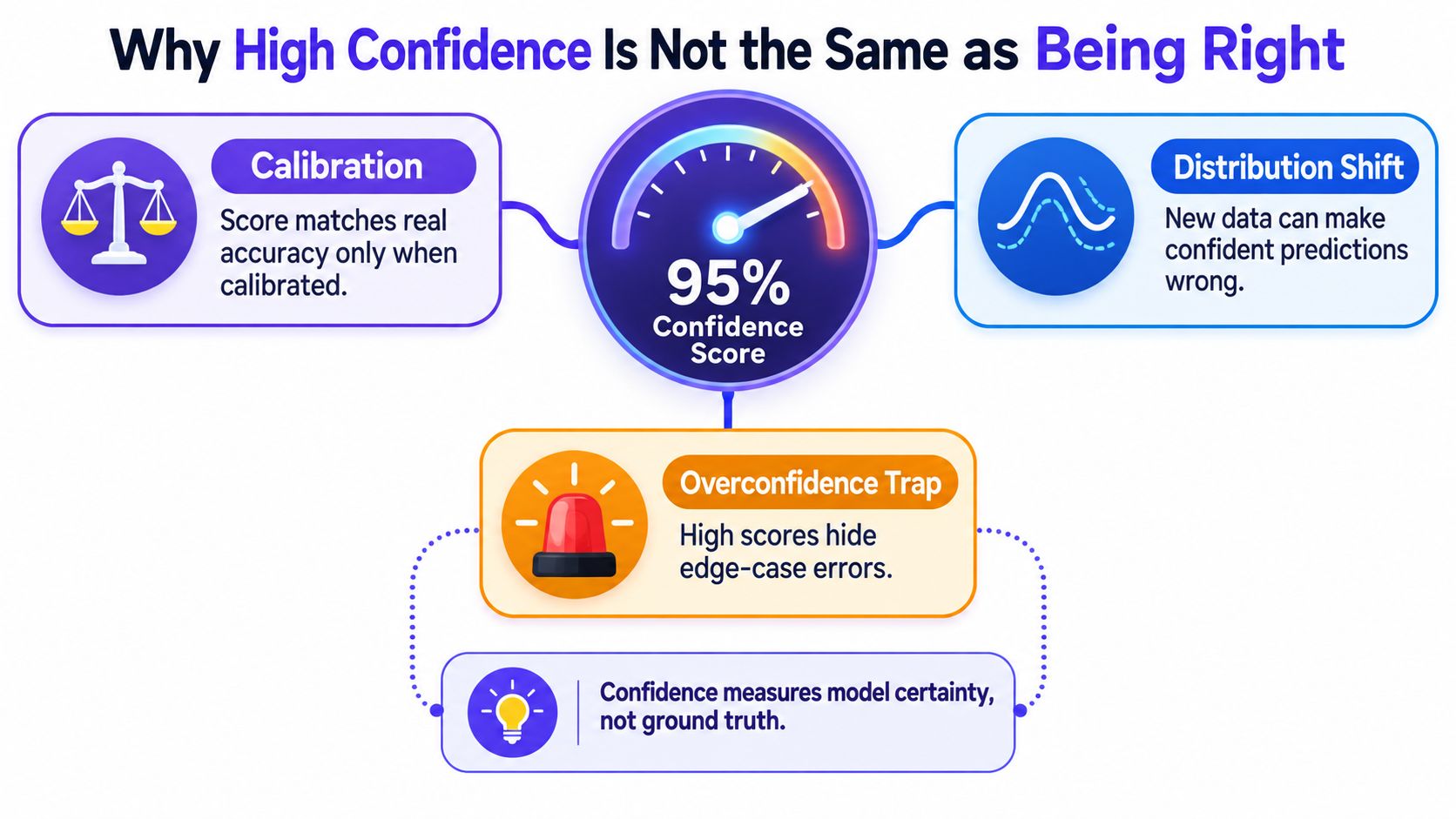
A high confidence score measures the model's certainty, not ground truth. That may sound obvious, but many operational mistakes begin when teams treat a score as a guarantee. A detector can assign a high probability to a prediction because the input resembles patterns in its training data, even when the underlying conclusion is false.
The probability promise
Calibration gives confidence scores their practical meaning. A calibrated classifier that assigns 0.80 confidence across a group of predictions should be correct for about 80% of that group, as described in the statistical foundations of confidence scoring. The score becomes a probability that stakeholders can interpret, rather than a ranking that merely says one result looks more plausible than another.
Without calibration, a score of 0.95 might mean “usually correct,” “more likely than alternatives,” or just “the model's internal preference is strong.” Those interpretations aren't interchangeable. A newsroom may mistake preference for verification, while a security team may treat an uncertain signal as sufficient evidence to block an account.
Why the error becomes expensive
Consider an altered video submitted during a breaking news event. A system detects visual artifacts and returns a high confidence score. An editor publishes immediately, assuming the score represents an established probability of manipulation. Later, reviewers discover that unusual compression from the original upload caused the detector to overreact. The problem wasn't just a wrong classification. The workflow gave an unvalidated score authority over a public claim.
The same pattern appears in legal evidence authentication and fraud prevention. A false positive can cause a legitimate item to be rejected, while a false negative can allow fabricated evidence or an impersonation attempt through. The cost of an error depends on the decision attached to the score, not just on the score itself.
Practical rule: Treat confidence as a claim that requires evidence. Ask whether historical predictions at that confidence level matched labeled outcomes.
Distribution shift makes the issue harder. A model trained on familiar camera pipelines, codecs, voices, or editing styles may encounter new conditions after deployment. The model can remain highly certain because its internal features still produce a strong response, even though the relationship between those features and correctness has changed.
The hidden risk in confidence score machine learning is therefore not only inaccuracy. It is misinterpreted certainty. Calibration, threshold policy, and ongoing monitoring must sit between a model output and a high-impact action.
Understanding Calibration and Model Reliability
A confidence score becomes useful only when it has a demonstrated relationship with outcomes. Calibration provides that evidence. If a system repeatedly assigns a particular confidence level, the predictions receiving that level should be correct at approximately the same rate across a suitable group of cases. This describes group reliability, not a guarantee about any individual prediction.
How Expected Calibration Error works
The Expected Calibration Error, or ECE, summarizes the gap between reported confidence and observed accuracy. Analysts place predictions into confidence bins, calculate the average confidence and actual accuracy within each bin, then compare those values. A large gap means the score is presenting an unreliable picture of model performance (calibration and ECE overview).
For example, a group of predictions reported at 80% confidence should be correct roughly four times out of five if that confidence is well calibrated. A group that is correct far less often is overconfident. A group that is correct more often is underconfident. The comparison becomes meaningful only when the evaluation set contains enough labeled examples and resembles the conditions in which the model will operate.
Calibration answers a different question from accuracy. Accuracy measures how often the final classifications are correct. Calibration measures whether the confidence attached to those classifications is honest. A model can select the right class frequently while still assigning confidence values that are consistently too high or too low.
That distinction affects workflow design. A team that sends only uncertain cases to human reviewers needs confidence to separate cases suitable for automatic handling from cases requiring examination. A ranking score may order cases effectively while failing to identify a reliable boundary for automation.
Why neural networks need explicit calibration
Research published in 2017 showed that contemporary deep networks could achieve strong accuracy while remaining systematically overconfident (historical calibration research). This finding established a practical warning for product and security teams: better classification performance does not automatically make the associated probabilities trustworthy.
Post-hoc calibration adjusts model outputs after training. It may leave the underlying class decision unchanged while reshaping the reported confidence to better match observed results on validation data. The adjustment still requires testing against relevant samples, because a calibration layer fitted to one population can perform poorly after camera pipelines, codecs, editing styles, or user behavior change.
Calibration should therefore be treated as a separate reliability task. Confidence quality should be optimized as its own objective, with evaluation criteria that reflect how the score will support review, escalation, or automated action.
Calibration for multimodal systems
Video detection combines visual evidence, audio, timing patterns, and file metadata. Each signal can have different error patterns, sample coverage, and sensitivity to changed inputs. A single final score can conceal a weak component, especially when one modality dominates the combination.
Resources on multimodal machine learning 2026 can help teams examine the validation questions created by combining these signals. In practice, evaluate each meaningful component, then test the combined output on labeled examples that resemble production traffic. Check whether confidence remains reliable across content types and operating conditions, rather than relying only on an overall average.
A probability symbol, percentage, or polished interface does not validate a score. Confidence becomes useful when teams compare it with outcomes, recalibrate when the relationship shifts, and monitor performance after deployment. The confidence calibration guide offers practical considerations for structuring that validation process.
How Thresholds Shape False Positive and Negative Tradeoffs
A confidence score becomes a business decision when someone sets a threshold. Above the cutoff, the system may automate an action. Below it, the system may reject the prediction, request more evidence, or send the case to a person.
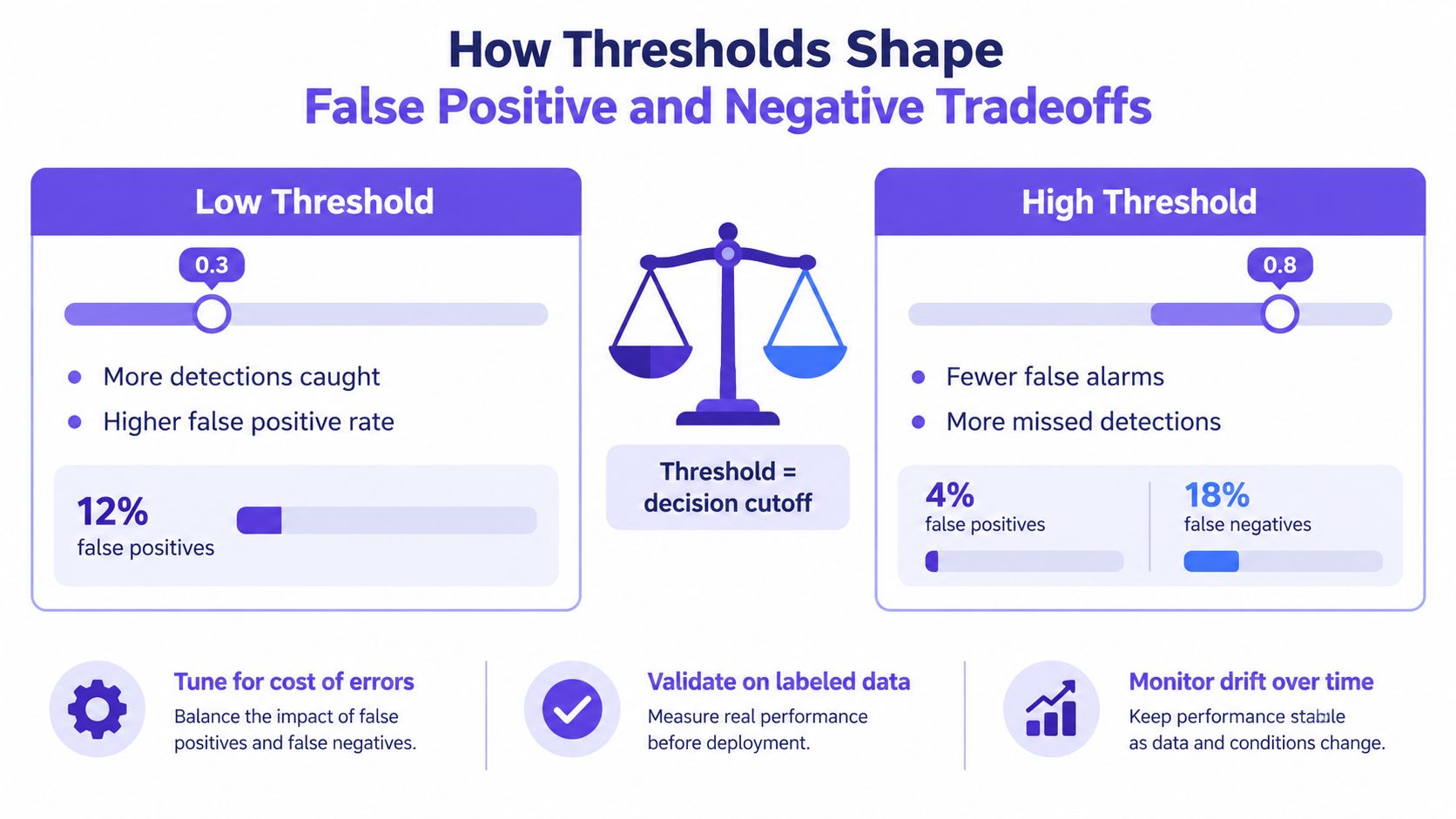
The threshold doesn't make the score calibrated. It only converts the score into a rule. If the score is overconfident, a seemingly cautious cutoff may still admit many incorrect predictions. Threshold selection must therefore follow calibration testing, not replace it.
Start with the cost of each error
A false positive occurs when the system flags a legitimate item as suspicious. A false negative occurs when it misses an item that should have been flagged. Neither error is universally worse.
A newsroom verifying user-submitted footage may prefer a review queue that catches questionable clips, even if editors must inspect more legitimate footage. A legal team may require stronger corroboration before labeling evidence manipulated, because an unjustified rejection could affect a proceeding. An enterprise security team might route ambiguous executive video calls to an analyst rather than automatically block every unusual recording.
The right policy depends on the consequence, reversibility, and availability of human review. Use the score to support a decision policy, not to make the policy disappear.
A practical threshold workflow
Define the action. Decide what happens above and below the cutoff. Options include automatic acceptance, automatic rejection, manual review, or a request for additional evidence.
Label representative data. Use examples with known outcomes that reflect the cameras, formats, users, attack patterns, and operating conditions expected in production.
Compare score ranges with outcomes. Check whether high-scoring predictions are more reliable and whether confidence tracks accuracy consistently across relevant groups.
Price the errors. Estimate the operational impact of a missed manipulation versus an unnecessary investigation. The comparison can be qualitative when financial costs are uncertain.
Add an abstention path. A system doesn't need to force a binary answer on every input. Low-confidence or conflicting cases can be rejected, escalated, or held for review, a deployment policy highlighted in practical guidance on enterprise confidence risk.
Monitor after launch. A threshold that works on validation data may behave differently when inputs, generation techniques, or user behavior change.
A threshold is a governance decision expressed as a number. It should have an owner, a documented rationale, and a review process.
Precision and recall help teams describe the consequences of a threshold from different angles. This precision and recall tradeoff guide can help product and security teams connect a cutoff to the types of mistakes they want to reduce.
Avoid copying a threshold from another product or use case. Two systems may output values that look similar while using different labels, datasets, calibration methods, and operating assumptions. A cutoff only has meaning in relation to the model that produced it and the action that follows.
Reading AI Video Detector Confidence Metrics in Practice
A video detector's score should be read as an assessment of the evidence available to the system, not as a universal declaration about the file. A result may reflect visual patterns, sound, timing, and file history, and those signals can agree, conflict, or provide too little information.

For example, a clip may contain convincing facial motion but synthetic audio. Another may have authentic audio and natural temporal behavior but show frame-level artifacts caused by generation or editing. A single number can summarize the result, but reviewers should ask which evidence contributed to it and whether the input resembles the data used for validation.
Four signals, one decision context
AI Video Detector analyzes uploaded video through frame-level analysis, audio forensics, temporal consistency, and metadata inspection. These signals examine different aspects of authenticity, including visual artifacts, sound anomalies, motion relationships, and encoding or file information.
That design supports a more disciplined review. A high result supported by several consistent signals may deserve different treatment from a high result driven mainly by one unusual property. The score still requires calibration and context, but the evidence profile gives investigators more to examine than a bare binary label.
A journalist could compare the result with the source's upload history, the original file if available, and independent reporting. A security analyst could combine the detector output with call records, identity verification, and an established escalation process. A legal team would preserve the original evidence and document how the tool's output influenced, but didn't independently establish, an authenticity conclusion.
Review habit: Record the score, the input conditions, the supporting signals, and the final human decision. The record becomes valuable calibration evidence later.
A practical dashboard should make uncertainty visible. Users need to know whether the system produced a confident result because multiple signals aligned or because one subsystem dominated. They also need a path for ambiguous cases, since forcing every clip into “real” or “synthetic” can conceal evidence gaps.
The following video illustrates how a confidence result can fit into a broader analysis workflow:
A detector's output should guide the next action. It shouldn't replace source verification, chain-of-custody controls, expert review, or corroborating evidence when the decision carries serious consequences.
Why Multi-Signal Detection Outperforms Single Scoring
A single signal can be useful, but it has a narrow view of authenticity. Frame analysis may identify visual artifacts while missing a synthetic voice. Metadata may look ordinary because a platform stripped it during transcoding. Temporal analysis may find motion discontinuities that a video editor introduced without any generative manipulation.
The problem isn't solved merely by adding more signals. Each signal needs its own validation, and the combined result needs testing as a system. Still, comparing independent evidence sources gives teams a better basis for identifying disagreement and deciding when to escalate.
What each signal can and can't tell you
| Signal | Useful question | Main interpretation risk |
|---|---|---|
| Frame-level analysis | Do individual frames contain patterns associated with synthetic generation or alteration? | Compression, resizing, or unusual capture conditions can produce misleading artifacts. |
| Audio forensics | Does the soundtrack contain spectral or voice-related anomalies? | Background noise, dubbing, and platform processing can obscure or imitate those patterns. |
| Temporal consistency | Do movement, transitions, and frame-to-frame relationships behave naturally? | Fast motion, edits, and low-quality footage can make authentic sequences look irregular. |
| Metadata inspection | Does file information support or contradict the claimed provenance? | Metadata may be missing, rewritten, or removed during ordinary handling. |
A multi-signal result is strongest when teams understand these limitations rather than treating agreement as proof. If visual and audio evidence point in opposite directions, the conflict itself is informative. It may indicate a partially edited clip, an unusual but authentic recording, or a condition outside the system's reliable operating range.
From one number to a reliability profile
Current confidence research increasingly examines multicalibration, ECE, prediction-rejection ratio, entropy-based uncertainty, and sequence-level confidence rather than relying on one scalar value (multi-dimensional confidence scoring research). These ideas ask whether confidence behaves reliably across groups, how performance changes when the system rejects uncertain cases, and how uncertainty accumulates across a sequence.
For video authentication, that shift changes the product question. Instead of asking only whether the overall score is high, ask:
- Which subsystem produced the strongest evidence?
- Do the signals agree on the same conclusion?
- How much of the clip was usable for analysis?
- Does the score remain meaningful under this format and source condition?
- Should the system abstain because the evidence conflicts?
Teams can explore the underlying visual evidence through video fingerprint features, then compare those observations with audio, temporal, and metadata findings. The goal isn't to overwhelm reviewers with technical output. It's to show enough context that a reviewer can distinguish strong convergence from false certainty.
A multi-signal architecture still fails if all signals share the same blind spot. Common training data, shared preprocessing, or a new generation technique can affect several subsystems at once. Validation must therefore include adversarial, unusual, and newly emerging inputs, not only familiar examples.
Building a Practical Framework for Interpreting Confidence Scores
A reliable interpretation framework begins before anyone sees a score. Product and security teams should define what the score measures, identify the ground truth used to test it, and document the conditions under which the result is expected to remain meaningful.
Ask five questions before acting
What is the score about? It may represent class probability, likelihood of manipulation, ranking strength, or agreement among subsystems. These are different quantities. Read the label and technical definition instead of assuming that every “confidence” field means probability of correctness.
Which ground truth supports it? Calibration requires known outcomes. For video, that may involve trusted originals, documented editing histories, expert adjudication, or carefully reviewed examples. If labels are uncertain, the evaluation can create a false impression of reliability.
Where was it tested? Offline benchmarks may not represent the videos a newsroom, legal team, or enterprise receives. Test with operational data, including ordinary uploads, difficult edge cases, platform transformations, and examples from the relevant sources.
What happens when signals disagree? Define an abstention or escalation path. A system that can say “insufficient evidence” is often safer than one that forces a confident binary answer.
Who owns the decision? Assign responsibility for threshold changes, calibration reviews, incident investigation, and communication when the model's behavior changes.
Account for drift and distribution shift
Confidence can degrade when production inputs differ from development data. New cameras, codecs, editing tools, attack methods, languages, environments, and platform workflows can alter the relationship between model signals and correctness. A high score on familiar data doesn't establish reliability under every future condition.
Build monitoring around outcomes rather than scores alone. Track how often automated decisions are overturned, which signal combinations lead to escalation, and whether certain input groups produce more conflicts. Sample reviewed cases for periodic recalibration, especially after model updates or major changes in the source data.
A useful operating policy separates three paths:
- Automate: Use this path only when validation shows that the score is reliable for the relevant inputs and the consequence of an occasional error is acceptable.
- Review: Send cases with conflicting signals, unusual conditions, or high potential impact to a trained analyst.
- Reject or request more evidence: Use this path when the system lacks enough usable information to support a responsible conclusion.
Decision principle: Confidence should control workflow intensity, not determine truth by itself.
For a newsroom, the framework may require corroboration before publication. For legal evidence, it may require preservation and expert authentication. For enterprise fraud prevention, it may combine detector output with identity, transaction, and access signals. The score can inform each process, but the acceptable evidence standard differs.
The most trustworthy teams treat confidence scoring as a monitored product capability. They validate probabilities, examine subsystem behavior, set thresholds according to error costs, and preserve human escalation for cases the model can't reliably judge. That approach turns a seductive number into a measured decision aid.
If you're evaluating an AI detector for newsroom verification, evidence authentication, or enterprise security, start with a labeled sample from your real workflow. Record each confidence score, supporting signal, reviewer decision, and final outcome, then use those results to set calibration checks and escalation rules before allowing high-confidence predictions to trigger consequential actions.