

Deepfake Detection Challenge: What It Takes to Spot Fakes

A deepfake detector can score 82.56% average precision on public evaluation footage and only 65.18% on a hidden dataset, so the deepfake detection challenge is fundamentally a generalization and robustness problem, not a missing-accuracy problem. Benchmarks often overstate what detectors can do in the wild because unfamiliar generators, recompression, editing, and hostile manipulation change the evidence a model sees.
A newsroom once received a video that appeared to show a public official making a damaging statement. The file had already passed through a messaging app, been cropped, and re-encoded. A detector returned a confident result, but the confidence described the model's familiarity with the file, not the video's provenance. That distinction is where responsible verification begins.
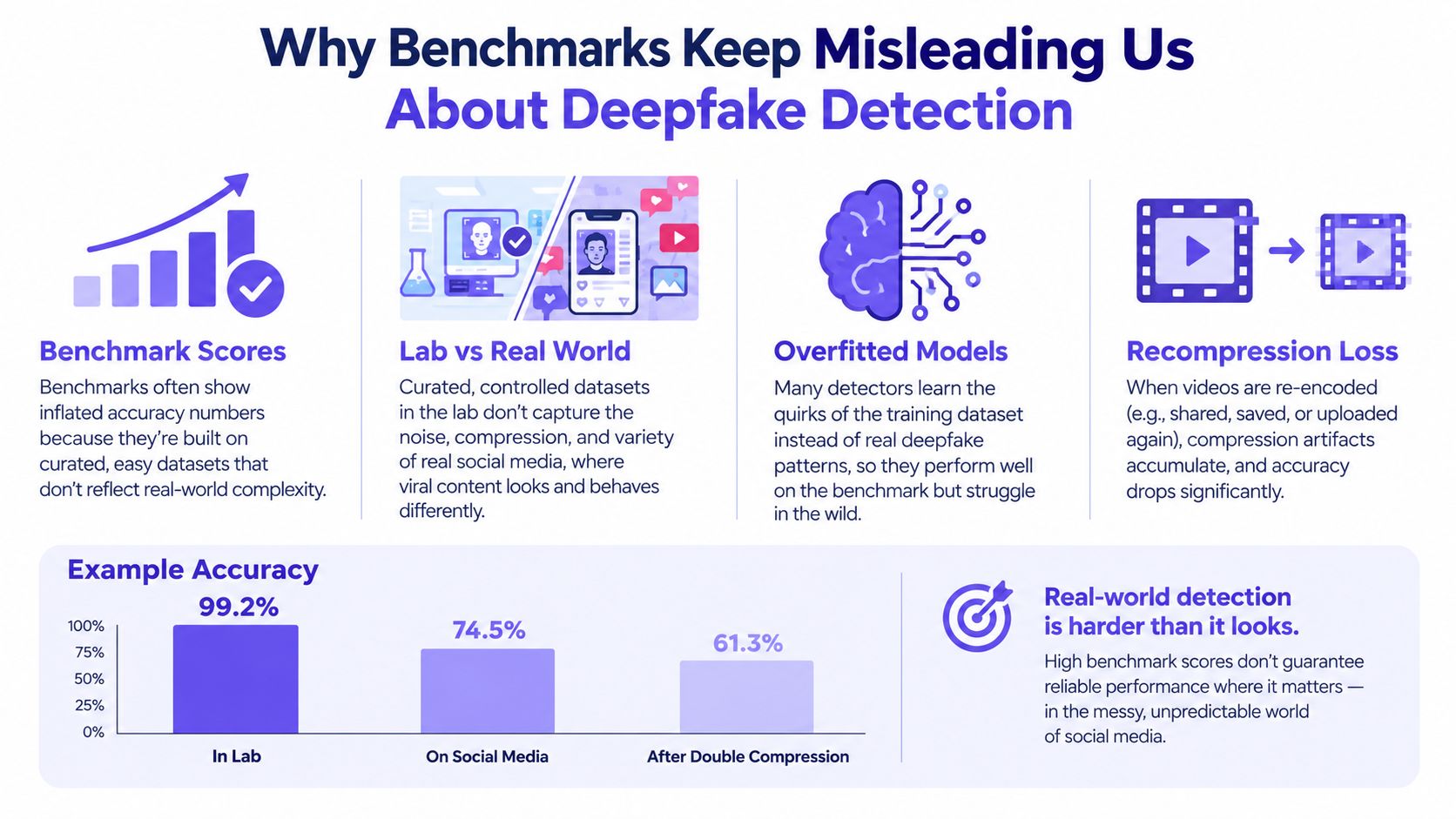
Why Benchmarks Keep Misleading Us About Deepfake Detection
A benchmark can be carefully designed and still answer the wrong operational question. Researchers may train and test a detector on videos that share identities, codecs, lighting conditions, manipulation pipelines, or post-processing habits. The resulting score can measure how well the system recognizes that dataset's fingerprints rather than whether it can identify manipulation in an unfamiliar upload.
The DeepFake Detection Challenge dataset makes the problem difficult to dismiss as a small-sample issue. Facebook launched the challenge in 2019 with 124,000 videos, eight facial-manipulation algorithms, and footage involving 3,426 paid actors. Its formal training set contained 119,154 clips, with about 100,000 synthetic videos, yet the strongest model still fell from 82.56% average precision on public evaluation data to 65.18% on a hidden black-box set.
The score is conditional
That decline isn't a footnote. It shows that a detector's output depends on the relationship between its training distribution and the uploaded media. If both sets contain similar compression patterns or generation artifacts, the model can perform well without learning evidence that transfers to new subjects and workflows.
This is why teams should treat benchmarking as an evaluation discipline, not a marketing number. A practical guide to benchmarking with Fetchin is useful background for separating a metric from the conditions under which someone measured it. For deepfake systems, those conditions should include unseen identities, withheld manipulation families, multiple codecs, altered resolutions, and platform-style copies.
Practical rule: A benchmark score is meaningful only when you know what changed between training, testing, and deployment.
A newsroom, court, or fraud team rarely receives pristine benchmark footage. The file may have been downloaded, clipped, screen-recorded, or stripped of metadata before anyone examines it. That makes deepfake benchmark datasets valuable for research, but insufficient as a stand-alone prediction of field reliability.
The central lesson is uncomfortable: more benchmark footage doesn't automatically solve generalization. Large datasets can still encode shortcuts, and a high score can still collapse when the source, generator, or distribution changes.
How Manipulation Type and Video Quality Break Detectors
Deepfake detection isn't one uniform classification task. Different synthesis methods leave different traces, and the same detector can respond very differently depending on how a face was altered or how the resulting video was encoded.
The FaceForensics++ evidence is stark. On its manipulation categories, the XceptionNet baseline reached 96.36% accuracy on DeepFakes but only 52.04% on NeuralTextures, with an average of 81.39% across the four techniques. These figures are reported in the FaceForensics++ benchmark literature. A model that performs strongly on one pipeline may therefore be learning artifacts specific to that pipeline, not a general definition of synthetic media.
Compression creates a second failure path. Under high-compression evaluation, XceptionNet's accuracy fell to 54.68%, while a more specialized method retained 78.92% under the same condition, as documented in the same benchmark review. The difference matters because normal distribution channels resize, transcode, crop, and recompress videos. Those operations can erase subtle manipulation traces and add ordinary codec artifacts that look suspicious to a detector.
What the file has been through matters
Consider a clip shared from an original camera file to a social platform, then downloaded and placed inside a news workflow. The detector isn't seeing the same signal that the creator produced. Frame rate may have changed, resolution may have fallen, audio may have been resampled, and container metadata may no longer describe the original recording.
A robust evaluation should separate these conditions instead of averaging them into one headline score:
- Manipulation families: Test face swaps, reenactment, synthetic textures, and generators withheld from training.
- Codec conditions: Compare raw footage with common H.264 and platform-recompressed versions.
- Temporal changes: Include frame-rate conversion, dropped frames, cuts, and edited sequences.
- Signal availability: Evaluate video-only, audio-video, and metadata-preserved cases separately.
The time consistency problem in deepfake detection is especially important because a few convincing frames don't establish that the entire sequence is coherent. Temporal artifacts may appear between frames, while compression can make both genuine motion and synthetic transitions harder to interpret.
The practical trade-off is clear. A detector optimized for clean imagery may be sensitive to tiny artifacts but fragile after sharing. A more resilient system may combine weaker signals and perform less impressively on pristine footage, yet provide better operational evidence when the file has survived real distribution.
The Generalization Problem Behind Cross-Dataset Failure
Cross-dataset failure usually begins with shortcut learning. Instead of learning manipulation-invariant evidence, a model may associate fakeness with an encoding pattern, a recurring identity, a background, a lighting setup, or a post-processing habit. The system then appears capable until a new dataset removes those clues.
This explains how detectors can exceed 90% accuracy in familiar settings yet drop substantially on unseen datasets. The cross-dataset generalization analysis identifies differences in compression, identities, capture conditions, manipulation pipelines, and generator architectures as persistent causes of that decline. High accuracy and high AUC are therefore conditional measurements, not universal guarantees.
Test the shift, not just the average
An operational evaluation should report at least two views of performance:
- Within-domain behavior, where test media resembles the training distribution.
- Cross-domain behavior, where identities, codecs, generators, recording conditions, and editing workflows change.
The second view is usually more informative for a verification team. It exposes whether the detector has learned transferable evidence or merely recognized the environment in which it was trained.
Training design can reduce some shortcuts. Paired real and fake samples derived from the same source video help hold irrelevant properties constant, making manipulation evidence easier for the model to isolate. That approach doesn't remove distribution shift, but it attacks one causal source of brittle performance.
Confidence requires the same discipline. A score from an original upload shouldn't automatically be treated as comparable to a score from a heavily recompressed social-media copy. Teams need calibration by upload format and degradation level, because the meaning of a score changes when the available forensic signal changes.
A detector doesn't fail only when it says “fake” incorrectly. It also fails when it gives a precise-looking score for content outside its experience.
This is why an “authentic” label can be dangerous if users interpret it as proof. A negative detection result may mean that the system found no reliable synthetic evidence, not that the video has a verified origin. Those are different conclusions and require different evidence.
What Happens When Attackers Actively Try to Fool Detectors
A passive detector assumes the video arrives naturally. A hostile actor doesn't have to respect that assumption. They can crop the frame, re-encode the file, record a screen, remove metadata, or apply transformations designed to weaken the traces a model uses.

Research summarized in a report on deepfakes and digital evidence demonstrated attack success rates above 99% with full model access and around 86% in limited-query settings. For compressed video, attack success remained above 78% in the reported settings. The important point isn't that every attacker can reproduce a laboratory attack. It's that a detector can be tested as an opponent-facing system rather than a passive classifier.
A negative result is not authentication
Limited-query attacks matter because a production adversary may not need the model's source code. If they can submit altered material and observe a system's response, they may learn which transformations reduce confidence. Repeated cropping, compression, or re-recording can turn a clear forensic signal into an inconclusive one.
The right response isn't to abandon automated analysis. It's to stop asking one detector to carry the entire authentication decision.
A layered process should preserve whatever evidence survives attack:
- Content signals can inspect faces, motion, audio, and frame-level irregularities.
- Provenance signals can establish whether a trusted chain of origin and edits remains intact.
- Uncertainty handling can prevent a weak or degraded input from producing false certainty.
- Human escalation can assess context, source history, and consequences.
The distinction between “likely synthetic” and “provenance verified” becomes essential here. A detector may identify patterns associated with generated content, but that doesn't establish who created the file, whether it was edited after recording, or whether an authentic video was manipulated only in a short segment.
A short demonstration can make the workflow intuitive, but it shouldn't be mistaken for a validation protocol.
Escalation trigger: If the decision could affect legal rights, public safety, employment, financial controls, or publication, an automated result should prompt review rather than end it.
Attack resistance also changes the value of metadata. Missing metadata isn't proof of fakery, because ordinary platforms and editing tools remove it. Conversely, metadata is affirmative evidence only when the chain of trust remains intact and the file's handling history is documented.
How to Read Detection Results Like a Verification Professional
A verification professional reads a detector result as evidence with conditions attached. The first questions concern the input, not the label: Is this the original upload? What codec and resolution does it use? Has it been cropped, transcoded, or screen-recorded? Does the audio belong to the same recording, and is metadata available?
Those questions determine how much signal the system could have observed. A low-confidence result on degraded footage may be an honest expression of uncertainty. A high-confidence result on unfamiliar content may still reflect a brittle artifact. Treating both outputs as universally comparable is a category error.
Separate the claims
Teams should keep three conclusions distinct:
| Claim | What it means |
|---|---|
| Likely synthetic | The content contains patterns associated with manipulation or generation. |
| Inconclusive | Available evidence is too degraded, incomplete, or unfamiliar for a reliable decision. |
| Provenance verified | A trusted origin and handling chain supports authenticity. |
These categories prevent a detector from making claims it wasn't designed to make. A content score can support a review, but it can't independently prove origin.
Frame analysis, temporal consistency, audio forensics, and metadata inspection provide complementary views. None is immune to compression or editing, so agreement across signals is more useful than treating one anomaly as decisive. A model may identify a visual irregularity while the audio remains consistent, or the metadata may show that the file has been repeatedly transcoded. That combination should produce a documented assessment, not an automatic verdict.
For teams interpreting machine-learning outputs, a practical explanation of the confidence score in machine learning can help clarify what a score represents and what it doesn't. Confidence is not the same as certainty, and calibration should reflect the upload conditions under which the score was produced.
Verification habit: Record the file condition, detector version, signals available, result, and reviewer decision together. A score without context isn't a durable finding.
The strongest conclusion may be “insufficient evidence.” That answer can feel unsatisfying, but it protects a newsroom from publishing an unverified accusation and a legal team from overstating forensic support. In high-stakes work, transparent uncertainty is more defensible than precision without provenance.
A Practical Workflow for Vetting Suspicious Video Content
A reliable workflow starts before anyone uploads the file to a detector. Preserve the original artifact, record where it came from, and avoid replacing it with a messaging-app download or an edited working copy. Create analysis copies, but keep the source file and its handling history separate.
Use a controlled evidence path
Preserve the original. Store the received file without alteration and document the source, time of receipt, transfer method, and any known edits.
Inspect the container and streams. Record available metadata, codec, resolution, frame rate, audio presence, and duration. Missing metadata should be recorded as a limitation, not treated as proof of manipulation.
Run automated analysis. Submit the original when possible, then document the exact tool, version, input, and output. Don't silently normalize or re-export the file before analysis.
Examine temporal and audio behavior. Look for motion discontinuities, lip-sync problems, abrupt changes in facial geometry, inconsistent reflections, and audio that doesn't fit the recording environment. Each observation needs context because compression can create ordinary artifacts.
Compare independent evidence. Check the earliest known source, related footage, alternate uploads, corroborating reporting, and provenance records. A detector should be one input in this comparison.
Escalate proportionately. Human or forensic review is appropriate when the content could trigger legal, journalistic, safety, employment, or financial consequences.
Teams supporting public-facing communities can also review practical tools for social care teams, particularly when moderators need a repeatable process for triage and escalation rather than a binary label.
Keep an audit record that another reviewer can reproduce. Note what was available, what was missing, which transformations occurred, and why the final decision was reached. If the evidence remains mixed, publish or act with an explicit qualification instead of hiding uncertainty behind a confidence number.
What the Deepfake Detection Challenge Really Means Going Forward
The deepfake detection challenge isn't a race toward one perfect classifier. It's an arms race involving new generators, changing codecs, platform transformations, adversarial edits, and increasingly unfamiliar content. A detector that leads a benchmark today can lose value when the evidence distribution changes.
That doesn't make benchmarks useless. They help researchers compare methods, identify known weaknesses, and measure progress under declared conditions. Their role changes when professionals stop treating them as deployment guarantees.
Reliability requires several layers
A defensible system combines:
- Cross-domain testing, including unseen identities, generators, codecs, resolutions, and capture conditions.
- Adversarial evaluation, where attackers deliberately crop, compress, re-record, or re-encode content.
- Signal diversity, so a decision doesn't depend on one fragile visual fingerprint.
- Calibrated uncertainty, with outputs that distinguish likely synthetic content from inconclusive evidence.
- Provenance and process controls, which preserve the original file and make the review auditable.
- Human escalation, especially when a false conclusion could cause serious harm.
More confidence labels won't repair missing provenance. More clean benchmark accuracy won't guarantee performance on a hostile upload. And a detector's failure to identify manipulation doesn't establish that a video is genuine.
The useful mindset is therefore operational rather than celebratory. Ask what the system was tested on, what changed before the file arrived, which signals remain available, and what decision the result can legitimately support. If those questions aren't answered, the output should remain provisional.
Before publishing a suspicious clip, admitting it as evidence, or approving a sensitive business action, upload the original file to AI Video Detector for a privacy-first review of frame-level, audio, temporal, and metadata signals, then preserve the result alongside your human verification notes. Use the outcome to guide escalation, not to replace provenance and professional judgment.