

AI Video Detector Explained: Signals, Accuracy, and Trust

A source sends you a leaked video shortly before publication. The speaker looks familiar, the voice sounds convincing, and the statement could change your story. Your editor asks whether it's authentic. You can replay it, inspect the face, and contact the sender, but none of those steps alone settles the question.
An AI video detector can help you decide what deserves closer investigation. The challenge is understanding what its result supports, especially when the file has passed through messaging apps, editing software, or social platforms.
What an AI Video Detector Is and Why It Matters
An AI video detector analyzes a video for evidence that someone generated or manipulated its content using artificial intelligence. Its practical output is an assessment, not a certificate of authenticity. Depending on the system, that assessment may include a classification, confidence score, suspicious segments, or information about which checks were possible.
For the journalist receiving that leaked clip, the useful question isn't whether the software displays a warning. It's whether the warning provides a reason to pause publication, seek the original recording, or bring in a specialist.
Detection answers a narrower question than truth
Synthetic media includes content created or altered using AI. A face replacement, generated voice, and fully generated scene present different verification problems. Understanding what synthetic media includes helps you distinguish those problems before selecting a tool.
A detector also can't establish whether the surrounding story is accurate. Consider these hypothetical situations:
- A genuine recording with a false caption: The footage may be authentic, while the claimed location or date is wrong.
- An openly synthetic training video: The content may be AI-generated without being deceptive.
- An altered executive message: A familiar face may appear to authorize something the person never approved.
The operational stakes are documented. A 2024 report on FBI data stated that 39% of victims of certain investment scams in the previous year encountered scams involving deepfake or AI-altered videos, according to USA Today's reporting on investment fraud. That figure concerns a specific victim group, not all fraud or all online video.
Practical rule: Separate evidence of AI manipulation from evidence that a claim is false. They're related questions, but they aren't interchangeable.
Newsrooms, investigators, security teams, and educators need that distinction. Detection can inform a decision about publication, evidence review, payment approval, or teaching material. It shouldn't silently become the decision itself.
How AI Video Detection Works
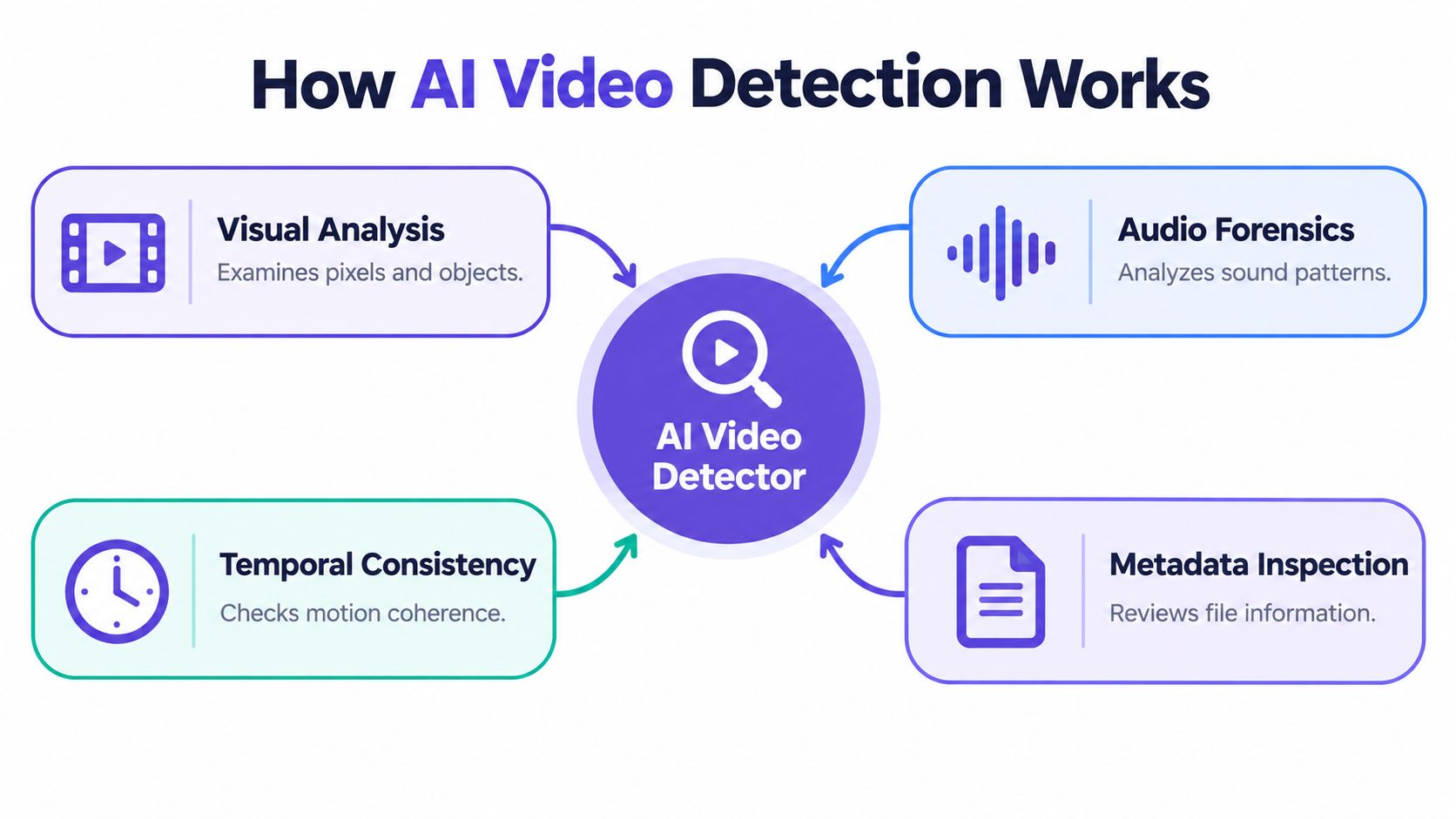
Think of detection as a coordinated investigation rather than a visual spot check. An investigator might examine the recording, interview a witness, and review documentation. A multi-signal detector similarly examines different aspects of the same file before combining its findings.
The analogy has a limit: different checks aren't necessarily independent witnesses. They may share training data or react to the same compression damage. More signals can broaden coverage without guaranteeing correctness.
The diagram summarizes the main analytical branches.
From an uploaded file to an assessment
A useful way to understand the workflow is to follow the file through successive stages:
- Prepare the material: Decode the video, identify available audio, and inspect accessible file information. Record any processing failures rather than treating missing evidence as a clean result.
- Analyze separate channels: Examine image content, sound, changes over time, and metadata. A silent clip should receive different treatment from a clip whose audio passed analysis.
- Combine the findings: Apply a fusion method that weighs the available evidence. A system shouldn't treat every anomaly as equally meaningful.
- Report the assessment: Present the result alongside limitations, unavailable checks, and any segments requiring human review.
Suppose, hypothetically, that a speaker's face appears normal in individual frames but changes unnaturally during a turn. A still-image check might find little, while a motion-focused check could identify a reason for closer inspection. Conversely, ordinary video damage could explain an isolated visual anomaly.
Agreement isn't the same as certainty
The important design question is how the system handles conflicting evidence. Does it explain disagreement, reduce confidence, or return an inconclusive result? Or does it hide everything behind a single label?
A fake doesn't necessarily have to fool every component to receive a low-risk result. The outcome depends on the fusion rules, thresholds, and missing-data handling. Professionals should therefore ask vendors how their systems combine evidence, not just whether they advertise multiple checks.
The most useful report tells an analyst what happened during analysis. A polished score without that context leaves too much interpretation to the person making the final decision.
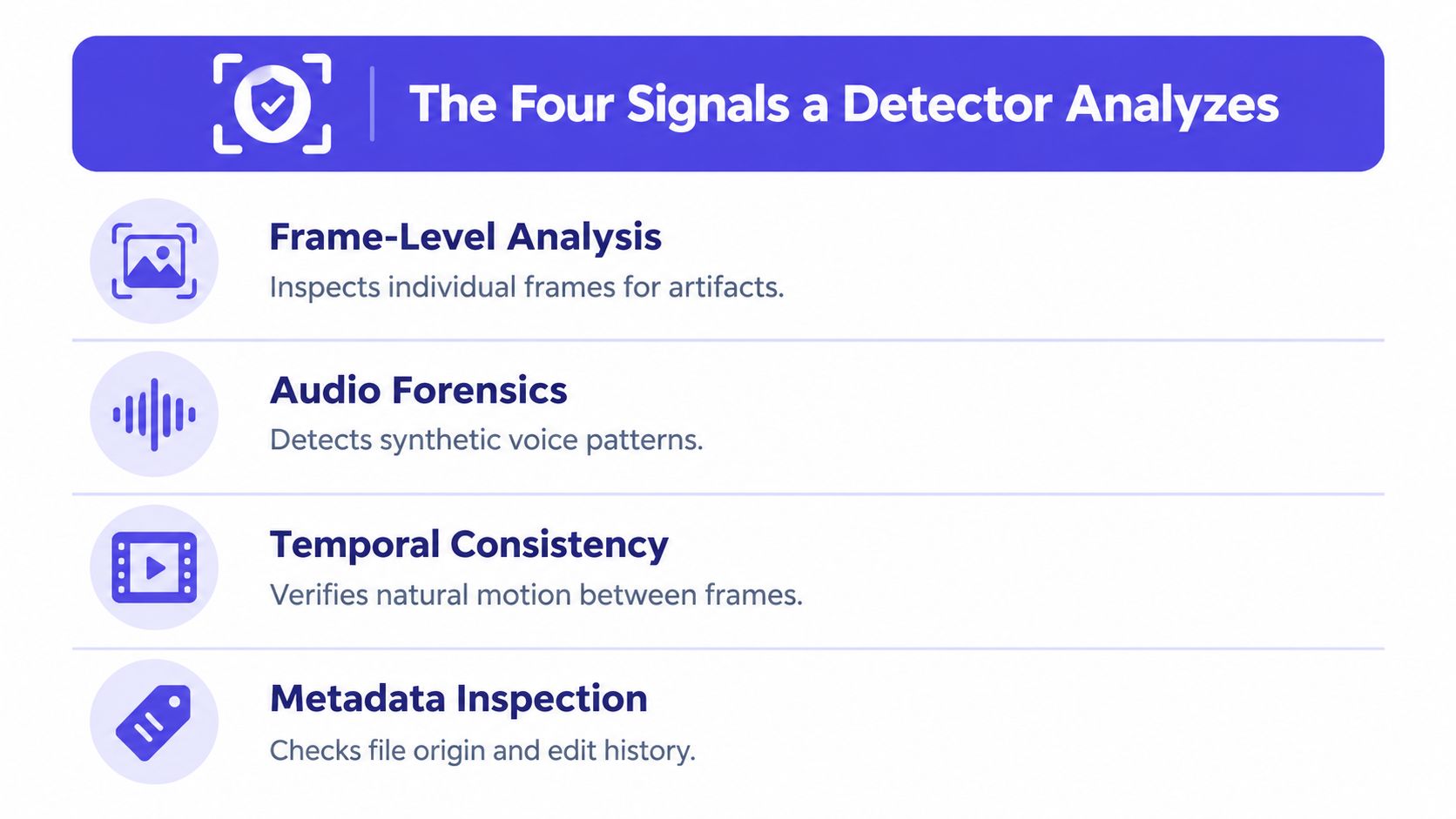
The Four Signals a Detector Analyzes
The signal families below describe different places to look for evidence. They aren't a checklist of defects that every synthetic video must contain, and an unusual feature isn't automatically evidence of fabrication.
This visual separates the main inspection targets.
Frame-level analysis and audio forensics
Frame-level analysis examines individual images for spatial evidence of manipulation. Depending on its design, a detector may seek generator-specific patterns, sometimes described as GAN fingerprints or diffusion artifacts. These are learned forensic features, not necessarily defects a reviewer can see unaided.
For example, an analyst might investigate an unstable boundary around a face. But sharpening, lighting, or ordinary editing could offer alternative explanations. The task is to assess the pattern in context, not declare every strange pixel synthetic.
Audio forensics examines the soundtrack for signs of voice generation or alteration. A system might analyze spectral patterns, while a reviewer listens for unusual transitions or phrasing. Missing breaths alone shouldn't establish a synthetic voice, because editing and audio cleanup are plausible alternatives.
Temporal consistency and metadata inspection
A convincing frame can still belong to an inconsistent sequence. Temporal analysis examines changes across frames, including motion, facial identity, and transitions. A hypothetical face that changes shape during a head turn warrants investigation, but blur and frame conversion should also be considered.
Metadata inspection examines available file information and encoding history. An unexpected editing application or encoding pattern may help reconstruct a file's journey. It doesn't prove deception, and absent metadata doesn't prove anything by itself.
The following video provides accompanying visual material for considering these checks.
Why compression belongs in testing
Compression matters because it can erase or distort forensic traces. FaceForensics++ tests DeepFakes, Face2Face, FaceSwap, and NeuralTextures using more than 1.8 million manipulated images derived from 1,000 original video sequences, including different compression levels, as described in the FaceForensics++ benchmark paper.
That design supports an important evaluation principle: test manipulation methods and compression conditions separately. An aggregate result can hide weaknesses in a particular combination.
For a professional reviewing a detector report, the practical vocabulary is straightforward:
- Spatial evidence: What looks anomalous within an image?
- Audio evidence: What sounds or measures as anomalous in the soundtrack?
- Temporal evidence: What changes inconsistently over time?
- File evidence: What can the available technical history establish?
Each answer needs an alternative-explanation check.
Accuracy Limits and Real-World Performance
A laboratory result describes performance under particular test conditions. It doesn't establish how a detector will handle your organization's incoming footage.
The central risk is distribution shift: the material you submit differs from the material used to develop or evaluate the model. A detector tested on well-lit, frontal faces may encounter screen recordings, obscured subjects, unfamiliar generators, or footage with no prominent face at all.
What benchmark results actually measure
A real-world benchmark using political deepfakes reported maximum AUC values of 73.67% for video and 74.78% for images, documenting a gap from stronger results commonly reported on curated datasets in its evaluation of political deepfake detection.
AUC measures ranking quality across possible thresholds. It isn't the percentage of individual files classified correctly, and it isn't the probability that a particular clip is fake. A detector can rank suspicious material reasonably well yet still make unacceptable errors at the threshold an organization selects.
Laboratory vs Real-World Detection Performance
| Setting | Reported Performance | Key Limitation |
|---|---|---|
| Curated laboratory evaluation | Specific to the dataset, model, and test conditions | May not represent incoming operational footage |
| Political deepfake evaluation | The cited evaluation reported weaker ranking performance than common curated benchmarks | Results still describe that evaluation, not every professional setting |
| Local operational validation | Must be measured on representative organizational material | Requires reliable labels and a defined decision policy |
A confidence score needs a definition
A confidence score might be a model output, a transformed classifier score, or a calibrated probability estimate. Those aren't equivalent. Ask what the value means before translating it into language such as “almost certainly manipulated.”
Calibration concerns whether predicted confidence corresponds to observed outcomes on comparable material. The distinction between ranking and confidence calibration matters because a confident error can look more actionable than a cautious, better-grounded result.
A high score is a statement from a model. Its reliability depends on evidence from comparable cases.
An operating threshold determines when a score triggers action. A lower escalation threshold may suit an internal review queue, where false alarms cost analyst time. A public accusation requires a much more demanding evidentiary process.
Don't force every file into a binary decision. An inconclusive category lets reviewers request better material or specialist analysis. That's particularly useful when essential signals are missing or the file falls outside the detector's validated scope.
Privacy Safeguards and Regulatory Context
Before uploading footage, ask a question that's independent of detection accuracy: Are you authorized to disclose this file to this service?
A confidential interview, internal board recording, or investigative video may expose sensitive information even if the detector never produces a useful result. Choosing a service therefore requires a data-handling review, not just an accuracy comparison.
Reviewing the service's policies should happen before uploading sensitive material.

Treat privacy promises as questions to verify
A privacy-first workflow should minimize unnecessary disclosure and retention. “No signup” may reduce friction, but it doesn't establish confidential processing. Likewise, a deletion claim needs a clear explanation of what happens to temporary files, extracted frames, audio, logs, and backups.
Use a video privacy protection checklist to structure your review:
- Retention: Does the policy cover uploaded files and derived material?
- Secondary use: Can the provider use submissions for training or product development?
- Access: Who can inspect the material, including subprocessors?
- Deployment: Can sensitive footage remain within an approved environment?
- Documentation: Can your team retain the necessary audit record without keeping unnecessary copies?
These are procurement and governance questions. They shouldn't be replaced by assumptions about what a free or accountless service does.
Transparency requirements are becoming formal obligations
The European Parliament adopted the EU Artificial Intelligence Act in March 2024. Article 50 requires providers of systems generating synthetic video to support machine-readable marking and detectability, while deployers of deepfakes must clearly disclose their artificial nature no later than first exposure; the transparency provisions are scheduled to apply in August 2026, according to the European Commission's Article 50 guidance.
The guidance recognizes technical approaches including metadata, frequency-based methods, cryptographic techniques, and statistical watermarking. It also describes limited exceptions for legally authorized criminal-law activities.
That framework does not mean every organization must purchase a detector, or that a detector score satisfies its legal obligations. Marking, disclosure, provenance, and independent analysis perform different functions.
Organizations should assess applicable duties with appropriate legal advice. Privacy safeguards remain a separate requirement in the selection process: a tool used to investigate deception shouldn't introduce an avoidable confidentiality problem.
Practical Use Cases Across Professions
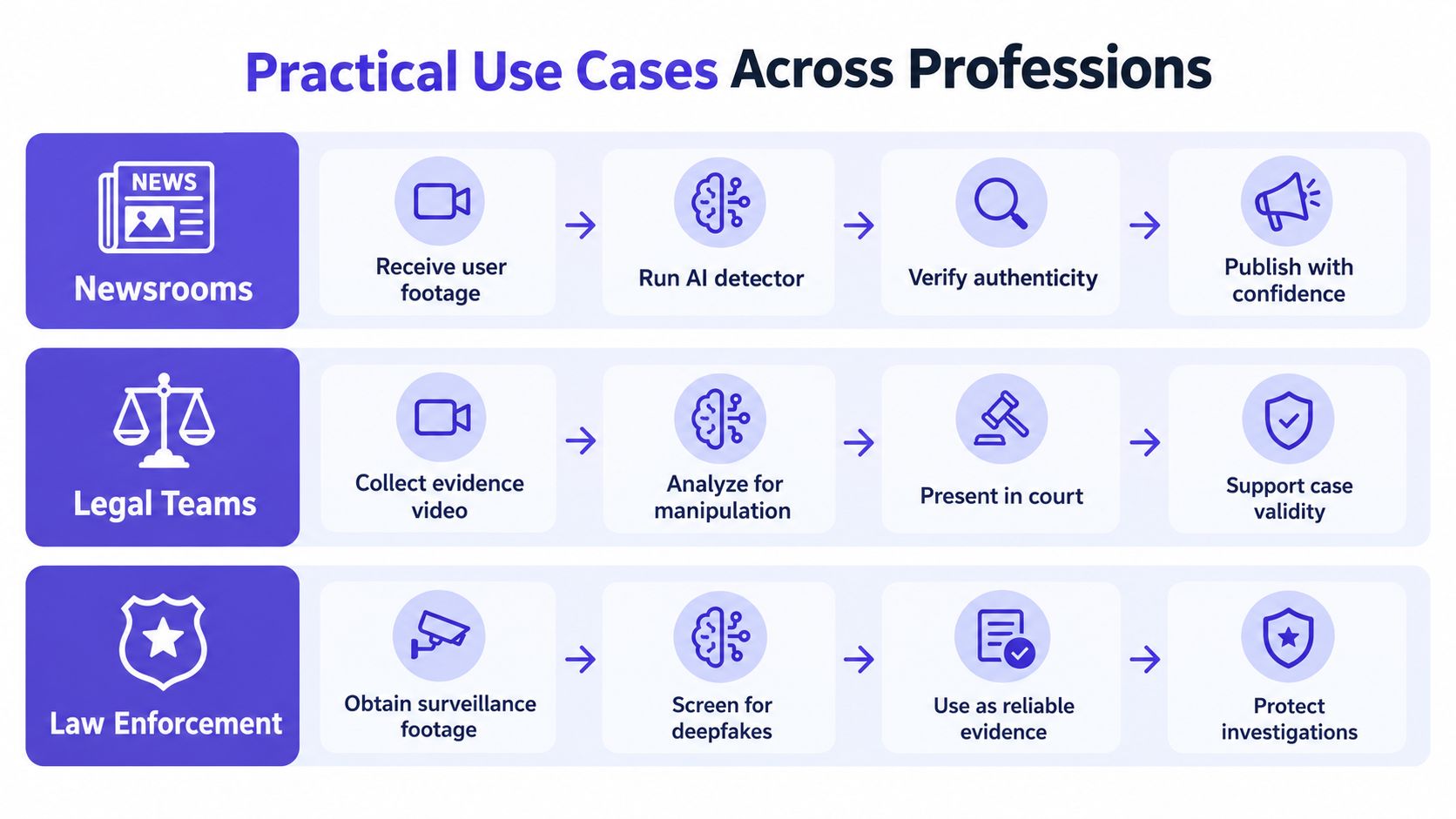
The following scenarios are hypothetical workflows, not reported customer outcomes. Their common feature is a consequential decision that needs more support than visual familiarity.
The infographic shows where detection can enter professional review. Its endpoints should be understood as goals requiring corroboration, not outcomes a detector guarantees.
Newsrooms and public-facing content
A reporter receives a clip apparently showing an official announcing an evacuation. The detection result helps the editor decide whether to hold the clip for deeper review. The reporting team still needs to contact the relevant authority and establish where the recording originated.
A platform moderator faces a different decision. A suspicious celebrity endorsement might justify escalation under the platform's review policy. Publicly labeling a named person's content fraudulent requires a separate assessment of evidence and policy.
For creators, the important distinction is between synthetic content and undisclosed impersonation. An educational reconstruction shouldn't be handled as though its artificial origin automatically establishes harmful intent.
Legal work and enterprise security
A legal team receives a disputed recording. Counsel should preserve the original and document how a working copy was analyzed. A specialist may then examine the flagged segments and explain both the findings and their limitations.
Evidence-handling principle: Preserve what you received before creating an analytical copy.
In an enterprise scenario, a finance employee receives a video message apparently approving an unusual payment. Detection may help prioritize the incident, but the safer control is to verify authorization through an established, separate channel. The employee shouldn't wait for a model to decide whether an unfamiliar payment request deserves scrutiny.
Live impersonation adds another requirement: confirm whether the selected system supports live analysis. A tool that accepts recordings shouldn't be assumed to protect an ongoing call.
Education and internal training
An instructor reviewing a suspicious lecture excerpt needs to distinguish the speaker's identity from the accuracy of the lesson. A synthetic presenter can explain a subject correctly; an authentic speaker can make an incorrect claim.
The instructor might compare the clip with the institution's original material and ask the purported speaker to confirm it. Detection informs that inquiry without replacing academic review.
Across these scenarios, speed is useful for triage. A prompt warning can help a team pause distribution or action while it verifies the underlying claim. Faster processing doesn't justify skipping the human decision controls appropriate to the stakes.
How to Evaluate and Use a Detector Responsibly
Choose a detector by examining its evidence, not its most prominent accuracy claim. Ask for evaluations that resemble your footage, explanations of failure conditions, and a documented process for handling uncertain results.
A review described in the assessment of detection reliability and reporting practices found performance declines of 11–44% on out-of-distribution data; only 40% of reviewed studies reported stratified false-positive and false-negative rates, and none supplied confidence intervals for error rates. Those findings make detailed evaluation reporting a practical selection criterion.
Match the tool to the decision
For uploaded-file screening, AI Video Detector is one option that combines frame, audio, temporal, and metadata analysis. Other approaches include specialist forensic review and provenance inspection. Select the approach according to the question you need answered, rather than assuming these methods are substitutes.
Ask prospective providers for:
- Relevant validation: Results separated by manipulation family, compression condition, and other important characteristics of your workload.
- Error reporting: False-positive and false-negative rates at the threshold you intend to use, with uncertainty estimates.
- Operational transparency: Clear descriptions of missing signals, unsupported material, model versions, and inconclusive outcomes.
- Privacy documentation: Written handling terms that your organization can approve.
Establish an escalation procedure
Request the original upload when a repost is the only available copy, important file information is absent, or the result conflicts with other evidence. Preserve the submitted version too, so reviewers can distinguish the original evidence from later analytical material.
Define what each outcome permits. A suspicious result might justify internal escalation, but not public attribution. A low-risk result shouldn't automatically authorize publication, payment, or evidentiary acceptance.
Record the file analyzed, tool version, findings, limitations, and reviewer's decision. Treat the result as an investigative lead unless independent evidence supports a stronger conclusion.
Before your next high-stakes video review, write a short verification procedure: identify who preserves the original, which services are approved, what triggers specialist review, and who authorizes the final action. Test that procedure on material your team is permitted to analyze, then use detection to support a documented decision rather than replace one.


