

AI Misinformation: How Fakes Spread and How to Spot Them

45% of responses from four major AI assistants contained at least one significant problem when representing news, according to a study by 22 public-service media organizations reported by DW. That reframes AI misinformation: the problem isn't just a convincing fake video. It's also an ordinary answer that sounds helpful but gets something important wrong.
The practical question isn't whether AI made something. It's whether the information deserves your trust, what evidence supports it, and what you should check before acting on it.
What AI Misinformation Is and Why It Spreads Faster
A European Parliament briefing contrasts approximately 500,000 deepfakes expected in circulation in 2023 with a projection of 8 million in 2025, and cites evidence that IT experts incorrectly judged 62% of AI-generated content to be human-created. The circulation figures are estimates and projections, not a verified count of every file online. Even with that qualification, they illustrate the shift from specialized demonstrations toward a high-volume verification problem.
AI misinformation is false or misleading information made or amplified using AI tools. It can appear as synthetic speech, manipulated footage, generated photographs, coordinated messages, or incorrect chatbot answers. Deliberate deception is often called disinformation, but a mistake can mislead people without anyone intending harm.
The scale shift is easier to understand visually.
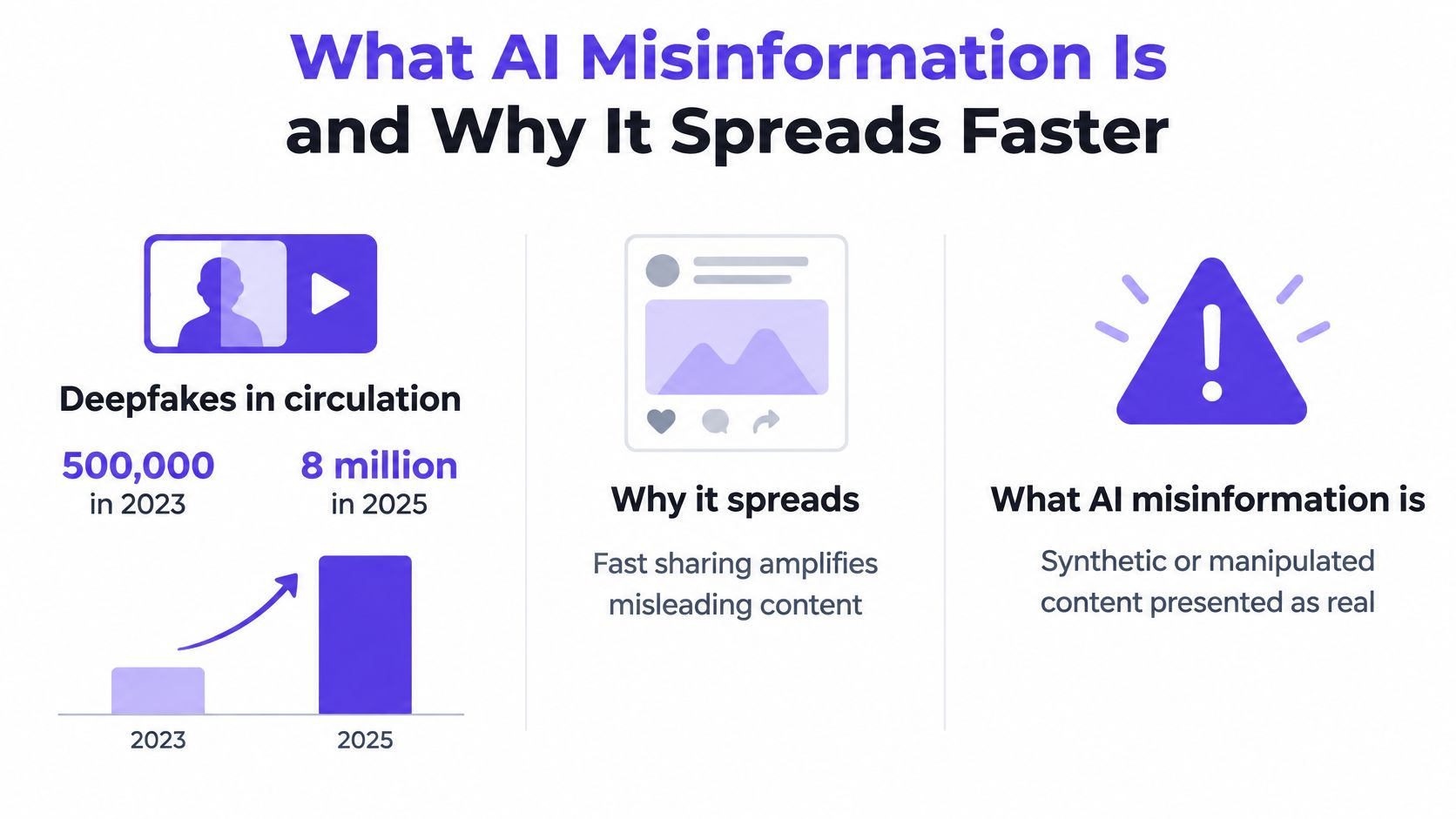
Production gets easier while verification still takes work
Generative AI works like a printing press for forgeries. Creating another version becomes inexpensive, but checking its origin still requires someone to investigate.
Several mechanisms matter:
- Cheap production: A person can generate variations of a message, image, or recording without rebuilding each one manually.
- Fast repost loops: Users can copy a file, remove its original context, and introduce it to another audience before anyone finishes checking it.
- Unreliable visual judgment: Realistic appearances can persuade viewers even when the underlying event never happened.
For practical purposes, distinguish synthetic media, targeted narratives, and factual errors from AI systems. Synthetic media raises questions about how a file was created. Targeted narratives raise questions about who is pushing a claim and why. Factual errors require checking the answer against reliable evidence.
These categories call for different investigations. A fabricated voice recording needs audio and source checks; an incorrect public-service deadline needs an authoritative document.
Practical rule: Treat your first impression as a starting point, not an authenticity test.
A verification process settles questions more reliably than confidence, familiarity, or a convincing face.
Types of AI Misinformation and How to Recognize Each
| Type | What It Looks Like | Warning Sign | First Check |
|---|---|---|---|
| Deepfake video | Face or voice swapped onto real footage | Unnatural blinking, lip-sync drift, edge flicker | Reverse image search keyframes and find the original upload |
| Cloned voice audio | Synthetic speech in a clip, voicemail, or call | Flat breath patterns, odd room tone, unusual spectral patterns visible in analysis | Confirm the speaker through a separate known channel |
| AI-generated image | Fully synthetic photo or scene | Garbled text, mismatched hands, inconsistent reflections | Check the earliest appearance and the source account |
| Targeted narrative | Coordinated posts pushing a false claim | New accounts, identical wording, rapid repost bursts | Map who posted first and review account history |
| Authentic clip, false caption | Real footage with a misleading date, place, or claim | Caption cannot be matched to the footage | Trace the original recording date and location |
| Chatbot factual error | Confident answer that's outdated or wrong | Deadlines, addresses, or rules don't match official sites | Compare against the primary government or organization source |
These categories overlap. Someone can attach a false caption to genuine footage, then distribute it through accounts that repeat identical wording. A deepfake can also contain an accurate statement, so identifying synthetic content doesn't automatically establish that every associated claim is false.
Visible irregularities are investigative clues, not verdicts. Blinking and lip movement can look strange because of editing or poor playback. A distorted hand might suggest generation, but motion blur can also make a real hand look implausible.
Start with inexpensive checks
Before examining pixels or buying forensic software, investigate the material's history:
- Search keyframes: Pause on a distinctive scene and use Google Lens or another reverse image search service to look for earlier appearances.
- Find the earliest upload: Follow reposts toward the original account rather than trusting the most popular copy.
- Compare official channels: Look for the same statement on the speaker's established website or verified organizational account.
- Read account history: Examine whether the first posters have a consistent identity and relevant previous activity.
Suppose a real protest video appears with a caption claiming it happened this morning. An older upload showing the same signs, camera movement, and crowd sequence would undermine that date claim. You wouldn't need to prove the video was generated, because the deception concerns its context.
Chatbot answers need a different habit: someone must take responsibility for checking consequential claims. SupportGPT's discussion of human oversight for trustworthy AI is useful context for designing that review rather than leaving verification to another automated response.
The governing distinction is between a reason to investigate and evidence sufficient to conclude. A warning sign gives you the former. Establishing fabrication requires more.
Why Reach Matters More Than the Number of Fakes
A review of election-related synthetic media cites 78 documented deepfakes worldwide during the 2024 election cycle, while an International Panel on the Information Environment project identified 215 examples of AI-generated deepfake electoral disinformation across 50 countries holding competitive national elections. Different definitions, collection methods, and geographic coverage explain why those totals differ. They aren't competing measurements of an identical collection.
Neither total, by itself, tells you how many people believed a claim or changed their behavior. A file count measures the material collected, not its reach, credibility, or consequences.
Follow the route to the audience
Consider a hypothetical candidate clip posted shortly before voting ends. The initial post describes it as eyewitness evidence; coordinated accounts reproduce it, and a familiar community account shares it without qualification. A newsroom encountering the clip has to investigate while those reposts continue.
The timing matters because a convincing clip released near a decision can be more consequential than a large collection that nobody sees. Authentication should therefore follow the developing audience, not merely the upload queue.
Three amplifiers deserve attention:
- Repetition: Viewers encounter the same allegation through apparently separate posts and may mistake familiarity for confirmation.
- Recommendations: Platform systems can put similar material in front of people who already engage with related topics.
- Trusted messengers: A recognizable colleague, local organizer, or creator can lend credibility to a file they haven't authenticated.
A repost can also remove caution. An original upload might describe a clip as unconfirmed, while later copies omit that qualification. By the time a journalist sees it, the most widely circulated caption may sound much more certain than the earliest account.
A file's importance depends on who encounters it, when they encounter it, and what they're being asked to believe.
Match the response to the distribution
For newsrooms, the useful record includes the earliest known post, influential reposters, caption changes, and the communities receiving the claim. Moderators can use that record to decide where contextual notices or review will be most useful, a practical concern in social media moderation.
An authentication result attached only to an obscure original post won't necessarily reach people watching a popular copy. Corrections should address the actual claim circulating with those copies, not just announce that a file was investigated.
The working rule is to time authentication to the spread window. Track who reposted the material and how its description changed, alongside any technical analysis of the file itself.
When Chatbot Answers Become Misinformation
In October 2026 testing reported by NPR, 13.9% of chatbot answers to voting-logistics questions were outdated or inaccurate, and 5.9% could plausibly cause a voter to miss a deadline, visit the wrong polling place, or skip a required step. Separately, NewsGuard's April 2025 audit found that leading generative AI tools repeated false claims in 28.18% of tested responses across 11 tools. These tests concern different tasks and samples, so their percentages shouldn't be combined into a universal chatbot error rate.
An incorrect answer doesn't need visual trickery to cause harm. It may be a neatly formatted explanation about voting, medication, a tax obligation, or a public service. Fluency makes the reply easy to understand, but doesn't establish that its instructions are current or applicable to your location.
Verify the actionable claim
Use this sequence before relying on an answer with practical consequences:
- Copy the exact claim. Preserve the deadline, address, eligibility condition, or rule as written. Checking a vague summary makes it easy to overlook the part that's wrong.
- Open the primary source. Use the responsible election office, health agency, statute, regulator, or service provider rather than another chatbot. A second fluent answer isn't independent confirmation.
- Match the details. Compare each number and proper name with the authoritative page, including the jurisdiction and effective date. Note missing exceptions rather than assuming they don't matter.
- Resolve disagreement before sharing. If the sources conflict or the page predates the claimed change, pause and contact the responsible office through its established contact details.
Suppose a chatbot gives you a registration deadline without naming the jurisdiction. Even if that deadline is correct somewhere, it hasn't answered your question reliably. Local applicability is part of accuracy, not an optional extra.
Read error rates with their scope intact
When you explore AI chatbot data through Statlyst, distinguish adoption figures from evaluations of factual reliability. A widely used system isn't necessarily reliable for a particular legal rule, local service, or changing deadline.
Measured errors in ordinary answers provide a better reason to verify routine AI replies than spectacular examples alone. Prioritize claims where being wrong could change someone's access, money, health, rights, or next action.
Why Detectors Fail on Real-World Misinformation
On the Deepfake-Eval-2024 benchmark, open-source state-of-the-art detectors suffered approximately 50% relative AUC reductions for video, 48% for audio, and 45% for images compared with earlier benchmarks, using material comprising 45 hours of video, 56.5 hours of audio, and 1,975 images from 88 websites in 52 languages. Those are relative changes in a discrimination metric, not percentage-point drops in accuracy.
AUC summarizes how well a detector separates authentic and manipulated examples across decision thresholds. It isn't the probability that a particular uploaded file is fake. A strong AUC on familiar material also doesn't establish that a detector will recognize a new generation technique.
Why familiar patterns disappear
The central problem is distribution shift: the material a detector encounters differs from what it learned during training. Recompression, re-encoding, resizing, multilingual speech, and unfamiliar generators can change the signals it relies on.
Think of a person trained to recognize photocopies by a particular printer's streaks. They may perform well until someone changes the printer or photographs the page. Recognizing a production artifact isn't the same as understanding every possible forgery.
| Signal | What It Detects | Where It Breaks |
|---|---|---|
| Frame-level artifacts | GAN fingerprints and diffusion traces | Recompression and cropping can erase or weaken traces |
| Audio spectral analysis | Synthetic voice spectral patterns | Noisy phone recordings and multilingual speech complicate interpretation |
| Temporal consistency | Motion flicker and frame-to-frame jumps | Low frame rates and screen recordings can conceal flicker |
| Metadata inspection | Encoding irregularities and missing fields | Platforms may strip metadata on upload |
These signals answer different questions. Agreement among them can strengthen an assessment, but only if they're meaningfully independent. Several detectors trained on similar examples may repeat the same mistake.
A laboratory score isn't a deployment guarantee
DeepfakeBench evaluated 15 detectors across nine datasets, with several systems achieving average within-domain AUC values around 93.9% to 95.4%, while cross-domain performance declined; increasing training frames improved or plateaued within-domain results but reduced cross-domain performance. The contrast matters because additional exposure to familiar examples can improve recognition of that environment without improving recognition elsewhere.
For a newsroom or fraud team, evaluation should resemble deployment. Test on material collected after the training period, include unfamiliar generators, and reproduce the transformations files undergo on the platforms you monitor.
- Measure false positives: Include authentic footage with difficult lighting, heavy compression, dubbing, and ordinary edits.
- Preserve uncertainty: Ask whether the score is calibrated and whether the system can abstain when the input is unsuitable.
- Review performance over time: Reassess after new generators or distribution formats appear, rather than treating a launch benchmark as permanent.
A detector can help prioritize investigation. It can't establish who recorded an event, whether a caption is accurate, or whether a technically authentic clip has been selectively edited.
Use the score as evidence about the file, not as a complete authenticity verdict. High-stakes decisions need source checks and a human review path, especially when technical signals conflict.
What Content Credentials Can and Cannot Prove
Content credentials are signed records that can document a file's origin and editing history. They help establish traceability when the record survives and its signatures validate. They're closer to a documented handling history than a certificate that everything depicted is true.
A credential display can make that history easier to inspect.

According to the Brennan Center's assessment, California's AI Transparency Act began requiring provenance data and public detection tools in August 2026, but follow-up testing found little improvement, with most tested chatbots still failing to identify AI-generated images. A system that recognizes an embedded label hasn't necessarily demonstrated that it can identify an otherwise equivalent unlabeled file.
Absence of a credential doesn't prove a file is fake or authentic. Presence of a credential doesn't prove the accompanying claim is true.
Separate missing history from false context
Different obstacles require different interpretations:
- Stripped metadata: A platform may remove embedded information, leaving an incomplete history rather than evidence of fabrication.
- Recompression and screen recordings: A new copy may no longer carry the original credential.
- Edited real footage: A valid history may document changes without establishing whether the selection is fair.
- False captions: An authentic image can still be assigned the wrong location, date, or explanation.
The following video provides additional context for thinking about authenticity checks.
A useful content authenticity assessment separates two outputs: confidence about the file's production history and confidence about its claimed context. Independent frame, audio, temporal, and metadata signals inform the former; external evidence establishes when, where, and what it depicts.
That distinction protects against both kinds of error. False positives can cause genuine evidence or journalism to be rejected. False negatives can allow fabricated material to pass unchecked. Neither risk is solved by replacing uncertainty with a simple label.
How Newsrooms Verify Suspect Footage Step by Step
A defensible verification process creates a record another editor can inspect. It should preserve the evidence, document uncertainties, and explain why publication is justified or why the footage remains unverified.
This overview highlights the handling and context checks that support the full procedure.
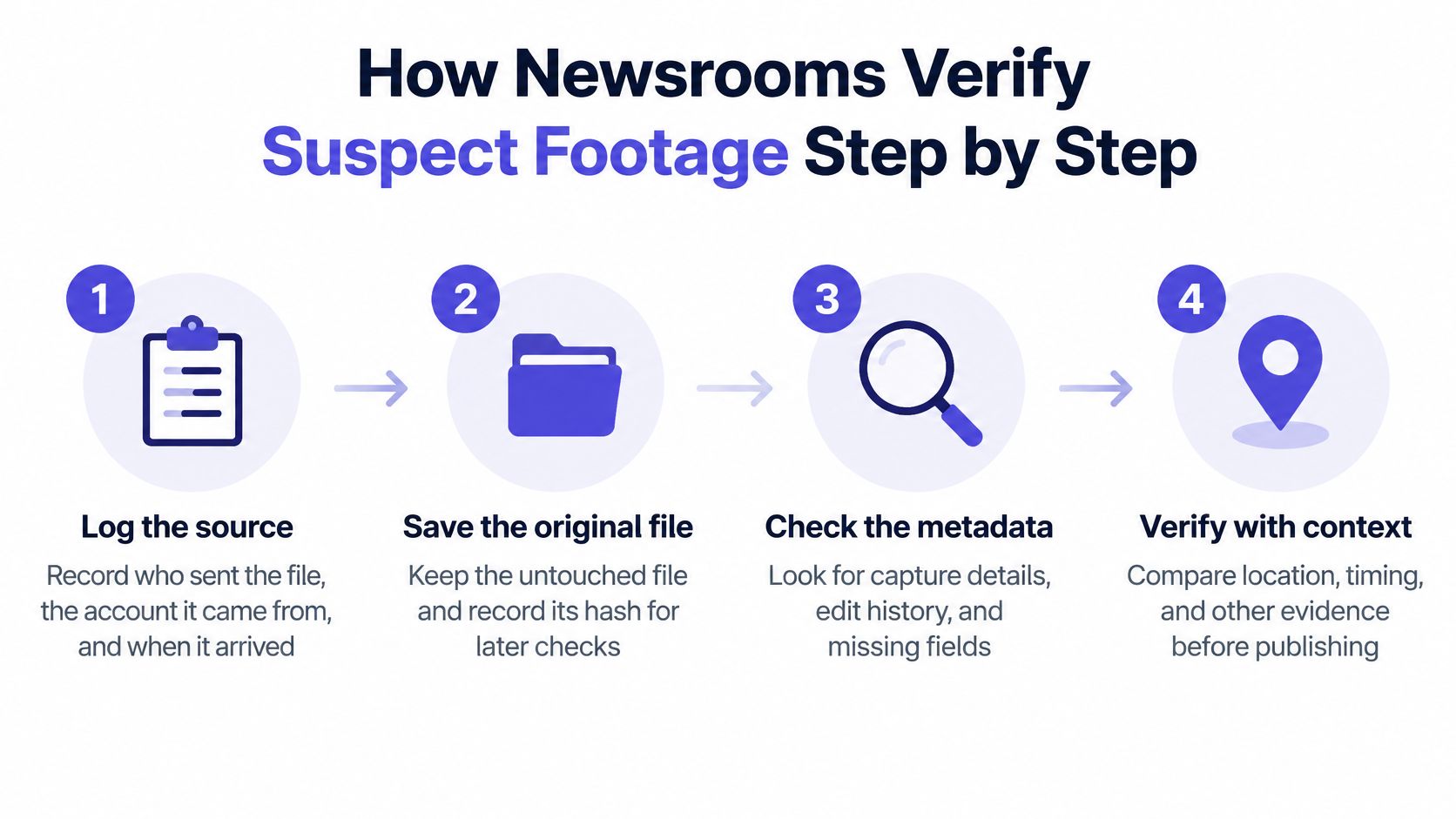
Preserve first, investigate second
Log the source. Record who supplied the file, the account or channel it came through, and when it arrived. Keep the sender's original description separate from facts your team has independently established, so an allegation doesn't become an editorial conclusion.
Save the untouched file and record its hash. Preserve the original separately from working copies and calculate a cryptographic hash, such as SHA-256, using an approved local utility. The hash lets you detect later changes to that exact file; it doesn't prove the recording itself is genuine.
Extract keyframes and search for earlier appearances. Use VLC or FFmpeg to capture distinctive frames, then reverse image search them and compare any matches with the full sequence. Record earlier upload locations and inspect available metadata, because an older matching recording may resolve the central question without further forensic work.
Run a detector and document its limits. Record the tool, analysis date, input version, score, and any confidence range it provides. If no validated range is available, say so rather than inventing one or treating the score as a calibrated probability.
AI Video Detector is an optional file-level signal for examining frames, audio, temporal consistency, and metadata. Log its assessment alongside the other evidence, including any supplied confidence range and unresolved limitations, rather than presenting the product's output as the publication verdict.
Test the recording against the world
Examine the audio separately. Listen for abrupt room-tone changes, inconsistent reverberation, and voice characteristics that warrant closer review, while allowing for ordinary edits or poor transmission. Isolate Audio's deepfake detection guide provides useful context for this part of the investigation; confirm consequential statements through a separately established contact channel.
Verify when, where, and what the footage shows. Match landmarks and road layouts, compare weather and shadows with the claimed circumstances, and check the event against independent reporting. Treat each match as supporting evidence rather than assuming a recognizable building establishes the recording date or the speaker's claim.
Seek independent corroboration and editorial review. Contact another source with direct knowledge, then escalate unresolved technical questions to a qualified analyst and the publication decision to a human editor. If important signals conflict, describe the footage as unverified and explain what's missing instead of forcing a real-or-fake conclusion.
A completed check is a written case record: the preserved file, source trail, search results, technical findings, uncertainty assessment, and publication decision. Use a consistent breaking-news verification workflow so another editor can distinguish observed facts from assumptions under deadline pressure.
Before sharing your next consequential AI answer or suspect clip, preserve the original, identify its central claim, and check that claim against independent evidence. For footage, add our file-level analysis where appropriate, then record what you know, what remains uncertain, and who approved the next action. Publish only what the evidence supports.


