

Social Media Moderation in 2026: How It Actually Works

You're watching a short video of a chief executive announcing an urgent payment. The voice sounds right, the face moves naturally, and colleagues are already sharing it. Then someone asks the question that changes everything. Is it real, and what should you do before you forward, publish, or act on it?
That's the everyday problem behind social media moderation in 2026. Teams can't treat every post as a simple yes or no. They have to weigh evidence, decide how confident they are, limit harm while they check, and leave a record the creator can challenge.
A Day in the Life of a Modern Moderation Team
The shift starts with three screens. One shows queues filling faster than anyone could review by hand. Another tracks that CEO impersonation video spreading across regions. A third holds a support ticket from a creator whose documentary clip was removed and who wants to know why.
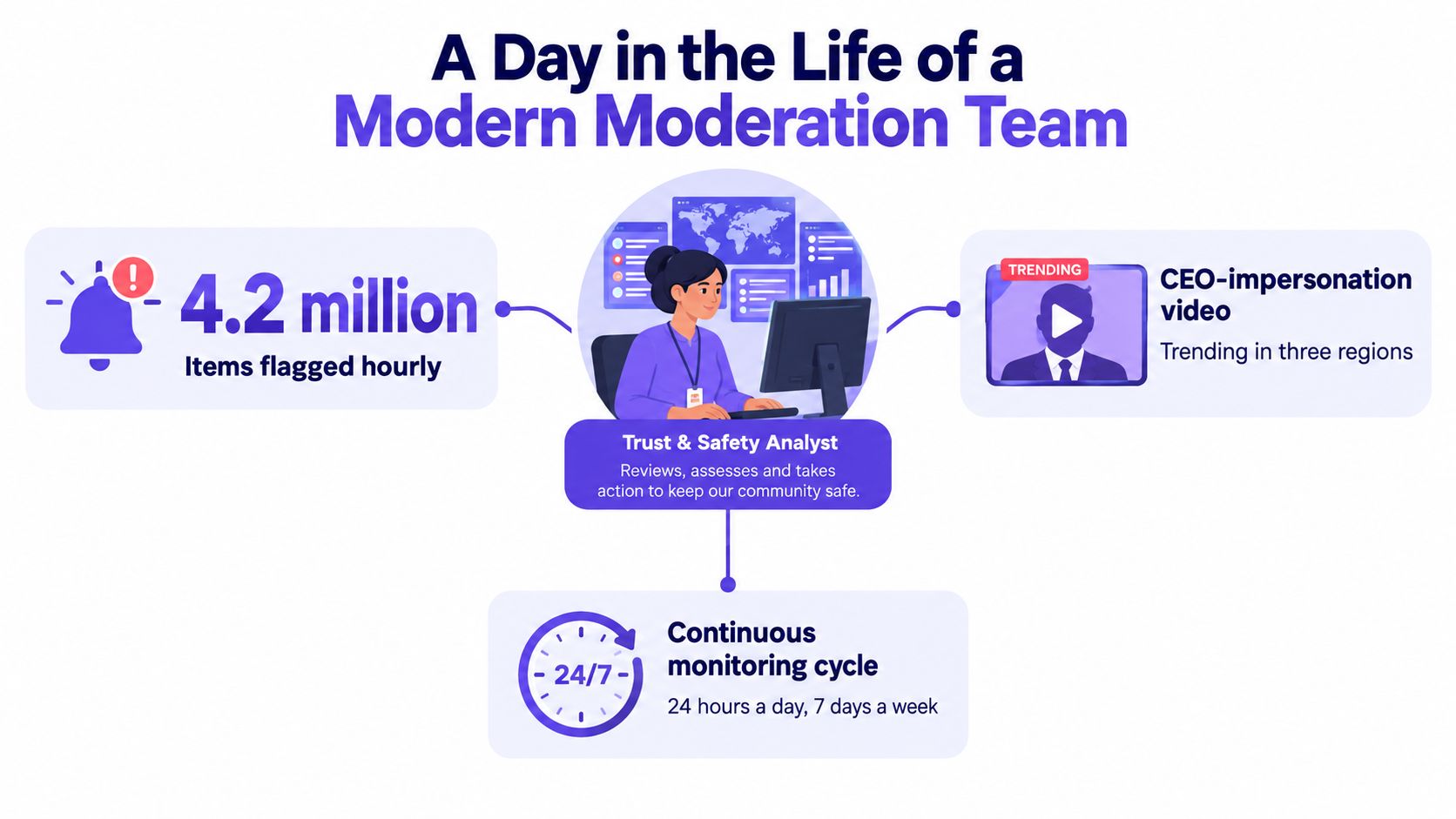
The analyst isn't asking only whether a rule was broken. She's asking how strong the signal is, how much harm could happen in the next hour, and whether removing the file would destroy evidence a journalist or investigator needs. A clear scam can be stopped fast. A borderline political parody needs context before anyone acts.
Four Jobs at Once
- Stop harm quickly: Pause distribution of likely scams, abuse, or dangerous instructions while review continues.
- Protect context and evidence: Preserve the original file, uploader details, and timestamps instead of deleting first and asking later.
- Treat creators fairly: Give a specific reason for action and a route to appeal that a person reads.
- Stay accountable: Log the model, policy, and reviewer decision so patterns can be audited later.
The scale explains why automation comes first. To take one reported example, TikTok removed more than 22 million pieces of content in the EU in the first half of 2024 and banned more than 5 million accounts. No human team reads that volume unaided, and no responsible team lets a score make every final call either.
Think of moderation as triage in an emergency room. Speed matters, but the first check sorts urgency. It doesn't replace diagnosis.
By midday, the impersonation clip has split into three decisions. The highest confidence copies are removed, uncertain copies are labeled and demoted, and one news report about the scam stays up. That's confidence-weighted moderation. The outcome matches the evidence instead of pretending every case is equally clear.
What Social Media Moderation Actually Means
Social media moderation is the combined system of policies, tools, and people that decides whether content is allowed, limited, labeled, or removed. It's broader than deletion. A post can stay on a profile but lose recommendation, carry a context label, or sit behind an age gate.
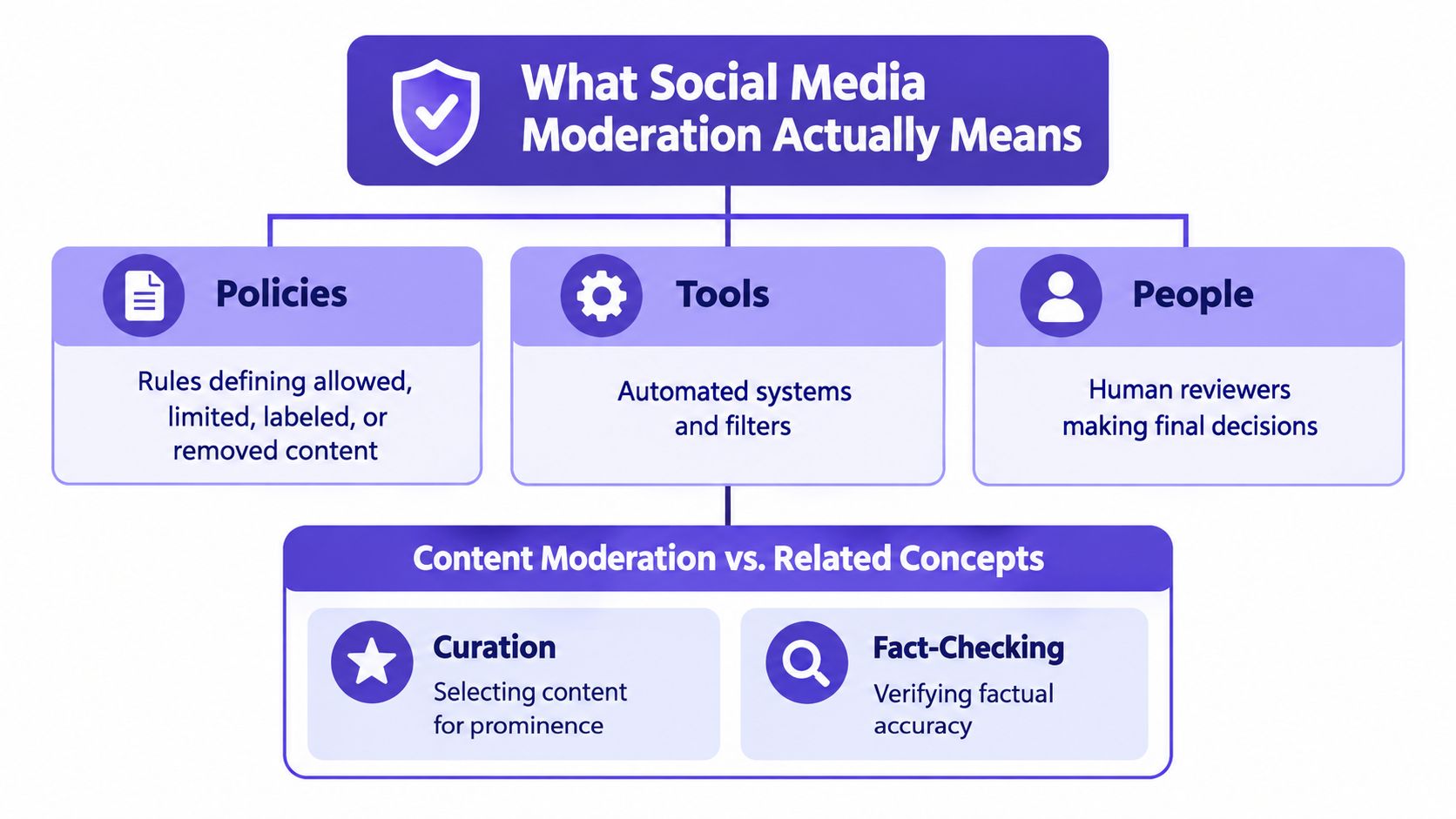
A restaurant kitchen makes the layers easier to remember. Policy is the recipe that defines what's acceptable. Detection is the prep cook sorting ingredients at speed. Human review is the head chef tasting the ambiguous dish. Appeals are the complaint window, where a wrong order can be corrected instead of argued about on the street.
The Four Roles in Every System
First, the rule-setter writes policy in language reviewers and users can apply. "No deceptive impersonation" needs examples for satire, news reporting, and clearly labeled parody. Without those examples, two reviewers will read the same rule differently.
Second, the enforcer finds and acts on content, usually with classifiers, hashes of known material, and user reports. Third, the reviewer handles the cases where context changes the answer. A graphic image in a war documentary isn't the same decision as the same image used to celebrate violence.
Fourth, the explainer tells the user what happened and why. This role gets skipped most often, and it's where trust is lost. "You violated our rules" teaches nothing. A useful notice names the policy, the specific element that triggered it, and how to appeal.
People often confuse moderation with censorship, so let's separate the terms. Platforms publish their own rules and enforce them on their own services. The harder public question isn't whether rules exist. It's whether they're applied consistently, with due process when the platform gets it wrong.
Distribution is the other distinction readers miss. Removing a post answers whether it may exist on the service. Ranking answers how far it travels. Good systems manage both, because an allowed but misleading clip can still cause harm if the recommender pushes it to millions.
The Moderation Pipeline from Signal to Appeal
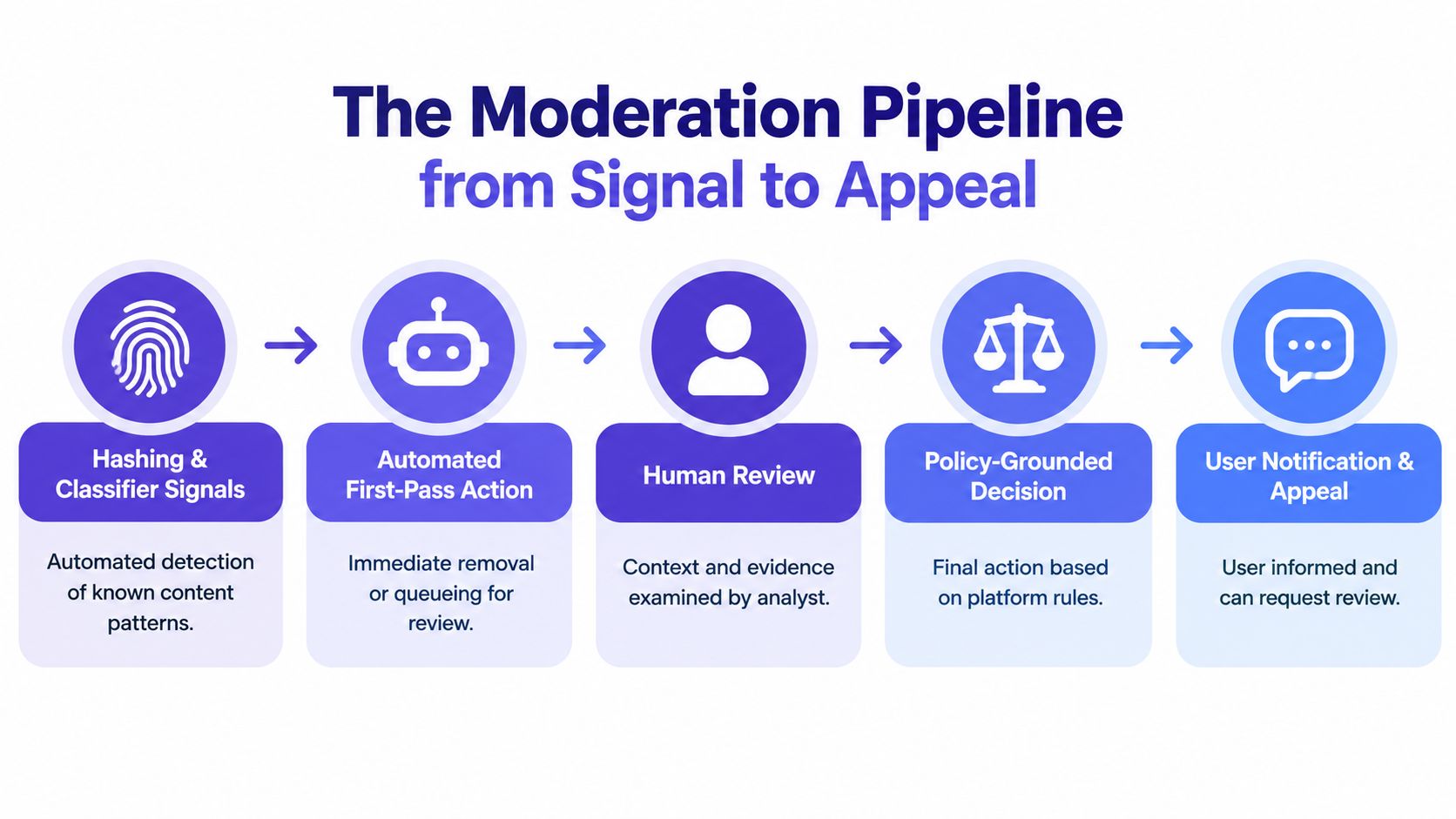
Moderation looks like one judgment from outside. Inside, it's a chain of small handoffs, and each handoff can improve or corrupt the next one. If you can sketch the chain, you can spot where your own process is blind.
From First Signal to First Action
It starts with signals. A hash match says this file resembles known harmful material. A classifier estimates that text, image, audio, or video fits a policy category. A user report adds a claim that still needs checking, because reports can be mistaken or coordinated.
The system then takes a proportionate first step. Very high confidence, severe material may be removed automatically. Everything ambiguous goes to a queue, sometimes with distribution paused. Teams building this stage often study how a content moderation API structures scores and routing decisions so downstream reviewers receive usable evidence, not just a red flag.
What travels with the item matters as much as the score. Reviewers need the content in context, surrounding posts, language, model confidence, detected category, and prior account history where policy allows it. A naked score invites rubber-stamping.
Decision, Notice, and Appeal
The reviewer makes a policy-grounded decision and records the rationale, model version, and decision time. That log is boring until you need it. Then it's the only way to prove what happened, retrain a model, or correct a pattern of errors.
Next comes notification. The user should learn the action taken, the rule applied, and the evidence standard used. If authenticity is uncertain, say so plainly instead of implying certainty you don't have.
Finally, the appeal tests whether the system can admit error. This isn't a courtesy feature. Since EU rules began applying to very large platforms in 2023 to 2024, users have appealed more than 165 million moderation decisions and nearly 30% were reversed. A reversal rate that large tells you initial decisions, human and automated, are fallible by design.
Practical rule: If an appeal can't change the outcome, you don't have an appeal process. You have a mailbox.
The EU framework also created a public database of statements of reasons, so outsiders can examine why content was removed, restricted, or demoted. That transparency turns private disputes into measurable accountability, and it gives smaller teams a model worth copying voluntarily.
Detecting Synthetic and Manipulated Video
Synthetic video breaks the old habit of asking whether content is real or fake. An authentic clip can carry a synthetic voiceover. A real voice can be dubbed onto edited footage. A fully generated scene can also be harmless satire, clearly labeled by its creator.
The screenshot below shows how a dedicated detector presents an authenticity check as evidence for review, rather than as an unexplainable verdict.

Four Signals That Catch Different Problems
- Frame-level analysis: Looks for generation artifacts within individual frames, including patterns left by generative models.
- Audio forensics: Examines the sound track for spectral irregularities that suggest synthesized or spliced speech.
- Temporal consistency: Checks whether movement, lighting, and facial motion stay coherent from frame to frame.
- Metadata inspection: Reviews encoding and file information for inconsistencies with the claimed source.
No single signal settles the case. Compression can mimic an artifact, and a clean metadata record proves little once a file has been re-uploaded through several apps. Reviewers should ask whether independent signals point the same way, which is the core idea explained in this overview of how an AI video detector combines multimodal evidence.
Take the worked example that confuses teams most. The footage is genuine protest video, but someone has replaced the chanting with a synthetic voice making a threat. Visual checks pass, audio checks fail, and the caption presents the result as unedited. Calling the whole file fake is inaccurate. Calling it authentic is worse.
That's why graduated outcomes work better than a binary label. Use verified authentic, likely manipulated, inconclusive, and contextually misleading. The protest clip is likely manipulated in audio and misleading in presentation. The right action may be a label and demotion, with the original preserved for investigators.
The video below walks through a detection workflow, so you can see how a score becomes one input to review instead of the final word.
For teams without an in-house system, AI Video Detector is one option to consider alongside internal review. It analyzes uploaded video across frames, audio, temporal consistency, and metadata, reports a confidence result quickly, and is designed not to store user videos. Treat that output like any other signal. Inconclusive should trigger human review and evidence preservation, not automatic punishment.
Human Review and Staged Triage
Should machines replace reviewers? The evidence points to a more useful division of labor. Machines are tireless at first-pass screening. People are still better when meaning depends on satire, news value, local language, or intent.
A multimodal benchmark makes the gap concrete. In that test, professional human reviewers reached an overall F1 score of 0.98, while Gemini-2.0-Flash reached 0.95 recall in a difficult image misuse category versus 0.96 for humans. Models matched people in selected classes, but they didn't match them overall.
Comparing the Two Reviewers Honestly
| Question | Machine screening | Human review |
|---|---|---|
| Speed | Scores huge volumes without fatigue | Slower, limited by staffing and wellbeing |
| Recall | Can be tuned to catch most likely violations | Strong overall, especially on nuance |
| Context | Weak on satire, documentary, and coded language | Reads intent and surrounding evidence |
| Cost when wrong | Errors repeat at scale until detected | Errors vary by training and consistency |
Staged triage uses each side where it's strongest. Set machine screening for high recall so likely violations surface early. Then route ambiguous, high-impact, and borderline cases to trained reviewers before a final penalty. Anyone designing that daily workflow should understand what an online content moderator actually needs in the queue, because a good handoff is an operational feature, not an afterthought.
Thresholds can't be global. Severe abuse justifies aggressive recall because a miss is costly. Satire and news reporting need a higher bar before removal because false positives silence legitimate speech. Calibrate by policy class, then report per-class precision, recall, and macro-F1. Aggregate accuracy hides failure in rare but serious categories.
The queue itself should show four things every time. Reviewers need model confidence, which modalities triggered the flag, the policy rationale, and an auditable record of model version and decision time. Without that package, reviewers either trust the machine blindly or redo its work from scratch.
The goal isn't fewer humans in the loop. It's fewer needless hours of graphic exposure for each human, and better information when judgment is required.
That framing keeps expectations honest. Automation reduces repetitive screening and can blur or prioritize the worst material before a person sees it. It doesn't remove the need for accountable decisions on the cases that shape public debate.
Beyond Removal, Controlling Distribution
A post can pass every content rule and still become a problem through distribution. Recommenders decide what gets offered to people who never searched for it. That makes ranking a moderation decision, whether the team calls it one or not.
The mechanism is a feedback loop. Early engagement raises ranking probability. Higher ranking creates more impressions. More impressions create more engagement, which tells the system the content deserves still more reach. Popularity starts to look like quality.
Simulation evidence helps explain which designs feed that loop. In modeled settings, popularity-based and network-based recommenders contributed more to misinformation diffusion, while content-based approaches showed the least propensity and item-based collaborative filtering reduced exposure. Those results depend on datasets and assumptions, so treat them as direction for experiments, not as a universal ranking recipe.
Levers Between Allow and Remove
- Reshare caps: Slow forwarding for rapidly spreading, unverified claims.
- Friction prompts: Ask users to read or confirm context before they repost.
- Source down-ranking: Reduce reach for accounts repeatedly flagged under the same policy.
- Candidate diversity: Mix recommendation sources so one engagement signal can't dominate the feed.
- Label linked demotion: Pair a synthetic media or fact-check label with reduced distribution while review continues.
These tools suit the middle cases that binary systems handle badly. A likely manipulated video can be demoted and labeled without deleting evidence. A misleading edit can stay available through direct links while the recommender stops amplifying it.
Measure the intervention by exposure, not applause. Click-through rate tells you what held attention. Counterfactual exposure, reshare depth, time to correction, and prevalence tell you whether fewer people saw harmful material because of your change. Run controlled experiments where possible, and check false positives by language and community before rolling out globally.
Distribution controls also need visible guardrails. If creators can't learn that reach was limited or why, demotion becomes a silent penalty. Connect the distribution action to the same notice and appeal record as any removal.
Accountability for Users and Moderators
Moderation has people on both sides of the screen. Users lose reach, income, or a record of abuse when decisions go wrong. Moderators absorb graphic and manipulated material so other people don't have to. A fair system has to protect both groups at once.
On the worker side, the evidence is sobering. Research summarized in the verified material found that more than one-third of commercial content moderators experienced moderate-to-severe psychological distress and one-quarter reported low wellbeing. Treat that as an operational risk, not a wellness slogan. Distressed, rushed reviewers make worse decisions.
Exposure controls belong in the same plan as accuracy targets. Rotate high-severity queues, limit continuous exposure, use blurring and audio controls by default, and test whether support services help. If a wellbeing program hasn't been independently evaluated, don't claim it solves the problem.
The User Side of the Same Loop
Users need notices they can understand in their own language. That requirement isn't cosmetic. A 2025 Center for Democracy & Technology report examined more than 560 frequent social media users and found uneven enforcement and poor automated performance in Maghrebi Arabic dialects, Kiswahili, Tamil, and Quechua. A confidence score trained mostly on high-resource languages shouldn't carry the same weight everywhere.
So publish metrics that cover remedy, not just removals.
- Appeal reversal rate: How often the platform was wrong the first time.
- Time to remedy: How long a wrongly actioned user waits for restoration.
- Language-specific error rate: Where automation and review perform unevenly.
- Moderator exposure dose: How much severe material reviewers handle over time.
- Repeat exposure: Whether users keep seeing the same harmful content after reports.
Automation doesn't automatically make moderation safer or fairer. It changes where the cost lands, and leaders are responsible for knowing where that is.
For synthetic video, accountability has a specific implication. An inconclusive authenticity result should preserve evidence, explain uncertainty, and invite additional context from the creator. Punishing first and investigating later teaches users that the process is arbitrary.
A Practical Playbook for 2026
Pick the moves your team can measure this quarter. Small teams can start with two. Larger platforms should be able to show progress on all six.
- Map the pipeline: Document every handoff from signal to appeal. Progress means every decision has a logged owner.
- Adopt graduated outcomes: Replace binary real or fake labels with authentic, likely manipulated, inconclusive, and misleading. Progress means inconclusive cases reach humans.
- Pair policy with multimodal detection: Check frames, audio, timing, and metadata together for video. Progress means reviewers see which signal triggered review.
- Set per-class thresholds: Tune severe abuse separately from satire and news. Progress means publishing per-class precision and recall.
- Instrument distribution: Measure counterfactual exposure and reshare depth, not clicks alone. Progress means demotions appear in user notices.
- Publish a real appeals report: Include reversal rates, time to remedy, and language breakdowns. Progress means outsiders can track whether errors are falling.
Start where uncertainty causes the most damage in your queue. That's usually the borderline video everyone is sharing before anyone has verified it.
Don't wait for the next viral clip to test your process under pressure. Take one recent borderline video from your newsroom, legal review, classroom, or moderation queue, run it through an evidence based authenticity check today, and write down what your team would do if the result were inconclusive. That single rehearsal will expose your missing thresholds, notice language, and appeal path faster than any policy rewrite, and it gives you a calmer, fairer decision when the actual case arrives.


