

Content Authenticity: How to Verify Media

Known deepfake videos reached approximately 95,820 in 2023, a 550% increase from 2019, according to a 2025 academic review of deepfake detection. That count covers identified videos, not every synthetic clip produced. For anyone deciding whether to publish footage, submit evidence or authorize a payment, the implication is practical: looking closely at a convincing video isn't a verification process.
What Content Authenticity Actually Decides
Content authenticity means establishing whether a media file is what it's claimed to be, using evidence about its creation, handling and presentation. It doesn't mean proving everything the video appears to show. A camera can faithfully record a staged event, and an untouched recording can circulate with a false caption.
The same file may reach a newsroom, campaign, company and court with different descriptions attached. Each recipient needs to identify which claim requires verification. Otherwise, an analyst can correctly assess the pixels while leaving the decision-maker's actual question unanswered.
Four Questions Content Authenticity Must Answer
| Question | Decision it supports | Primary evidence | What it cannot prove |
|---|---|---|---|
| Was the file synthetically generated? | Whether generative AI created or substantially altered the pixels or audio | Frame, audio and temporal forensic signals | That a real recording's story is false, or that a synthetic clip was meant to deceive |
| Has it been edited after capture? | Whether trimming, color correction, re-encoding or an AI tool changed the asset | Signed edit assertions compared with encoding and forensic signals | That every declared assertion is truthful |
| Is this the original or a repost? | Whether custody and the content binding survived distribution | Signer identity, hashes, manifest binding and gaps in the chain | That missing credentials equal manipulation |
| Does the claim match the event? | Whether the caption, date, place and speaker are accurate | Reverse search, geolocation, source interviews and corroboration | File integrity, or that a high authenticity score makes the narrative true |
The false-certainty error is using an answer from one row to settle another. A detector might find no persuasive signs of generation, but that result won't establish the recording date. A documented edit might explain a shorter clip without showing whether the omitted passage changes its meaning.
Decision rule: Write down the claim you need to verify before choosing a detection tool.
Consider an executive video requesting a supplier payment. Determining whether the face or voice is synthetic matters, but the payment still requires authorization through a separate, trusted channel. Even a genuine recording doesn't establish that the request remains valid or that the recipient account is correct.
Match the Evidence to the Action
For a newsroom, the immediate decision might be whether footage supports a specific sentence in a report. For an investigator, it might be whether the submitted copy can be connected to the device that recorded it. A security analyst may need to determine whether a communication justifies escalation rather than whether it can be labeled fake.
Organizations also need to manage the content they create, not just suspicious submissions. For an adjacent example of enterprise content operations, Freeform Company's Best Buy case study offers a useful resource to consider alongside verification procedures, without substituting for forensic evidence.
Choose the question your decision depends on first. Then choose the evidence capable of answering it, and explicitly leave unsupported conclusions unresolved.
Provenance Signatures and Content Credentials
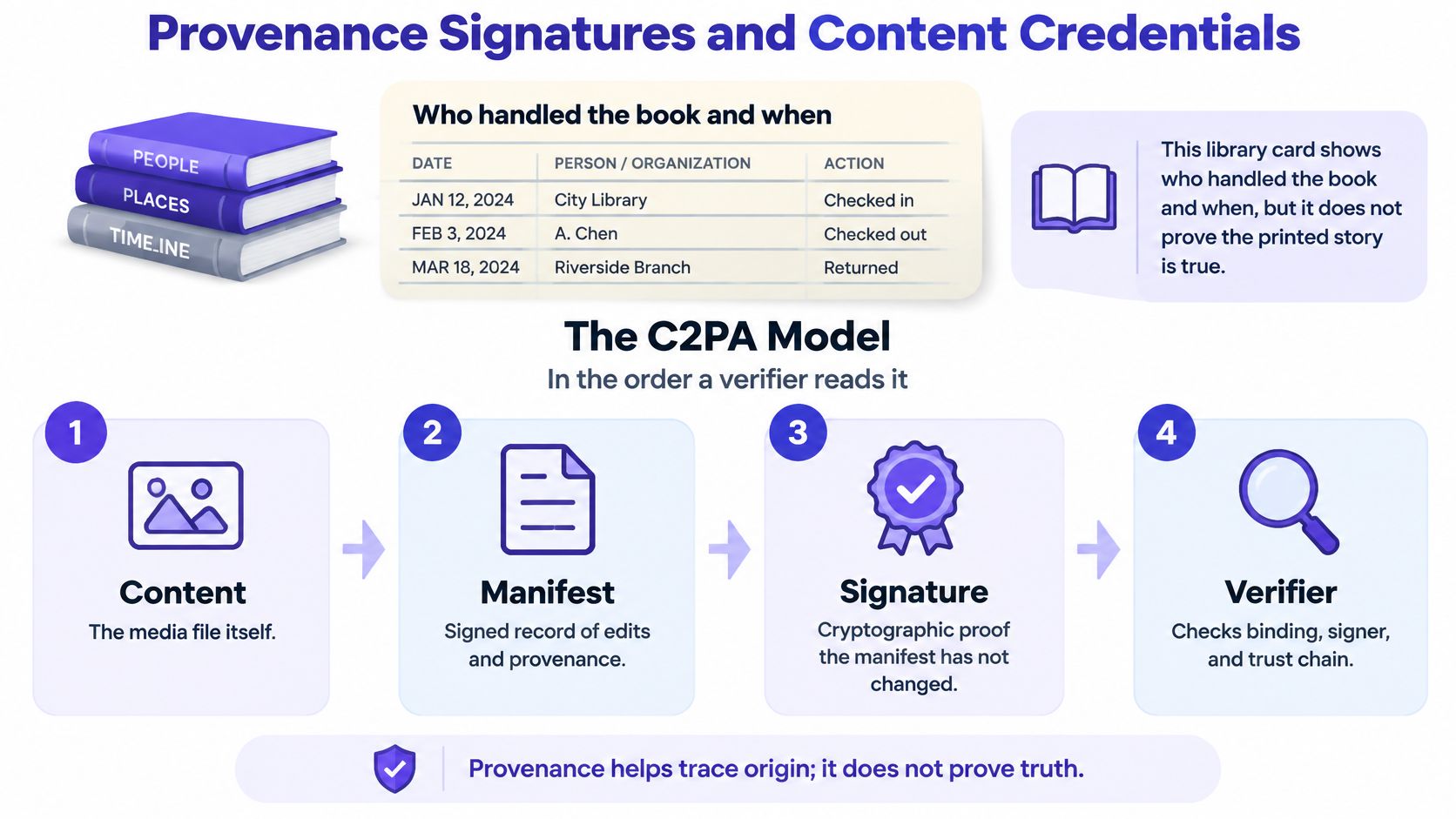
Think of provenance as a library circulation card. The card can document who handled a book and when, but it doesn't prove the story printed inside. Digital content credentials serve a comparable purpose, with cryptographic checks rather than handwritten entries.
Say a newsroom receives footage with a credential attached. Under the C2PA technical explainer, a camera, creator or editing tool can record assertions about origin, capture context, editing operations, applied tools and AI involvement. Those assertions are assembled into a claim, authenticated by the signer's digital signature, and carried in a manifest cryptographically bound to the media.
Read the Record Before Trusting the Label
The verifier checks whether the manifest belongs to the supplied asset and whether its signed information remains intact. The analyst then reads what the credential declares. A valid signature on a record of color correction answers a narrower question than a complete, trusted history beginning at capture.
The relationships between the file, record and verifier are shown below.
Use distinct operational labels:
- Verified provenance: The available credential passes the relevant binding, signature and organizational trust checks. Record the scope of that verification.
- No provenance found: No usable credential is available. This is an unknown state, not a failed manipulation test.
- Validation problem: A credential is present but cannot be validated. Preserve the specific error instead of collapsing it into a fake label.
A Valid Signature Still Needs a Trust Policy
Before accepting the record, establish who signed it and which signers your organization accepts. Check credential revocation, investigate key-security concerns, and identify any gaps where a transformation wasn't recorded. Also check whether later transcoding preserved a verifiable connection to the asset.
A newsroom, court and platform may use different signer policies. The analyst should therefore document the trust list or acceptance policy applied, rather than presenting technical signature validity as universal institutional approval.
Our guide to C2PA content credentials provides additional orientation for interpreting these records. C2PA is the specification used here, but signer trust, binding integrity and incomplete histories deserve attention in any credential system.
Treat the manifest as a declared history to compare against observable evidence. An unsigned file may still be genuine, while a signed file may contain an inaccurate assertion. Adoption and preservation depend on the tools and platforms through which the asset travels.
Four Detection Signals That Still Matter
When credentials are missing, partial or untrusted, analysts still need to inspect the media itself. Even with a usable manifest, forensic inspection helps determine whether the declared processing is consistent with the supplied file.
Keep frame, audio, temporal and metadata findings separate. They examine different properties, and a result in one category shouldn't stand in for the others.
Four Signals Used to Inspect a Video File
| Signal | What it inspects | Typical red flag | Weakens when |
|---|---|---|---|
| Frame-level analysis | Textures, facial detail and generator-linked patterns in individual frames | Diffusion artifacts, unnatural textures, inconsistent micro-expressions | Heavy compression, resizing or image enhancement |
| Audio forensics | Spectral character of speech and other recorded sound | Synthetic spectral patterns that don't match the scene | Re-encoded audio, noise reduction or a loud music bed |
| Temporal consistency | Motion and identity across consecutive frames | Flicker, motion discontinuities, identity drift | Low frame rate, stabilization or aggressive frame blending |
| Metadata inspection | Container fields, encoding history and attached credentials | Camera-original claim with no capture data, or conflicting manifests | Platform uploads that strip metadata and content bindings |
Frame-level review looks for patterns associated with generation, including GAN fingerprints, diffusion artifacts and unusual local textures. A suspicious mouth contour deserves closer inspection, but an isolated distorted frame isn't enough to identify its cause. Compare nearby frames and examine whether the same defect appears elsewhere.
Audio analysis examines the sound rather than relying on how believable the words seem. Inspect speech and background sound separately where possible, preserving the untouched track. A music bed can obscure relevant voice characteristics, while noise reduction may remove or introduce features that complicate interpretation.
Describe the Observation Before the Conclusion
Temporal review asks whether identity, motion and scene continuity remain coherent across consecutive frames. A face that changes shape during a head turn is a different observation from a single blurry frame. Stabilization, low frame rate and frame blending can nevertheless produce apparent motion errors without synthetic generation.
Metadata inspection reads container fields, encoding details and attached credentials. Use tools such as ExifTool or ffprobe on a working copy, saving the output with the case record. A camera-original claim without capture metadata warrants follow-up, but a platform may have removed those fields.
An anomaly is a reason to investigate its cause, not a complete explanation of that cause.
Log the signal that fired, its location in the clip, its strength and a plausible alternative explanation. For example, record that identity drift appears during a turn while noting that aggressive frame blending could contribute. Don't average these observations into an unexplained AI-or-real badge.
When Compression Breaks a Confident Score
Can you trust an authenticity result after a video has been compressed, resized, re-encoded or reposted? Only after considering what those transformations did to the evidence. A score belongs to the analyzed file and analysis conditions, not automatically to every copy of the same scene.
The analysis workspace should preserve that distinction between an incoming asset and its processed derivatives.
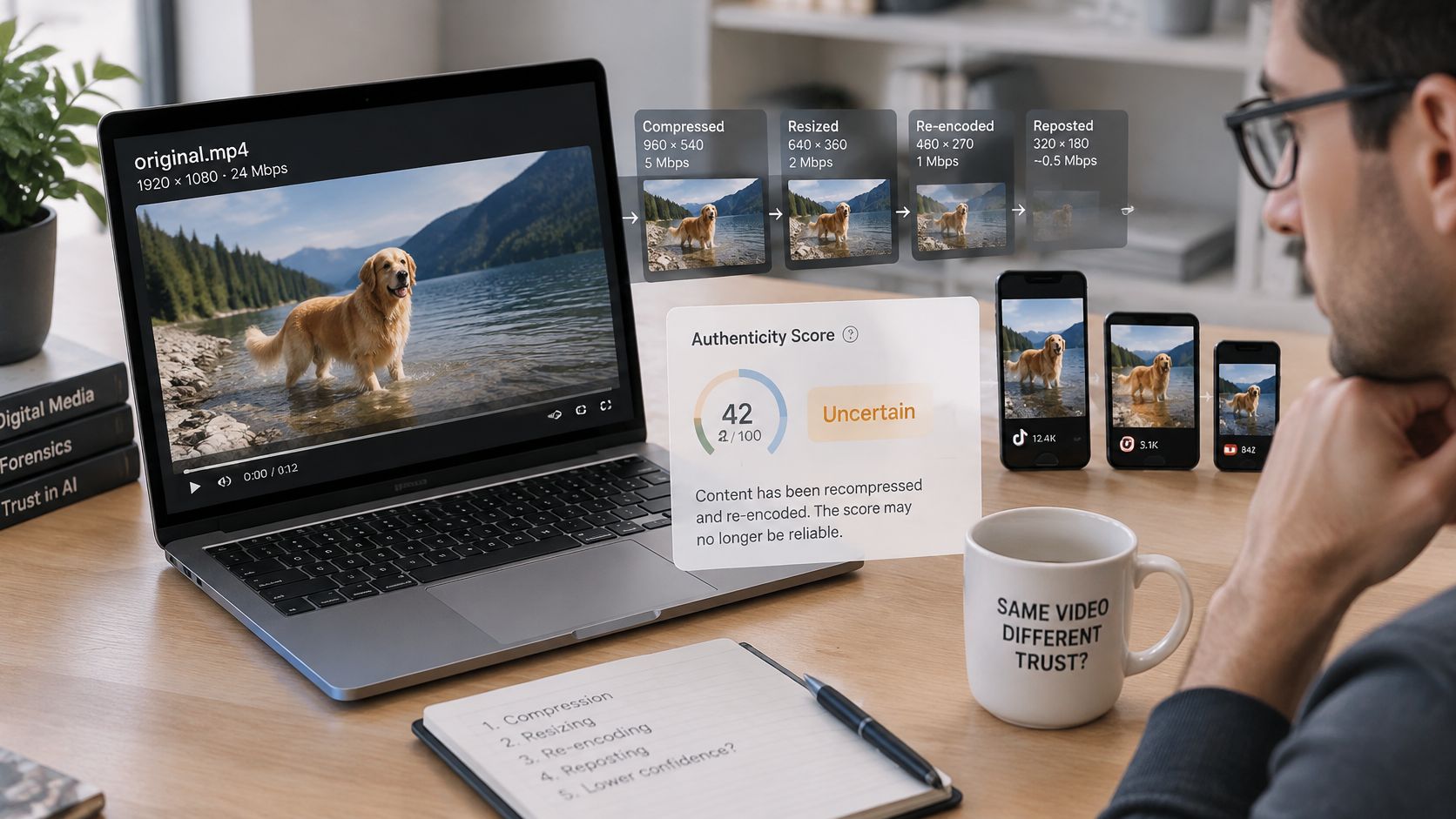
An independent 2025 detector evaluation reports a gap between controlled-dataset performance and real-world deepfake detection, particularly outside the training distribution, and describes substantial sensitivity to processing such as JPEG compression and image enhancement. That doesn't mean every compressed clip is unusable. It means a confident laboratory result can't be assumed to transfer unchanged to a social download.
Preserve Before You Process
- Keep the earliest available file. Request the capture file from the source when possible. If you only have a repost, describe it as such rather than calling it the original.
- Record identifying details. Calculate a cryptographic hash, such as SHA-256, and record the filename, size, source URL and time received. A matching hash establishes byte-for-byte identity, not truthfulness.
- Compare metadata across versions. Note changes in resolution, frame rate, codec and available capture fields. Keep the comparison with the analysis record.
- Test more than one version. Analyze the earliest copy and relevant derivatives separately. Don't treat the smallest, most convenient file as representative of every version.
- Document custody before re-export. Record who received, copied and processed the asset, and what each person did. Work on derivatives while preserving the received file.
A low-confidence result after processing may reflect lost or altered forensic information. It neither clears the video nor confirms manipulation. If versions produce conflicting assessments, report the disagreement and investigate the processing difference instead of selecting the result that suits the intended conclusion.
The accompanying video can be used as a discussion aid when reviewing this preservation routine.
Preservation principle: The quality of an authenticity assessment depends partly on what investigators preserved before analysis began.
Authenticity isn't only a property of the source video. It's also a property of the evidence-preservation workflow. A detector that doesn't communicate sensitivity to transcoding encourages users to place more weight on its output than the available evidence supports.
Election Clips and Misleading Real Video
A political clip reaches an assignment desk shortly before voting ends. The uploader says it shows misconduct, but nobody can identify the first publisher. The desk's problem isn't whether a face looks generated. Editors need to establish what happened, where the footage originated and whether the caption accurately describes it.
The CIVICUS and Digital Democracy Initiative election report, drawing on the International Panel on the Information Environment, identified 215 examples of AI-generated deepfake electoral disinformation across 50 countries holding competitive national elections in 2024; it also summarized a Knight First Amendment Institute review in which 39 of 78 cases tracked by the WIRED AI Elections Project involved no deceptive intent.
Those findings distinguish synthetic production from deceptive presentation. A clearly disclosed parody or illustrative synthetic scene doesn't become misinformation merely because AI helped create it. Conversely, camera footage can mislead without any generative model touching the pixels.
Follow the Publisher and the Caption
In the hypothetical assignment-desk scenario, an editor should preserve the incoming copy while another journalist traces earlier appearances. Search distinctive frames, compare visible landmarks, contact the claimed source and seek the longer recording. Don't let an urgent caption become the premise of the investigation.
The distribution and context questions are summarized below.
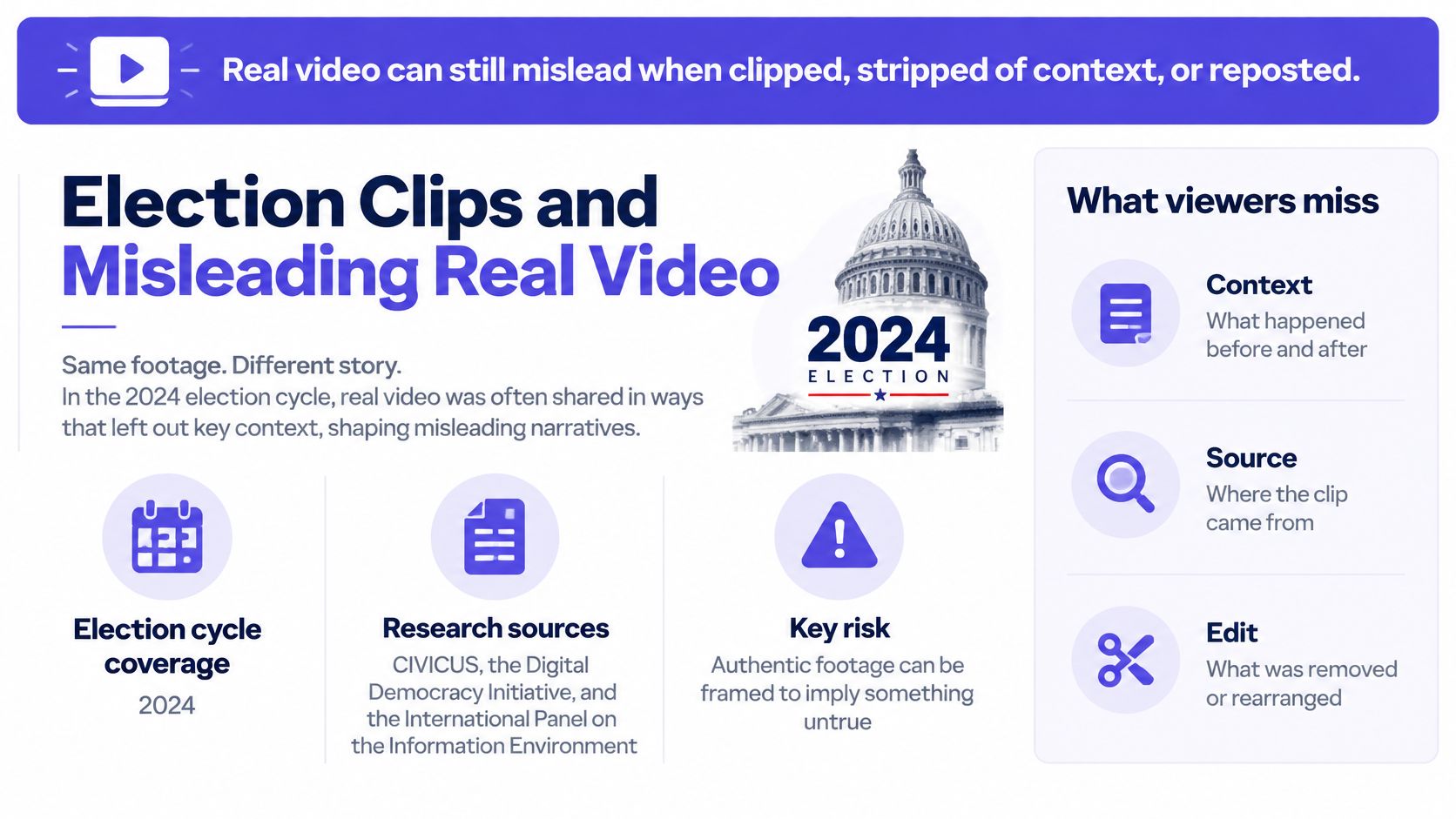
A genuine recording might show a previous election, another location or a staged encounter. Selective trimming can remove an explanation immediately before the circulated passage. A false caption can identify the wrong person, while replaced audio creates a separate question about whether the soundtrack belongs to the scene.
The IEEE Open Journal of the Computer Society article on deepfake detection discusses limitations involving datasets, manipulation diversity and real-world generalization. Operationally, an analyst shouldn't ask a detector to establish recording circumstances or narrative fairness.
Make Publication Claims Narrower Than the Evidence
Our guide to breaking-news verification can support a desk checklist for urgent submissions. Assign responsibility for source tracing separately from technical screening so an unresolved origin doesn't disappear behind a clean result.
The central risk is distribution without context. A strategically timed clip can demand a rapid response even when the underlying technical assessment remains incomplete. If the desk can't establish the claimed date or location, it shouldn't publish those details as verified merely because the media appears camera-recorded.
A Verification Workflow for High-Stakes Video
Build the case around the file's history, not just its final appearance. The C2PA implementation guidance describes provenance across transformations and emphasizes the role of signer trust, giving investigators a basis for reconstructing declared operations rather than inspecting an isolated endpoint.
Execute and Record the Checks
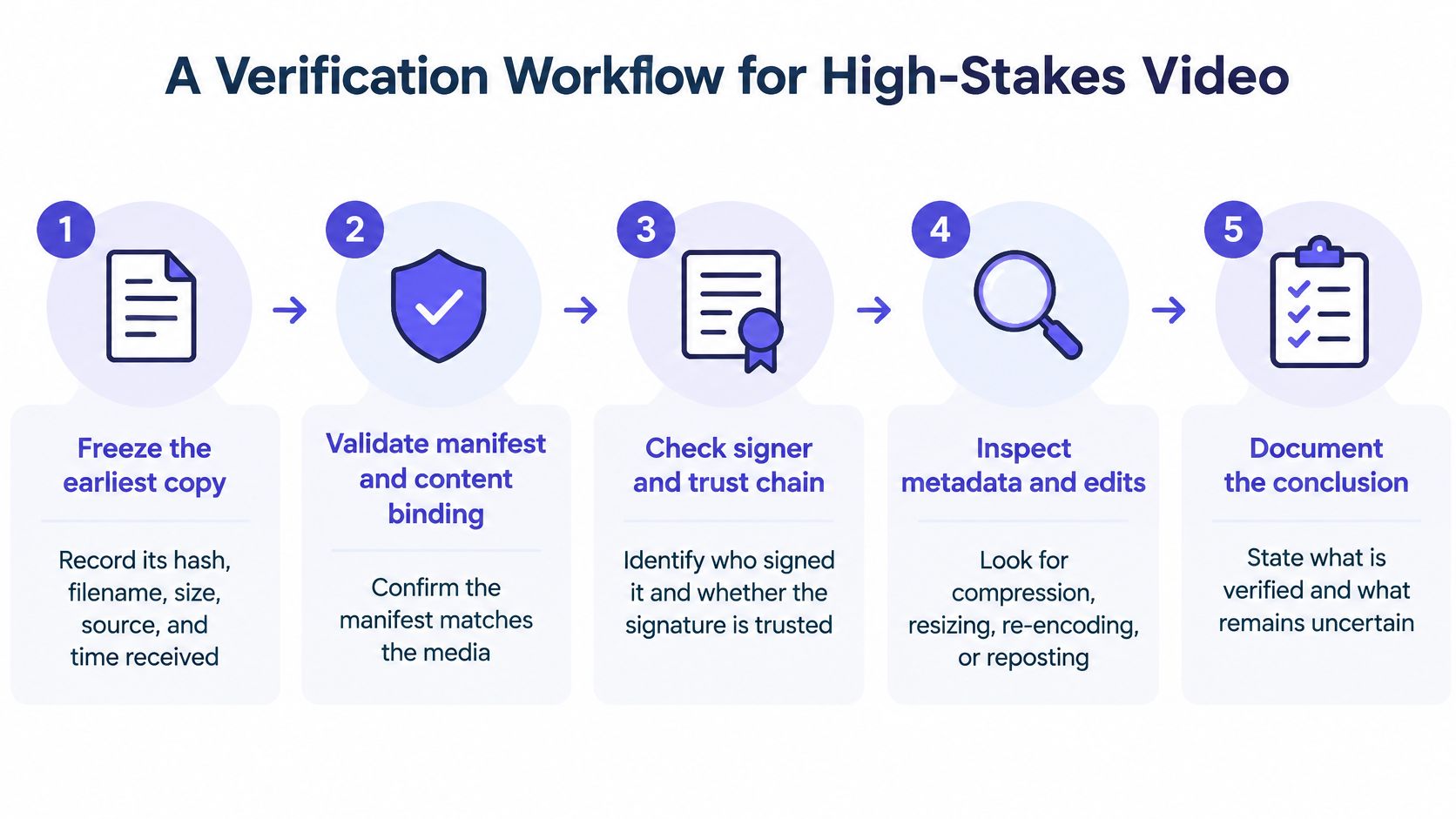
- Freeze the earliest copy. Preserve the received bytes and record the hash, filename, size, source and receipt time. Create a working copy for inspection.
- Validate the manifest and content binding. Check the signature, signer identity, revocation status and applicable trust policy. Record whether the supplied file retains a valid binding.
- Reconstruct declared operations. Identify capture, trimming, color correction, re-encoding and AI-tool use. Mark where the documented chain ends or becomes incomplete.
- Compare declarations with observations. Examine frame, audio, temporal and metadata signals. Log locations and strength, noting whether a declared operation plausibly explains an anomaly.
- Classify missing credentials accurately. Record absence of provenance rather than inferring manipulation. Keep this finding separate from any failed validation of an existing credential.
- Test the surrounding claim. Use reverse search, geolocation, source interviews and independent corroboration appropriate to the stakes. For payment requests, confirm authorization through a previously established channel.
- Write a scoped finding. Answer the opening questions separately, include any detector confidence score, and identify the version analyzed and processing it underwent. State unresolved issues and their effect on the proposed action.
Use the visual checklist as a handoff aid, while retaining the detailed examination record.
Verification Emphasis by Institution
| Institution | Main risk | Verification emphasis |
|---|---|---|
| Newsroom | User tips and wire video reused without context | Freeze the earliest copy, screen for manipulation and check context before publication |
| Court or investigator | Gaps in the chain of custody | Document custody, signer trust and undeclared edits before any re-export |
| Platform | Bindings stripped on reposts | Compare reposts against originals and treat missing credentials as unknown |
| Enterprise security | Executive impersonation and scam video calls | Run all four signal layers on call recordings and confirm requests through a separate channel |
An operational finding should make the next person's job easier. Instead of authentic, write that the examined copy has validated provenance from a named signer, contains declared trimming, and still lacks independent confirmation of the caption's location. That wording distinguishes completed checks from remaining work.
For legal matters, this technical record supports review; it doesn't replace jurisdiction-specific evidentiary requirements. For security incidents, preserve relevant communications as well as the video so investigators can evaluate the request in context.
The design rule is straightforward: validate the manifest first, then test whether the declared edits match the observed signals. Escalate unexplained conflicts rather than hiding them inside a combined score.
Check the File Before You Act
Act only when the authenticity questions have documented answers adequate for the decision, the earliest available file is preserved, and any detection score is interpreted as probability rather than certainty. An unresolved answer can be acceptable for continued investigation, but it isn't permission to publish an allegation or authorize a payment.
Before uploading evidence anywhere, follow your organization's confidentiality and evidence-handling rules. Our guide to checking video metadata can help you capture file details before analysis.
Use Screening Without Overstating It
At AI Video Detector, we provide a screening layer using frame-level analysis, audio forensics, temporal consistency and metadata inspection. Our service analyzes supported uploads in under 90 seconds, accepts MP4, MOV, AVI and WebM files up to 500MB, doesn't store the uploaded video, and requires no signup for basic detection.
Newsrooms can use our tool to screen user-submitted tips and wire footage for AI manipulation. If you attach an authenticity badge to published content, explain what was checked and avoid implying that the badge verifies the entire narrative.
Our detection score represents probability, not certainty, and no detection is perfect. Record which signals fired and preserve the output alongside the exact file examined, rather than treating the result as proof that an event happened.
Keep the original, run the layered check, record which signals fired, and don't publish or pay on an unexplained score. If technical screening is the missing step, use our detector alongside source verification and a documented custody record before you act.


