

What Is Video Verification: A Complete Guide

Video verification establishes whether footage is authentic, complete, and unaltered by checking its origin, metadata, handling history, and manipulation signals. In benchmark testing, commercial tools reached 98.00% accuracy for Bio-ID and 93.47% for Deepware, but a detector result alone still can't prove that a clip is genuine.
A clean-looking video can be misleading. A convincing face swap may be only one layer of manipulation, while an authentic recording can look suspicious after compression, editing, or reposting. So, what is video verification really trying to prove?
It is not just a matter of asking whether artificial intelligence created a clip. It asks whether the file came from the claimed source, whether it remained intact, whether its technical history makes sense, and whether independent evidence supports what it appears to show. That distinction matters to journalists, investigators, lawyers, security teams, and anyone making a high-stakes decision from visual media.
Why Suspicious Footage Is Harder Than It Looks
How can a video look convincing and still fail basic verification?
A newsroom may receive a clip that supposedly captures a breaking event. It appears to show the correct location, weather, and a person resembling a public official. Editors must quickly choose whether to publish it, hold it for review, or tell the audience that its origin remains unknown.
A legal team faces the same problem under different conditions. Bodycam or surveillance footage may affect a case, yet opposing counsel can question when the file was created, whether anyone edited it, and who handled it before submission. The central question is whether someone can show that the file fairly represents the original recording.
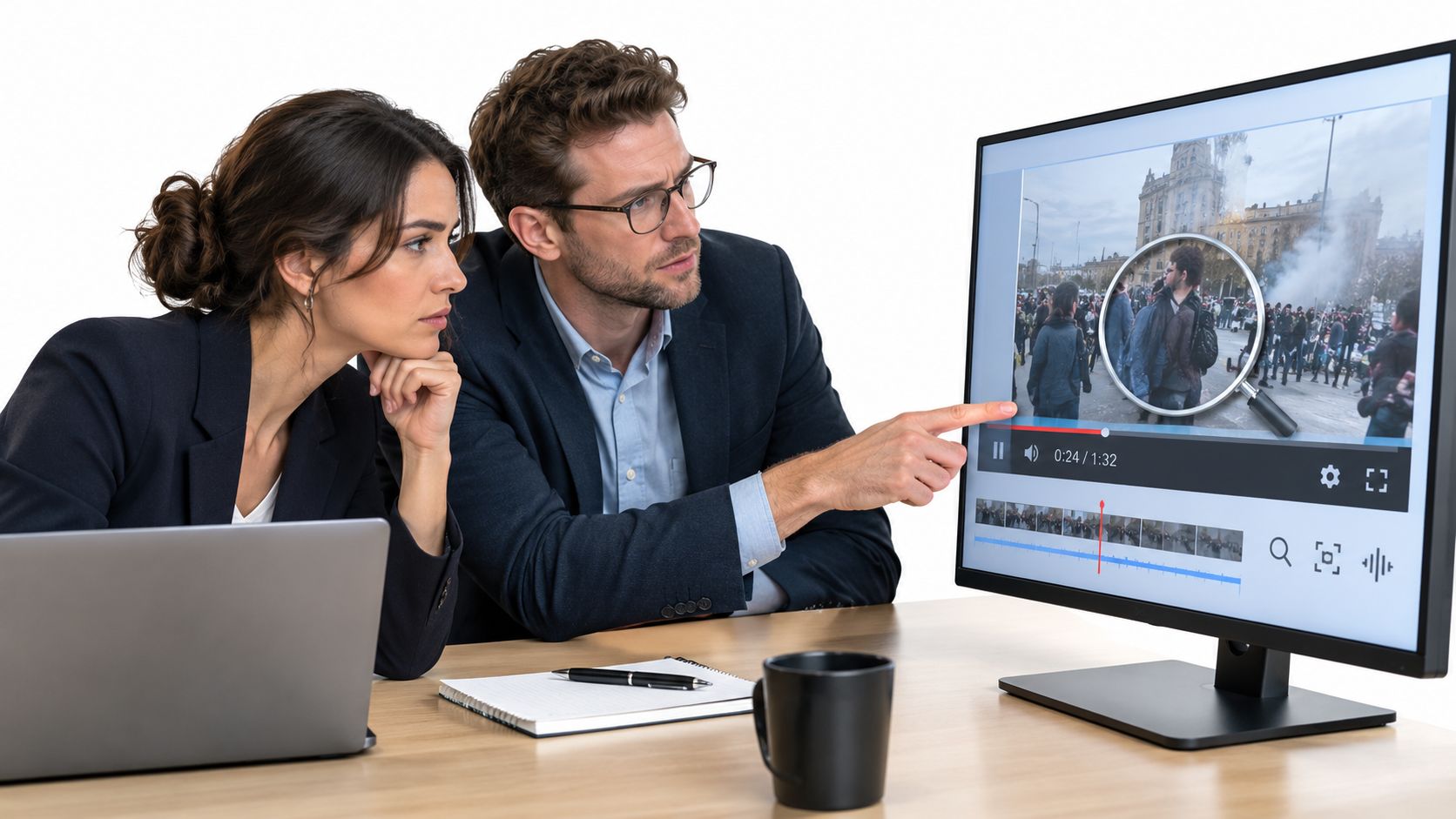
Why visual confidence isn't enough
Synthetic media weakens familiar visual cues. A clip may contain a generated face, altered background, replaced voice, or selectively removed segment without appearing obviously artificial. Reposting can strip metadata and add compression artifacts, which makes an authentic file harder to assess.
Verification therefore covers more than deepfake detection. Guidance on authenticating digital evidence in the era of the liar's dividend explains why authentication matters when AI-generated media makes video easier to dispute. Established approaches may include testimony that footage fairly and accurately depicts events, or a “silent-witness” foundation showing that the recording system operated properly.
A detector can flag a suspicious face or unusual frame pattern, but that output is only one piece of the case. A court-defensible conclusion requires the result to align with the file's provenance, handling history, and supporting evidence. These strands work like independent witnesses: one may raise concern, while several consistent strands can support a reliable finding.
Practical rule: Treat a viral clip as an unverified file until its source, integrity, and context support its use.
This discipline helps prevent misinformation, fraud, wrongful conclusions, and altered material entering formal investigations. Video verification is now a working skill for editorial, legal, security, and research teams handling uncertain footage.
Defining Video Verification
What does it take to verify a video when a convincing image can still mislead? Video verification is the forensic process of determining whether footage is authentic, complete, and unaltered. Analysts examine provenance, metadata, chain of custody, and signs of tampering instead of trusting a visual impression. The recording's origin and handling form part of the evidence, especially when the result may need to withstand legal scrutiny.
A practical explanation begins with three questions:
- Where did the video come from? This is provenance. Investigators may trace the original device, account, camera system, uploader, or location where the recording was made.
- What happened to the file afterward? This is chain of custody. The reviewer documents who obtained it, how it moved between people or systems, and which copies were created.
- Does the file support the claimed story? Forensic analysis examines frames, timing, compression, containers, codecs, and metadata for alterations or contradictions.
These questions work like links in a case file. A detector result is useful only when it agrees with the file's history and the surrounding evidence.
Detection versus verification
A detector searches for signs of manipulation. It may flag an inconsistent facial region, an unusual frame pattern, or a signal associated with synthetic generation. That finding can justify closer examination, but it cannot establish where the file came from, who handled it, or whether the depicted event occurred as described.
Full verification asks whether the entire evidentiary chain is coherent. A file may show no obvious deepfake artifact while lacking a trustworthy source. A genuine recording may also contain technical irregularities caused by transcoding or platform processing. Analysts therefore interpret detector outputs alongside provenance and custody records, rather than treating any single result as a verdict.
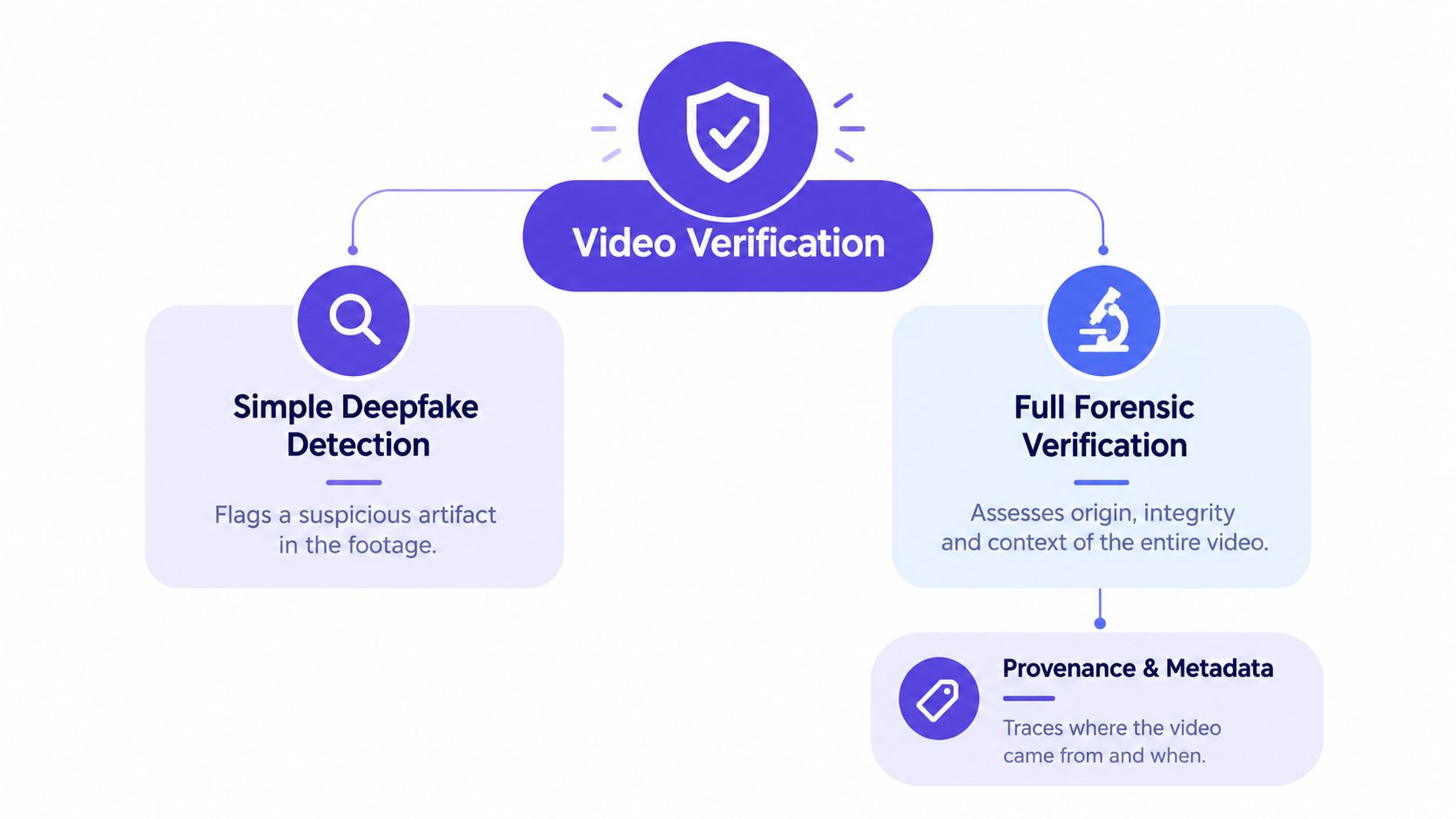
Metadata can connect a file to a claimed device or event, but it is one evidentiary strand, not an automatic certificate of truth. Records describing where data originated and how it changed also matter in sensor-rich systems. The discussion of physical AI physical data provenance shows how that principle extends beyond video.
The outcome may be qualified rather than binary: signs of manipulation, supported origin with uncertain context, or insufficient evidence for a confident finding. Court-defensible verification depends on convergence, where independent technical findings, provenance, and chain-of-custody evidence point toward the same conclusion.
How Verification Methods Work
How can a reviewer decide whether suspicious footage is authentic? By examining different parts of the recording and comparing the results with its history. Each method acts like a separate witness. One witness may be mistaken or incomplete, while several independent findings can establish a much stronger account.
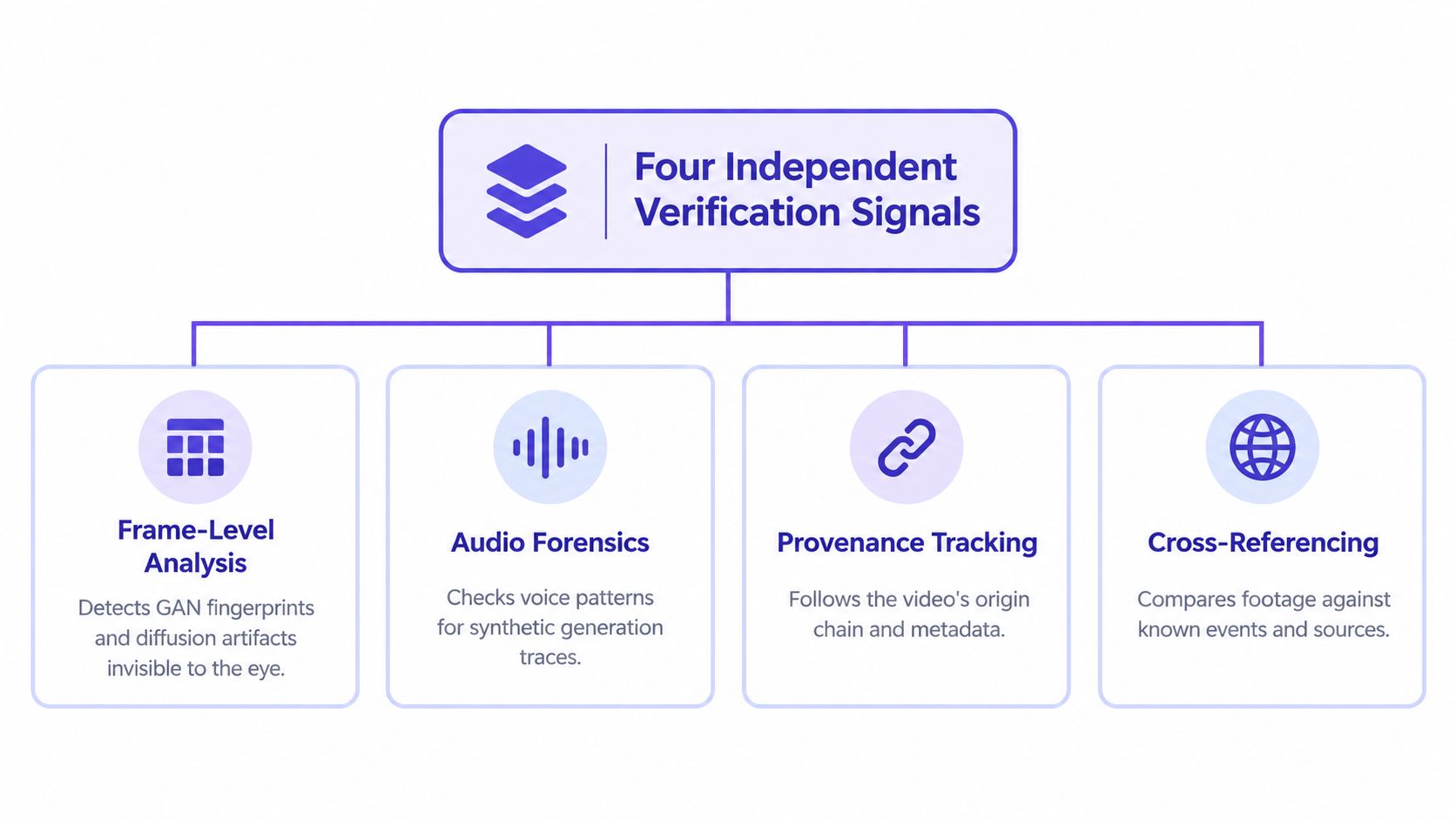
Frame-level analysis
The reviewer isolates individual frames and compares regions that should behave consistently. A face, object edge, reflection, or background may contain unusual texture, blending, or compression patterns. These signs can disappear during ordinary playback because movement and screen size hide small differences.
Frame review isolates locally produced material from the rest of the recording. A face may have different noise characteristics from the surrounding scene, or an edited object may leave a sharp boundary where the rest of the image is naturally blurred. Such findings indicate where to investigate. They do not, by themselves, establish who changed the file or when.
Temporal consistency
A video is a sequence of related images, so analysts also examine how visual information changes from one frame to the next. They look for discontinuities in movement, lighting, object boundaries, reflections, or the behavior of the scene. An inserted or generated element may look plausible in a single frame but fail to maintain a stable relationship with its surroundings as the camera or subject moves.
This method resembles checking handwriting across a sentence. Individual letters may appear acceptable, yet changes in spacing or stroke direction can reveal that part of the text came from another writer. Temporal review is especially useful when an alteration affects only one object or a short part of the sequence.
Metadata and file structure
A video file includes technical details about its container, codec, device, creation time, and sometimes location. Analysts compare those fields with the claimed source and recording process. A camera model that does not match the alleged device, a creation time that conflicts with the event, or an encoder signature inconsistent with the workflow can create a meaningful discrepancy.
Metadata is supporting evidence, not an automatic certificate of truth. Social platforms and editing software may rewrite it, and a legitimate export may generate a new encoder signature. Video forensics research from AFIP describes mismatched creation times, camera fields, GPS traces, and encoder signatures as examples of contradictions investigators may examine.
Audio and external context
Audio supplies another line of inquiry. Reviewers compare speech timing with mouth movement, listen for abrupt changes in room sound, and assess whether the soundtrack fits the pictured environment. These checks can identify a mismatch, but they cannot establish the file's origin without supporting evidence.
External comparison tests whether the footage fits independently documented circumstances. A newsroom may compare shadows, landmarks, weather, or surrounding footage with known events. A security team may compare the clip with access logs or other camera records. For live operations, real-time video safety monitoring can support immediate situational assessment, although operational monitoring and forensic authentication serve different purposes.
Professionals seeking a closer technical examination can consult this guide to video forensics analysis. The practical conclusion is that detector outputs are only parts of the case. Analysts pair them with provenance and chain-of-custody evidence so that the technical findings, file history, and handling record support one defensible conclusion.
The Convergence Problem
A suspicious metadata field doesn't automatically prove editing. A blocky face may result from platform compression. A brief audio mismatch could come from a damaged recording or an ordinary dubbing process. Verification becomes persuasive when independent signals converge, not when one tool produces a dramatic score.
The reviewer therefore compares three broad evidence groups:
| Evidence group | Main question |
|---|---|
| Content artifacts | Does the picture, sound, or motion contain signs of manipulation? |
| File history | Do metadata, container details, and timestamps fit the claimed source? |
| Handling integrity | Can the team show how the original was obtained, preserved, and examined? |
Why custody changes the conclusion
Suppose a team downloads a clip from a messaging platform and runs it through a detector. The tool finds no obvious manipulation. That result may be useful, but the team still doesn't know whether the platform compressed the file, whether an earlier version existed, or whether the uploader had edited it before posting.
A court-defensible workflow preserves the original source format, creates a working copy, and records the relationship between them. SWGDE best-practice guidance for digital video analysis recommends hashing the original evidence and working copy to support chain of custody. A hash is a calculated digital fingerprint. If the file changes, the resulting value changes, helping the examiner demonstrate that the analyzed copy matches the preserved evidence.
The important conclusion: A detector can identify a problem. Provenance and custody help establish what the file is and whether it can be relied on.
This is why verification isn't a binary button. The final assessment weighs technical findings against acquisition records, source testimony, device information, and the limits of the available material.
Verification Across Industries
The same principles appear in different industries, but each team defines “enough evidence” according to its risk. A newsroom prioritizes speed and corroboration. A legal team prioritizes admissibility and a documented evidence trail. An enterprise security group may focus on whether a purported executive video is part of an impersonation attempt.
The need has expanded alongside synthetic media. A 2025 benchmark study evaluated 300 manipulated videos, with commercial tools in the test set reaching 98.00% accuracy for Bio-ID and 93.47% for Deepware on that benchmark, as reported in the published video detection study. Those results show that tools can perform strongly under test conditions, while changing manipulation methods still require ongoing review. The same source reports market-facing research that placed online deepfake videos at about 500,000 in 2023, with a projected 16× increase by 2025.
Video Verification Use Cases by Industry
| Industry | Primary Goal | Key Method Focus |
|---|---|---|
| Newsrooms | Decide whether user-submitted footage can be published | Source tracing, location and event cross-referencing, frame and temporal review |
| Legal and law enforcement | Establish whether evidence is authentic and properly handled | Original preservation, metadata, hashing, chain of custody, expert interpretation |
| Enterprise security | Detect executive impersonation and fraudulent video communications | Identity context, provenance, audio and visual consistency, independent confirmation |
| Social platforms | Identify synthetic or manipulated content before it spreads | Automated detection, escalation review, source signals, moderation context |
| Education | Confirm that lectures, interviews, or training materials represent their claimed source | Provenance, speaker consistency, file history, contextual corroboration |
Identity workflows add another variation. Teams using video in KYC or proof-of-life processes can review KYC video verification as a related application, but identity verification isn't identical to proving that every scene in a video is complete and unaltered.
The practical difference is the decision that follows. A platform may label content for review. A journalist may delay publication. A lawyer may challenge admission. A security analyst may request confirmation through a separate channel. The evidence standard changes, but the convergence principle remains.
The Limits of Detection
A “no manipulation detected” result is not the same as “this event happened exactly as claimed.” That distinction is easy to miss because software often presents a confidence score that looks definitive.
Current expert guidance separates high-confidence provenance authentication from generic authenticity checks. The Microsoft review of media authenticity methods explains that detection generally identifies signs of manipulation, while stronger authentication requires evidence about origin and history. UK government guidance cited in that review likewise treats detector outputs as confidence scores, not proof of truth.

A clean result can still leave questions
Detection systems learn patterns associated with known manipulations. An unfamiliar generation method, a heavily compressed upload, or a clip that combines authentic and synthetic material can reduce the value of a single result. The tool may not recognize the alteration, or it may flag harmless processing.
Non-face manipulation creates another blind spot. A fake may alter a background, object, gesture, voice, or sequence while leaving the face untouched. Recent research has pushed analysis beyond faces toward motion, backgrounds, temporal cues, and full-scene inconsistencies, and reporting on commercial tools notes that video detection can remain harder than still-image detection. Coverage of advances in non-face deepfake analysis describes this broader direction.
What a responsible conclusion sounds like
A careful report might say:
- The file contains artifacts consistent with manipulation.
- The source account provided the clip, but the original recording isn't available.
- Metadata conflicts with the claimed device or time.
- The available evidence supports the file's origin, but not the truth of the event depicted.
- No decisive manipulation signal was found, and provenance remains unconfirmed.
That language may feel less satisfying than a simple label, but it accurately separates what the analysis found from what the evidence can prove.
Building a Verification Workflow
Professionals need a repeatable process, not an improvised search for visual glitches. The following sequence keeps technical analysis connected to evidence handling.
- Preserve the original. Obtain the source file in its original format where possible. Don't begin by editing, trimming, converting, or adding annotations.
- Record acquisition details. Note who supplied the file, when it was received, how it was transferred, and what the source claims about the recording.
- Create a working copy. Keep the preserved original separate from any copy used for playback, frame extraction, or enhancement.
- Hash both files. Use digital fingerprints to document file identity and support later chain-of-custody review, following guidance on authenticating video evidence.
- Inspect technical properties. Review the container, codec, timestamps, device fields, GPS information, and encoder details for contradictions.
- Run multiple analyses. Combine frame-level, temporal, compression, and, where appropriate, audio or contextual checks. Don't treat one detector score as the conclusion.
- Trace the source. Look for an earlier upload, the original camera system, a witness, or an independent copy. Compare versions without overwriting the preserved material.
- Write a bounded conclusion. State what the evidence supports, what it contradicts, and what remains unknown.
AI Video Detector is one available option for analyzing uploaded clips for AI generation or manipulation. Its stated workflow examines frame-level, audio, temporal, and metadata or container signals and returns an authenticity assessment with a confidence score. That output can inform triage, but it should sit inside the broader preservation and provenance process.
The Future of Video Trust
A newsroom may soon receive a clip that contains an authentic street scene, a synthetic speaker, and an altered soundtrack in the same file. A security team may face a video call in which the participant looks real but the surrounding context has been generated. These mixed cases are harder than the classic face swap because parts of the evidence may be genuine while other parts are not.
Detection systems will continue to adapt by examining motion, backgrounds, temporal behavior, and scene-wide consistency instead of concentrating only on faces. Provenance technologies can add another layer by attaching information about a file's origin and transformations, but provenance records still need to be interpreted alongside the actual media and its custody history.
Trust needs a process
The strongest future workflow won't ask AI to make an isolated yes-or-no decision. It will combine automated signals with source records, authenticated capture where available, independent corroboration, and human review for consequential decisions.
That approach also makes uncertainty visible. A journalist can explain why publication was delayed. An investigator can show how an original was preserved. A legal team can distinguish a detector result from a complete authentication foundation. Those records become increasingly important as synthetic media becomes easier to create and harder to recognize by sight alone.
Final principle: Video verification doesn't promise certainty from one scan. It builds a defensible conclusion from evidence that agrees.
If you're reviewing a suspicious clip, start by preserving the original and documenting its source before uploading or editing it. Then combine a technical detector with metadata inspection, provenance tracing, independent context, and a written chain-of-custody record. That workflow gives your newsroom, legal team, or security operation a stronger basis for deciding what the video can responsibly prove.
Use a structured video verification process before publishing, presenting, or relying on suspicious footage. Preserve the source, document its history, and assess the file with multiple independent signals so your next decision rests on evidence rather than appearance.


