

Video Forensics Analysis: Authenticating Media

An editor receives a video that appears to show a public official making a damaging statement. It arrived through a social account, has already been reposted, and the sender insists it came directly from a phone at the scene. The frames look convincing. The voice sounds natural. There's pressure to publish before competitors do.
That's precisely when visual judgment becomes dangerous. Video forensics analysis isn't a quick search for an obvious face-swap defect. It's a structured examination of a file's origin, integrity, encoding, audio, timing, and surrounding evidence. The practical question is not whether a detector labels a clip “fake.” It's whether an investigator can explain what was tested, preserve the original, identify limitations, and defend the conclusion to an editor, opposing counsel, or a court.
The New Reality of Video Forensics Analysis
The newsroom scenario is no longer unusual. A security team may receive a video of an apparent incident, a legal department may be handed footage that supports a claim, or a communications director may be asked to respond to a clip spreading across social platforms. In each case, the file is both evidence and a potential attack surface.
A convincing video can mislead viewers in several ways. A person may have been composited into an authentic scene, an authentic recording may have been selectively edited, the audio may have been replaced, or a file may have been re-encoded so many times that its original provenance is unclear. A clean visual appearance doesn't distinguish between those possibilities.
Video forensics analysis treats the media as a technical object, not just a picture. The examiner asks:
- Where did this file come from?
- Has it been re-encoded, trimmed, or assembled from other material?
- Do the container, codec, timing, and metadata support the claimed origin?
- Are the audio and video synchronized?
- Do motion, lighting, noise, and compression behave consistently?
- Can another qualified person reproduce and understand the finding?
This distinction matters because authenticity and content are separate questions. A real recording can still be misleading if it has been cropped, removed from its original context, or presented with a false date. Conversely, a manipulated clip might contain authentic background footage while altering only a speaker's face or voice.
The research reflects that growing complexity. The FaceForensics++ and DeepFake-Eval-2024 survey describes a shift from curated laboratory datasets toward more diverse, real-world testing conditions. FaceForensics++, released in 2019, contained 1,000 real videos and 4,000 fake videos, while Deepfake-Eval-2024 expanded to 2,036 total videos and 45.1 hours of content, including 1,072 real videos and 964 fake videos. Those figures don't prove that a detector will perform reliably on a particular submission. They show why testing conditions have become central to the discipline.
Practical rule: Treat a viral video as an unverified lead until its file history, technical signals, and external context support the claim being made about it.
The operational shift is straightforward. Don't ask only, “Does this look real?” Ask, “What evidence supports authenticity, what evidence contradicts it, and what remains unknown?”
The Four Signals of Media Authentication
Professional review works best when independent signals are examined together. A detector may identify a suspicious facial texture, but that finding becomes more useful when it aligns with an audio discontinuity, an implausible frame cadence, or metadata that contradicts the claimed device.
Frame-level evidence
Frame analysis examines pixels, edges, textures, faces, reflections, and repeated regions. Earlier manipulation systems often left detectable patterns around facial boundaries, hair, teeth, eyes, or skin. Newer generation methods can produce fewer obvious defects, so an examiner looks for local inconsistencies, not a single “AI look.”
Useful checks include unusual texture continuity, mismatched sharpness between a face and its surroundings, repeated pixel structures, inconsistent blur, and abrupt changes in compression behavior. These indicators are clues, not automatic proof. A low-resolution social-media copy can create artifacts that resemble manipulation, while a carefully edited high-quality file may conceal visible defects.
A specialist workflow may also examine fingerprint features that arise from a camera's sensor and processing pipeline. The guide to video fingerprint features is useful background for understanding why source-device characteristics can matter alongside content inspection.
Audio forensics
Audio deserves separate treatment because voice cloning and post-production can leave traces that aren't visible in the image. Analysts inspect the waveform, frequency distribution, room characteristics, background noise, breath patterns, and the relationship between speech and lip movement.
A synthetic or replaced voice may have an unusually controlled spectral profile, missing environmental variation, or transitions that don't match the acoustic space. Those signs must be interpreted carefully. Noise reduction, platform transcoding, microphones, and speakerphone processing can all alter sound without indicating fraud.
Temporal consistency
A manipulated frame can look plausible in isolation and fail when examined as part of a sequence. Temporal analysis evaluates motion continuity, lighting changes, object boundaries, facial movement, frame cadence, and the physical relationship between subjects and their environment.
Look for a face that changes subtly between frames without corresponding head movement, a hand that jumps position, a shadow that responds incorrectly to motion, or a background that shifts independently of the camera. Analysts also examine whether frames appear to have been inserted, removed, duplicated, or reordered.
Metadata and encoding
Metadata is best understood as a passport, not a verdict. A passport includes security features, issuance details, and consistency checks, but its photograph alone doesn't establish where the traveler has been. Likewise, a file's metadata can support or weaken a provenance claim, but it can be stripped or rewritten.
For MP4 and MOV files, examiners compare container structures such as ftyp, moov, and mdat, track timing, vendor-specific metadata boxes, and encoder behavior. The research on codec and container-level video forensics explains why GOP structure, quantization behavior, and inconsistencies between claimed device provenance and observed bitstream patterns can indicate re-encoding or source substitution.
Teams that need a broader explanation of how records are tracked from origin through processing can consult this overview of data provenance. It provides useful conceptual context, though a provenance framework doesn't replace examination of the actual media file.
No single signal should carry the entire conclusion. The strongest assessment records what each signal shows, where signals agree, and where they conflict.
Workflows for Authenticating Suspicious Footage
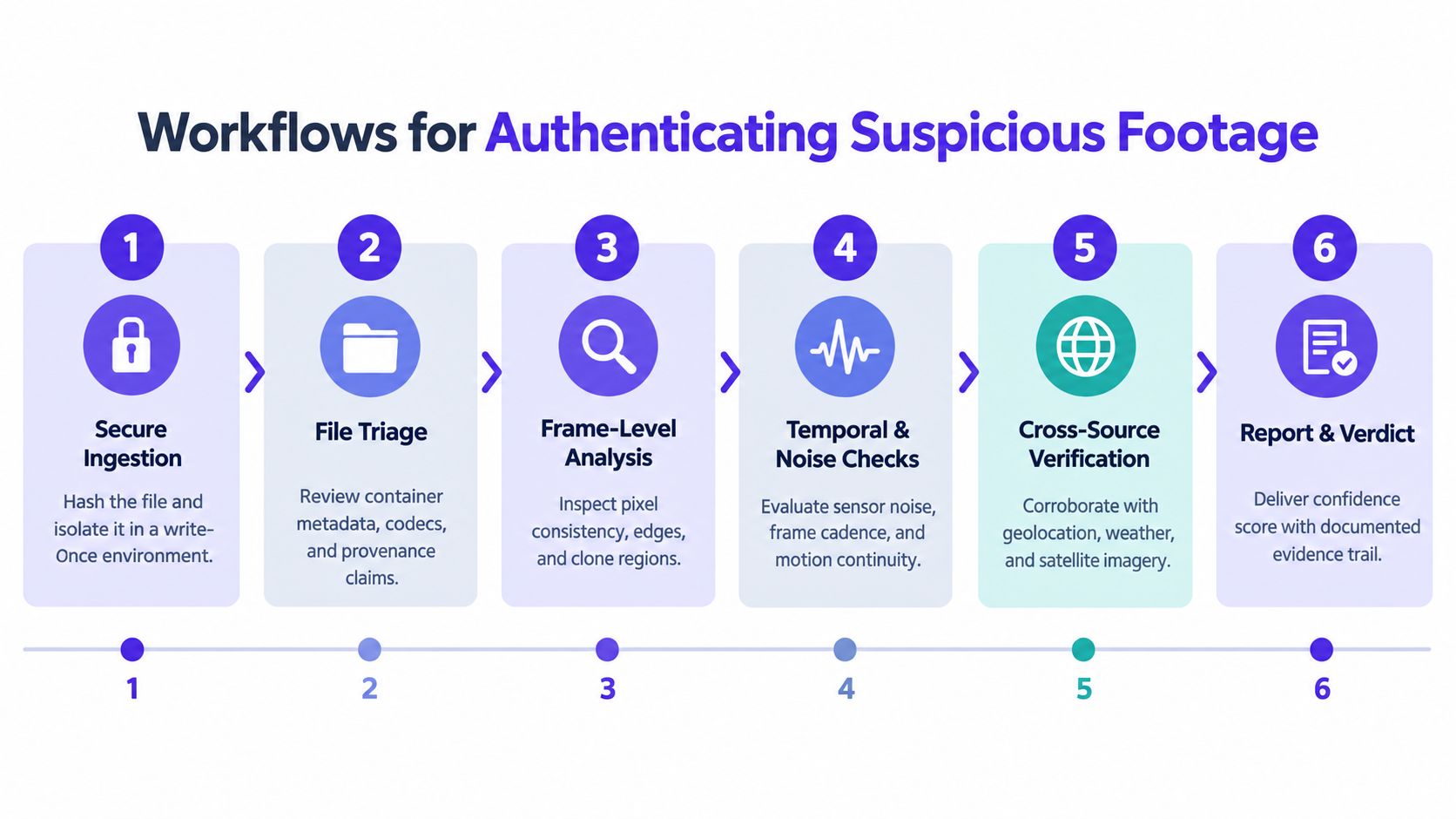
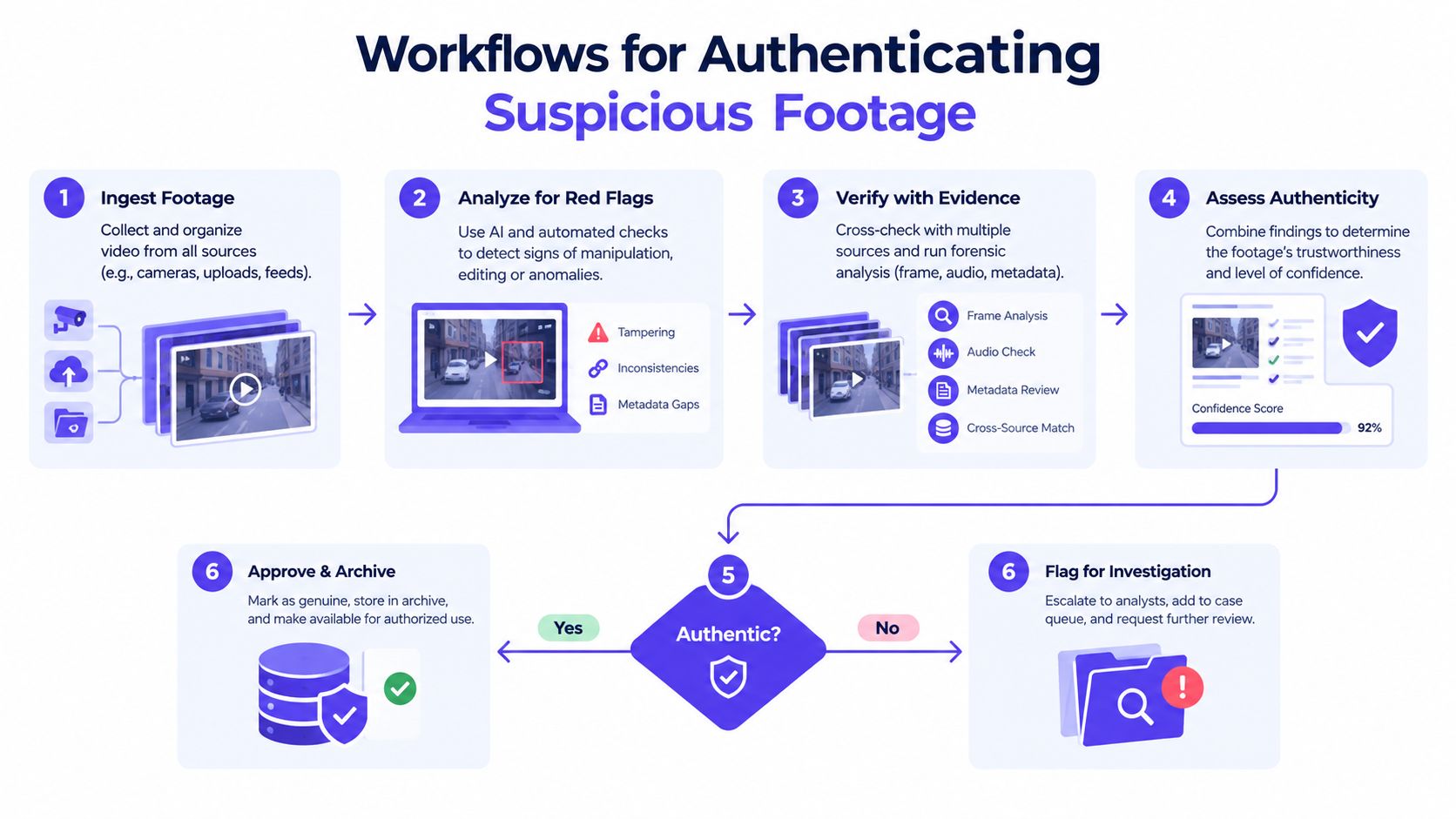
A defensible workflow begins before anyone runs a detector. The first mistake is often not technical. Someone opens the only copy, exports it through a consumer editor, or forwards it through a messaging service that changes the file. Once that happens, the team may lose information needed to assess the original.
Start with controlled ingestion
Preserve the received file in its original form. Record who supplied it, when it arrived, through which channel, and what the sender claims about its capture. Generate a cryptographic hash, store the original in a controlled location, and conduct analysis on a working copy.
The hash doesn't prove that a video is authentic. It proves that the preserved file remains unchanged after acquisition. That distinction belongs in every report.
Triage the file before interpreting it
Identify the container, streams, codec, dimensions, frame rate, duration, audio characteristics, and embedded metadata. Compare those observations with the claimed device and capture process. A phone-origin claim paired with an unexpected editing application, a strange time base, or an encoder profile associated with later processing deserves scrutiny.
This stage also identifies whether the file is a platform copy rather than the original. A downloaded social clip may be genuine content that has passed through several transformations. The right conclusion may be “source provenance cannot be established,” not “the video is fabricated.”
Run multi-signal screening
Automated tools are useful for prioritization. A privacy-conscious screening platform can examine frame-level patterns, audio, temporal behavior, and metadata before an analyst commits time to a deeper review. AI Video Detector is one option in this category. Its published workflow describes a confidence-based result based on those four signals, with analysis intended for uploaded video triage.
Screening should create questions for the investigator. It shouldn't replace them. Record the tool version, input file hash, settings, output, and known limitations. The evidence documentation workflow offers practical guidance on preserving that audit trail.
Escalate flagged segments
Review the exact timestamps that triggered concern. Extract representative frames without altering the original, inspect motion across adjacent frames, compare audio and video alignment, and examine whether the anomaly persists or appears only after a platform transition.
Cross-source verification can be decisive. Search for earlier uploads, compare crops and frame sequences, check landmarks and shadows, and test the claimed time against available environmental information. Corroboration doesn't prove that every pixel is untouched, but it can establish whether the event itself is plausible.
Report a bounded conclusion
A useful report separates observations from interpretation. State what was examined, what was found, what methods were used, and what the method cannot establish. Use conclusions such as “consistent with the claimed capture,” “indications of post-processing,” or “insufficient information to determine authenticity” when the evidence doesn't support a stronger statement.
Evidence is not stronger because a software interface displays a precise score. It's stronger when the underlying observations are preserved, reproducible, and understandable.
The Gap Between AI Detection and Usable Evidence
A classifier answers a narrow question under particular conditions. A forensic opinion answers a broader question about a particular file, its history, its limitations, and the significance of the findings.
That difference is visible in benchmark results. The FaceForensics++ benchmark discussion describes a dataset covering over 1.8 million manipulated images and videos, with best reported methods exceeding 95% accuracy on controlled data. The same discussion emphasizes that controlled results don't automatically transfer to open-world, long-form footage, and points to TASLE with 12,472 untrimmed videos and segment-level rationales as an effort to improve temporal localization and explainability.
The target also keeps moving. A 2026 benchmark paper on deepfake video detection describes limited coverage of recent synthesis methods and introduces a benchmark with 100,000 videos spanning 33 synthesis methods. That scale illustrates the generalization problem. A detector trained on familiar face swaps may miss a newer synthesis approach, unusual lighting, short clips, heavy compression, or a manipulation outside its training distribution.
Classifier vs. forensic evidence
| Feature | Standard AI Classifier | Forensically Usable Evidence |
|---|---|---|
| Primary output | A label or confidence estimate | A documented opinion tied to observations |
| Main strength | Rapid screening and prioritization | Explainability, reproducibility, and case-specific reasoning |
| Typical weakness | May fail on unfamiliar generation methods or altered inputs | Requires qualified review and more time |
| File handling | May accept a convenient copy | Preserves the original and records acquisition |
| Interpretation | Often opaque to the decision-maker | Explains what was tested and what remains uncertain |
| Legal value | Rarely sufficient by itself | Can support expert assessment when methodology and custody are sound |
A score can be useful internally. It can tell an analyst which files deserve closer attention. It doesn't establish who created the file, whether a real event occurred, or whether the observed manipulation changes the meaning of the footage.
The discussion of how AI Website Detector works provides a helpful comparison for non-specialists because it frames automated detection as an analytical process rather than an oracle. The same caution applies to video. Decision-makers need to know what evidence produced the result and how reliably the method applies to the media in front of them.
The core question is the one highlighted in the INTERPOL review of deepfake evidence: Can the result be explained, defended, and used as evidence? That standard changes the workflow. The analyst must preserve inputs, document processing, identify uncertainty, and avoid presenting a probabilistic screening output as a definitive finding.
Legal and Ethical Considerations in Practice
A technically impressive analysis can still fail if the team mishandles the file. Courts and internal investigations care about provenance, continuity, methodology, competence, and whether the conclusion follows from the observations. A report that says “the AI tool detected manipulation” without describing the acquisition and limits leaves obvious room for challenge.
Protect the chain of custody
Maintain the original file, its hash, acquisition notes, access history, and working copies. Don't overwrite source media with enhanced exports. Keep enhancement separate from authentication, because sharpening, stabilization, denoising, or color changes can improve interpretation while also changing the pixels under review.
Document every transformation. If a clip is converted for compatibility, retain the source and record the conversion tool and settings. If screenshots or excerpts are distributed to editors, counsel, or investigators, label them as derivatives.
Minimize privacy exposure
Video can contain faces, voices, locations, private conversations, employee activity, and sensitive business information. Teams should define who may upload media, how long files remain available, whether vendors retain them, and which jurisdictions govern processing.
Privacy-first architecture matters most when the material is confidential. A service that analyzes a file without storing user videos can reduce exposure, but the organization still needs access controls, retention rules, and a lawful basis for processing. “Not retained” doesn't mean “no governance required.”
Avoid reputational overreach
A false positive can harm a person before they have an opportunity to respond. Newsrooms should distinguish between evidence of manipulation, evidence of editing, inability to verify provenance, and uncertainty caused by compression. Legal teams should avoid treating an automated label as a factual admission.
The practical guide to authenticating evidence can help teams structure questions around source, integrity, corroboration, and documentation. Those questions should be built into policy before a crisis arrives.
Ethical reporting starts with calibrated language. “We couldn't verify the original” is not the same finding as “the video is fake.”
Real-World Applications Across High-Stakes Industries
The same technical signals carry different weight depending on the decision being made. A newsroom may need to decide whether to publish. A legal team may need to disclose an exhibit. A security group may need to stop an impersonation attempt before an employee authorizes a sensitive action.

Newsrooms
Editors usually start with provenance and corroboration. Who supplied the clip? Is there an earlier version? Do landmarks, weather, shadows, language, and event timing fit the claim? Frame and temporal analysis can identify editing or synthesis, while metadata may reveal that the file is a later platform export rather than a camera original.
The newsroom's decision threshold isn't always “prove every pixel is genuine.” It may be “can we accurately describe what this file establishes, and what it doesn't?” That distinction supports responsible publication when the original file is unavailable but independent evidence confirms the underlying event.
Legal and investigative teams
Legal teams need a repeatable process that survives disclosure and cross-examination. They should preserve original media, document hashes and custody, separate enhancement from authentication, and engage qualified examiners when the footage is central to a dispute.
Investigators may also need timeline reconstruction, camera comparison, audio review, or scene measurements. A detector can identify a suspicious segment, but it won't by itself explain the event, identify the editor, or establish the legal meaning of a clip.
Enterprise security
Corporate defenders face impersonation through video calls, executive messages, and altered recordings. Here, audio-visual synchronization, voice characteristics, identity verification, and transaction controls may matter more than a post-incident pixel report.
Organizations should pair media analysis with procedural safeguards. Require an independent confirmation for sensitive requests, use known communication channels, and treat an urgent video instruction as a signal to verify, not a reason to bypass controls.
Education and platforms
Schools and training providers may verify whether lectures, assessments, or instructional recordings were altered. Platforms and moderators may use screening to prioritize suspicious uploads, but enforcement decisions need context, appeal routes, and human review.
Across all sectors, the durable pattern is the same: automated analysis prioritizes attention, while people establish context and accountability.
Building a Sustainable Defense Against Synthetic Media
Synthetic media will continue to change faster than static review procedures. Organizations that rely on one detector, one visual cue, or one confidence score will repeatedly encounter unfamiliar cases.
A sustainable program combines technology with disciplined practice:
- Use multi-signal screening: Examine frames, audio, temporal behavior, and file structure rather than relying on one artifact.
- Preserve originals: Hash incoming files, isolate them, and work from copies.
- Train reviewers: Teach editors, investigators, counsel, and security staff how to interpret uncertainty.
- Update procedures: Reassess tools as new synthesis methods and edge cases appear.
- Escalate proportionately: Send high-impact or ambiguous files to qualified forensic specialists.
The business risk is broader than fake videos. The analysis of how deepfakes reshape corporate strategy is useful context for leaders planning controls around impersonation, trust, and decision-making.
Human oversight isn't a concession to weak technology. It's the control that turns a screening result into a responsible decision. The strongest teams know when automation is sufficient for triage, when corroboration is needed, and when a defensible expert report is the only appropriate next step.
If your newsroom, legal team, or security operation receives suspicious footage, define the intake and evidence workflow before the next urgent clip arrives. Preserve the original file, record its provenance, run multi-signal screening, and document every conclusion. Use a video forensics analysis process that helps your team explain not only what it found, but also what it still cannot prove.


