

Should you opt out of ai resume screening: A practical guide to automated hiring

For most people hunting for a job, the big question is: should you try to opt out of AI resume screening? Honestly, the answer is usually no. Trying to completely sidestep these systems is often impossible, and you risk your application getting tossed before a human ever lays eyes on it.
A much better approach is to get smart about how these automated systems work and tweak your resume to beat them at their own game.
Your First Interview Is with a Robot
In today's hiring world, your first hurdle isn't a person—it's an algorithm. This is what we mean by AI resume screening: software that automatically scans, sorts, and ranks stacks of job applications.
Think of it like a bouncer at an exclusive club with a very, very specific guest list. This bouncer isn't there to appreciate your personality or unique style. Its only job is to check if your name (or in this case, your resume's keywords) is on the list provided by the hiring manager. If it’s not a perfect match, you’re not getting in.
This digital gatekeeper has no time for creativity. It might reject a Nobel laureate because their resume had an odd font or used "led a team" instead of the exact phrase "personnel leadership." It’s this frustratingly literal process that creates a huge challenge for even the most qualified applicants.
And this isn't some niche trend; it's the new standard. In 2023, a whopping 73% of companies poured money into recruitment automation. The primary driver? Saving time, which was the main reason for 87% of them.
The tough reality for job seekers is that this efficiency has a serious downside. A staggering 75-88% of resumes sent through typical online job portals are automatically rejected. Often, it's for something as small as a formatting quirk or a keyword mismatch. If you're curious, you can dig into more data on AI's growing role in hiring to see the full picture.
This puts every job seeker at a crossroads. Do you play the AI’s game, carefully tailoring your resume to please the algorithm? Or do you try to find a back door and bypass the system altogether?
AI Screening Strategy To Engage or To Bypass
Your best move really depends on your industry, the specific job you're after, and whether your skills and experience can be neatly summarized for a machine. This table breaks down the two main approaches.
| Strategy | Primary Advantage | Key Risk | Best For... |
|---|---|---|---|
| Engage & Optimize | You'll get past the first automated filter and boost your visibility, especially when you're one of hundreds of applicants. | An algorithm might miss the nuance of your unique skills or an unconventional career path. | Candidates applying to large companies with very structured, standardized job requirements. |
| Bypass & Network | A real person gets to see the full story of your experience and skills right from the start. | You might get lost in the shuffle if you can't find the right hiring manager or get an internal referral. | People in creative fields, those seeking senior-level roles, or anyone with a non-linear career history. |
Ultimately, understanding the trade-offs is the first critical step in building a job search strategy that actually works in this new era of hiring.
How AI Resume Screeners Actually Work
Ever wonder what happens in the seconds after you hit "submit" on a job application? It’s not a person on the other side, at least not at first. Your resume is entering a methodical, three-step digital sorting process built for one thing: efficiency. If you want to make it to a human, you first have to understand this automated gatekeeper.
Think of your resume as a collection of puzzle pieces. The AI's first job is to dump them all out and try to make sense of what’s there.
Stage 1: Parsing and Data Extraction
The process kicks off with parsing. The software scans your document—whether it's a PDF or a Word file—and pulls out all the raw text. It then tries to categorize that information into neat little digital boxes labeled "Work Experience," "Education," "Skills," and so on.
This is the first hurdle, and it’s a surprisingly common place for applicants to trip up. If your resume is packed with fancy graphics, columns, or tables, the parsing software can get completely lost. It might mistake your address for a past job or, worse, fail to read a key qualification because it was part of an image. Simplicity is your friend here.
Stage 2: Scoring and Keyword Matching
Once the system has your information sorted, the real test begins: scoring. The AI essentially plays a matching game, comparing the words and phrases on your resume against the ones in the job description.
An Applicant Tracking System (ATS) isn't designed to understand your potential as a candidate. It’s built to measure your relevance against a checklist. If the job posting calls for "agile project management," but your resume says "managed agile projects," a simpler system might not connect the dots and score you lower.
Every keyword match earns you points. The more your language aligns with what the employer is asking for, the higher your score. This is precisely why that one-size-fits-all resume you send everywhere rarely gets a response—it's not optimized with the specific "keyword currency" that role requires. To see just how advanced these systems are becoming, take a look at our breakdown on reviewing undetectable AI technology.
This whole process is a funnel, designed to narrow down a massive applicant pool.
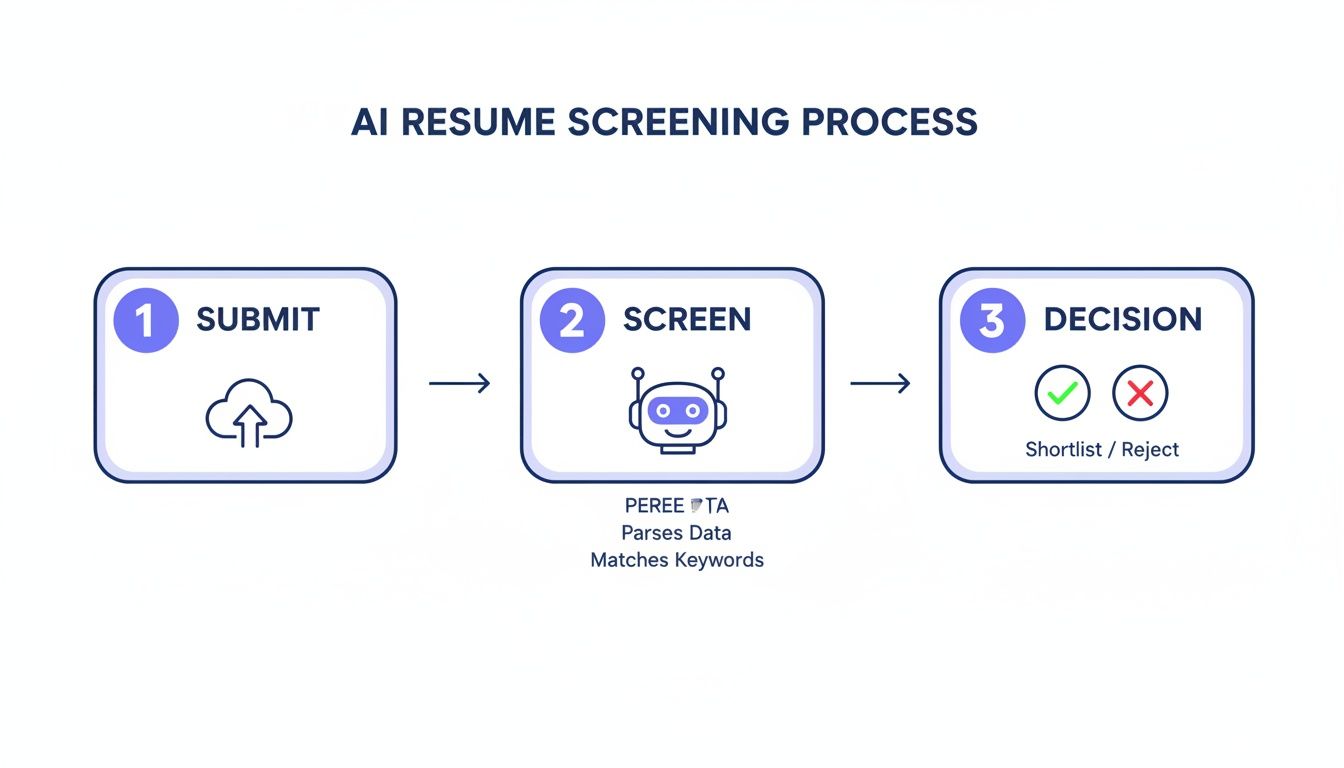
As the visual shows, that automated screening stage is the make-or-break moment where the vast majority of resumes are either moved forward or kicked out of the running.
Stage 3: Ranking and Shortlisting
Finally, the AI takes all the candidates who passed the initial scan and ranks them. The recruiter doesn't see a random pile of resumes; they get a ranked list with the highest-scoring candidates sitting right at the top.
Your position on that list is based entirely on your match score. You could be the perfect fit for the role in real life, but if your resume only scores a 75% match and another candidate hits 85%, they’ll be seen first.
For a popular job with hundreds of applicants, a hiring manager might only look at the top 10% of those ranked profiles. Your objective isn't just to get past the AI—it's to score high enough to land in that top-tier group that actually gets a human review.
The Unseen Risks of Automated Hiring
AI promises to streamline hiring, but it brings along a new set of hidden challenges that can push excellent candidates to the sidelines. These systems aren't neutral observers. They carry the baggage of the data they learn from, introducing major risks around fairness, accuracy, and your privacy. Before you decide if you should opt out of AI resume screening, you have to understand the potential downsides.
The biggest red flag is algorithmic bias. An AI model is only as fair as the data it’s trained on. If a company's historical hiring data shows a preference for candidates from certain universities or backgrounds, the AI learns to treat those patterns as the gold standard for success.
This creates a digital echo chamber, reinforcing and even amplifying the biases of the past. A brilliant, self-taught coder from a bootcamp could be consistently overlooked because the AI was trained on a decade of resumes from traditional computer science graduates. The system isn't malicious; it's just mindlessly repeating what it was taught.
When Your Creativity Becomes a Liability
Bias aside, the accuracy of these systems can be surprisingly brittle. AI screeners are built for predictability and structure, meaning they often get tripped up by anything unconventional. Your effort to stand out with a creative resume format could be the very thing that gets it tossed in the virtual trash.
AI recruiting platforms might claim 85-95% accuracy when pulling skills from a standard resume, but that number can plummet with unconventional layouts. In fact, up to 75-88% of critical qualifications can be missed entirely if the text is embedded in graphics or doesn't follow a rigid header structure.
This means a designer's beautifully crafted resume could get rejected by the machine simply because of its design. While AI handles standard formats with precision, its inability to parse creative layouts is a serious flaw. You can learn more about how these platforms screen resumes and what job seekers should know on edligo.net.
Common formatting choices that can trip up an AI include:
- Columns and Tables: These can scramble the parsing order, making your work history look like nonsense to the machine.
- Images and Graphics: Any text inside an image, like a logo or a skills chart, is often completely invisible to the AI.
- Unusual Fonts: It's always safest to stick to standards like Arial, Calibri, or Times New Roman.
These accuracy failures mean the system could miss your biggest achievements just because you didn't present them in the exact format it expected.
Your Personal Data in the Digital Filing Cabinet
Finally, you have to think about data privacy. When you submit your resume to an AI screening platform, you’re handing over a treasure trove of personal information—your name, contact details, work history, and skills. This data gets stored, processed, and analyzed by third-party software.
While most companies are bound by privacy laws, the specific policies of each AI vendor can differ widely. Your data might be used to train future algorithms or kept on file for years, long after the job you applied for has been filled. Understanding where your data is going is a crucial part of the decision. We explore the complex relationship between AI and user data more in our guide on building trust and safety in digital platforms.
When to Actively Bypass AI Screening
While tweaking your resume to get past the bots is a solid strategy most of the time, there are definitely situations where fighting the machine is the smarter move. Knowing when to sidestep the digital gatekeeper and get your resume directly to a human is a calculated decision—one that depends on your career, the specific role, and the company itself.
For a lot of job seekers, the whole debate boils down to one simple question: Can a machine really understand the nuances of my career journey? If you suspect the answer is no, it's time to find another way in.
You Have a Non-Traditional Career Path
Let's be honest: AI screeners are trained on data from people with neat, linear careers. They're great at spotting candidates who have climbed a traditional corporate ladder but get easily confused by anything that deviates from that predictable path.
Think about these scenarios where trying to get around the AI makes a lot of sense:
- Significant Career Changers: If you're a marketing director aiming for a job in software development, an algorithm will probably get stuck. It just won't see how your project management and client communication skills translate, even if they're a perfect fit.
- Long Employment Gaps: A lengthy gap on a resume can still trigger a red flag for a basic screening tool. The software doesn't know you were caring for a family member or backpacking through Asia; it just sees a blank space and ranks you lower.
- Portfolio-Driven Professionals: For creatives—designers, writers, architects, you name it—your portfolio is your real resume. An AI can’t look at your designs or read your articles, so your application is fundamentally incomplete until a person sees it.
The bottom line is this: If your biggest strengths aren't things you can boil down to a handful of keywords, you need a human to review your application first. Bypassing the AI isn't cheating; it's just making sure you get a fair shot.
You Are Pursuing a Specialized or Senior Role
The higher up you go, the less a simple keyword match matters. For senior or highly specialized positions, things like leadership style, industry reputation, and subtle experience carry way more weight than a checklist of software proficiencies.
You can't capture a CEO's value by scanning for buzzwords; it's demonstrated in a long history of strategic wins. Likewise, a senior research scientist's groundbreaking work can't be properly judged by an algorithm looking for jargon. It needs an expert eye.
This is where your professional network becomes your most valuable asset. A warm introduction from a trusted colleague is the single best way to get past the AI and put your resume directly into the right hands. It also helps to target smaller companies or startups, which tend to have more personal hiring processes. They simply don't have the firehose of applications that forces larger corporations to rely so heavily on automated filtering.
Decision Matrix: Bypass vs. Optimize
So, should you focus your energy on outsmarting the bots or getting around them entirely? It's a classic strategic choice. This table can help you weigh the factors and decide which approach makes the most sense for your specific situation.
| Consideration | Favors Bypassing AI | Favors Optimizing for AI |
|---|---|---|
| Your Career Path | Non-linear, with gaps or a major career change. | Traditional, with clear progression in one field. |
| Role Seniority | Executive, senior management, or highly specialized roles. | Entry-level, mid-level, or common corporate roles. |
| Industry Type | Creative fields (design, writing), academia, R&D. | Tech, finance, healthcare, large-scale corporations. |
| Company Size | Small-to-medium businesses (SMBs), startups. | Large enterprises, multinational corporations. |
| Your Network | You have a strong, relevant contact at the company. | You're applying "cold" with no internal connections. |
| Job Application Source | Referral, direct outreach, or networking event. | Applying through a large, public job board or portal. |
| Key Qualifications | Your value is in your portfolio, strategy, or soft skills. | Your skills align perfectly with keyword-heavy job descriptions. |
Ultimately, there's no single right answer. The best strategy is often a hybrid one. You might optimize your resume for the AI while simultaneously working your network to find a human connection. By understanding the game, you can choose the tactics that give you the best chance of winning.
Smart Strategies to Beat the System
Alright, you've got the lay of the land—you know when it makes sense to sidestep the AI and when you have to face it head-on. Now it’s time to get practical.
Whether you're planning a detour around the digital gatekeeper or preparing to optimize your resume for it, the right tactics will seriously boost your odds of landing an interview. These are two different paths, but they both lead to the same destination: getting your experience in front of an actual person.
One strategy involves finding a way around the automated front door, making sure your resume never even sees the algorithmic filter. The other is all about learning the system's rules so you can sail right through with flying colors.
The Art of Bypassing the AI
Going around the AI is, at its heart, about making a human connection. You’re trying to turn a cold, anonymous application into a warm introduction. This definitely takes some proactivity and a little detective work, but it’s often the single most effective way to get noticed, especially for specialized or senior positions.
Here are three powerful ways to get your resume seen by human eyes:
- Leverage Your Network for Referrals: This is the undisputed champion of bypassing AI. A referral from a current employee almost guarantees your resume lands directly on a recruiter’s or hiring manager’s desk. It's a powerful endorsement that immediately says, "Pay attention to this person."
- Identify and Contact Hiring Managers Directly: Use platforms like LinkedIn to figure out who your potential boss would be. A short, professional message that explains your interest and includes your resume can completely sidestep the formal application portal.
- Engage with Recruiters: Start building relationships with recruiters who specialize in your industry. They are always on the hunt for great talent and often have a direct line to hiring teams, making them a fantastic ally in your job search.
While 99% of Fortune 500 companies use Applicant Tracking Systems, the best results always come from pairing automation with human oversight. Recruiters who use AI for the initial shortlist but then apply their own judgment report a 20% gain in efficiency and make 46% better hires. This really drives home the value of getting your resume into human hands. Discover more insights about how human judgment complements AI in hiring on byu.edu.
This data shows exactly why bypassing that initial screen can be such a powerful move.
Creating an AI-Friendly Resume
If you have to go through the main application portal, your focus needs to shift to optimization. The goal is simple: create a resume that is easy for a machine to read, packed with the right keywords, and formatted for parsability.
This doesn't mean your resume has to be bland or generic. It just has to be strategically designed. A big part of navigating automated hiring is learning the art of crafting a perfect resume to beat the bots.
Here’s how to make your resume AI-proof:
- Mirror Keywords from the Job Description: Go through the job posting with a fine-tooth comb and pull out the specific skills, tools, and qualifications they mention. Weave these exact terms naturally into your resume, especially in your skills and work experience sections.
- Choose a Simple, Clean Format: Stick to standard, easy-to-read fonts like Arial or Calibri. Stay away from columns, tables, headers, footers, and fancy graphics. These elements can confuse the parsing software and cause it to miss critical information.
- Use Standard Section Headings: Don't get creative with your section titles. Use clear, conventional headings like "Work Experience," "Education," and "Skills." This helps the AI correctly categorize all your information.
- Submit the Right File Type: Unless the application specifically asks for something else, a .docx file is often parsed more reliably than a PDF. It’s also helpful to understand how digital files get analyzed in general, which you can learn more about in our article on how to tell if a photo is Photoshopped.
Answering Your Top Questions About AI Resume Screening
It's completely normal to feel a bit in the dark about how AI hiring tools work. Job hunting is stressful enough without adding a robot gatekeeper to the mix. Let's tackle some of the most common questions head-on so you can approach your next application with a clear strategy.
How Can I Tell If a Company Is Using an AI Screener?
Most companies won't hang a sign on their digital door saying, "Warning: AI at work." But the clues are almost always there if you know what to look for.
The biggest tell is the application process itself. If you're applying to a large corporation through a massive online portal, it's a safe bet an AI is your first reader. Platforms like Workday, Taleo, or Greenhouse are designed for this.
Here’s another dead giveaway: have you ever uploaded your beautifully formatted resume, only for the system to ask you to manually type every single job, date, and duty into a series of bland text boxes? That's not just for their convenience. The system is parsing your data—breaking it down into structured information it can easily analyze and score.
Frankly, for any big company, you should just assume an AI is involved and build your resume accordingly.
Will an AI Screener Automatically Reject Me for a Career Gap?
It's a definite risk, but not a guaranteed rejection. Older, more rigid Applicant Tracking Systems (ATS) are notorious for this. They see non-continuous employment dates, flag them as a negative, and sink your ranking before a human ever sees your name. The good news is that more modern AI tools are getting better and can be trained to look past gaps.
The smartest play isn't to try and hide the gap, but to make it a non-issue.
- Shift the focus: Pack your resume with concrete skills and impressive accomplishments from the jobs you did have.
- Use your cover letter: If you want to, you can briefly add context for the gap there. Don't over-explain, just be straightforward.
- Think about format: A skills-based or functional resume can highlight what you can do, but be warned—a simple, clean chronological layout is still the easiest for most systems to read without errors.
The goal is to make your qualifications scream louder than your timeline. When you emphasize the incredible things you've accomplished, the gap starts to fade into the background for both the AI and the human recruiter who will (hopefully) see your application next.
Are Online Resume Keyword Scanners Actually Worth It?
Yes, but think of them as a diagnostic tool, not a magic bullet. Services that scan your resume against a job description are fantastic for getting a glimpse of what the AI sees. They can quickly point out that you forgot to mention a key software or used different phrasing for a critical skill.
Just don't fall into the trap of keyword stuffing—cramming in terms just to boost your score. It makes your resume sound unnatural and will immediately turn off a human reader. Instead, use the feedback to make sure you've included important terms for skills you actually have. Your resume still needs to be persuasive and readable for a person.
Is It Possible to Avoid AI Altogether in My Job Search?
Completely? Probably not. But you can absolutely minimize its role and find a path around it.
Your secret weapon is networking. Nothing beats a referral. When a current employee walks your resume over to the hiring manager's desk (or DMs it to them), you've just skipped the entire AI screening process. It’s the number-one bypass method.
You can also be strategic. Spend your time building real connections with recruiters on LinkedIn, go to industry meetups, and focus on smaller companies that are more likely to review every application by hand. The aim is to create a direct line to a human being, making the AI screener totally irrelevant.