

Fake Video Detector: How It Spots Manipulated Footage

Open-source detection models' video AUC fell by about 50% on the in-the-wild Deepfake-Eval benchmark compared with earlier benchmarks, according to the benchmark's researchers. AUC measures how well a detector distinguishes manipulated from authentic material across scoring thresholds. The result shows why performance on clean footage may not predict how well a tool handles a particular file.
A dim face in a screen recording may be harder to assess, and repeated reposting can alter the video. A detector's score is a probability shaped by the footage and the model, not a verdict. Learning to use a fake video detector means understanding those limits, especially when the face belongs to a celebrity rather than an ordinary person.
Why Detectors Score Footage Instead of Judging It
A fake video detector returns a score indicating how strongly a clip resembles generated or manipulated material, not a verdict about its authenticity. Think of a laboratory test: the result can justify further investigation, but its meaning depends on the test, the sample, and how that sample was collected.
Suppose an editor receives a clip of someone apparently confessing to misconduct. A detector flags the face as suspicious. That result supports investigating the file, but it doesn't establish who edited it, whether the soundtrack is original, or whether the statement has been taken out of context.
A score needs context
The tool can examine individual frames, sound, movement across frames, and file information. Those checks address different questions, and a product may combine their outputs differently. Privacy is a separate consideration: before submitting evidence, you also need to understand what happens to the upload.
A confidence score isn't automatically a calibrated probability. Unless the provider explains its calibration, a synthetic score should be read as the model's assessment, not a guaranteed chance that the clip is fake.
Treat the result as a reason to investigate, not permission to accuse.
The practical goal is a defensible decision: share, hold, request better evidence, or escalate. That requires knowing what the detector examined, what it couldn't examine, and which human checks remain unfinished.
The Four Signals a Detector Checks
A building inspector wouldn't approve a house by looking only at its paint. Someone checks the walls, someone examines the wiring, and someone reviews the paperwork. Video analysis benefits from the same separation of responsibilities.
The diagram illustrates that layered inspection approach, including source information that can support the technical checks.
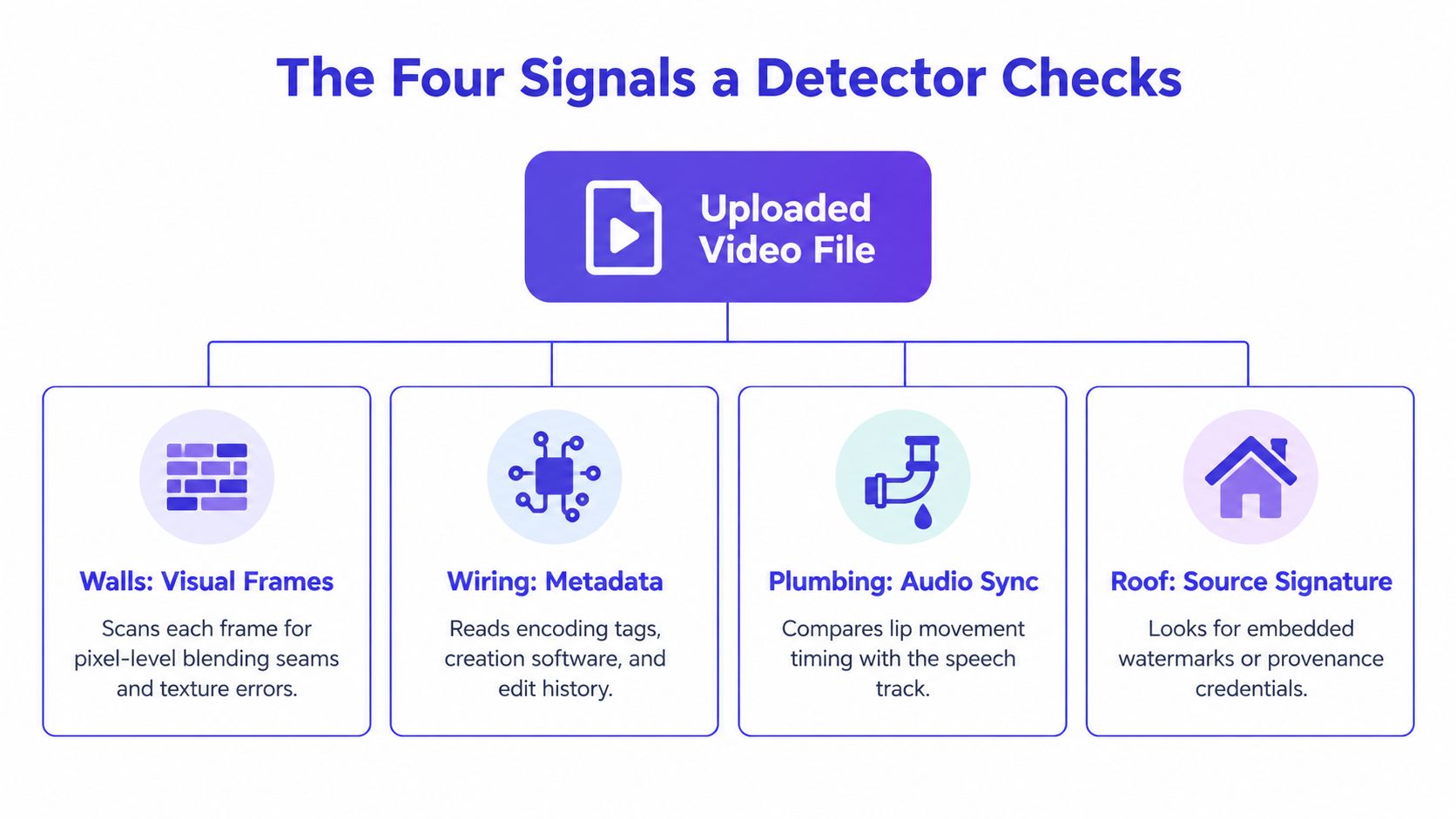
The four detector signals and their weak points
| Signal | What It Examines | Typical Irregularity | Main Weakness |
|---|---|---|---|
| Frame-level analysis | Individual video frames and faces | Possible GAN fingerprints, diffusion artifacts, blending seams, unnatural texture | Heavy compression and low resolution hide fine detail |
| Audio forensics | Soundtrack and voice | Possible spectral anomalies, cloned-voice artifacts, missing room tone, odd breathing | Noise, music beds, and overlapping speech complicate interpretation |
| Temporal consistency | Sequences of frames over time | Motion discontinuities, flicker, identity drift, lip-sync offset | Low frame rates and very short clips provide little motion to test |
| Metadata inspection | File container and encoder tags | Encoder mismatch, missing creation data, editing-software tags | Re-uploads can strip tags, while legitimate edits can change them |
Agreement matters more than an isolated flag
These are separate evidence channels, not necessarily statistically independent measurements. Compression, for example, can affect both facial detail and apparent motion. Agreement therefore deserves attention, but shouldn't be mistaken for several completely independent confirmations.
A visual flag with coherent motion and ordinary audio calls for a different investigation from a clip with suspicious facial boundaries, unstable identity, and unexplained soundtrack changes. Likewise, an editing-software tag tells you that software handled the file, not that someone fabricated its contents.
Before interpreting a combined result, ask:
- Coverage: Did the tool analyze the soundtrack and moving sequences, or only selected images?
- Visibility: Was the relevant face large and clear enough to inspect?
- Explanation: Does the report identify suspicious regions or merely display a label?
A useful report should help you understand the evidence, rather than ask you to trust an unexplained number.
Frame Analysis for Faces and Pixels
A magician's trick can look flawless from the audience seat while leaving clues around the stage machinery. Frame analysis takes the closer view, looking for inconsistencies that disappear during normal playback.
This illustration captures the central problem: a familiar-looking person on a screen isn't proof that the recording is authentic.

Texture, edges, and facial boundaries
A detector may search for GAN fingerprints, meaning statistical patterns in texture or noise associated with generative adversarial networks. Think of these as possible manufacturing traces, not visible signatures that identify every generated image. A viewer usually can't establish their presence just by enlarging a face.
For suspected diffusion-generated material, an analyst might examine unusually regular skin, unstable hair edges, or distorted writing in the background. These are inspection prompts, not reliable rules for identifying a particular generator. Real camera processing and ordinary editing can also produce strange-looking detail.
With a possible face swap, attention shifts to the jaw, hairline, ears, and neck. Does the face appear to blend naturally into the surrounding image? Does its lighting fit the body and setting? Eyes and teeth offer further comparison points, although an odd reflection or blurred tooth is never sufficient evidence on its own.
Why a sequence beats a screenshot
A single selected frame can exaggerate an innocent glitch or conceal a brief manipulation artifact. Examining sampled frames across the clip helps an analyst distinguish a persistent inconsistency from an isolated decoding or motion-blur problem.
The research foundation includes FaceForensics++, introduced in 2019, with 1,000 authentic videos and 4,000 manipulated videos spanning DeepFakes, Face2Face, FaceSwap, and NeuralTextures, as described in this review of deepfake-detection benchmarks. Its controlled comparisons helped researchers evaluate different manipulation methods, but success on known methods doesn't guarantee success on unfamiliar footage.
For a visual companion, inspect the video critically rather than treating its appearance as an authenticity test.
Before accepting a visual flag, make a short manual check:
- Inspect boundaries: Follow the jaw and hairline during head turns.
- Compare lighting: Look for unexplained differences between the face, neck, and surroundings.
- Check persistence: Determine whether the same problem appears across neighboring frames.
- Consider alternatives: Blur, beauty filters, sharpening, and difficult lighting deserve consideration before manipulation.
Audio and Motion Checks Across Time
A recorded band can look convincing until you notice that the singer's mouth and the soundtrack don't quite meet. Video forensics applies a similar idea, but it must distinguish suspicious timing from ordinary recording and playback problems.
Sound matters because a visually plausible face can accompany a manipulated voice. In 2024, 49% of surveyed companies reported experiencing both audio and video deepfakes, compared with 29% reporting video deepfakes in 2022, according to Regula and Sapio Research. Those are different reporting categories, so they shouldn't be presented as a like-for-like measure of video-only growth.
Listening to the recording environment
Audio analysis can examine a spectrogram, a visual map showing how sound frequencies change over time. An analyst may use it to investigate unusual frequency patterns, abrupt transitions, or other features that warrant closer listening.
Possible inspection cues include oddly uniform breathing, abrupt changes in background sound, or a voice that seems acoustically disconnected from the visible room. None is a universal cloned-voice marker. A noise-reduction filter, close microphone, or edited soundtrack can offer an ordinary explanation.
For example, a person shown in a large room might sound unusually dry and close. That discrepancy raises a question about the recording setup, not an immediate conclusion that the speaker is synthetic. The next useful step is to ask how the sound was captured.
Following movement rather than appearances
Temporal analysis compares what happens across frames. It can investigate a facial boundary that flickers during movement, an expression that changes abruptly, or identity drift, where facial features appear to change shape during the sequence.
Lip-sync analysis asks whether visible speech movements align with the soundtrack. A timing offset needs context because legitimate files can also acquire synchronization problems. A short excerpt or sparse frame sequence may provide too little evidence for a dependable assessment.
Viewing advice: Use slowed playback to locate a possible mismatch, then return to normal speed before deciding what it means.
Manual review works best when it asks specific questions:
- Speech timing: Do mouth closures and openings plausibly follow the spoken sounds?
- Head turns: Do facial features remain coherent as the person rotates?
- Sound continuity: Does the background change abruptly without a visible explanation?
- Recording setup: Could dubbing, conferencing software, or editing explain the discrepancy?
Record the timestamp and observation. “The mouth appears delayed during this phrase” is a useful note; “the person looks fake” isn't.
Metadata and Compression Traces in the File
Metadata is like a shipping label. It can help explain where a parcel has been, but someone can replace the label or remove it entirely.
An analyst can inspect encoder names, codec settings, creation fields, device information, and editing-software tags where those fields exist. An inconsistency is a lead to investigate. It isn't a substitute for examining the actual recording.
File history isn't the same as content truth
A creation timestamp might describe an export rather than the original capture. An editing-software tag could reflect harmless trimming, captions, or accessibility work. Conversely, absent device information doesn't establish that a video was generated.
Use a metadata requirements guide to understand what information is available before interpreting a report. The right question is whether the file's available history fits the account of how it was recorded and delivered.
Compression complicates the content analysis as well. In a cross-dataset study using FaceForensics++, DFDC, and Celeb-DF, one baseline's AUC fell by 0.105 and its equal-error rate increased by 0.109 under a harsher raw/C40 condition relative to the stronger comparison setting, according to the compression study.
When the copy changes the evidence
Compression removes fine spatial detail and changes coding features such as block boundaries and motion information. Those changes can erase traces a detector relies on or introduce patterns it misinterprets. A model may then respond partly to encoding quality rather than manipulation.
The practical comparison is between the untouched source file and the circulating copy, when both are available. A changed score doesn't prove either file is fake. It demonstrates that the assessment is sensitive to the representation being tested.
- Keep versions separate: Label the source, platform download, and screen recording clearly.
- Avoid unnecessary exports: Don't “improve” the evidence with sharpening or repeated saving before testing.
- Document transformations: Note known cropping, resizing, transcoding, and reposting.
- Request quality-specific evidence: Ask whether the detector was evaluated on footage resembling your copy.
Practical rule: Investigate a score change between versions instead of selecting whichever result supports your preferred conclusion.
Reading a Confidence Score Without Being Misled
A low synthetic score on a reposted copy means the detector found little evidence in that copy, not that it proved the recording authentic. A high score on a clean original deserves closer investigation, particularly when the tool has been validated on comparable material.
A benchmark based on the Political Deepfakes Incident Database reported maximum AUCs of 74.78% for images and 73.67% for videos, according to the real-world benchmark researchers. Those are benchmark discrimination measures, not the probability that an individual flagged clip is fake.
Match the result to the evidence conditions
Real footage varies in lighting, camera processing, resolution, frame rate, and upload history. For interpreting the output, confidence calibration matters because the score needs to reflect conditions resembling actual use.
What each detector result usually means
| Result Pattern | What It Usually Means | Next Step |
|---|---|---|
| High synthetic score on the original file | Strong sign of generation or manipulation, subject to validation and calibration | Corroborate with the source, uploader history, and independent footage before acting |
| Low synthetic score on a reposted, compressed copy | No evidence detected, not proof of authenticity | Find the original file and check where it first appeared |
| Frame flags but audio and motion look clean | Signals disagree; the result is inconclusive | Escalate to human review and log the score and detector version |
| Clip is AI-generated but openly labelled or fictional | Synthetic, but not necessarily deceptive | Confirm disclosure and check whether a real person is impersonated |
| Low light, multiple faces, or screen recording | Evidence may be insufficient or difficult to interpret | Give the score less weight and request a higher-quality source |
| Non-celebrity or ordinary person's face | Training-data differences may reduce reliability | Corroborate with the person named or independent sources |
Ordinary faces deserve representative testing
A 2025 assessment of 16 leading detectors by CSIRO and Sungkyunkwan University found that none reliably identified real-world deepfakes; it also found substantially worse performance on non-celebrity faces for a detector trained on celebrities, according to CSIRO's research announcement.
That doesn't make an ordinary person's recording suspicious by its nature. It means celebrity-heavy evaluation can give an incomplete picture of a tool's usefulness for everyday footage.
When tools disagree, don't average their outputs unless their scoring systems justify that operation. Preserve the disagreement as an inconclusive finding. Every path in the table ends with corroboration or further review, not unquestioning acceptance of a label.
Illustrative Scenarios From Newsrooms, Fraud and Classrooms
By May 31, 2024, Hong Kong police had received reports of 21 online deepfake video clips impersonating government officials or celebrities, according to the Hong Kong government.
The workflows below are illustrative, not documented case studies. Each shows how a detector can add evidence while leaving the decision to people who can check the source and context.
A newsroom holds an unverified clip
A verification editor receives a clip that appears to show a public official making an inflammatory statement. The detector flags parts of the face, but the file is only a downloaded social-media copy. Compression and reposting can blur visual clues, so the score is a probability based on that copy, not a verdict about the original recording.
The editor asks for the source file, reviews the uploader's history, and seeks independent witnesses or footage. Publication stays on hold until the statement is corroborated. The decision rests on the evidence, not on a detector label. A breaking-news verification workflow can help editors organize those checks.
A finance team verifies the instruction
Deloitte projected that US generative-AI-enabled fraud losses could reach US$40 billion by 2027, up from US$12.3 billion in 2023, in its fraud-loss analysis. The projection concerns a broader fraud category, not a measured total for video-call scams.
In an illustrative incident, a finance manager receives an urgent payment request during a call with someone who appears to be an executive. A review of an authorized recording produces an ambiguous score. The manager pauses the transaction and contacts the executive through an established channel. Authorization procedures determine whether payment proceeds.
A teacher checks purpose and disclosure
A teacher reviews a training video featuring a presenter who appears synthetic. Detection raises a question, and the publisher confirms the presenter is a fictional character whose use is disclosed.
The teacher can then assess the lesson's accuracy, permissions, and suitability. Synthetic production does not by itself mean deception, just as an authentic recording does not prove that its claims are accurate.
The right follow-up depends on the decision at hand: verify the event before publication, confirm authorization before payment, or assess accuracy and disclosure in class. A detector helps focus those checks, but it cannot make them for you.
Confirm the Video Before You Share or Act
A detector score is one clue, not a verdict. Compression, reposting, or a face's familiarity can affect how much weight to give it. Before sharing a disputed clip or acting on its instructions, preserve the file and check for independent confirmation.
Before uploading or sharing, check the tool's retention policy, the personal information in the clip, and whether you have permission to submit it. Sensitive evidence may need an approved internal process instead of a public upload.
Alongside specialist forensic review and provenance checks, AI Video Detector states that it doesn't store user videos, offers basic detection without signup, and reports confidence scores. Check current terms before submitting confidential material. A privacy check before uploading helps protect both the people in the clip and the evidence.
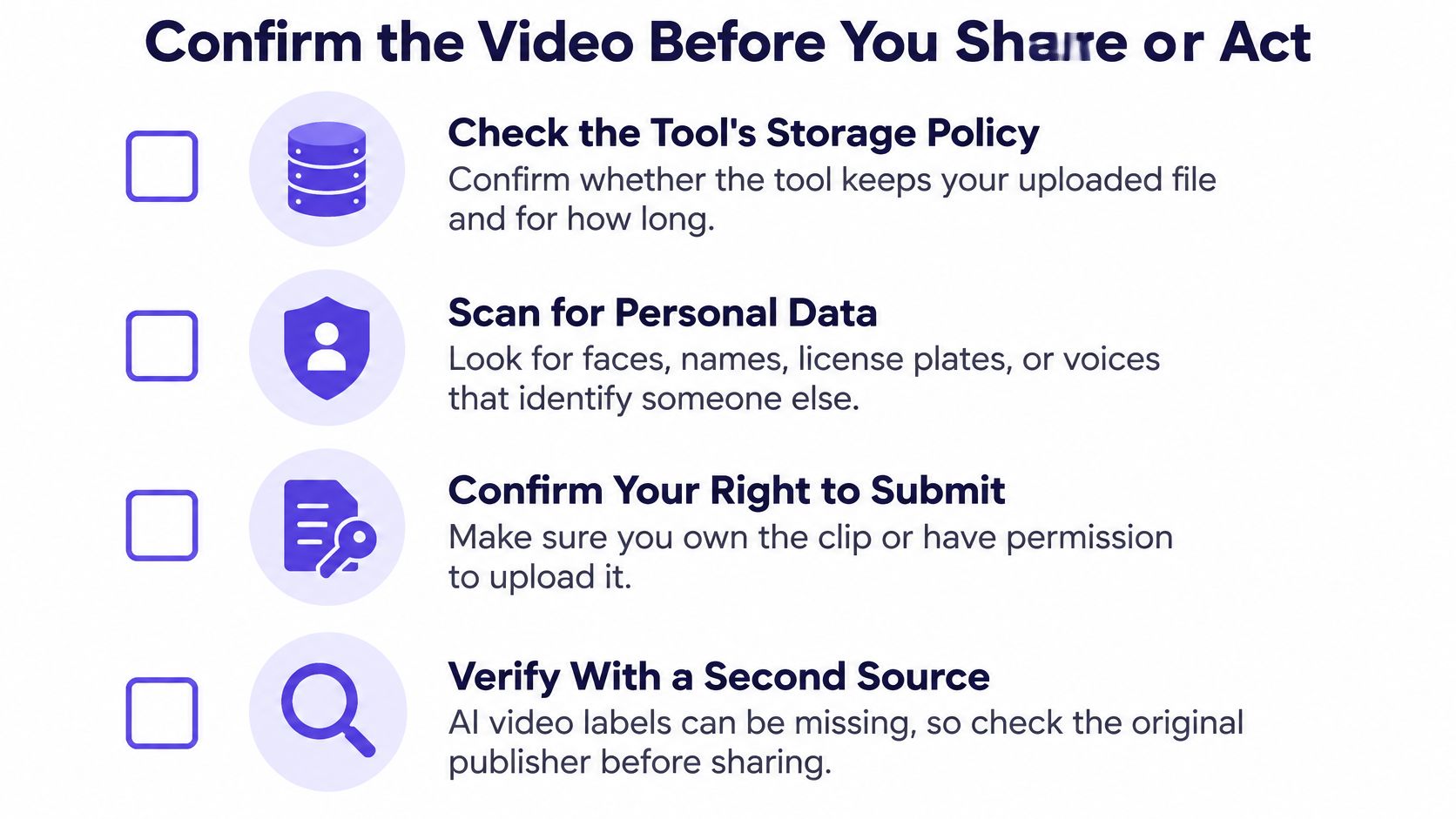
Keep a reviewable record
The evidence-preservation approach is consistent with professional guidance on AI-related evidence.
- Preserve the original. Keep the untouched file, its source, and the time received. Hash and log working copies when appropriate.
- Test the source file. Avoid using a version that has been unnecessarily re-saved.
- Record the analysis. Save the detector name, available version information, score, and report.
- Investigate the uploader. Review the account history and search for earlier appearances of the footage.
- Seek independent confirmation. Contact the person depicted through an established channel or find separate evidence.
- Document the decision. Note what remains uncertain. Escalate high-impact or conflicting findings for qualified human review.
If results are inconclusive or detectors disagree, keep the uncertainty visible and seek corroboration before acting. A detector narrows the question; corroboration answers it.


