

Metadata Requirements for Video Authentication

A newsroom receives a viral video that supposedly captures a breaking incident. The file opens normally, but it has no trustworthy creation timestamp. Its container metadata names a generic encoding tool, and the embedded GPS coordinates place the recording in the wrong city. Editors now have a file that looks usable, yet little evidence about where it came from, what happened to it, or whether anyone altered it before submission.
That situation is common across journalism, litigation, platform moderation, and corporate security. Metadata can reveal contradictions, preserve an audit trail, and support attribution, but its presence doesn't establish that the depicted event happened. Effective metadata requirements make an investigation reproducible and defensible. They turn an opaque media file into a documented evidence item without pretending that technical fields can answer factual questions on their own.
Why Metadata Requirements Matter for Video Authentication
The first mistake teams make is treating metadata as either proof or noise. A timestamp may support a claim about when a camera produced a file, while a codec field may reveal that the file passed through editing software. Neither fact, by itself, proves that the video is genuine. A missing field also tells investigators very little unless they know how the file was acquired, downloaded, transferred, or transcoded.
A newsroom handling the example above should preserve the submitted file before opening it in an editor or converting it for review. It should record the source account, download context, acquisition time, original filename, file size, and cryptographic hash. It should also extract the technical fields into a separate record, retaining parser warnings instead of discarding them.
Metadata is an investigative signal
Useful requirements answer practical questions:
- Where did the file come from? Record the submitting person or system, acquisition channel, source URL where applicable, and any stated camera or device.
- What happened to it? Capture editing, transcoding, remuxing, repair, upload, download, and export events.
- Who handled it? Associate actions with people, services, tools, or devices.
- What relationships exist? Link an original file to derivatives, screenshots, clips, and reports.
- Can another examiner reproduce the result? Preserve the original, extraction method, tool version, timestamp, and warnings.
For teams that need a practical overview of file fields before designing a pipeline, the RenderIO metadata reference is a useful technical starting point. It helps distinguish ordinary file properties from the broader provenance record required in an investigation.
Practical rule: A metadata result should change what you investigate next, not end the investigation.
Courts and platform reviewers care about more than whether a file contains EXIF or container fields. They may ask who acquired the evidence, whether the original survived, who accessed it, whether transfers were documented, what processing occurred, and which forensic methods produced the conclusion. Missing or contradictory metadata therefore creates a credibility problem, but it isn't an automatic finding of manipulation.
W3C PROV-DM Foundational Metadata Requirements
The W3C PROV-DM Recommendation, published by the World Wide Web Consortium on 30 April 2013, provides a useful conceptual foundation for provenance metadata. It defines provenance as information about the entities, activities, and people involved in producing, influencing, or delivering a digital object. The W3C PROV-DM specification treats provenance as a relationship model, not merely a collection of descriptive fields.
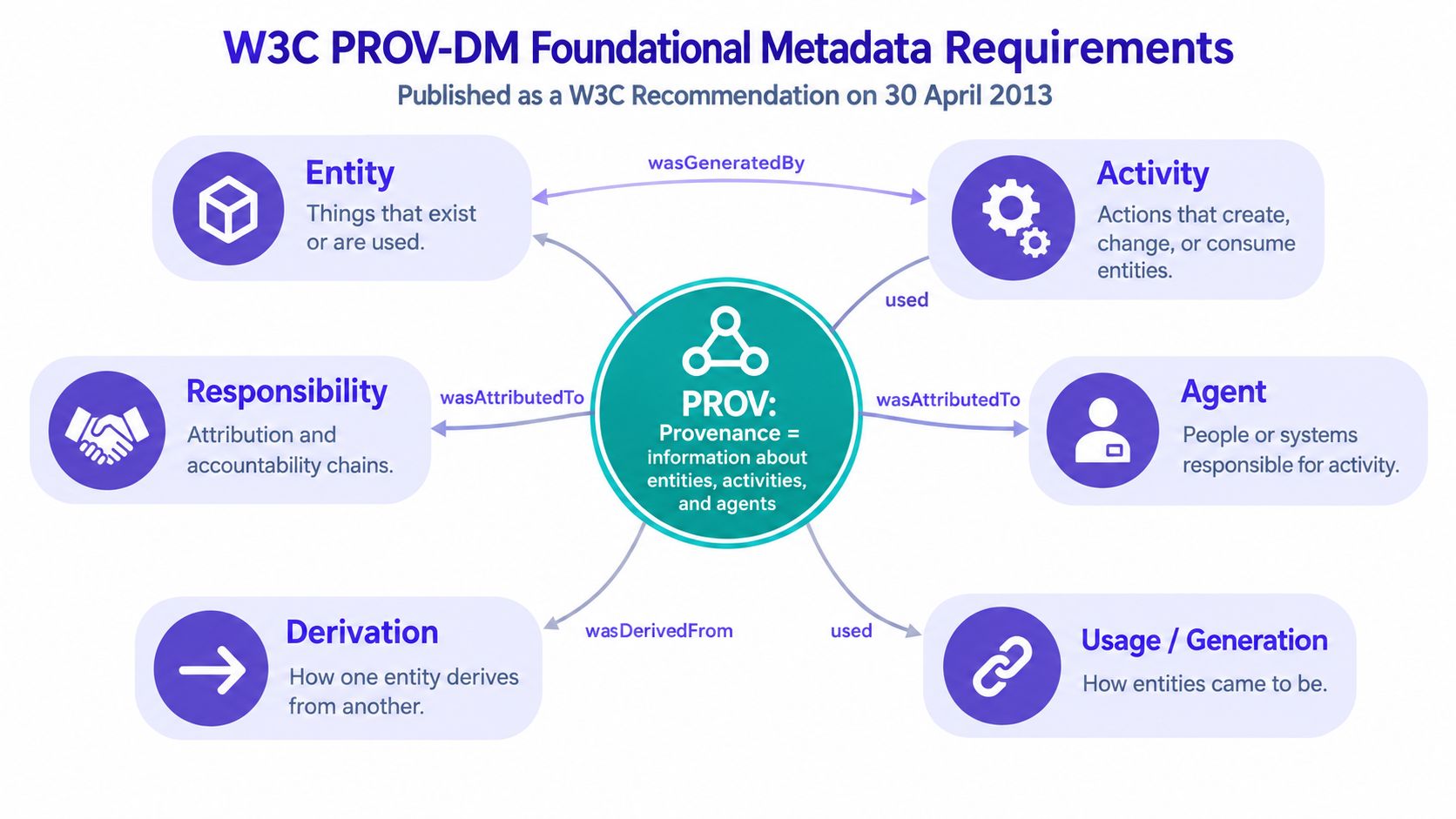
For video authentication, the model maps naturally onto an evidence chain:
- An entity can be the camera original, a downloaded copy, a transcoded derivative, or an analyst's report.
- An activity can be recording, editing, uploading, downloading, transcoding, inspection, or export.
- An agent can be a person, camera, editing application, platform, or verification service.
- A derivation relationship can connect a social-media download to the file submitted for examination.
- A responsibility relationship can associate an action with the system or person that performed it.
Why a generic model helps
PROV-DM is intentionally generic. A newsroom, archive, court, and enterprise security team can represent provenance in different systems while translating their records into a common conceptual structure. The wider W3C PROV family includes a data model, an OWL2 ontology, human-readable notation, access and query guidance, and mappings to established vocabularies such as Dublin Core.
That interoperability matters when evidence crosses organizational boundaries. A platform may provide download metadata, a newsroom may add editorial handling events, and a forensic examiner may append analysis results. If each record preserves the same basic relationships, another party can understand how the submitted object relates to earlier and later versions.
PROV-DM still has a hard limit. Provenance metadata can be removed, rewritten, or fabricated. A detailed history supports accountability and review, but it doesn't independently prove that the camera captured a real event or that an identified person made the claimed recording. Treat PROV-DM as a structure for documenting what is known, what was done, and who was involved.
PREMIS Preservation Metadata Requirements
Provenance describes relationships. PREMIS adds an operational preservation mindset, asking how an institution will maintain, identify, manage, and document a digital object over time. The Library of Congress identifies PREMIS as a practical resource for preservation metadata, with an emphasis on the information needed to support long-term management of digital materials.
That distinction matters because an evidence file is not preserved just because someone saved a copy. A defensible process must show which object was received, where it was stored, what actions were performed, and how later derivatives relate to the submitted item. A report that omits those details may describe a highly refined analysis without showing whether the analyst examined the original evidence.
Build the record around the lifecycle
A preservation-oriented policy should separate metadata categories rather than placing every value into one undifferentiated record:
- Descriptive metadata identifies the subject, stated source, language, and editorial or investigative context.
- Technical metadata records the container, streams, codecs, dimensions, timing, audio properties, and other file characteristics.
- Rights metadata records ownership, permissions, licensing, and restrictions on use or disclosure.
- Provenance metadata connects the object to its origin, transformations, systems, and responsible actors.
- Event metadata documents acquisition, inspection, conversion, repair, export, transfer, and validation activities.
PREMIS is particularly useful for forcing teams to document events that are easy to overlook. If an examiner repairs a damaged index, converts a file for a specialist tool, or extracts a representative frame, that action belongs in the record. The working derivative can be useful, but it must remain visibly distinct from the preserved evidence item.
Preserve the evidence first, then create working copies. Never let convenience erase the object you were asked to authenticate.
The practical outcome is an auditable chain involving file identity, fixity checks, processing history, storage context, and custody records. PREMIS doesn't prescribe one universal checklist for every video format. It supplies a disciplined way to decide what must remain known as the object moves through review.
EBUCore Structured Ingestion Schema
An ingestion pipeline needs more than a free-text note saying “video received.” EBUCore offers an audiovisual framework for asset identification, content description, rights, technical parameters, and publication events, making it a useful interoperability baseline for production and archival workflows. Its technical metadata framework includes fields for container, codec, resolution, bitrate, duration, and related audio-video properties.
Capture the following at intake:
| Record area | Values to preserve |
|---|---|
| Asset identity | Original filename, byte size, cryptographic hash, source reference |
| Container and streams | Container identifier, stream count, codec identifiers, dimensions |
| Timing | Frame rate, time base, duration, timecode |
| Video properties | Resolution, bitrate, pixel and encoding characteristics |
| Audio properties | Sampling rate, channel layout, audio codec details |
| Context | Creation and modification timestamps, language, rights |
| Processing record | Tool version, UTC extraction time, parser warnings, transformations |
The raw value matters. Store it alongside a normalized representation. A parser might return a duration in one format while the normalized record represents it consistently for search and comparison. A remux or transcode may change container fields without changing the underlying frames, so overwriting the original extraction would hide an important part of the processing history.
Preserve both evidence and interpretation
At intake, preserve the original file byte-for-byte and calculate its cryptographic hash. Extract metadata with a named tool and record its version, the UTC timestamp, and every warning. Keep the extraction output separate from analyst interpretation, so a later reviewer can distinguish “field absent,” “field malformed,” and “field changed during processing.”
This distinction is valuable for automated review. A model should not treat an absent timestamp, an invalid timestamp, and a timestamp that disappeared after platform processing as the same condition. The ingestion schema should expose those states instead of reducing them to a misleading yes-or-no authenticity flag.
EBUCore also helps teams keep rights and publication context in view. A newsroom may need to know whether it can publish a clip, while an archive may need to preserve the relationship between a master, a broadcast version, and a web derivative. Technical metadata supports forensic comparison, but contextual and rights metadata determine how the evidence can be handled responsibly.
C2PA Cryptographic Provenance Requirements
Ordinary EXIF, XMP, and container fields are assertions embedded in a file. They may be useful, but a later export can remove or rewrite them. C2PA changes the evidentiary mechanics by allowing provenance assertions to be cryptographically bound to an asset and signed by an identified actor or device. The C2PA explainer describes assertions concerning creation, editing, timing, location, and ingredients.
A conforming verifier can test whether a manifest is correctly formed, associated with the asset, and free from tampering. That answers a narrower question than many users expect. C2PA can support the integrity of an asserted production history, but it doesn't determine whether the underlying claim is true or whether the video depicts an authentic event.
Report explicit validation states
A verification system shouldn't collapse every result into “credential found” or “credential missing.” It should return at least these states:
- Manifest absent. No signed provenance record was available in the examined media.
- Manifest present and cryptographically valid. The record is associated with the asset and passes the relevant integrity checks.
- Manifest present but invalid, incomplete, or detached. The record exists, but the verifier found a problem with its association, structure, completeness, or validation.
Retain the signed manifest as evidence. The record should include certificate-chain details, signer identity or pseudonym, assertion labels, ingredient relationships, and validation time. Those details let a later reviewer understand exactly what was signed and what the signature did not cover.
C2PA is therefore stronger than an unexplained metadata field, but it isn't a truth machine. A valid credential may document that an identified device or actor asserted a creation or editing history. It can't independently establish that the scene wasn't staged, that the location claim was truthful, or that the event occurred as described.
Teams implementing this layer can pair signed provenance with an explanation of C2PA Content Credentials to clarify what the credential validates. The practical design principle is simple: cryptographic validity belongs in the result, but it must sit beside content analysis and external corroboration, not replace them.
Four Layers of Metadata and Evidence
Investigators often ask whether a video is “authentic” as though one technical test can answer the question. A stronger approach separates four layers. Each layer answers a different question, and each has a different failure mode.
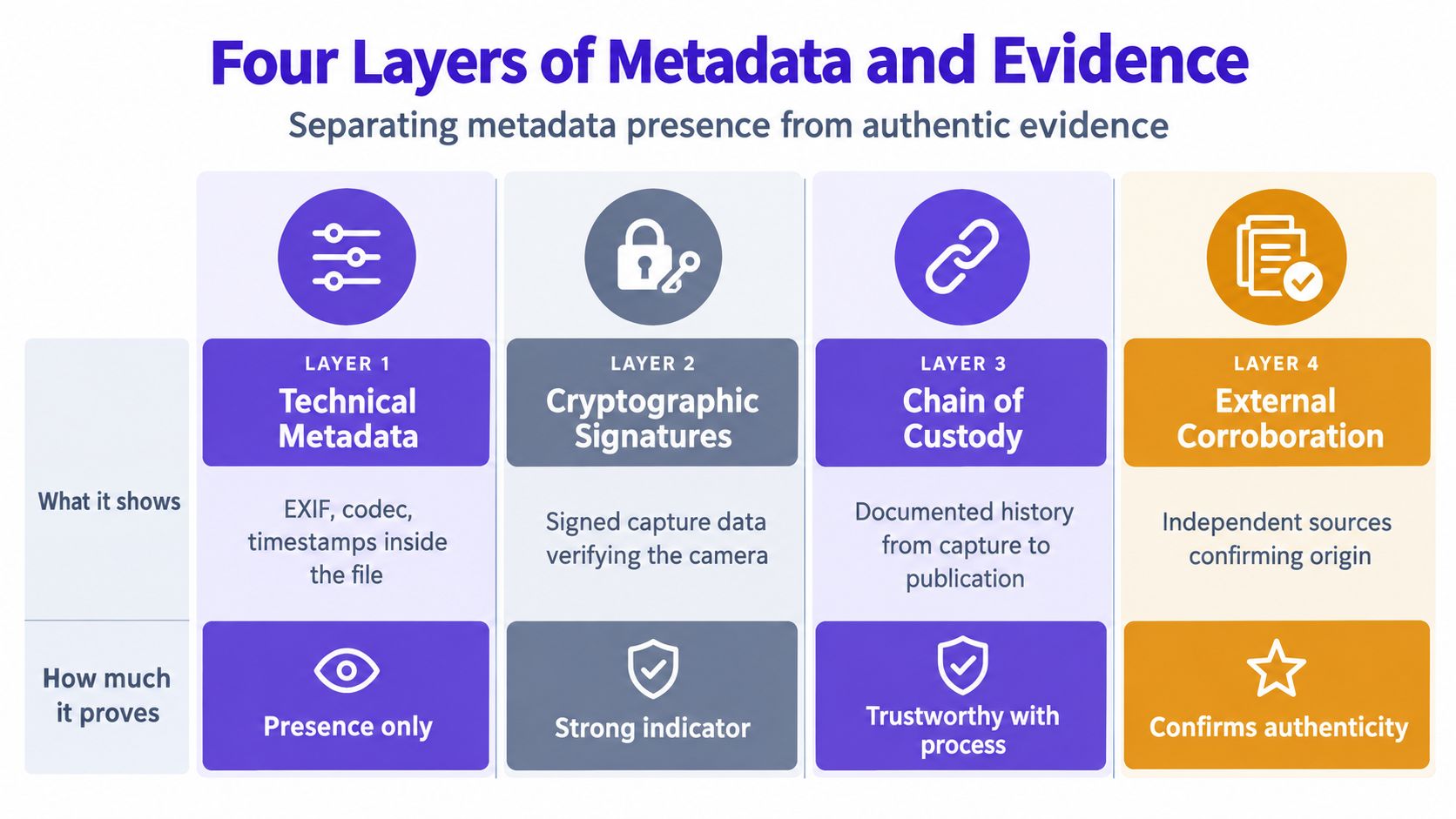
| Layer | What it shows | What it can support | What it cannot establish |
|---|---|---|---|
| File metadata | EXIF, container fields, timestamps, GPS, codecs | Technical consistency and investigative leads | That the recording or event is genuine |
| Cryptographic integrity | Whether bytes stayed unchanged after acquisition | File continuity from the hashing point | That the original recording was truthful |
| Provenance credentials | Signed production and editing assertions | Claimed creation history and signer association | That the depicted scene actually happened |
| Content-level analysis | Frame, audio, temporal, and encoding signals | Signs of manipulation or synthesis | A complete conclusion without context and corroboration |
Why the layers must remain separate
A hash is powerful for showing that the examined file hasn't changed since acquisition. It doesn't tell you whether someone supplied a fabricated file at acquisition. Likewise, a C2PA signature can validate a manifest while leaving the factual scene unresolved. A codec inconsistency may suggest a processing event, but legitimate editing and platform recompression can produce similar traces.
Court guidance asks broader questions about file origin, access history, preservation, transfer records, editing events, forensic methods, and corroborating sources, rather than treating metadata as conclusive. That makes the investigator's written reasoning as important as the detector output.
A detector can identify an anomaly. The examiner must explain what the anomaly means, what alternative explanations remain, and what evidence would resolve them.
For operational teams, a crypto audit workflow guide can help translate hash and event logging into a repeatable audit process. Apply that discipline to media evidence, but don't confuse an audit trail with factual corroboration. The strongest conclusion usually comes from agreement among preserved files, documented handling, technical analysis, provenance records, and independent evidence.
How Metadata Requirements Are Evolving
Provenance standards are becoming more capable, but adoption doesn't create universal coverage. C2PA version 2.2 was released in May 2025 and supports provenance implementation for MP4, MOV, and WebM, according to the C2PA specification overview. That gives video workflows a more structured route to signed creation and editing history than ordinary embedded fields.
The gap appears at the edges. A capture device or editing tool may not sign a file. A platform may transcode an upload and remove the credential. A manifest may record only part of the media history. Legacy footage, screen recordings, and recompressed social-media clips can therefore arrive without a credential even when no manipulation occurred.
Treat absence as unknown
A missing Content Credential should normally mean unknown, not fake. It tells the reviewer that this workflow cannot provide signed provenance for the examined asset. The correct next action is to preserve the file, inspect its technical and content-level signals, compare independent copies, and seek corroboration.
A valid credential also requires careful wording. It can authenticate an asserted production history, signer relationship, or editing event. It doesn't authenticate the truth of the scene, the honesty of the signer, or the broader claim attached to the post.
That distinction changes how product teams should design results. They should display credential status separately from frame-level, audio, temporal, and encoding findings. A metadata testing tool can support that inspection, but no metadata interface should turn “not found” into “manipulated” without additional evidence.
The durable requirement is layered compatibility. Systems should verify provenance when available, preserve unsigned legacy media, document recompression, and continue content-level examination. Mature standards improve the evidence record. They don't eliminate uncertainty.
Repeatable Authentication Workflow
A disputed clip lands in legal review after spreading across platforms. One copy has sparse metadata. Another has different timestamps and encoding details. In that situation, the question is not whether metadata exists. The question is whether the handling of the file and the supporting record let another examiner reach the same result.
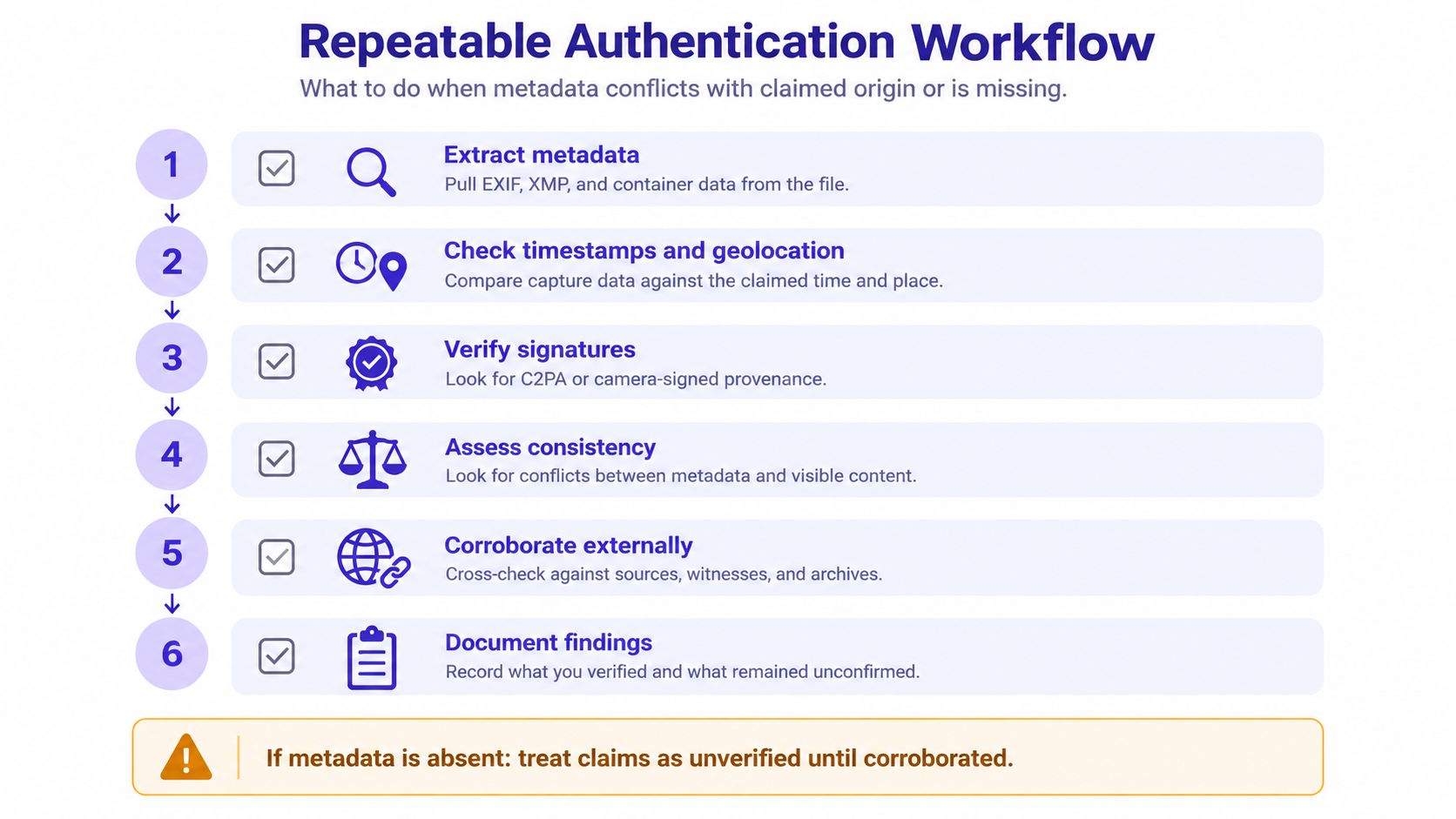
Use a workflow that preserves evidence first and interpretation second.
- Preserve the submitted file. Save the original byte-for-byte in controlled storage. Avoid opening it in software that may rewrite headers before the preserved copy exists.
- Calculate a cryptographic hash. Record the hash at acquisition and tie it to the evidence identifier, acquisition time, and custodian. This proves continuity for that file after collection. It does not prove the scene is real or the claim attached to the video is true.
- Document every transfer. Record who supplied the file, who accessed it, how it moved, and whether a platform download, message export, or archive retrieval altered the object.
- Extract metadata non-destructively. Capture raw and normalized values, tool version, UTC extraction time, parser warnings, and the exact file examined. A practical guide to checking video metadata helps standardize this step.
- Compare independent material. Look for the source device, earlier downloads, platform copies, witness accounts, surrounding footage, or archival captures. Differences can indicate a derivative copy, not fabrication.
- Write bounded findings. State what was verified, what remains unknown, which transformations occurred, and what the available evidence supports.
Keep the conclusion narrower than the suspicion
Authentication work usually rests on chain of custody, metadata, forensic tools, and corroborating sources together. Any single element may be incomplete. A missing timestamp is a limitation to record. A stable hash supports continuity after acquisition. A content anomaly may justify more examination, but it does not settle authorship or factual truth by itself.
An AI-video detector may inspect container, codec, and encoding details alongside frame-level, audio, and temporal signals. AI Video Detector is one example of a tool that includes metadata inspection within a broader analysis workflow. Treat that output as an investigative signal and keep the original file, extraction record, and acquisition history separate in the case file.
If metadata is absent, preserve the absence as a finding, not as a verdict.
Metadata Requirements by User Role
The right metadata record depends on who will rely on it. A newsroom needs rapid origin assessment and publication context. A legal team needs a defensible custody record. An archivist needs long-term identity and preservation events. A marketing team may focus on rights and attribution. The underlying file can be the same while the required evidence record differs.
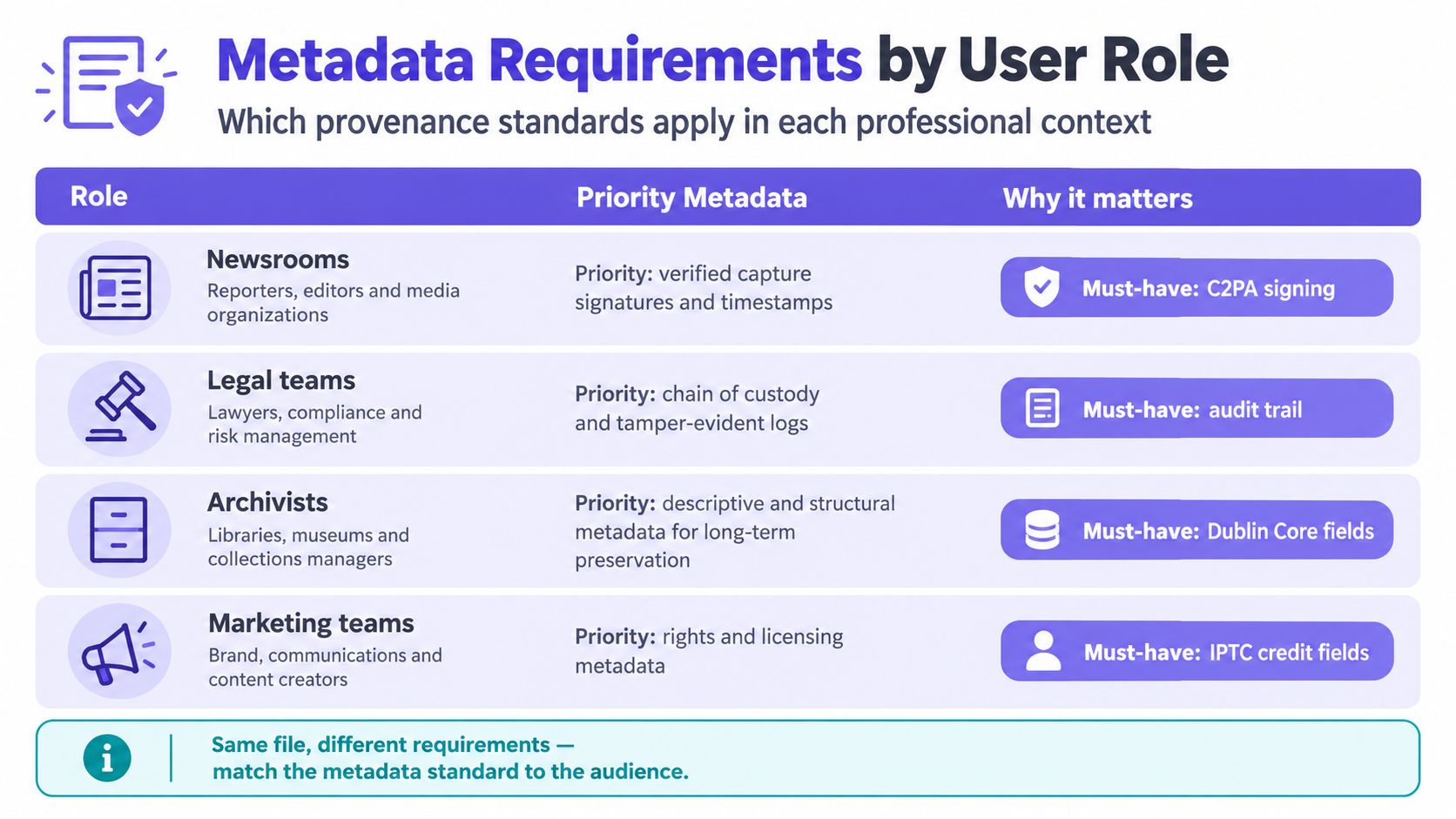
| Role | Priority metadata | Operational emphasis |
|---|---|---|
| Newsrooms | Source details, platform-download context, timestamps, provenance status | Preserve submitted media and distinguish publishable facts from unresolved claims |
| Legal teams | Hashes, custody events, access history, processing records | Make every transfer, derivative, and examination step auditable |
| Archivists | Object identity, technical fields, rights, provenance, preservation events | Maintain the file and its history across future storage and format changes |
| Platforms and moderators | Credential validation state, recompression indicators, content-analysis results | Handle signed, unsigned, detached, and transformed media consistently |
| Enterprise security teams | Acquisition context, identity records, technical consistency, custody logs | Investigate impersonation, fraud, and suspicious video communications |
| Developers | Raw and normalized fields, schema mappings, parser warnings, event records | Build ingestion that separates absence, malformation, and transformation |
The shared requirement is governance. Someone must define which fields are mandatory, who can alter records, how derivatives inherit identifiers, and how long evidence remains available. Teams designing broader controls may find tooling for modern data governance useful when connecting media records to organizational accountability.
Don't force every user into the same schema or every result into the same verdict. Match the record to the decision, preserve the evidence needed for later review, and state plainly what metadata proves and what it cannot.
If your team reviews user-submitted video, start by documenting the intake record for the next file, not the last one. Preserve the original, hash it immediately, capture raw and normalized metadata, record every transformation, and require independent corroboration before calling a clip authentic. That process gives editors, investigators, developers, and security teams a defensible foundation when the metadata is incomplete, contradictory, or absent.


