

Your Ultimate Guide to AI Song Detector Technology

At its core, an AI song detector is a specialized tool that scans an audio file, looking for clues that tell you whether it was made by a person or a machine. It works by hunting for the subtle digital fingerprints and unnatural patterns that AI music generators often leave behind, helping you spot the difference between a synthetic track and a human creation.
The AI Music Boom and the Need for Detection
We're living in a new age of audio, where AI-generated music is being created at an incredible pace. It feels a lot like the early days of Photoshop—what was once a highly specialized skill is now in the hands of millions, making it harder than ever to tell what's real and what's not. This explosion, fueled by easy-to-use tools, brings up some serious questions about authenticity and intellectual property.
For people working in fields like journalism, law, and corporate security, figuring out if a piece of audio is real or machine-made isn't just a curiosity anymore. It's become a critical tool for fighting misinformation, copyright theft, and sophisticated scams.
Why Verification Is Now Essential
The incredible progress in AI, especially with advanced voice cloning software, is exactly why we need reliable detection methods. When AI can create audio that sounds completely real to our ears, the potential for misuse grows exponentially.
Just think about these situations:
- Evidence Tampering: A lawyer is handed an audio file that could make or break a case. Is it a genuine recording, or was it created to mislead the court?
- Copyright Infringement: A musician finds a song online that mimics their unique style perfectly, but they never made it. Was their work used to train an AI model without permission?
- Corporate Security: An employee gets a voicemail from someone who sounds exactly like the CEO, demanding an immediate wire transfer. Is it a real directive or a clever deepfake scam?
These aren't hypothetical problems for the future; they are happening right now. An AI song detector adds that crucial layer of verification needed to tackle these challenges directly.
This isn't just about spotting fake pop songs for fun. It's about maintaining trust in our digital world, protecting artists' rights, and securing our communications when we can no longer believe everything we hear.
Building a Foundation of Trust
This guide is here to cut through the noise and give you a clear picture of this new audio reality. We’ll break down exactly how an AI song detector functions, turning complex technology into practical, real-world knowledge.
By getting a handle on these audio verification tools and techniques, you can confidently navigate the world of synthetic media. Developing these skills is a vital part of building digital resilience, a concept we explore more in our resources like these https://www.aivideodetector.com/blog/media-literacy-lesson-plans. This knowledge will help you make smarter decisions, whether you're a journalist checking a source, a lawyer validating evidence, or just someone who wants to know what they're really listening to.
How an AI Song Detector Actually Works
So, how do these tools actually figure out if a song was made by a human or a machine? Let's pull back the curtain.
Think of an AI song detector as a digital sound detective. It's not just listening to the music; it's performing a forensic analysis, hunting for clues that are often completely invisible to the human ear. It doesn't rely on one single trick. Instead, it combines several different methods to build a case for whether a track is authentic or artificially generated.
This whole field is exploding for a reason. As AI music tools get better and more accessible, the need to verify what's real has become critical. The global AI Detector Market, which covers everything from text to video, is expected to be worth USD 583.6 billion in 2025 and is on track to hit a staggering USD 3,267.5 billion by 2032. Music is a huge part of that picture. The AI-generated music market pulled in USD 440 million in 2023 and is projected to reach nearly USD 2.8 billion by 2030.
This chart really drives home the cycle we're in: new tools lead to wider adoption, which in turn creates a massive need for authenticity checks.
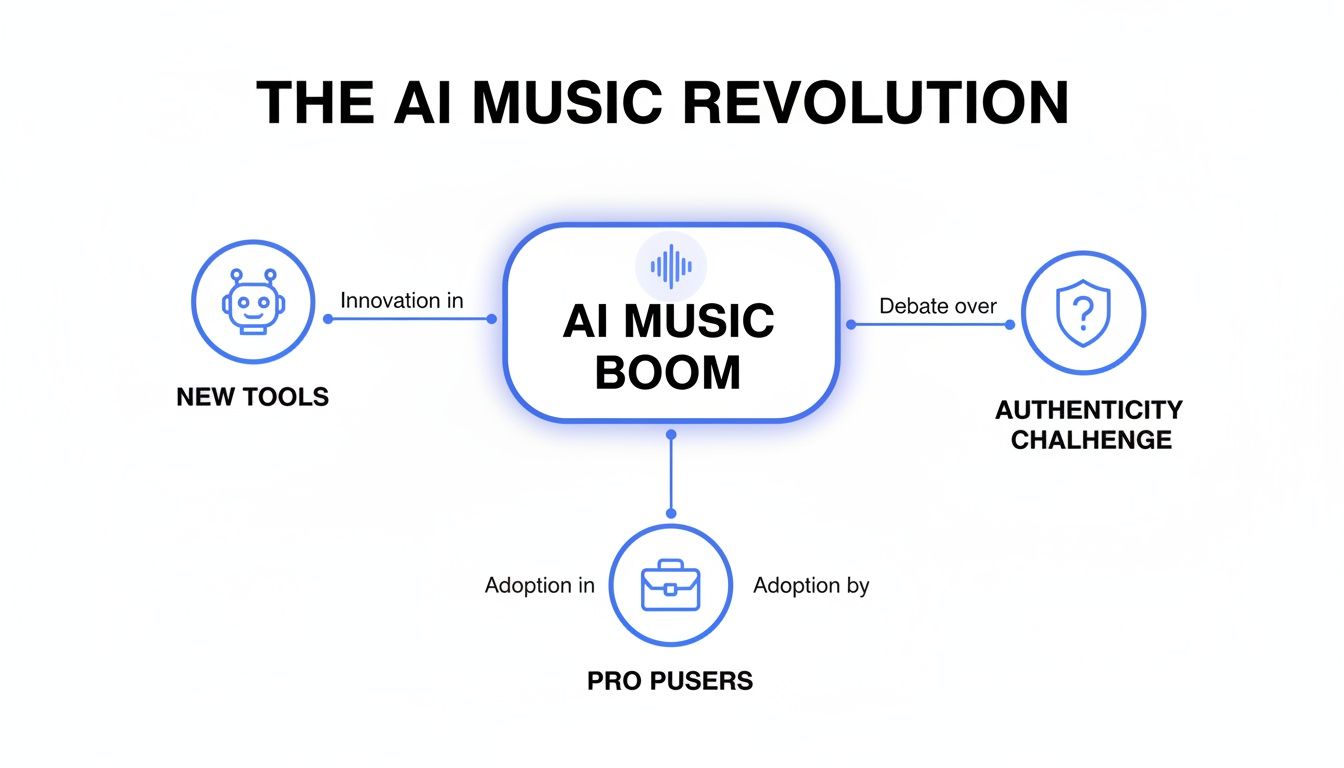
As you can see, making AI music tools easy to use for professionals and hobbyists alike has a direct ripple effect—it makes verification a must-have, not a nice-to-have.
Let's dig into the core techniques these detectors use.
The four main pillars of AI song detection each tackle the problem from a different angle. By combining these methods, a detector can build a much more reliable and nuanced picture of a song's origin.
| Detection Method | What It Analyzes | Real-World Analogy |
|---|---|---|
| Spectral Analysis | The underlying frequency spectrum of the audio. | A food critic tasting a dish for artificial flavors that are just "too perfect." |
| Model Fingerprinting | Unique, recurring patterns left by a specific AI model. | An art expert identifying a painter by their signature brushstrokes. |
| Digital Watermarking | Hidden, inaudible signals embedded by the AI generator. | A secret stamp on a dollar bill that proves where it was printed. |
| Temporal Analysis | The flow and consistency of musical elements over time. | A detective noticing a suspect's alibi doesn't add up over the full timeline. |
Each of these methods provides a crucial piece of the puzzle, and when used together, they create a powerful system for sniffing out AI-generated content.
Spectral Anomaly Detection
Every sound has a unique fingerprint made of different frequencies. Think of it like a sound's signature color palette. A real violin played by a person has a rich, complex spectrum full of tiny, natural imperfections and overtones. That's what gives it warmth and character.
An AI-generated violin, on the other hand, might produce a sound that's a little too perfect. The frequency palette might be unnaturally clean or contain bizarre spikes that don't belong. Spectral Anomaly Detection is all about spotting these weird inconsistencies.
An AI song detector uses a spectrogram—a visual map of the audio's frequencies—to look for red flags like:
- Harmonic Uniformity: Harmonies and tones that are so mathematically precise they sound sterile, lacking the subtle drift of real instruments.
- Unusual Frequency Artifacts: Tiny, often inaudible digital blips or weird patterns that have no business being in an acoustic recording.
- Phase Inconsistencies: The way sound waves line up can be just slightly "off" in AI music, a dead giveaway to a machine performing spectral analysis.
Watermarking and Model Fingerprinting
Sometimes, the simplest way to find an answer is to look for a label. Some AI music generators embed a digital watermark directly into their audio files. It’s an inaudible signal that basically says, "I was made by an AI." A detector can be trained to listen for these specific watermarks.
But even when there isn't an intentional watermark, AI models often leave behind their own accidental calling cards, known as model fingerprints. Think of it like a specific artist's unique brushstroke style. A particular AI, because of how it was built and the data it learned from, will tend to create audio with certain recurring glitches or patterns.
Detectors are trained on massive libraries of both human and AI-made music. This helps them learn the distinct "accent" of different AI models, allowing them to not only say "this is AI" but sometimes even pinpoint which tool was used to create it.
Temporal Consistency Analysis
Music isn't just a collection of sounds; it's about how those sounds change and flow over time. A human musician naturally adds tiny variations in rhythm, timing, and volume. It’s what makes music feel alive.
An AI can sometimes get this wrong. It might be perfect from one second to the next, but the coherence falls apart over the length of the entire song. Temporal Consistency Analysis is designed to catch these long-term slip-ups.
For instance, a synthetic drum beat might be robotically perfect for three straight minutes, something no human drummer could ever do. Or the reverb on an AI-generated voice might shift bizarrely from one line to the next, revealing that the vocals were pieced together without a consistent sense of acoustic space. If you're curious about the other side of the coin—how AI can be made to hide its tracks—our review of undetectable AI tools dives deep into that topic: https://www.aivideodetector.com/blog/undetectable-ai-review
Of course, for any of this to work, the AI detector needs to be trained on high-quality, accurately labeled data. That process is called Audio Annotation. It’s the foundational step where thousands of audio clips are tagged as "human" or "AI-generated," teaching the system exactly what to look for. Without good data, the detective is just guessing in the dark.
A Practical Checklist for Detecting AI Songs
Alright, we've covered the theory behind how these detectors work. Now, let's get our hands dirty. When you're faced with a suspicious audio file, you need a solid workflow to figure out its origin.
Think of this as your investigative game plan. It’s not about just pushing a button and trusting the output; it's about blending sharp human observation with smart technology. Following these steps will help you build a strong, evidence-based case for whether a song is human-made or came from an algorithm.
Start with Critical Listening
Before you even think about uploading the file to an ai song detector, just listen. Seriously. Your ears are an incredibly powerful first line of defense, and with a little practice, you can start to notice the subtle giveaways of synthetic audio.
Here’s what to listen for—the common artifacts AI often leaves behind:
- Sterile Perfection: Does the rhythm feel a little too perfect? Human musicians have a natural groove with tiny, almost unnoticeable variations in their timing. AI, on the other hand, can lock into a mechanically flawless beat that just sounds and feels robotic after a few minutes.
- Odd Phrasing or Vocals: Zero in on the singer's breathing. AI-generated vocals often miss the small, realistic inhales and exhales between phrases. You might also hear bizarre, slightly unnatural vocal slides or transitions that no human singer would make.
- Inconsistent Acoustics: Pay attention to the space the music is in. An AI might slap one type of reverb on a vocal line and then, for the next line, switch to a completely different acoustic environment. That's a classic mistake a human sound engineer would spot and fix immediately.
This first listening pass is all about forming a hypothesis. It gives you a gut feeling and points you toward specific things to look for when you bring in the tech. You're no longer just a passive user; you're an active investigator.
Choose and Use Your Detection Tool
Once your ears have given you some clues, it's time for the technology to take over. Picking the right ai song detector is one thing, but knowing how to use it properly is what really counts.
- Prep the File: First, make sure you're working with a high-quality audio file. A WAV or FLAC is ideal. Heavily compressed formats like low-bitrate MP3s can have their own digital artifacts that might muddy the waters and confuse the detection tool.
- Upload and Analyze: Send the file over to your chosen platform. The tool will then do its thing, running spectral analysis, checking for model fingerprints, and looking for all the tell-tale signs of AI generation.
- Interpret the Results: A good tool won't just spit out a simple "yes" or "no." It should give you a confidence score or a probability. An 85% AI-generated score is a pretty strong signal, but if you get something like 55%, that’s your cue to dig deeper.
Cross-Reference and Corroborate Your Findings
Here’s where a lot of people go wrong: they trust a single tool or a single signal. A professional approach means corroborating the tool’s results with other pieces of evidence. The tech is just one part of a bigger puzzle.
You need to expand your search beyond the audio file itself to get the full picture.
- Investigate the Source: Where did this track come from? An anonymous social media upload is a world away from a release on a verified artist's official channel. The source gives you crucial context.
- Check the Metadata: Pop open the file's metadata with a dedicated tool. You might find clues about the encoding software, the creation date, or even comments left behind by the AI generator. Sometimes, the answer is hiding in plain sight.
- Look for a Human Footprint: Does the artist supposedly behind the song actually exist? Is there any record of them performing it live, or do they have any other online presence? A complete lack of a digital footprint for a "human" artist is a massive red flag.
By bringing together your own critical listening, the analysis from an advanced tool, and some old-fashioned detective work, you build a workflow that's thorough, defensible, and way more accurate.
Real-World Use Cases for AI Song Detectors
The real value of an AI song detector isn't just about the cool tech behind it; it's about solving urgent, real-world problems. This technology is becoming a critical line of defense in high-stakes situations where knowing if a piece of audio is real can make or break a case, a news story, or a company's bottom line.
Let's move past the theory and dive into a few concrete scenarios where these tools are not just helpful, but absolutely essential.
Protecting Journalistic Integrity
Picture a newsroom analyst on a tight deadline. A video is blowing up on social media, supposedly showing a protest where the crowd is chanting a highly provocative slogan. This clip is inflammatory and could have serious political fallout.
The analyst's job is to verify the footage before it gets reported as fact. While the video looks authentic, something about the audio feels a little… off. The chanting is too perfect, too uniform for a real crowd. Is this a genuine recording, or was the audio created with AI to escalate tensions and spread disinformation?
This is where an AI audio detector becomes a journalist's best friend. The analyst uploads the track and gets a high-confidence score flagging it as AI-generated. The tool points out unnatural harmonic patterns and a total lack of the acoustic variation you’d expect from a large outdoor crowd. The newsroom wisely holds the story, preventing a dangerous piece of misinformation from spreading like wildfire.
Authenticating Evidence in Legal Disputes
In a tense copyright lawsuit, an indie artist accuses a major record label of stealing their melody. In their defense, the label's legal team produces an audio file they claim is a "demo" that predates the artist's song, seemingly proving they came up with the tune first.
The artist's lawyer is skeptical. The demo sounds clean, but the instrumentation feels strangely modern for its supposed creation date. Could this entire piece of evidence have been fabricated to win the case?
An AI audio detector gets put to work on the demo. The results are a game-changer. The tool flags subtle artifacts consistent with a recent AI music generation model. These digital "fingerprints" simply don't match the audio technology available at the supposed creation date, giving the lawyer powerful ammunition to challenge the file's authenticity in court.
Defending Against Corporate Fraud
Think about a security officer at a major corporation. The finance department gets a voicemail that sounds exactly like the CEO, urgently demanding a wire transfer of $250,000 to a new vendor for a "confidential deal."
The request is unusual, but the voice is a perfect match. The pressure to act fast is immense. Thankfully, company policy requires more verification for large transfers, so the officer decides to scrutinize the voicemail itself.
They run the audio file through a detection platform. The system immediately flags it as a probable audio deepfake, identifying unnatural vocal pacing and spectral glitches that are completely imperceptible to the human ear. The transfer is stopped, preventing a huge financial loss. This kind of threat underscores the need for solid trust and safety protocols in any corporate setting.
Safeguarding the Music Industry's Economy
The entire economic model of the music industry hinges on fair royalty payouts from streaming services. But there's a problem. Bad actors are now using AI to flood platforms with thousands of generic, low-effort songs every single day. They then use bot farms to rack up millions of fake streams, siphoning royalties away from actual human artists.
This isn't just unfair; it threatens to break the whole system. So, how can a streaming platform possibly fight back against this scale of fraud?
- Automated Ingestion Scanning: Platforms can build an AI song detector right into their upload process to automatically flag suspicious tracks before they even go live.
- Fraud Pattern Analysis: By identifying AI-generated content, they can connect the dots between those tracks and bot activity, spotting fraud networks more effectively.
- Royalty Protection: This allows them to disqualify the fraudulent streams and make sure the royalty money goes to the real artists who earned it.
The scale of this issue is only getting bigger. The global AI music generation software market is set to explode from USD 1.18 billion in 2026 to a staggering USD 7.29 billion by 2036. With so much growth, robust detection is no longer optional for platforms like YouTube and Spotify; it's a necessity to keep the ecosystem fair for creators.
Choosing the Right AI Song Detection Tool
With a flood of new tools hitting the market, picking the right AI song detector can feel like finding a needle in a haystack. But here’s the thing: not all of them are built the same. Choosing a weak one can lead to bad calls and wasted effort, and for professionals, the stakes are just too high for a shot in the dark.
You need something that goes beyond flashy marketing and delivers rock-solid, trustworthy results. Think of it as a reliable partner in your workflow, whether you’re a journalist fact-checking a viral video or a lawyer authenticating audio evidence for a case.
Evaluating Accuracy and Reliability
Let's cut to the chase: the single most important factor is accuracy. Specifically, a tool’s ability to keep pace with the ever-advancing world of AI music generation. New models that sound more convincing than the last pop up all the time. A good AI song detector can't be static; it has to be a moving target, constantly learning from new data to spot the latest fakes.
When you're kicking the tires on a potential tool, ask yourself these questions:
- Does it detect the latest models? A detector that only flags AI from last year is already out of date. Look for providers who are open about their ongoing R&D.
- Does it give you confidence scores? A simple "AI" or "Human" verdict just doesn't cut it. Professionals need nuance, like a probability score (e.g., 92% likely AI-generated), to understand the tool's level of certainty.
- How does it handle false positives? An overzealous tool that incorrectly flags human-made music is just as damaging as one that misses an AI track.
Speed, Security, and Usability
Beyond raw accuracy, a few practical features determine if a tool is actually useful day-to-day. If you're on a tight deadline verifying a clip for a breaking news story, you need results in minutes, not hours. Processing speed is a must.
Data security is just as critical. You might be handling unreleased music, confidential corporate audio, or sensitive legal evidence. You absolutely must trust that the service provider has ironclad privacy protocols in place.
Look for tools that process files without storing them long-term. A privacy-first approach is non-negotiable when handling sensitive information, ensuring your data remains your own.
Finally, the tool has to be easy to use. An interface that requires a Ph.D. in data science is a non-starter for most teams. A well-designed platform makes complex data easy to understand, empowering journalists, investigators, and content moderators to get the answers they need without a massive learning curve.
Criteria for Selecting an AI Song Detector
To help you navigate the options, we've put together a checklist of what truly matters for professional use. This table breaks down the essential features to look for when choosing a detection tool that you can depend on.
| Feature | Why It Matters for Professionals | What to Look For |
|---|---|---|
| Model Updates | Ensures detection of new AI generation techniques. | A clear commitment to ongoing research and frequent updates. |
| Processing Speed | Critical for time-sensitive verification tasks. | Sub-minute analysis times for standard audio file lengths. |
| Data Security | Protects confidential or sensitive audio files. | Privacy-first policies, such as no-storage file processing. |
| File Support | Accommodates various professional audio formats. | Support for high-quality formats like WAV and FLAC, not just MP3. |
| Ease of Use | Allows non-technical users to interpret results. | An intuitive interface with clear confidence scores and reports. |
Ultimately, the goal is to find a tool that integrates seamlessly into your work, providing fast, reliable, and secure analysis you can act on with confidence.
The Future of Audio Authenticity
While an ai song detector gives us some powerful tools, let's be clear: no single tool is a magic bullet. The truth is, we're in a perpetual cat-and-mouse game. As soon as detectors get good at spotting the quirks of one AI model, a newer, smarter one comes along that’s even better at mimicking human creativity.
This constant back-and-forth means today's best detection methods might be a step behind tomorrow. The technology on both sides—creation and detection—is always evolving, constantly pushing the limits of what we thought was possible.
The Challenge of Adversarial Attacks
One of the biggest wrenches in the works is something called adversarial attacks. This is a clever trick where someone intentionally creates AI music with subtle, almost invisible distortions designed to fool a detector. It's a bit like a counterfeiter adding tiny, deliberate flaws to a fake bill to make it look and feel more like real, worn-out cash.
These attacks target the very digital fingerprints that detectors are trained to find, essentially tricking the software into seeing the AI's work as more "human." This is a perfect example of why just relying on an automated tool isn't enough; you always need a human in the loop.
The goal isn't to find one perfect tool that's always right. The future of audio verification lies in a smart combination of powerful detection tech, sharp human judgment, and clear industry standards for content authenticity.
Emerging Solutions and Industry Standards
Even with these hurdles, the future of audio authentication looks bright. We're moving away from simple "real or fake" detection and toward a more complete ecosystem of trust. A few key developments are paving the way.
- Multi-Modal Detection: This approach is about looking at the bigger picture. Instead of just analyzing the audio file, it cross-references it with any accompanying video, metadata, and contextual information. This holistic view makes it much tougher for a fake to pass muster.
- Industry-Wide Standards: Groups like the Coalition for Content Provenance and Authenticity (C2PA) are working on a game-changer: a universal standard for embedding secure, tamper-proof credentials directly into digital content. Think of it as a digital birth certificate that shows exactly where a file came from and how it was made.
- Continuous Model Training: The best detection services don't rest on their laurels. They are constantly re-training their AI models on audio from the latest and greatest generative tools, which is the only way to keep pace.
The sheer scale of AI-generated content makes these advancements crucial. Just to give you an idea, by November 2025, the streaming platform Deezer was already getting over 50,000 fully AI-generated tracks submitted every single day. That accounted for about a third of all new uploads. You can dig deeper into these music industry trends and predictions to grasp the size of this challenge.
Ultimately, the path forward isn't about finding the perfect ai song detector. It’s about building a robust verification process—one that blends smart technology with critical human thinking to make sure we can continue to trust what we hear.
Frequently Asked Questions
When you're digging into audio verification, a lot of questions come up. Let's tackle some of the most common ones professionals ask about using an AI song detector.
Can an AI Song Detector Pinpoint the Specific AI Tool Used?
Sometimes, yes—the really sophisticated ones can. These tools are trained to spot the unique "digital fingerprints" or audio artifacts left behind by specific AI models, like those built on GANs or diffusion techniques.
It's not a sure thing every time, but nailing down the generation model can be a game-changer for an investigation, particularly in copyright or fraud cases. This capability really hinges on how extensively the detector was trained and whether it's been updated to recognize the latest AI music generators out there.
Are AI Song Detectors Actually Useful for Musicians?
Absolutely. For any creator, these tools are a new form of protection. You can use them to check if samples or loops you're thinking of using are original, making sure you don't accidentally incorporate AI-generated content with messy licensing strings attached.
Musicians can also use a detector to keep an eye out for unauthorized AI remixes or straight-up copies of their work popping up online. It’s a practical way to protect your intellectual property when the internet is flooded with new audio every day.
For creators, the goal isn't to fight AI, but to ensure its use is transparent and fair. Detection tools provide the clarity needed to protect original work and make informed decisions about collaboration and licensing.
How Accurate Are AI Detectors Against New AI Models?
This is the big challenge. Accuracy is a constantly moving target because generative AI is evolving so quickly. The best detection services are always in a cat-and-mouse game, constantly updating their systems to catch the new tricks and artifacts from the latest AI music models.
A good AI song detector won't just give you a "yes" or "no." Instead, it will provide a confidence score. This number tells you the statistical likelihood that a track is AI-made, which is a much more useful and realistic result. If the stakes are high, you absolutely need a tool that is committed to keeping up with the breakneck pace of generative audio.