

Video Manipulation Detection Explained Simply

A newsroom editor receives a video that appears to show a public figure making a damaging statement. A legal team is handed a clip that could influence a case. An employee joins a video call with someone who looks and sounds like the company's chief executive, then hears an urgent request for sensitive information. In each situation, the footage may look convincing while still carrying traces of editing, synthesis, or re-encoding.
That's why video manipulation detection should be treated as a forensic safety net, not a magic truth button. A detector can identify suspicious signals, but responsible decisions still require source checks, file preservation, human review, and documented uncertainty.

Key concept: A credible verdict comes from signals that support one another, not from a single impressive score.
This guide builds the investigation in four layers: frame evidence, audio evidence, temporal consistency, and metadata. It also explains why benchmark accuracy can mislead legal and newsroom users, and why a detector may miss a short synthetic segment hidden inside an otherwise authentic recording. For a related introduction to synthetic video, see AI-generated video and how it differs from ordinary editing.
What Video Manipulation Detection Really Means
A newsroom receives a two-minute interview that appears to show a public official making a damaging statement. The file looks ordinary, yet a few seconds may contain a replaced face, altered mouth movements, or synthetic audio. The rest of the recording can be genuine. Video manipulation detection examines the file for technical traces of generated, altered, composited, or re-encoded content, rather than judging whether the story feels believable.
The investigation resembles checking a disputed document. An examiner compares the ink, paper, handwriting, timestamps, and chain of custody. Video analysis follows the same logic through four evidence streams: frame evidence, audio evidence, temporal consistency, and metadata. One suspicious detail raises a question. Several independent signals pointing to the same alteration provide a stronger basis for review.
Three different things can be true
A video may be fully synthetic, with most or all of its visual or audio content generated. It may be partially manipulated, with only a face, mouth, voice, object, or short interval changed. It may also be authentic but compressed, stabilized, color-graded, or transferred between platforms.
The last category creates a common trap. Compression can remove fine detail and produce blockiness, blur, ringing, or irregular edges. Those effects may resemble manipulation artifacts even when the scene itself was never altered. A careful examination must separate ordinary encoding damage from evidence of synthesis.
The 2017 research benchmark described in a later reviewed benchmark and context shows why test results need context. Classical forensic methods reached 100% accuracy for region-duplication detection in stationary-camera MPEG videos, but fell to 81.2% for moving-camera MPEG videos. The same work reported 84.2% average accuracy for frame-level manipulation in non-recompressed videos and 97.4% overall accuracy on 20 self-captured AVI and WMV test videos. Controlled footage can make a method look highly reliable. Real evidence may involve motion, platform compression, unknown provenance, and a tiny fake hidden inside a long authentic recording.
A verdict is not the same as proof
A detector produces an investigative lead, not a conclusion about who created a clip, why it was made, or whether the depicted event occurred. A high suspicion score can direct a journalist toward particular frames or prompt a legal examiner to preserve and inspect the original. Human review, source verification, and documented uncertainty remain part of the finding.
File handling also affects interpretation. A secure video URL generator can create a controlled link for remote collaboration without exposing a local file path. Use access controls, retain the original separately, and record each transfer. Downloads, conversions, and re-encoding can change the evidence.
The Four Core Signals Behind Reliable Detection
A useful forensic investigation doesn't rely on one clue. It compares independent evidence streams and asks whether they point in the same direction. The four core signals are frame, audio, temporal, and metadata analysis.
Frame-level evidence
Frame analysis examines individual images inside the video. It may look for unusual texture, inconsistent lighting, unnatural blending around a face, or statistical patterns associated with generative systems. GAN-produced media can leave one type of fingerprint, while diffusion-generated media may leave another. A detector may also inspect whether skin texture, hair, teeth, glasses, or background edges behave differently from nearby pixels.
The analogy is a printed photograph assembled from several sources. Even if the final image looks smooth, the lighting and grain may not match where the pieces meet. Frame analysis searches for those seams. For a deeper explanation of visual signatures, see how fingerprint features help identify synthetic media.
Frame evidence has limits. Low resolution can hide useful detail, while compression can create suspicious-looking noise. A face that turns sharply, becomes partly occluded, or appears under unusual lighting may also challenge a frame-only system.
Audio forensics
Audio analysis treats the soundtrack as evidence rather than background. It can inspect spectral patterns, speech rhythm, breath transitions, pitch movement, and the relationship between phonemes and facial motion. A cloned voice may sound natural to a listener yet show regularities that differ from organic speech.
Audio can also expose a manipulation that the face does not. An editor might replace only a spoken phrase, insert synthetic narration, or alter a speaker's voice while leaving the room and body untouched. Conversely, background noise, a poor microphone, or aggressive audio compression can make authentic speech look unusual.
Temporal consistency
Temporal analysis studies how frames connect. It may identify flicker, unstable facial features, abrupt motion changes, or expressions that don't progress naturally from one frame to the next. A single frame can look convincing while the sequence reveals a subtle jump in a mouth shape, eye position, shadow, or head movement.
This is similar to checking a flipbook. Each drawing can appear plausible in isolation, but the animation feels wrong if the transition between drawings breaks. Temporal analysis catches continuity failures that a frame classifier can miss.
Metadata inspection
Metadata can contain information about a file's creation, encoding, software history, or device lineage. Investigators may compare those records with the claimed origin of the footage. An unexpected editing application, inconsistent timestamps, or an unusual encoding path can raise questions.
Metadata rarely proves manipulation on its own. Platforms often strip or rewrite metadata, and legitimate editing can produce the same clues. It works best as a provenance signal that supports or challenges the visual and audio findings.
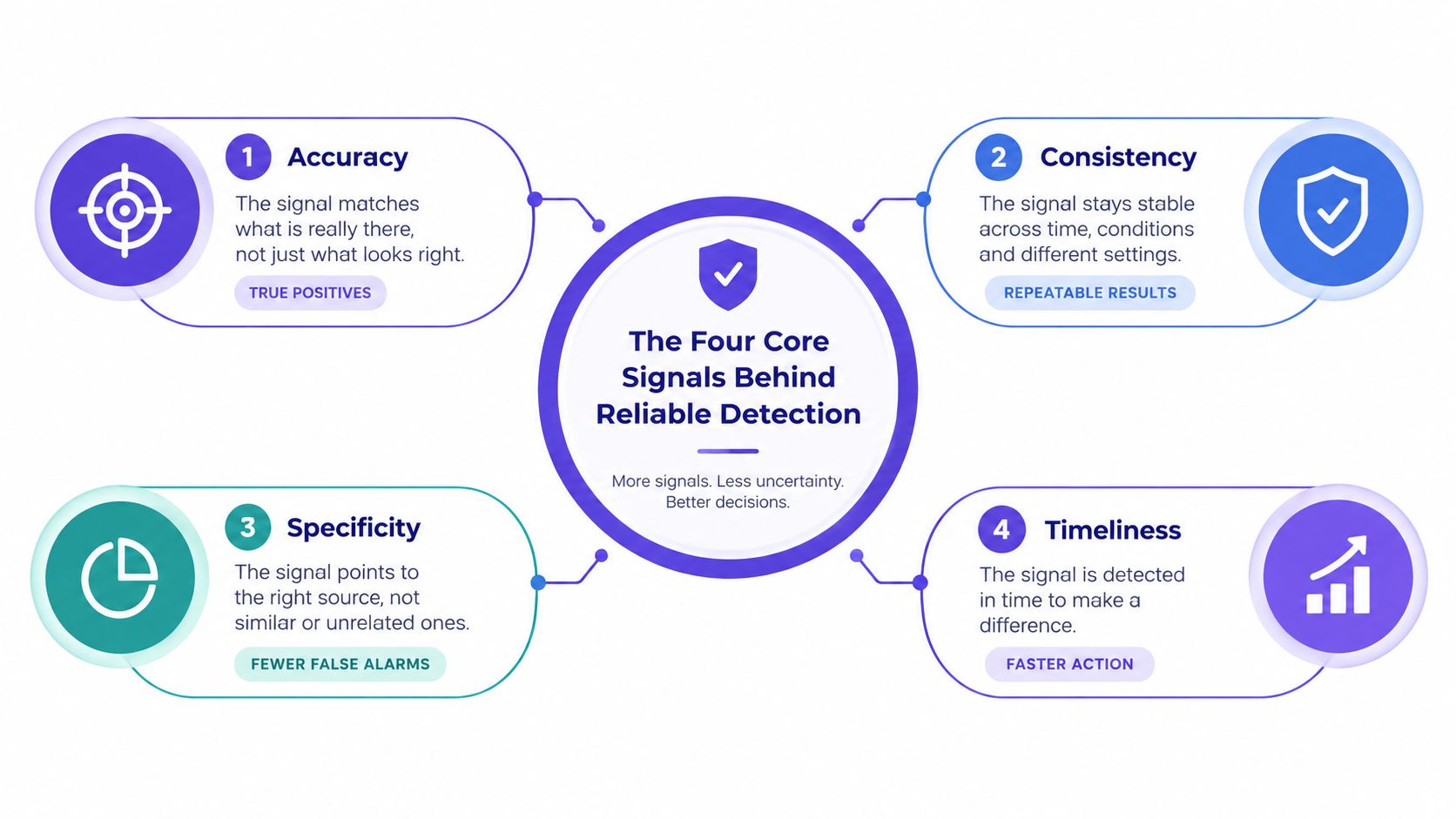
The strongest workflow asks whether all four signals agree:
- Frames show suspicious texture or blending.
- Audio contains synthetic or altered speech characteristics.
- Timing reveals unstable motion or lip synchronization.
- Metadata conflicts with the claimed file history.
Agreement doesn't eliminate uncertainty, but it gives reviewers a more defensible basis than a single visual impression.
How Detection Methods Compare in Practice
Detection methods answer different forensic questions. Classical analysis can expose familiar duplication, editing, or encoding traces, while deep-learning classifiers recognize complex visual and audiovisual patterns at scale. Search-grounded systems test claims against outside evidence. Localization models examine where an alteration appears, which matters when a long, mostly authentic recording contains only a short fake.
Research in this field expanded substantially after 2017. A systematic review identified 108 relevant articles published between January 2018 and February 2024 (systematic review and field context). Benchmark datasets made method-to-method comparison easier, but they cannot represent every camera, codec, platform, speaker, or generation technique. FaceForensics++ contained 1,000 real videos and 4,000 fake videos totaling 21.66 hours, illustrating both the value and the limits of controlled test collections.
| Approach | Best At | Key Limitation | When to Use |
|---|---|---|---|
| Classical forensic analysis | Known duplication, editing, and encoding traces | Can weaken when motion, compression, or file history changes | Initial examination of original files and familiar formats |
| Deep-learning classifiers | Recognizing complex visual or audiovisual patterns | May fail on unfamiliar generation methods or out-of-distribution footage | Large-scale triage and consistent first-pass screening |
| Search-grounded verification | Connecting video claims to external evidence across time | Depends on reliable sources and complete supporting evidence | Misinformation investigations and newsroom verification |
| Localization-focused models | Finding altered regions or intervals in longer footage | Needs detailed annotations and is harder than whole-video classification | Partial edits, inserted synthetic segments, and forensic review |
| Human-led multimodal examination | Combining frame, audio, temporal, and metadata signals with context | Slower and dependent on examiner skill | Legal evidence, publication decisions, and high-risk incidents |
Benchmark accuracy therefore provides a starting point, not courtroom-ready certainty. A model may perform well on familiar examples yet miss a new manipulation, a compressed upload, or a small altered region. Reviewers should compare its result with the other three signals and preserve the relevant interval for examination.
Modern benchmarks increasingly test partial edits rather than obvious full-frame face swaps. FakePartsBench contains more than 25,000 videos with pixel-level and frame-level annotations for localized inpainting, style transfer, object substitution, frame-specific alterations, and temporal interpolation (FakePartsBench). That design matches an important investigative problem: a tiny changed region can carry more evidentiary weight than a completely synthetic clip.
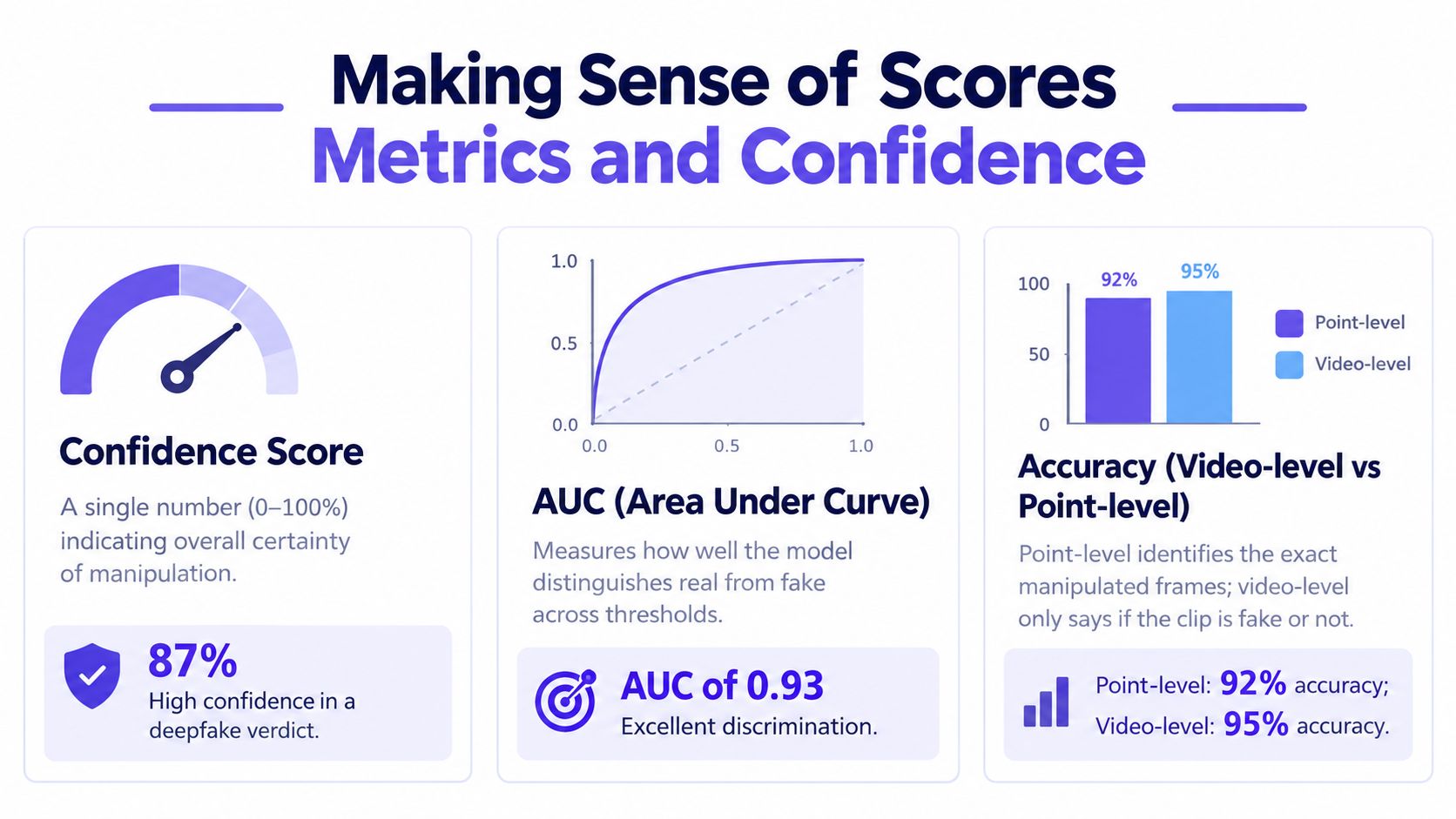
Making Sense of Scores Metrics and Confidence
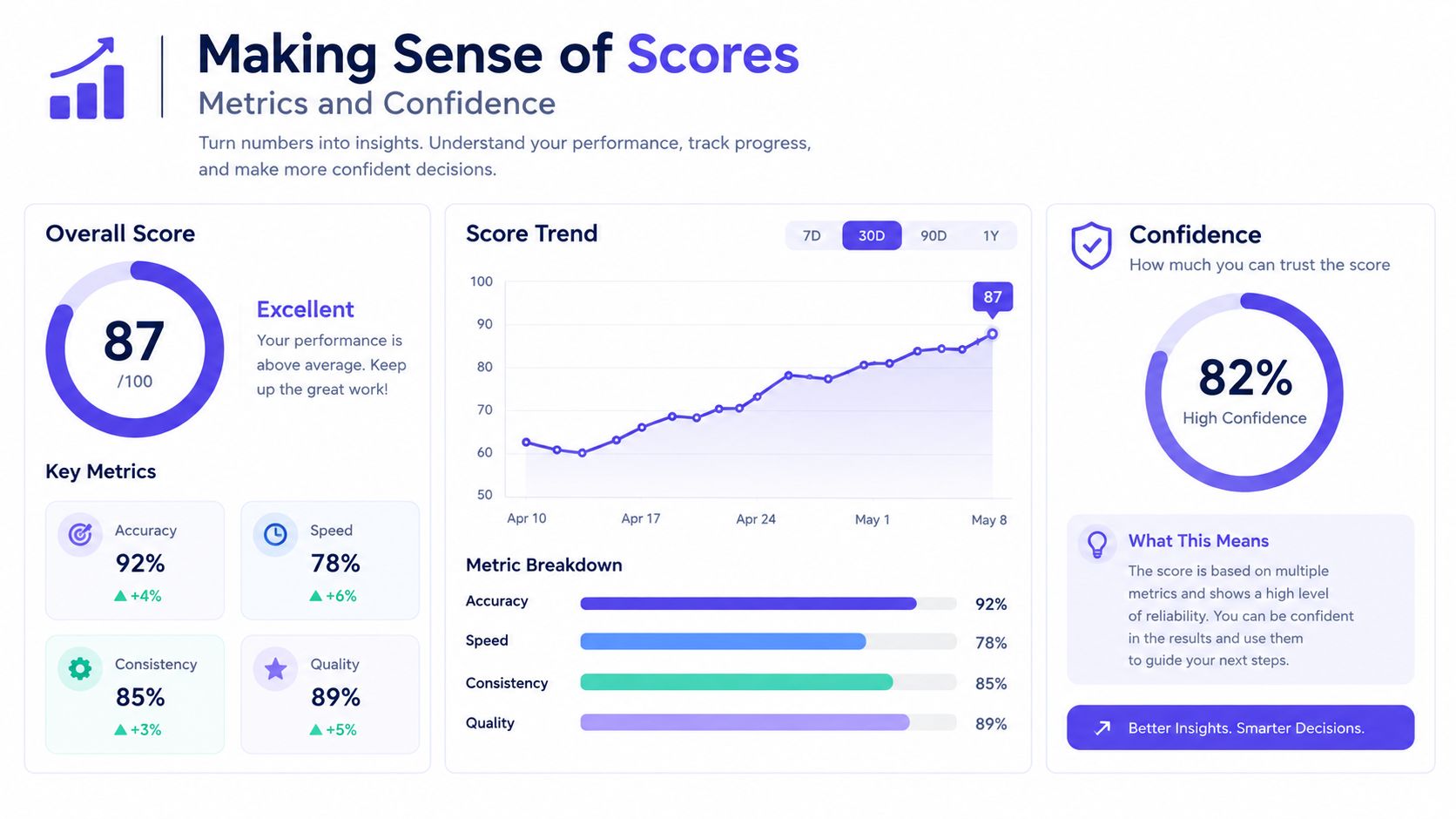
A detector can return several kinds of measurements, and they don't all answer the same question. A confidence score usually expresses how strongly a system believes manipulation indicators are present. It isn't automatically the probability that a video is fake, and it doesn't tell you whether the system has been tested on footage like yours.
Accuracy measures correct classifications under a particular evaluation setup. AUC, or area under the receiver operating characteristic curve, measures how well a model separates real and manipulated examples across decision thresholds. Neither metric tells you how the system behaves after social-platform compression, unusual lighting, new generation methods, or a different population of speakers unless those conditions were part of the evaluation.
Video-level and point-level results differ
A video-level result answers, “Does this file contain manipulation?” A point-level result asks, “Which frames or intervals contain it?” The second task is more useful for a long recording, but it's also harder because the system must identify location as well as existence.
EVID-Bench tested 222 videos across 9 manipulation types. Its strongest system reached only 61.43% point-level accuracy and 43.24% video-level accuracy when the task required search-grounded evidence to be linked across time and content changes (EVID-Bench benchmark). Those results don't mean every detector performs identically. They show that end-to-end reasoning about changing video evidence remains difficult.
The localization gap appears in other work too. AV-Deepfake1M++ reported 97.83% AUC for video-level classification, while a baseline that scored 96.30% on an older dataset reached only 14.01% on the newer localization task (ICML poster on sparse manipulation localization). A high whole-video score can therefore coexist with poor ability to identify a short manipulated segment.
Ask what the score leaves out
Before using a result in a newsroom or legal file, ask:
- What was tested: Was the media compressed, re-encoded, cropped, or recorded from a screen?
- Which error matters: How often does the system miss manipulation, and how often does it flag authentic footage?
- Where is the uncertainty: Does the report identify affected frames, audio intervals, or metadata anomalies?
- What does “real” mean: Does it mean no detected manipulation, or does it establish provenance?
A detector that reports uncertainty and scenario-specific errors is more useful than one that offers only a polished headline number. The practical value of confidence calibration for detection outputs is that it helps teams connect a score to an action, such as escalation, corroboration, or cautious publication.
Real World Workflows for Newsrooms Legal Teams and Enterprises
The same four-signal investigation can support very different decisions. A newsroom needs to decide whether it can publish. A legal team needs to document an examination that others can reproduce. An enterprise needs to slow down an impersonation attempt before someone acts.
Newsroom triage
Start by preserving the submitted file exactly as received. Record who sent it, when it arrived, where it was first posted, and whether the clip has been downloaded or converted. Run a multi-signal scan, then inspect the flagged frames and audio intervals manually.
If the detector finds uncertainty rather than a clear result, seek independent corroboration. Compare the scene with other recordings, contact the alleged speaker or venue through a separate channel, and examine the video's provenance. A suspicious result should change the reporting posture, but it shouldn't become an unsupported statement that the video is fake.
Legal and evidentiary review
Legal teams should separate preservation from analysis. Keep the original media in controlled storage, calculate and record its file identity using the organization's approved evidence process, and perform analysis on a working copy. Document the tool version, settings, findings, limitations, reviewer, and time of examination.
The report should distinguish observed facts from interpretation. “The audio and facial motion show a synchronization anomaly” is different from “the defendant created the video.” The first is a technical observation. The second requires attribution evidence outside the detector.
Enterprise incident response
For a suspected executive impersonation, pause the requested action. Confirm the request using a pre-agreed, independent channel, not a phone number or contact method supplied during the suspicious call. Preserve the recording, call details, messages, and any related transaction instructions before routing the incident to security or fraud staff.
The shared workflow is simple:
- Intake: Preserve the original and document its source.
- Scan: Examine frame, audio, temporal, and metadata signals.
- Review: Have a qualified person inspect the findings.
- Corroborate: Check identity, provenance, and outside evidence.
- Decide: Publish, escalate, hold, or reject with the uncertainty recorded.
AI Video Detector is one option for this first-pass workflow. Its stated approach analyzes video frame by frame alongside motion, audio, and metadata signals, and its publisher says it supports common formats up to 500MB without storing uploaded videos. Treat those product statements as capabilities to verify against your own privacy and evidentiary requirements before deployment.
Best Practices Limitations and What to Do Next
A high benchmark score does not describe the file in front of you. Recent reviews found tools claiming 95–99% benchmark accuracy falling to 54–75% on realistic out-of-distribution data, with none reaching a minimum forensic-suitability threshold. Only 40% of studies reported false-positive or false-negative rates, and none provided confidence intervals for error rates (forensic reliability review).
Field performance can also weaken when compression, recording conditions, or manipulation methods change. The review describes a 10–15% performance drop in out-of-distribution settings and more than 80% adversarial attack success in some settings. A short synthetic interval inside a long authentic recording creates another blind spot. A detector may judge the overall file correctly while failing to locate the small altered segment.
Use this checklist before treating a result as actionable:
- Preserve originals: Keep the received file unchanged and analyze a working copy.
- Corroborate signals: Look for agreement across frames, audio, timing, and metadata.
- Record uncertainty: Save scores, flagged intervals, tool details, and reviewer notes.
- Match the scenario: Test performance on the codecs, resolutions, speakers, and workflows you handle.
- Escalate high-risk decisions: Do not authorize publication, legal conclusions, payments, or access from one automated verdict.
- Review regularly: Generation methods and manipulation patterns change, so evaluation must continue.
For the next suspicious clip, preserve the original, examine all four signals, and arrange independent human review before anyone acts on its contents. Organizations handling frequent submissions or high-stakes evidence should document this workflow, test it on representative footage, and require out-of-band confirmation for urgent requests. AI Video Detector can support first-pass review by analyzing frames alongside motion, audio, and metadata. Verify its stated format, file-size, and storage capabilities against your privacy and evidentiary requirements before deployment.


