

Video Authentication Software Compared and Explained

In two Royal Society experiments, people correctly identified deepfake videos in only 10.7% of cases without warning, and only 21.6% even when they were told a synthetic clip was present, so 78.4% still failed to separate real from fake (Royal Society summary of the experiments). That single result explains why video authentication software has moved from a niche forensics tool to a frontline control for newsrooms, legal teams, fraud units, and platforms that can't afford to guess.
| Platform | Detection Methods | Speed | Privacy Posture | Integrations | Price Band |
|---|---|---|---|---|---|
| AI Video Detector | Frame, audio, temporal, metadata | Under 90 seconds | No retention | Browser upload, API | Per-video and enterprise options |
| Forensic lab workflows | Multi-signal forensic review | Slower, analyst-led | Local or controlled environment | Case management, export tools | Enterprise and specialist services |
| Provenance-first workflows | Metadata and chain-of-custody checks | Fast when credentials exist | Depends on signer and storage model | Content-credential tools, workflow systems | Varies by deployment |
Why Video Authentication Software Is Now Mission-Critical
Synthetic media isn't just a content problem, it's an evidence problem. When viewers can't reliably tell manipulated footage from authentic footage, the cost of a wrong decision rises sharply in contexts where people act fast and under pressure. That's why automated verification has become a defensive layer, not a novelty.
The harder lesson is that human intuition doesn't scale into a trustworthy filter. Even warned viewers struggled to identify deepfakes, which means a person can remain uncertain, accept a clip as real, or pass it along while still being wrong. In a newsroom, that creates verification risk. In a legal team, it affects admissibility and disclosure. In enterprise fraud, it can enable impersonation.
Practical rule: if a clip can trigger a decision, don't treat visual inspection as your primary control.
The better framing is calibrated risk assessment. A detector shouldn't be expected to issue a magical real or fake verdict and end the matter. It should produce a repeatable signal, show where confidence is strong or weak, and tell you when the clip needs human review, corroboration, or provenance checks. That shift matters because video authentication software sits inside a workflow, not above it.
A procurement decision follows from that reality. Buyers need tools that can process uploads quickly, survive everyday file handling, and show how they behave when a clip has been copied, compressed, cropped, or re-encoded. That is what separates a useful operational layer from a demo that looks persuasive on a clean sample.
The Four Signal Families That Power Modern Detectors
A credible detector doesn't look for just one flaw. A 2024 survey of the field describes spatial artifacts, motion continuity, audio evidence, frequency anomalies, and file-level metadata as the core signal families used in video authentication, and it notes a study that exceeded 97% accuracy on footage from 600 movies using just 40 frames per video (survey). That is the clue buyers should care about: detectors win when they combine multiple weak signals, not when they obsess over one frame.
Signal families at a glance
| Signal Family | What It Catches | Best Use | Known Weakness |
|---|---|---|---|
| Spatial artifacts | Local image inconsistencies, synthesis traces | Frame-level screening | Can degrade after compression |
| Temporal consistency | Motion, blink, pose, and facial continuity | Sequence-level review | Short clips can hide instability |
| Audio evidence | Lip-sync drift, spectral anomalies | Voice and dialogue checks | Muted or missing audio |
| Metadata inspection | Codec, timestamps, editing history, container issues | Provenance triage | Metadata can be stripped or rewritten |
The point of this table is operational, not academic. If a vendor only talks about frame analysis, it may miss sequence-level manipulation. If it only talks about metadata, it may miss a video that was stripped or re-exported. If it only touts audio, silent footage becomes a blind spot.
Single-signal systems can still be useful, but they're brittle. The more credible platforms combine visual artifacts with motion continuity, audio cues, and file-level context. For more detail on how those signals are typically read in practice, see this video forensics analysis guide.
A detector that can't explain which signal failed is not giving you a workflow, it's giving you a guess.
Benchmark Accuracy vs Real-World Reliability
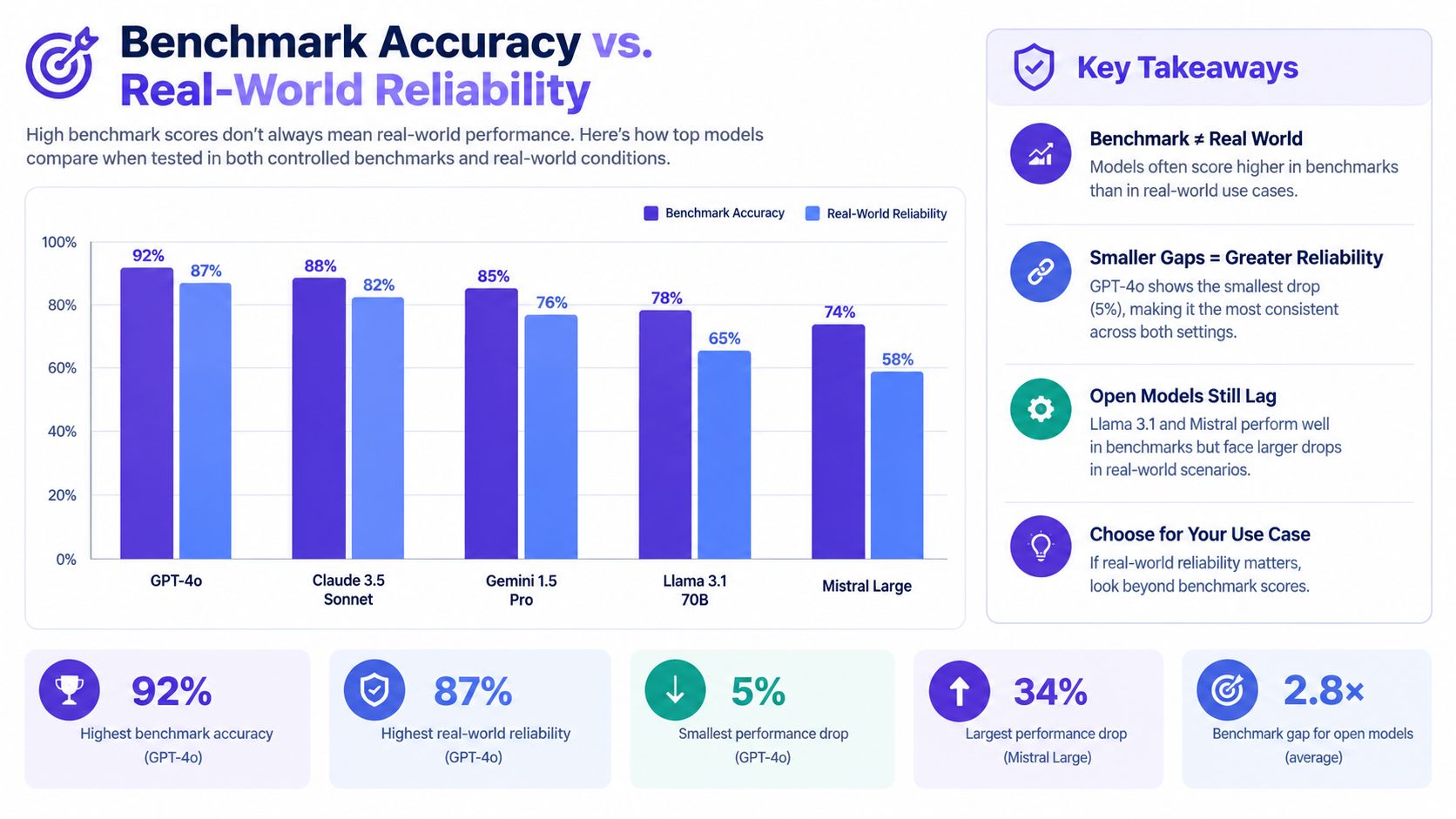
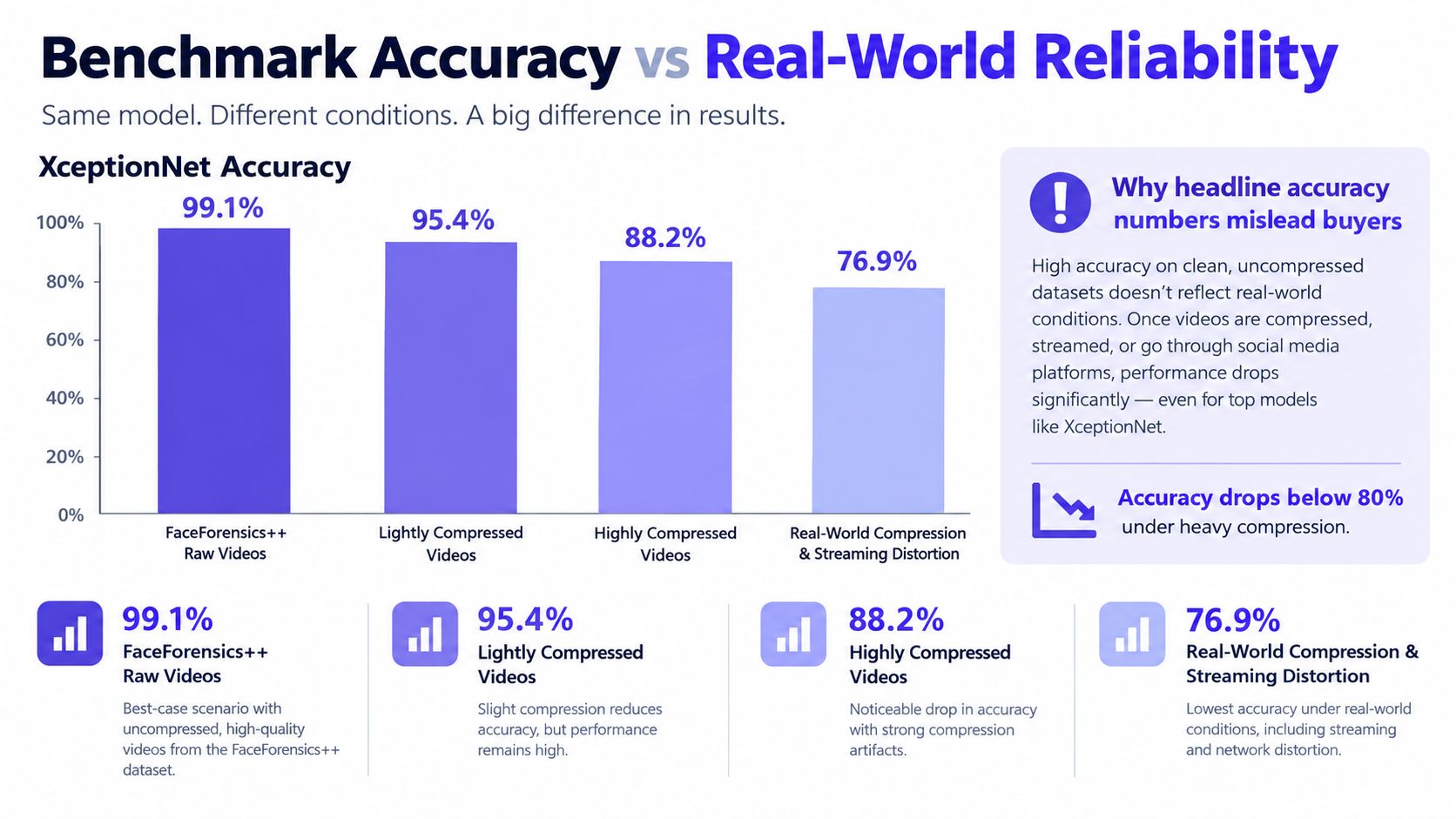
A strong benchmark score can still mislead buyers. On FaceForensics++, reported XceptionNet accuracy is about 99% on uncompressed video, yet it can fall below 80% under high-ratio compression (benchmark evaluation). That drop matters because real footage often arrives after downloading, recompression, resizing, or streaming through low-bitrate pipelines.
Domain shift is the harder problem. Independent evaluation on the in-the-wild Deepfake-Eval-2024 benchmark found that open-source state-of-the-art models suffered roughly a 50% reduction in video AUC compared with earlier benchmarks. In practical terms, a model that looks excellent in a curated test set can lose much of its value once the footage stops resembling its training data.
What buyers should demand instead of a single score
Accuracy alone does not show how a detector behaves across messy inputs. Buyers should ask for ROC-AUC, equal-error rate, precision, recall, and calibration measured separately on original, recompressed, resized, cropped, and screen-recorded samples. They should also check whether the system preserves the original bitstream when possible and whether it lowers confidence when the evidence is degraded.
Evaluation conditions shape results as much as model design. A March 2025 CSIRO and SKKU study reviewed 16 leading detectors and found none could reliably identify real-world deepfakes, while also identifying 18 factors affecting accuracy, including data processing, model training, and testing conditions (CSIRO/SKKU study). Benchmark hygiene matters because the same detector can look excellent in one dataset and fragile in another. Buyers should ask what happens outside the curated set, not only what happened inside it.
Buyer test: if a vendor cannot show performance under compression and cross-dataset shift, the headline score is incomplete.
For a separate close look at how detection claims should be interrogated, see this analysis of AI detector accuracy.
Comparing Leading Video Authentication Software
A detector is only as useful as the evidence behind its score. Research on multimodal-style architectures that combine spatial and temporal cues reported an F1-score of 90.6% and an AUC of 98.5% against XceptionNet, CNN-LSTM, and CNN-Transformer baselines (multimodal benchmark paper). The practical lesson is straightforward, layered signals usually hold up better than a system that relies on one cue.
| Platform | Detection Methods | Speed | Privacy Posture | Integrations | Price Band |
|---|---|---|---|---|---|
| AI Video Detector | Frame, audio, temporal, metadata | Under 90 seconds | No storage of uploaded videos | Browser upload, API | Basic per-video checks to enterprise |
| Forensic lab tools | Multi-signal forensic review | Analyst-led | Local or controlled handling | Export, case systems | Specialist services |
| Provenance tools | Content credentials and signing | Fast where credentials exist | Depends on signer and retention model | Workflow and metadata tools | Varies by deployment |
Method coverage is only half the comparison axis. The other half is how the platform behaves when the input is compressed, cropped, or screen-recorded. A newsroom workflow needs speed, low friction, and a privacy posture that does not burden sources. A legal workflow needs repeatability, auditability, and exportable evidence handling. An enterprise fraud workflow needs confidence scores that can feed into a case or identity stack without guesswork.
AI Video Detector fits one part of that spectrum. It analyzes frame-level, audio, temporal, and metadata signals, supports common browser upload and API workflows, and returns a confidence-based result quickly. The question buyers should ask is not whether the platform can produce a score. It is whether that score is calibrated for the kind of review they need, and whether the system still behaves predictably when the footage is ugly.
Layered Verification Beyond the Detector
Detection answers a narrow question: does this file show signs of manipulation? It does not, by itself, prove the event in the video is true. That distinction matters because a clip can carry valid provenance and still depict a staged scene, or it can lack credentials entirely because it was captured on an older device, re-exported, or stripped of metadata later.
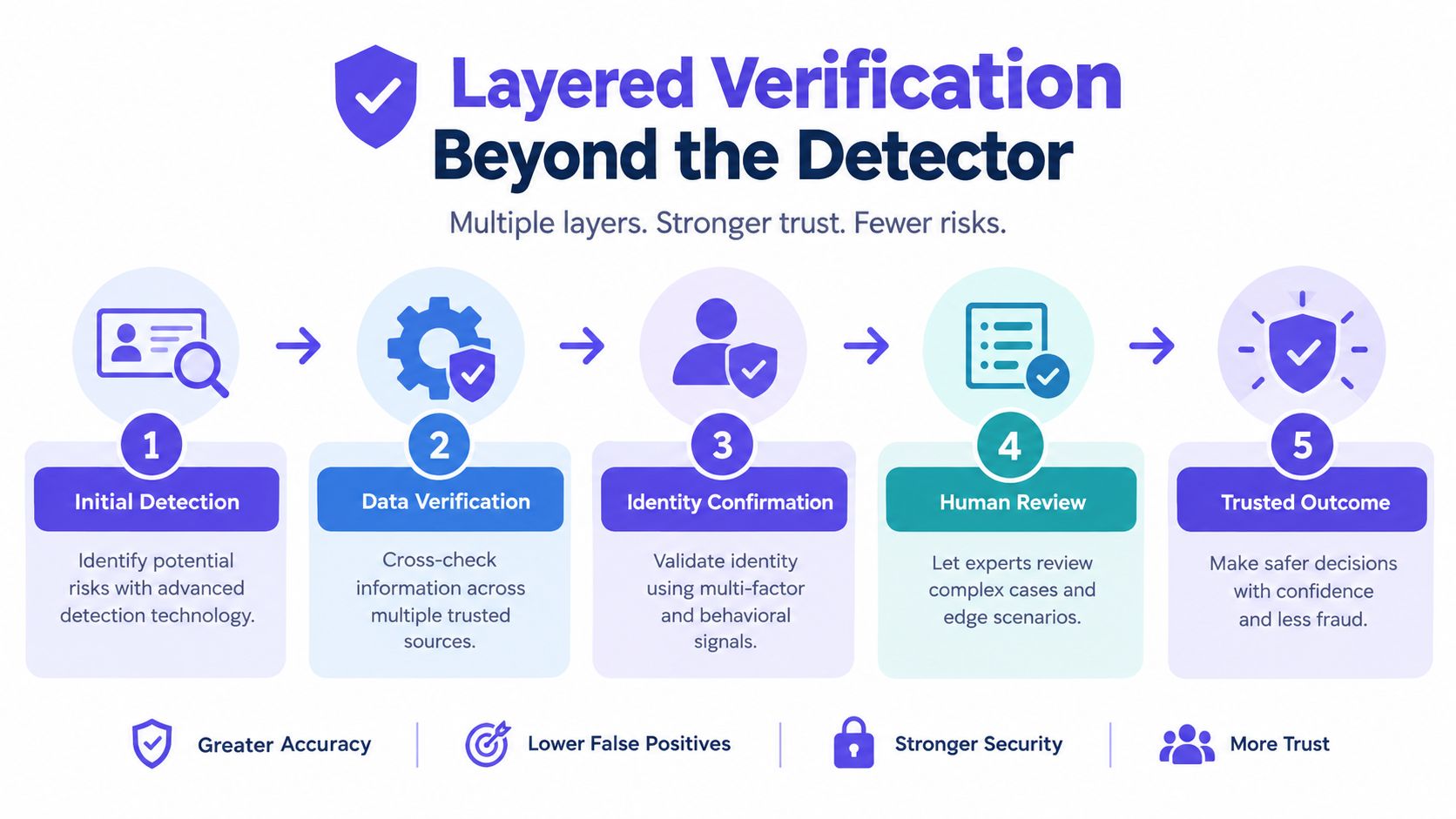
A 2025 U.S. government publication describes Content Credentials as cryptographically secured metadata that can track origin, edits, and production history, while also noting that deepfake detection and digital forensics sit alongside provenance rather than being replaced by it (Content Credentials publication). The correct workflow is layered. Provenance gives chain-of-custody context. Forensic analysis looks for manipulation indicators. Independent corroboration checks factual truth.
A case studies on trust data transformation resource from Rite NRG is relevant here, because trust workflows often live at the intersection of metadata, verification, and operational decision-making. The lesson is not that provenance replaces forensic checks. It's that strong systems convert fragmented signals into usable evidence.
For a practical primer on provenance controls, see this Content Credentials overview.
Use this rule in production: if provenance, forensic signals, and outside corroboration don't agree, escalate rather than force a binary verdict.
Match the Tool to the Workflow
A newsroom under deadline needs one thing first, usable confidence fast. The right tool there handles common formats, gives a clear score, and shows when compression or missing frames weakens the result. As noted earlier, benchmark performance can shift once the footage stops looking like the training set, so a polished demo is not enough to predict real use.
A legal team needs a different standard. Speed matters less than defensibility, chain of custody, and whether the output can be explained later in disclosure or court. That workflow should prioritize layered review, documented processing, and the ability to pair authentication with provenance and human judgment.
An enterprise fraud team sits somewhere else again. It needs to screen suspected CEO impersonation attempts, but it also needs integration depth so a result can move into an existing risk, identity, or case-management process without manual copying. Privacy posture matters too, because these workflows can involve sensitive internal material.
If the tool does not fit the workflow, the score will not matter.
The buyer mistake is choosing a platform for its strongest demo instead of its operating environment. Newsrooms need speed and simplicity. Legal teams need explainability. Fraud teams need integrations, audit trails, and escalation logic. A detector that does all three poorly still is not a fit.
Choosing the Right Platform for Your Use Case
A fast, no-signup checker makes sense when volume is low and the decision is urgent. That suits journalists triaging inbound clips, creators checking suspicious uploads, and small teams that need a quick pass before they publish or repost. The tradeoff is obvious, lighter workflows are easier to adopt, but they still need to show how they behave when compression or format conversion weakens the evidence.
An API-first enterprise deployment fits teams with recurring volume and formal review chains. That's the right lane for trust and safety teams, legal operations, and fraud units that need logging, routing, and repeatable confidence outputs. In those cases, a per-video price can become the wrong mental model, because the true cost is the consequence of a false negative, not the fee attached to a single check.
For provenance-aware buyers, the best answer is usually not either-or. They need forensic detection for manipulation signals and content credentials for chain-of-custody context, then human corroboration for anything that still looks ambiguous. That is the most defensible posture in environments where a wrong call creates legal, financial, or reputational damage.
If you want the shortest version, buy for workflow first, not model marketing. Buy speed if you need immediate triage. Buy integrations if you need sustained operations. Buy layered verification if the clip can influence a high-stakes decision.
A Practical Selection Checklist
Before you shortlist a vendor, ask these questions:
- Does it use more than one signal family? Frame-only systems are easier to fool after recompression or cropping.
- Does it expose confidence clearly? A binary answer hides uncertainty that should trigger review.
- Has it been tested under real-world processing? Re-encoding, resizing, screen recording, and missing frames change reliability.
- Does it show cross-dataset evidence? If the model only shines on one curated benchmark, generalization may be weak.
- Can it retain or preserve provenance? Metadata and credentials can help, even when they can't prove truth on their own.
- Is there a privacy and retention policy you can accept? Sensitive uploads need handling rules before procurement, not after.
- Can it plug into your workflow? API, browser upload, export, and logging all affect adoption.
- Does the vendor explain when not to trust the output? Good systems know when to escalate.
A platform that passes these questions gives you more than a score. It gives you a controlled way to decide when to trust the clip, when to challenge it, and when to ask for more evidence.
If you're comparing tools for newsroom verification, fraud screening, or evidentiary review, start with the workflow you actually need to support, then test the vendor against compressed, cropped, and screen-recorded samples before you commit. The right choice is the one that fits your risk level, your privacy requirements, and your escalation path, not the one with the flashiest benchmark number.


