

Forensic Voice Analysis Accuracy: What Numbers Really Mean

The popular advice is to ask whether forensic voice analysis is “accurate.” That question is too broad to protect a courtroom, a newsroom, or an investigation. A voice comparison can perform differently depending on which speaker is tested, which language is spoken, which recording channel carries the signal, and how much usable speech the examiner receives.
A defensible assessment therefore starts with conditions, not a headline score. In controlled laboratory settings, modern forensic speaker-recognition systems have still produced about 6% false-identification errors and 13% false-elimination errors, according to a 2023 NIST OSAC guide summarized in a forensic evidence review. Those paired results tell us far more than a claim that a system is “highly accurate.”
The practical conclusion is uncomfortable but useful: forensic voice analysis accuracy isn't one property of a tool. It's a conditional result that must be measured against the recording and the decision the court is being asked to make.
Why a Single Accuracy Number Misleads in Forensic Voice Analysis
A statement such as “97% accurate” sounds precise, but it leaves the most important question unanswered: accurate in what way? A speaker-comparison system can wrongly identify an unrelated speaker, or it can fail to identify the actual speaker. Those are different errors with different consequences.
The first is a false identification, sometimes called a false positive. The system or examiner reports support for a match when the questioned voice came from someone else. The second is a false elimination, or false negative. The actual speaker is present in the reference material, but the method fails to associate the questioned recording with that person.
Those outcomes must be reported separately. The NIST OSAC guide describes about 6% false identification and 13% false elimination under laboratory conditions, demonstrating that a controlled test still produces an asymmetric error profile rather than one universal accuracy score (NIST OSAC landscape findings).
| Reporting style | False ID rate | False elimination rate | What it hides |
|---|---|---|---|
| Headline accuracy | Not stated | Not stated | Whether the error concerns a false match or a missed association |
| Paired laboratory result | About 6% | About 13% | The fact that performance depends on the tested conditions |
| Courtroom conclusion | Must be case-specific | Must be case-specific | Whether the study resembles the disputed recording |
A courtroom receives an evidence statement, not merely a classification. If an expert says a recording “matches” a suspect, the fact finder needs to know how often the method makes that kind of mistake, with what population, and under what recording conditions. A single percentage can conceal whether the method was tuned to avoid false matches at the cost of more false eliminations, or the reverse.
Practical rule: If a report gives one accuracy figure but doesn't disclose paired error rates, the figure is incomplete.
The four variables that most often change the meaning of the result are audio quality, sample duration, language and speaker variability, and recording channel. Synthetic or cloned speech adds a separate authentication problem. A comparison may be technically consistent with a speaker while the audio itself has been manipulated, which means identification and authenticity must be treated as distinct questions.
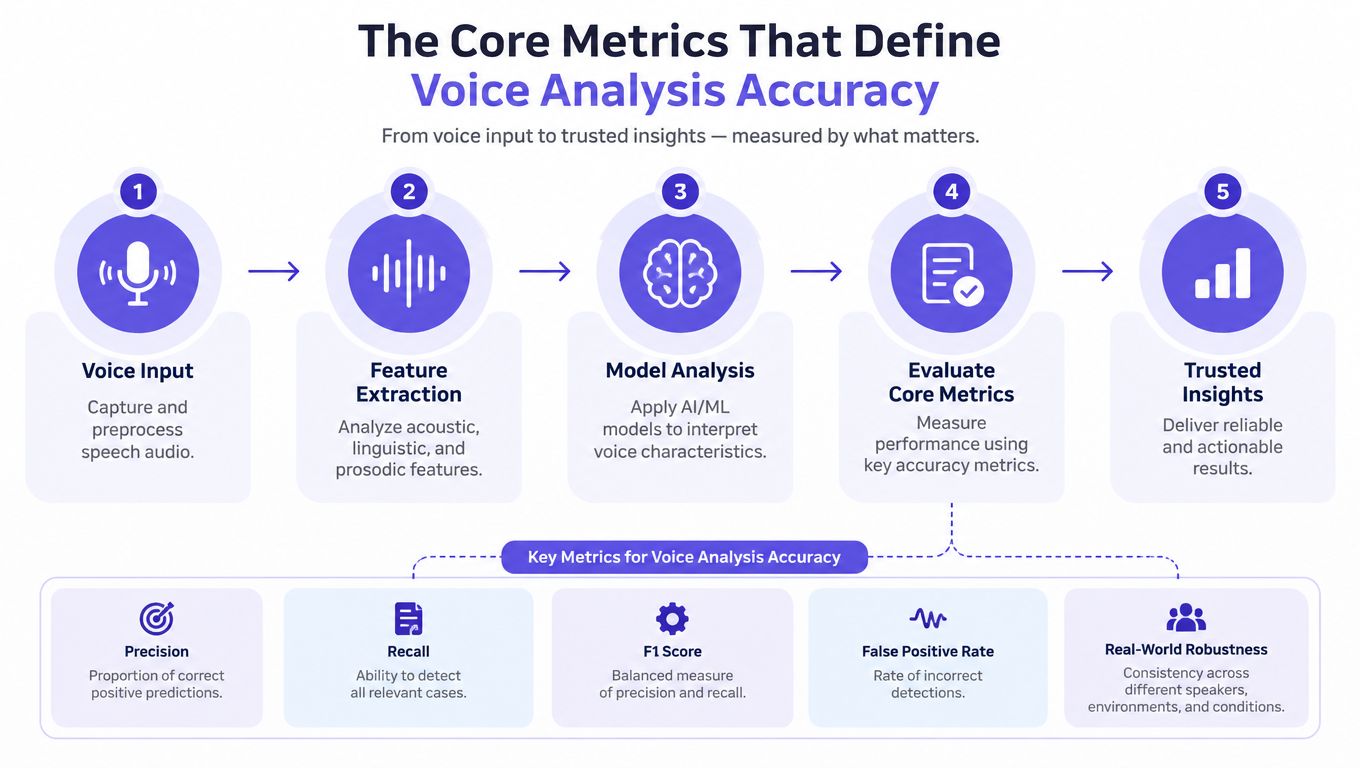
The Core Metrics That Define Voice Analysis Accuracy
Forensic voice analysis has no meaningful accuracy figure outside its test conditions. The first question is which error is being measured:
- False-positive rate: the proportion of non-target comparisons incorrectly treated as matches.
- False-negative rate: the proportion of target comparisons incorrectly rejected or missed.
These paired rates describe different risks. Lowering the decision threshold may recover more genuine matches while admitting more false identifications. Raising it may reduce false matches while increasing false eliminations. A defensible evaluation therefore reports performance across thresholds, rather than presenting one selected operating point as a general accuracy claim.
Read the curve, not just the score
A receiver operating characteristic curve, or ROC curve, shows how detection and false-alarm behavior change as the threshold moves. Speaker-recognition studies may also report an equal-error rate, where false-acceptance and false-rejection behavior meet at a selected operating point. That value can support system comparison, but it does not recreate the conditions, speaker population, or decision costs of a particular case.
A point estimate also requires uncertainty. Confidence intervals indicate how much sampling variation surrounds the reported rate. Without them, a result can look more exact than its test supports. The interval should be considered with the number of comparisons, language mix, speaker population, and similarity between the evaluation recordings and the disputed audio.
Use likelihood ratios for evidential meaning
A log-likelihood ratio, or LLR, does not claim that a voice is “97% the suspect.” It compares how well the evidence fits two competing propositions:
- the questioned voice came from the suspect;
- the questioned voice came from another relevant speaker.
For a threatening voicemail, the analyst should explain whether the observed vocal features are more probable under the suspect proposition than under the alternative. A ransom call raises the same population issue. Comparison with a narrow or unrepresentative reference group can make evidence appear stronger than its real discriminatory value.
Speech quality affects both transcription and feature extraction. Teams assessing evidentiary audio may consult how Matil reduces word error rate, while keeping transcription accuracy separate from speaker-attribution validation. A clean transcript cannot correct channel mismatch or establish that the recording is authentic. Deepfake audio detection methods address that authentication question, which remains distinct from identity comparison.
A defensible accuracy claim should identify:
- The error definitions, including what counted as a false identification and false elimination.
- The evaluation population, including relevant speaker, language, and channel characteristics.
- The operating threshold, ROC behavior, and uncertainty around estimates.
- The evidence framework, preferably an LLR calibrated to the relevant population.
- The case similarity, including duration, noise, codec, disguise, and possible manipulation.
What Conditions Quietly Drive Error Rates Higher
A voice sample isn't just a voice. It is a voice filtered through a microphone, room, transmission path, codec, speaking style, language, and available duration. Validation that ignores those variables can produce a number that describes the test collection more accurately than it describes the evidence.
The first variable is background noise. Noise masks spectral details used by both human listeners and automatic systems. A recording captured over a telephone line, in a vehicle, or beside other speakers may preserve enough speech for transcription while still removing information needed for reliable comparison. Expert reviews emphasize that performance deteriorates as audio quality worsens, samples become shorter, or speakers disguise their voices, with error rates rising under those conditions (condition-dependent forensic voice analysis review).
Transmission and codec effects create a related problem. A questioned recording and a reference recording may contain the same speaker but arrive through different microphones or compression paths. Those transformations can alter the measurable features, so an apparent difference may reflect the channel rather than the person. The analyst should document the handset, microphone, file history, codec, and any enhancement applied before comparison.
Four variables that require stress testing
| Condition variable | Clean baseline EER | Degraded EER | Dominant failure mode |
|---|---|---|---|
| Noise | Must be measured in the relevant clean condition | Rises as speech is masked | Feature distortion and unstable similarity scores |
| Codec or channel | Must match the evaluation design | Rises with channel mismatch and compression | Recording artifacts mistaken for speaker differences |
| Duration | Must reflect the questioned sample | Worsens with very short speech | Insufficient phonetic and speaker information |
| Language and speaker variability | Must represent the case population | Can deteriorate across unfamiliar conditions | Population and distribution mismatch |
Duration deserves separate attention. A short questioned clip may contain too little stable material to distinguish speaker characteristics from momentary pronunciation, emotion, or background interference. The relevant comparison is not only whether the reference recording is long. It is whether the evaluation tested the same kind of duration imbalance found in the case.
Language and familiarity can shift results sharply. A legal review summarized experiments in which unfamiliar-voice identification error rates reached 51%, while cross-lingual accuracy ranged from 70% down to 12%, with false-alarm rates above 67% in some conditions (2011 legal review of voice identification evidence). These findings don't produce a universal courtroom rate. They show why a result measured in one language or speaker population cannot automatically answer a question involving another.
Counsel should ask: Did the validation audio reproduce the evidence's noise, channel, duration, language, and familiarity conditions?
For analysts, audio quality analysis can help characterize the recording before comparison. It doesn't replace a validated speaker-comparison protocol, but it can expose why a clean benchmark may be a poor proxy for the disputed clip.
Lab Benchmarks Versus Real Forensic Conditions
A benchmark and a forensic examination answer different questions. A closed-set automatic speaker-recognition test typically evaluates whether a system can discriminate among speakers represented in a curated corpus. A forensic comparison may involve an open population, an unfamiliar voice, a short clip, a mismatched channel, and a decision that could wrongly implicate or exclude a person.
The distinction matters because benchmark scores can be excellent without establishing case-level reliability. The referenced benchmark data reports equal-error rates of 0.87% and 0.39% on VoxCeleb1-O, while forensic-style forced-decision experiments report about 6% false identification and 13% false elimination (benchmark and forensic error comparison). These figures aren't interchangeable. They arise from different tasks, populations, protocols, and assumptions.
| Evaluation type | Typical condition | Reported EER range |
|---|---|---|
| Automatic benchmark | Curated, controlled speaker-recognition corpus | 0.87% and 0.39% in the cited VoxCeleb1-O results |
| Forensic-style forced decision | Forensic comparison conditions with paired decision errors | About 6% false identification and 13% false elimination |
| Case-specific assessment | Evidence-matched noise, channel, duration, and population | Must be established by validation |
A benchmark may also use a closed world, where the target speaker is known to be among the candidates. Courtroom identification can operate more like an open-world problem. The relevant alternative may include speakers who were never part of the system's test set. That changes the meaning of a similarity score and makes population calibration essential.
Human and automatic comparison are not substitutes
Human auditory or auditory-acoustic comparison has its own vulnerabilities. In the forensic voice analysis study summarized by a peer-reviewed source, Layered Voice Analysis operators averaged 48% correct decisions for truth-tellers and 25% for deceivers, while human auditors reached 68% and 71%, respectively (peer-reviewed study summary). The study addressed deception detection, not ordinary speaker identification, so it shouldn't be used as a direct identification rate. It does, however, demonstrate why claims about detecting truth or deception from vocal behavior require task-specific validation.
Automatic systems and human examiners can fail for different reasons. Machines may be sensitive to channel artifacts and synthetic speech. Humans may rely on expectation, familiarity, or contextual bias. Neither a clean machine benchmark nor an expert's impression transfers one-to-one into courtroom reliability without testing the actual proposition and conditions.
The right question for an admissibility assessment isn't whether a system passed a benchmark. It is whether the proponent can show empirical performance under conditions sufficiently similar to the disputed evidence, with transparent error definitions and a reproducible protocol.
Cloned and Synthetic Audio as a Reliability Problem
Authentication now sits beside speaker comparison as a core reliability issue. A system may detect vocal similarity in an audio file that contains generated, cloned, edited, or mixed speech. If the file's provenance is uncertain, identifying the apparent speaker and establishing that the recording reflects a genuine human utterance are separate tasks.
A 2025 forensic study reported equal-error-rate increases from 0.06 for genuine-versus-genuine comparisons to 0.20 for genuine-versus-cloned and cloned-versus-cloned comparisons (study of cloned-voice effects on speaker recognition). The result doesn't mean every cloned recording produces the same error. It shows that manipulation changes the operating conditions enough to undermine assumptions built around genuine speech.
Why ordinary speaker features can miss the problem
MFCC-based methods describe aspects of the speech signal that help compare voices, but those features aren't a universal defense against spoofing. The cited study concludes that MFCC approaches don't generalize across cloning algorithms. A detector trained on one generation method may behave differently when the audio comes from another model, a re-recorded playback, a compressed file, or an edited segment.
That creates a mismatch between tasks. Speaker recognition asks who produced the speech, while synthetic-audio detection asks whether the signal carries evidence of generation or manipulation. A voice-biometric system optimized for the first task isn't automatically reliable for the second.
More promising research examines segment-level phonetic features, prosodic behavior, and artifacts associated with the source generation process. The cited research also reports strong benchmark performance for a method using segment-level phonetic features, including 98.43% mean identification accuracy on benchmark and forensic-style corpora, but that result remains method-dependent and doesn't establish performance for every cloned or edited recording (cloned-voice study and method comparison). A court should therefore ask what manipulation types were tested, how the test audio was created, and whether the evaluation resembles the exhibit.
A practical workflow should screen for authenticity before treating a match score as identity evidence. AI Video Detector, for example, describes a workflow that examines audio forensics alongside frame-level analysis, temporal consistency, and metadata when assessing uploaded video or audio content. That kind of screening can inform triage, but it doesn't replace a case-specific speaker-comparison validation or an expert opinion about evidential weight.
A voice match without an authenticity assessment can answer the wrong question with impressive technical precision.
Validation Best Practices for Courtroom-Grade Reliability
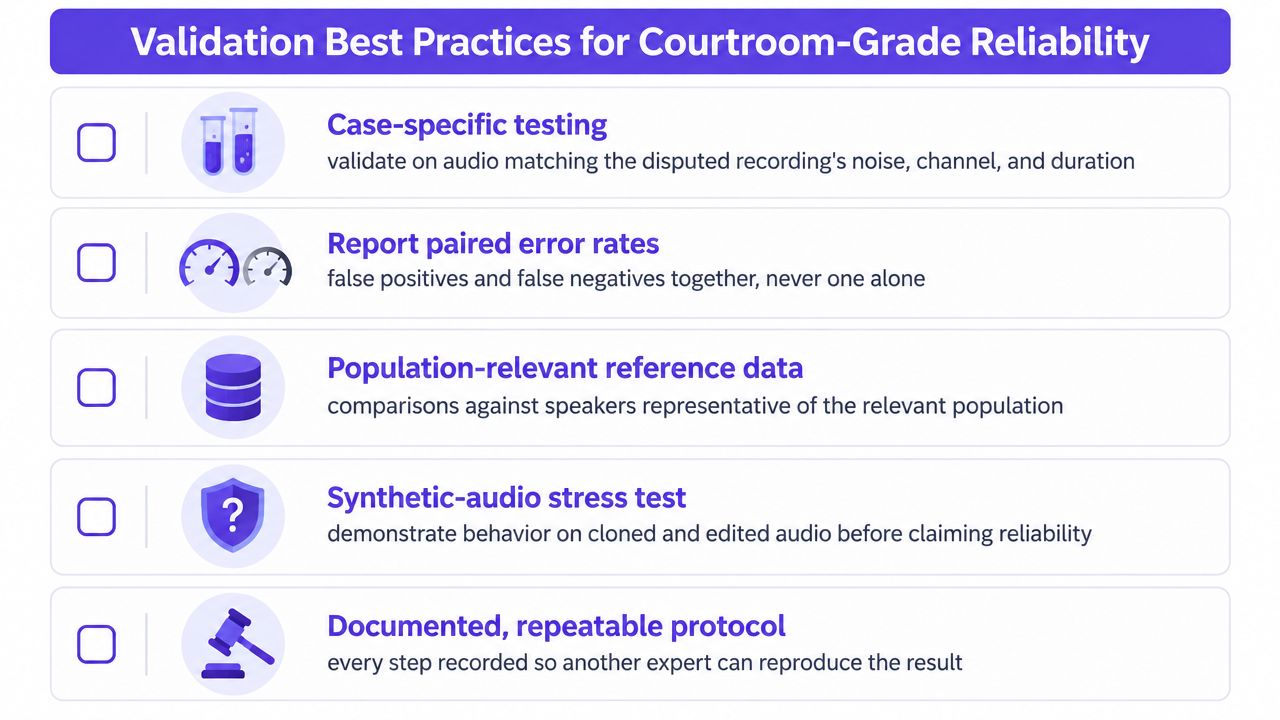
Validation should follow the evidence, not the marketing label attached to the software. An expert preparing a report should first characterize the questioned recording and then select validation material that reproduces its relevant conditions. If the exhibit is short, noisy, telephone-recorded, cross-lingual, emotionally charged, or potentially disguised, those features belong in the validation design.
Build the test around the case
The analyst should document the original file, acquisition history, microphone or handset information, transmission path, codec, enhancement steps, and chain of custody. Reanalysis must be possible. Another qualified examiner should be able to understand what was measured, which settings were used, and how the conclusion followed from the data.
The report should also disclose the reference population and training material. Likelihood ratios require calibration against a relevant population, not an abstract global database. Language coverage, dialect representation, vocabulary, and speaking style can affect whether the comparison population resembles the alternatives that matter in court.
Require complete uncertainty reporting
A point estimate without a confidence interval can overstate precision. A single accuracy figure can hide asymmetry. The report should present false-identification and false-elimination behavior together, describe the threshold or decision rule, and explain how uncertainty affects the conclusion.
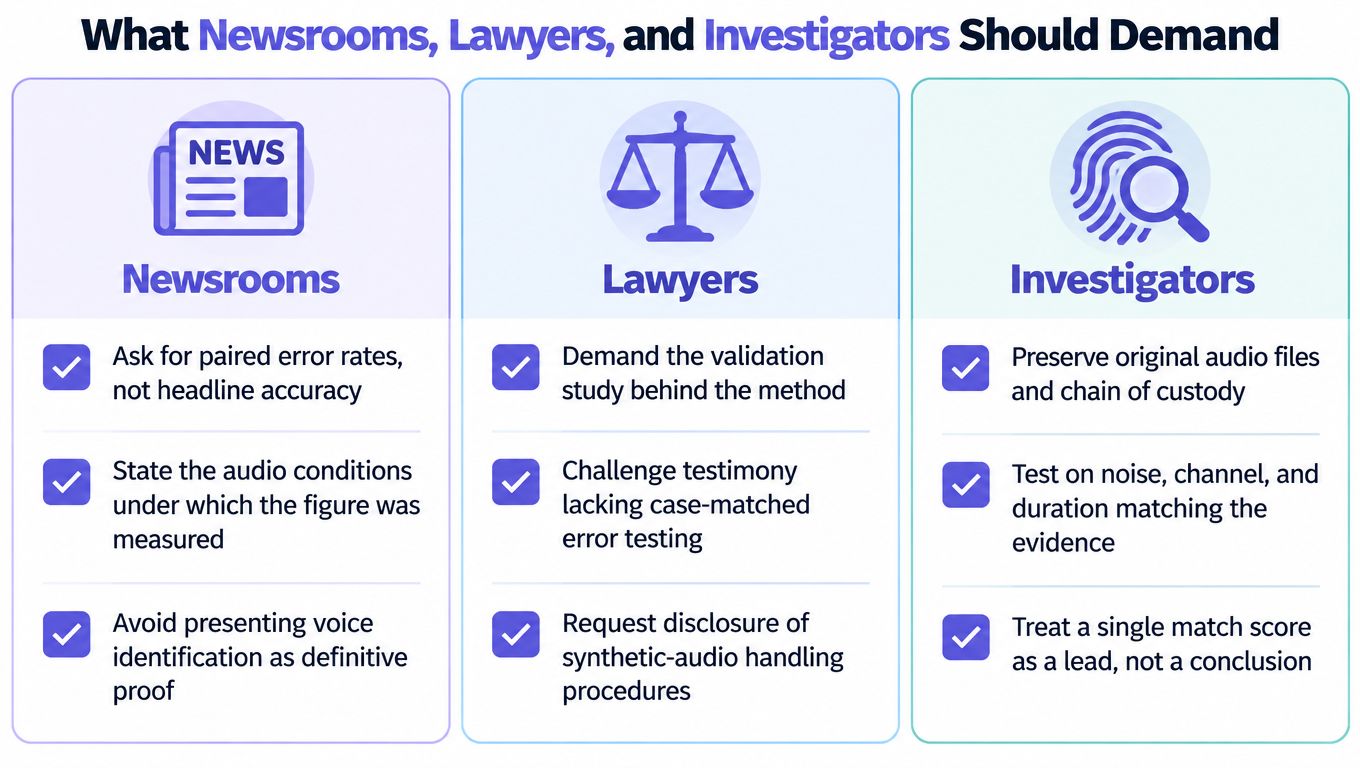
Opposing counsel can turn these principles into direct questions:
- Case match: Was the validation audio recorded through a comparable channel and codec?
- Duration: Did the study test questioned samples with similar usable speech?
- Population: Were alternative speakers representative of the relevant language and demographic conditions?
- Manipulation: Did the protocol include cloned, synthetic, edited, or re-recorded audio?
- Reproducibility: Can another examiner repeat the analysis from preserved originals and documented settings?
- Uncertainty: Are confidence intervals and paired error rates reported?
The strongest report doesn't promise certainty. It explains how much weight the evidence deserves, what proposition the analysis addresses, and which limitations prevent a stronger conclusion. For a practical authenticity check, legal and investigative teams can also review a deep voice test workflow, while keeping authenticity screening distinct from speaker attribution.
What Newsrooms, Lawyers, and Investigators Should Demand
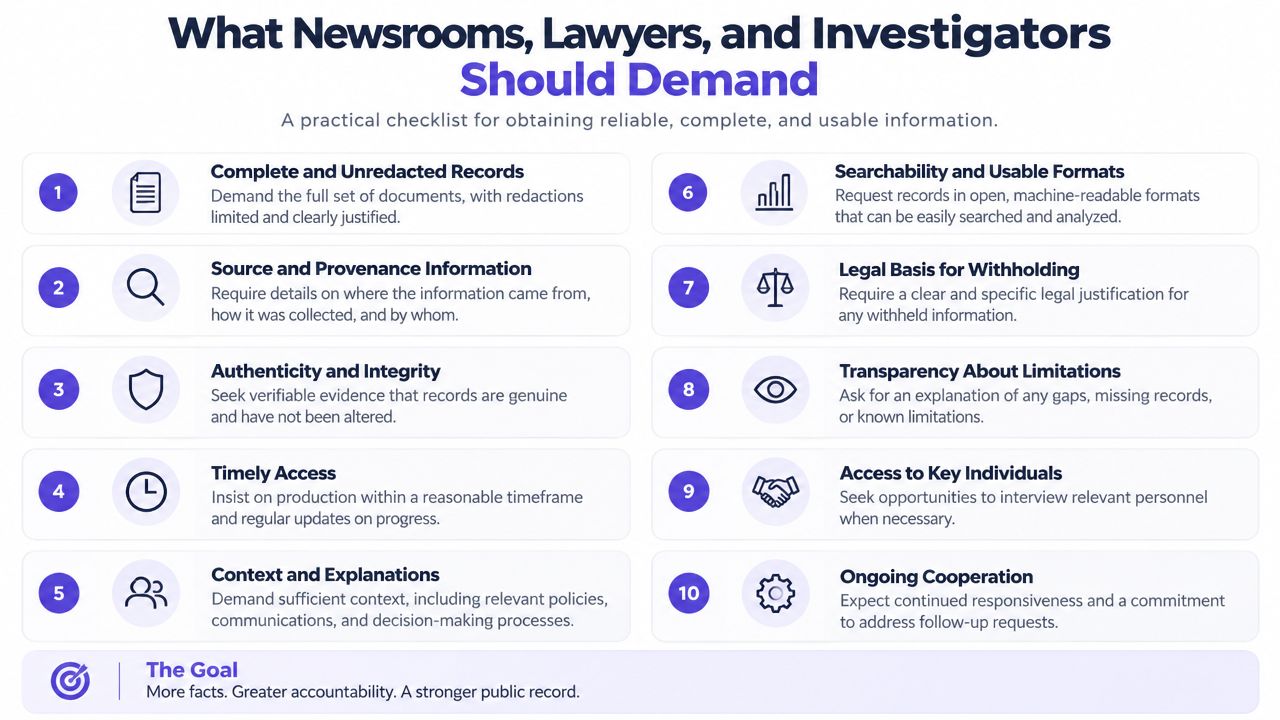
The central operational shift is simple: replace “How accurate is the system?” with “How accurate is this method for this speaker, language, channel, duration, and audio provenance?” That wording forces the evidence provider to identify the conditions behind the number.
Newsrooms should demand the validation study, paired error rates, confidence intervals, and a plain description of the recording conditions before publishing a voice-match claim. A reported match should be framed as evidence with stated limitations, not as definitive proof of identity. Editors should also ask whether the file underwent authenticity screening before treating the voice as genuine.
Lawyers have a more pointed task. They should request the relevant likelihood-ratio calibration, the comparison population, the threshold policy, and any case-matched testing. Testimony that relies on a clean benchmark while ignoring short duration, channel mismatch, cross-lingual speech, or synthetic-audio handling deserves careful challenge.
Fraud investigators should treat an unverified match as a lead. Preserve the original file, document its chain of custody, and test the audio under conditions that resemble the evidence. A score detached from channel, duration, and provenance can't carry the same weight as a result produced by a documented, reproducible protocol.
Educators should teach equal-error rates as condition-bound measurements, not universal properties. Platform moderators should require anti-spoofing evaluation that includes the kinds of cloned, edited, and re-recorded audio their systems encounter in practice. A detector's performance on genuine speech doesn't establish its behavior on generated speech.
Decision standard: Don't accept a match score until you know what was compared, against whom, under which conditions, and with what paired error profile.
For your next voice-evidence review, preserve the original audio first, request the full validation record, and ask the analyst to report false-identification and false-elimination risks separately. If the file may be cloned or edited, commission authenticity screening before relying on speaker attribution. That process won't produce a convenient universal percentage, but it will produce a conclusion that can be tested, challenged, and responsibly used.