

Deepfake Audio Detection: How It Actually Works

The toughest challenge in deepfake audio detection isn't reaching high benchmark accuracy. It's maintaining that accuracy when the voice changes, the codec changes, the language changes, or the recording comes from an uncontrolled environment. A 2026 survey reviewed systems that achieved 87% to 98.5% accuracy on benchmark datasets, yet an in-the-wild evaluation found AASIST at only 0.43 AUC and 55.22% EER on audio collected from 88 websites in 52 languages (systematic survey, Deepfake-Eval-2024 benchmark).
That gap changes how you should think about a detector. A score from a clean laboratory dataset can show that a model learned useful patterns. It can't guarantee that the same model will identify a compressed voice message, a short phone recording, or speech generated by a tool it never encountered during training.
This guide approaches deepfake audio detection from an engineering and forensic perspective. You'll learn how synthetic speech is produced, which artifacts detectors examine, how spectral analysis and machine learning differ, why benchmark results degrade in practice, and how to validate a system before trusting it with editorial, legal, or financial decisions.
Why Deepfake Audio Detection Matters Now
A newsroom receives a recording that supposedly comes from a whistleblower. The voice sounds familiar, the subject matter is urgent, and publication pressure is high. An enterprise employee receives a call from someone who sounds like the CEO and requests a sensitive transfer. A legal team is asked to authenticate an audio file whose origin and editing history are uncertain.
In each case, human listening is useful but insufficient. One study reported that people identified deepfake speech correctly only 73% of the time in a trial format. In that same format, bona fide speech was recognized at 67.78%, while deepfakes were recognized at 85.59% (WACV 2026 SAFE paper). Listeners can notice obvious glitches, but fluent synthesis often removes the cues people expect to hear.
Practical rule: Treat a detector as an investigative instrument, not as a substitute for provenance, corroboration, or expert review.
The stakes also include identity rights and organizational preparedness. Startups dealing with cloned voices, impersonation, or misuse of recordings may need legal guidance alongside technical controls, and this overview of deepfake legal protections for startups provides useful context for that side of the problem. For video calls and other impersonation scenarios, AI Video Detector's impersonation deepfake use case shows how audio authenticity can be considered alongside speech and mouth movement.
The practical question isn't whether detectors can perform well somewhere. It's whether the evidence supports the decision you're about to make. That means understanding the signals, testing the system under your conditions, and documenting uncertainty instead of turning a probability into an absolute verdict.
How Synthetic Speech Leaves Fingerprints
Synthetic speech is convincing because its pipeline reproduces the large features of a voice while approximating the small ones. A text-to-speech system turns written language into an acoustic representation, then a vocoder converts that representation into a waveform. Voice-conversion systems follow a related route, changing a speaker's vocal characteristics while retaining or altering the spoken content.
Each transformation leaves room for approximation. Pitch, timing, and timbre may sound natural, yet the system does not recreate every microscopic interaction between a human vocal tract, microphone, room, and recording chain. The result resembles a photocopy of a photograph: the composition remains recognizable, but fine grain may be smoothed away or repeated in patterns no camera would produce. That synthesis-specific mismatch is the clue. It can help separate a generated signal from genuine speech, although a new generator or altered recording path may change the clue.
The raw waveform is a poor inspection surface. It records air-pressure changes over time, but many relevant differences are too subtle to distinguish visually. Detection systems therefore convert the signal into a time-frequency representation. The investigation then asks: which frequencies appear, how strong are they, and how do they change over time?
What the representations reveal
A spectrogram maps frequency energy across time. MFCCs, or Mel-Frequency Cepstral Coefficients, summarize parts of the speech spectrum using a scale related to human sound perception. CQCCs, or Constant-Q Cepstral Coefficients, use another frequency scale and can expose different spoofing behavior.
A systematic review of audio deepfake detection identifies these representations as useful because vocoders and synthesis pipelines can leave patterns that are difficult to see in a waveform but clearer in frequency space. Examples include high-frequency noise, spectral discontinuities, and aliasing-like patterns.
High-frequency noise may add energy where a natural recording would be quieter. A spectral discontinuity is an abrupt shift between nearby time or frequency regions. Aliasing-like patterns can look like duplicated or folded frequency content introduced during generation or resampling.
Why noise creates confusion
Compression can produce roughness, missing high frequencies, and discontinuities too. Background noise may hide an artifact, while a clean synthetic clip may make it easier to isolate. That is why dedicated audio quality analysis matters before interpreting a result. Without accounting for the recording path, a detector may label a codec artifact as synthetic, or miss generated traces beneath room noise. A fingerprint learned on clean benchmark audio can therefore weaken when the microphone, codec, environment, or generator changes.
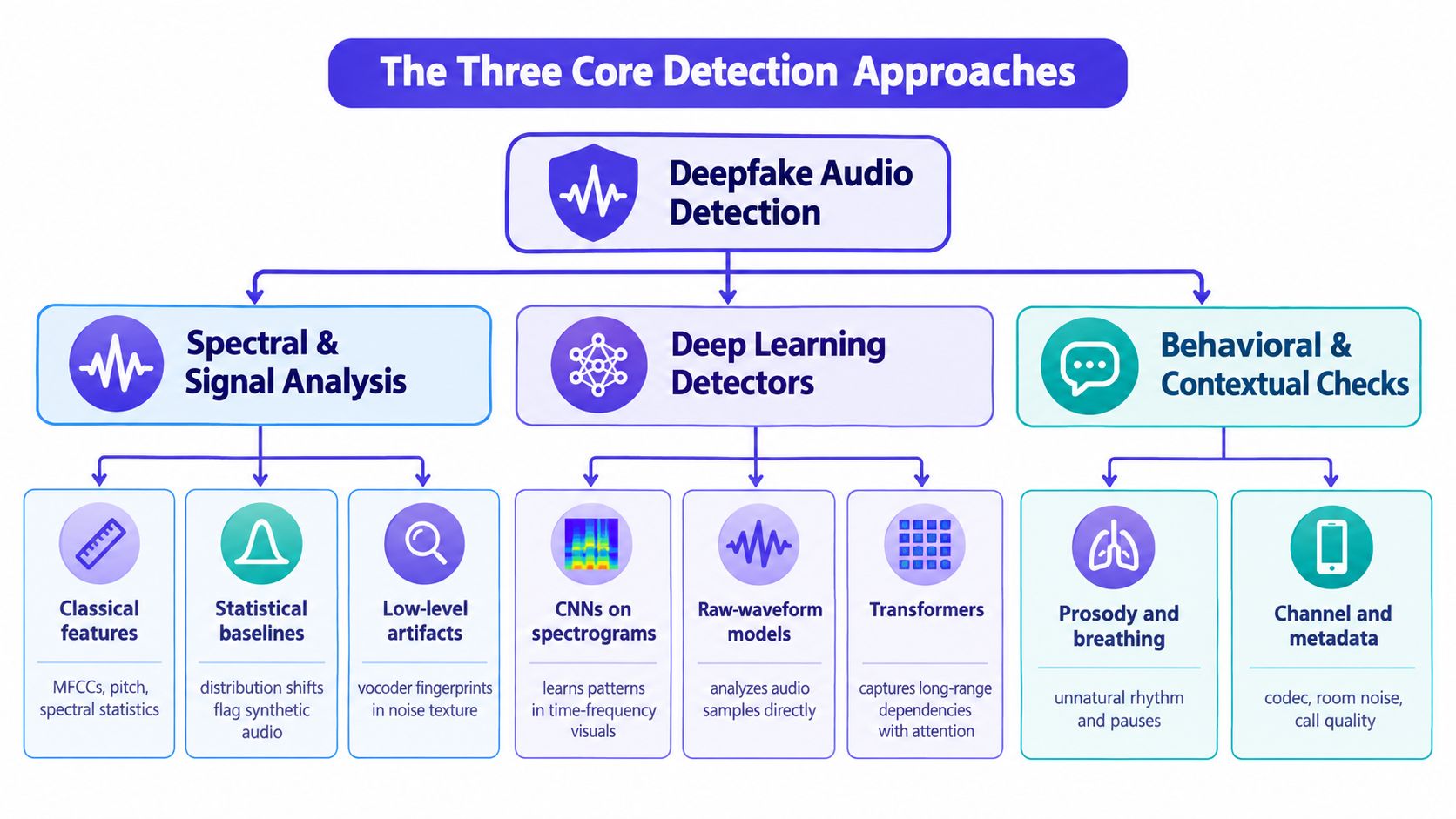
The Three Core Detection Approaches
Most practical systems draw from three families of evidence. They may use one family heavily, or combine several so that a weakness in one signal doesn't decide the entire result.
Spectral and signal analysis
The oldest approach examines measurable acoustic features directly. A system can compare pitch behavior, spectral statistics, cepstral features, energy distributions, and other properties against patterns found in genuine and synthetic speech.
Classical models such as support vector machines, or SVMs, and Gaussian mixture models, or GMMs, can classify those features. They're relatively understandable and can work well when the training and test conditions resemble each other. Their weakness is that fixed features may fail when a generator changes its artifacts or when the recording channel alters the signal.
Learned classifiers
Deep models learn representations from examples rather than relying only on hand-selected rules. Convolutional networks can process spectrograms as structured images. Raw-waveform systems learn directly from the signal. Hybrid convolutional-recurrent architectures can combine local artifact detection with information about how speech evolves over time.
A 2026 survey reported that models including ResNet, SENet, and hybrid convolutional-recurrent architectures typically exceeded classical SVM and GMM methods by 5% to 12% in accuracy under matched conditions (audio deepfake detection survey). The qualification matters. “Matched conditions” means the comparison doesn't automatically describe performance on unseen generators, codecs, or languages.
Models such as AASIST use integrated spectro-temporal analysis to capture relationships that simpler feature pipelines may miss. They can be powerful, but their complexity makes it harder to explain precisely why a particular clip received a score.
Provenance and context checks
A third approach examines the file and its journey. Analysts inspect container metadata, encoding history, sample characteristics, and whether the claimed recording context fits the file. These checks can expose a mismatch between a purported direct recording and a file that has clearly passed through editing or re-encoding.
Provenance checks don't prove that speech is genuine. A capable actor can strip metadata, and a real recording can be edited for legitimate reasons. Their value comes from independence. When spectral evidence, file history, speaker behavior, and external corroboration point in the same direction, the conclusion becomes more defensible.
Modern deployments often combine these signals. The aim isn't to produce a magical certainty score. It's to reduce dependence on one fragile clue and give a reviewer several lines of evidence to examine.
Choosing the Right Method for Your Use Case
The correct method depends on the consequence of being wrong. A newsroom may need rapid triage before assigning a specialist. A legal team may need repeatable analysis, preserved originals, and a clear explanation of limitations. An enterprise fraud team may need low-latency screening, but it should still route high-risk requests to an independent verification process.
Detection approaches compared for practitioners
| Approach | What It Detects Best | Skill Required | Best-Fit Scenario |
|---|---|---|---|
| Spectral analysis | Frequency and cepstral irregularities, including possible vocoder traces | Moderate audio-forensics knowledge | Technical triage and research analysis |
| ML classifiers | Learned combinations of spectral, temporal, or waveform patterns | Moderate operational skill, higher evaluation skill | Large-scale screening and prioritization |
| Provenance checks | Metadata inconsistencies, encoding history, and recording-context conflicts | Moderate forensic and file-analysis skill | Legal review, newsroom authentication, chain-of-custody checks |
| Multi-signal platforms | Agreement or disagreement across audio, visual, temporal, and file-level evidence | Lower for routine use, higher for interpretation | High-stakes editorial, enterprise, and platform workflows |
A low-stakes queue can use a fast classifier to identify files that deserve attention. That doesn't mean the tool should automatically label every flagged clip as fake. A false positive can suppress legitimate reporting or evidence, while a false negative can allow impersonation or fraud to continue.
For legal work, require the original file where possible, record the hash and handling history, preserve the detector version, and retain the output with its confidence and limitations. For a financial request, use the detector as a warning signal, then confirm through a trusted channel. Do not call back using a number supplied in the suspicious recording or message.
AI Video Detector is one example of a multi-signal product that analyzes uploaded video using frame-level analysis, audio forensics, temporal consistency, and metadata inspection. A platform with that design can be useful when the suspected incident involves both a voice and a visual impersonation, but teams should still test its results against their own samples before making it part of a formal decision process.
Confidence scores need interpretation. A score can express how strongly a model separates two classes under its calibration conditions, not how certain a human should be about the underlying event. Ask what threshold was used, what data produced it, and whether the threshold reflects the cost of each type of error.
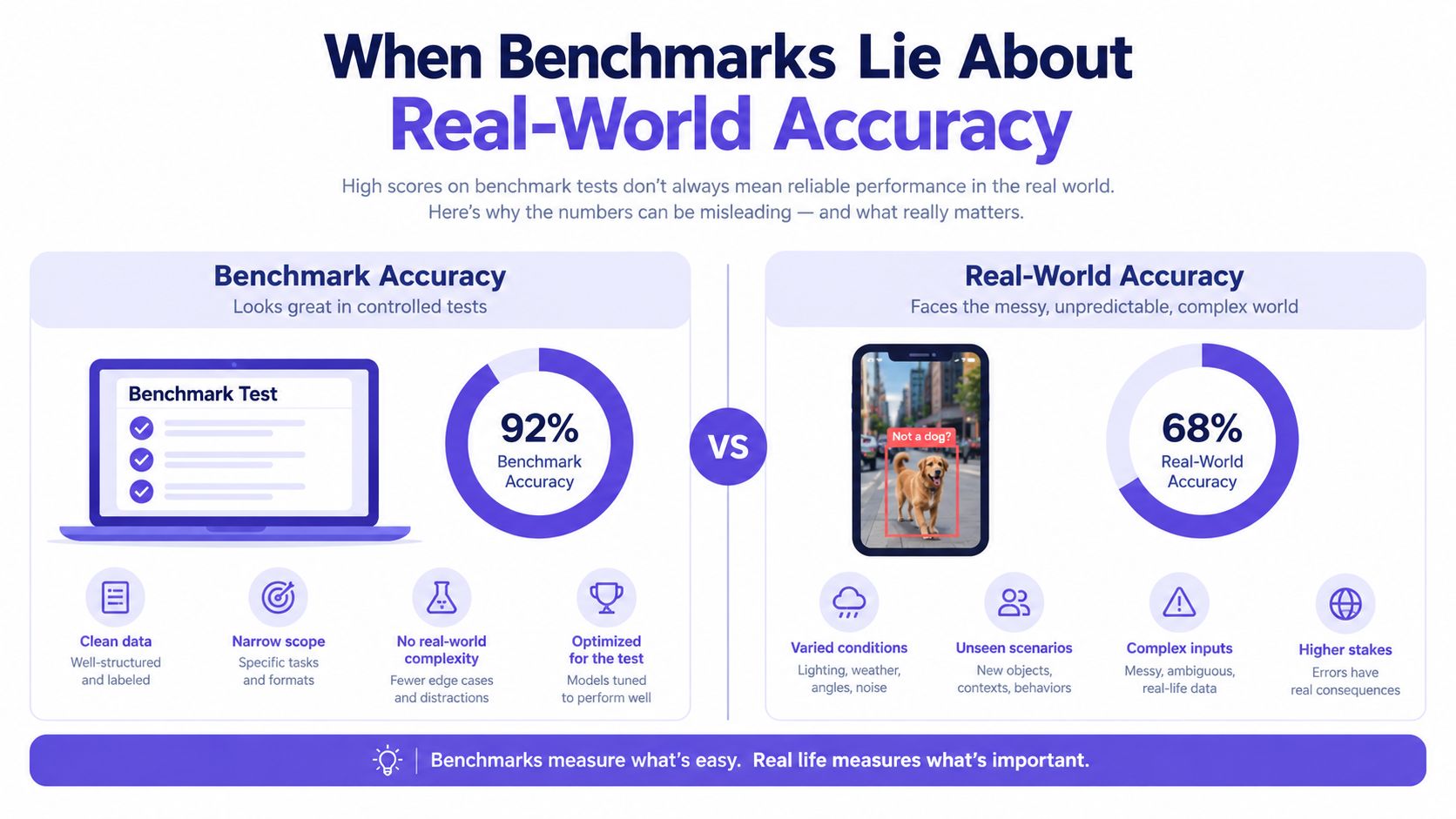
When Benchmarks Lie About Real-World Accuracy
A benchmark can be valid and still be a poor forecast of deployment performance. Controlled datasets often make the task cleaner than the conditions your investigators, moderators, or fraud analysts will face. The speakers may be consistent, the generators may be known, the files may be minimally compressed, and the train-test split may not represent a novel attack family.
The deployment conditions change the signal
Compression removes detail. Noise competes with the artifact. A short clip may not contain enough speech transitions for a model to distinguish a generator trace from ordinary channel variation. A different language can alter phonetic patterns, while a new vocoder can eliminate the cues that a detector learned during training.
The Deepfake-Eval-2024 results make the problem concrete. AASIST recorded only 0.43 AUC and 55.22% EER on a collection containing 56.5 hours of audio from 88 websites in 52 languages, despite stronger results on more controlled benchmarks (Deepfake-Eval-2024 study). That isn't evidence that AASIST is useless. It shows that a model can learn the distribution of a benchmark without learning a durable definition of synthetic speech.
Questions for a vendor
Treat a headline score as a starting point for due diligence. Ask:
- Training coverage: Which generators, languages, speakers, codecs, and recording conditions appeared in training?
- Unseen attacks: Was the model tested against generators and vocoders excluded from training?
- Channel stress: What happens after phone compression, platform transcoding, background noise, or re-recording through a speaker?
- Short inputs: How does performance change when the clip contains only a brief utterance?
- Operational output: Does the system provide calibrated confidence, uncertainty, and reasons for escalation?
- Monitoring: How does the vendor detect drift when new generation methods appear?
A vendor demonstration is a sample, not a guarantee. Your own acceptance test should include genuine recordings from the channels you receive and synthetic samples produced by tools that weren't disclosed to the model during training.
Understanding the Metrics and What Good Looks Like
Metrics answer different questions. Accuracy is the share of decisions classified correctly, but it can conceal class imbalance and may look favorable when the test distribution doesn't resemble operational traffic. Equal Error Rate, or EER, is the point where false acceptance and false rejection rates are equal. Lower is generally better, but the useful threshold may not be that balance point.
An EER of 1.8% and an EER of 8.3% represent different trade-offs under the tested conditions, but neither tells you the result for an unknown codec or generator. Those figures come from ASVspoof 2019 evaluations summarized in a 2026 review, which reported benchmark accuracy commonly ranging from 87% to 98.5% and EER from about 1.8% to 8.3% (systematic review).
AUC, or area under the receiver operating characteristic curve, measures ranking quality across thresholds. F1 combines precision and recall, making it useful when you care about both missed fakes and false accusations. t-DCF evaluates the cost of spoofing in an automatic speaker-verification pipeline, so lower values indicate better performance under the defined cost assumptions.
Translate scores into decisions
One 2026 evaluation reported an IBD-dataset model at 23.34% EER, 84.29% AUC, and 66.37% F1, while the same benchmark's best overall model reached 4.18% EER, 98.87% AUC, and 93.18% F1. A separate benchmark summary reported one commercial system at 98.1% F1, while several open-source models scored between 48% and 63% (benchmark summary).
The spread shows why “good” has no universal value. A newsroom may prefer a cautious threshold that sends ambiguous clips to an editor. An enterprise fraud team may prioritize catching suspicious calls, then require a human-controlled callback process. Legal teams should avoid treating any single metric as authentication.
For a practical explanation of how false positives and false negatives interact, this guide to the precision-recall tradeoff provides a useful decision framework. Your evaluation should report results at the threshold you plan to use, on data that reflects your actual risk.
A benchmark metric describes a test condition. It doesn't describe your incident until you reproduce the condition that matters.
Best Practices for Detecting Deepfake Audio in the Field
Start with the incident, not the classifier. Before uploading or processing a suspicious file, record who supplied it, when it arrived, how it was transferred, and what the source claims about its creation. Preserve the original and work from a copy. If the file may become evidence, restrict access and log every transformation.
A field workflow
Establish provenance. Ask whether the audio came from an original recorder, a messaging platform, a screen recording, or a forwarded file. Note any claimed edits, exports, or conversions.
Assess the recording context. Compare the acoustic environment with the story. Does the room sound consistent? Is the speaker supposedly on a call, yet the file has characteristics of a studio export? Context raises questions, but it rarely proves the answer.
Run independent checks. Use spectral or machine-learning analysis, inspect metadata, and compare the clip with verified recordings of the same speaker when legally and ethically appropriate. Look for agreement, not one decisive-looking score.
Verify the requested action. If the audio asks for money, credentials, access, or publication, confirm through a trusted channel. A familiar voice doesn't authenticate the request.
Document uncertainty. Save the file identifier, tool name and version, input conditions, output score, threshold, reviewer, and follow-up evidence. Record what the detector couldn't evaluate.
Test before deployment. Build a local validation set containing genuine material from your channels and synthetic material with varied noise, compression, speakers, and generation methods. Re-test after model updates.
What not to conclude
A clean spectrogram doesn't establish authenticity. A detector flag doesn't establish malicious intent. Synthetic speech can be used for accessibility, privacy, entertainment, or legitimate automation, so classification and attribution are separate questions.
Newsrooms should combine technical output with source verification and editorial corroboration. Legal teams should involve qualified audio-forensics professionals when authenticity is disputed. Enterprise security teams should connect voice screening to established approval controls rather than allowing a model score to authorize a transaction.
Operational safeguard: Make the detector capable of escalating uncertainty. A system that can only say “real” or “fake” encourages people to overstate what the evidence supports.
The Future of Deepfake Audio Detection
Generation and detection will continue to improve in response to each other. New vocoders may hide familiar artifacts, while detectors will search for more stable patterns across signal behavior, provenance, context, and speaker interaction.
The most useful direction is not a permanent universal detector. It's continuous out-of-domain evaluation, supported by diverse local test data and monitoring for drift. Multi-signal systems can reduce reliance on one artifact, while stronger provenance infrastructure can help investigators understand how a file was created and transformed.
Practitioners should watch how vendors validate unseen generators, degraded channels, short clips, languages, and re-encoded material. Those tests are more informative than a single headline score.
The central lesson is simple: trust tools validated under your conditions, not benchmark accuracy in isolation. Combine detection with human judgment, independent verification, and disciplined documentation, and deepfake audio detection becomes a practical defense rather than a promise of certainty.
If your team handles voice-based fraud, disputed recordings, newsroom submissions, or impersonation incidents, create a small validation set from your real channels and test candidate detectors against it before deployment. Document the thresholds, failure modes, and escalation process, then review that test whenever your recording sources or detection tools change.


