

Digital Magic Wand AI Detector: What It Checks

The Digital Magic Wand AI detector scores written text, not video, evaluating prose generated by ChatGPT, Claude, Gemini, and more than 20 AI models. If you need to check whether a video clip is synthetic or manipulated, a text classifier returns zero evidence about the footage.
Common advice around AI verification pushes a shortcut that fails under scrutiny: pick any well-known detector with a high accuracy claim, upload whatever suspicious file landed in your inbox, and trust the percentage it spits out. That approach breaks down in two ways that cost newsrooms, educators, and security teams real credibility.
First, people routinely confuse text-classification tools with media forensics platforms, expecting a writing scorer to settle questions about video footage. Second, they treat an undisclosed headline accuracy figure as hard proof, overlooking how rewriting, recompression, and unstated test conditions can swing a detector's score from near certainty to noise. Separating what a tool inspects from what its marketing implies is the only reliable place to start.
What Digital Magic Wand Actually Scores
The Digital Magic Wand AI Detector is a text-classification service, and nothing in its design reaches video footage. According to the Digital Magic Wand AI Detector product page, the platform evaluates writing from ChatGPT, Claude, Gemini, and more than 20 AI models, claiming 96%+ accuracy. That same page does not disclose the benchmark dataset, class balance, confidence intervals, false-positive rate, or evaluation protocol behind the headline figure.
That omission matters more than the number itself. An accuracy claim without a published test protocol cannot be checked against the conditions of your own case, such as edited text, mixed authorship, or passages rewritten after generation.
Because the service is built exclusively for written prose, its signals have nothing in common with video verification. The visual breakdown below summarizes that boundary before both tool categories go side by side.
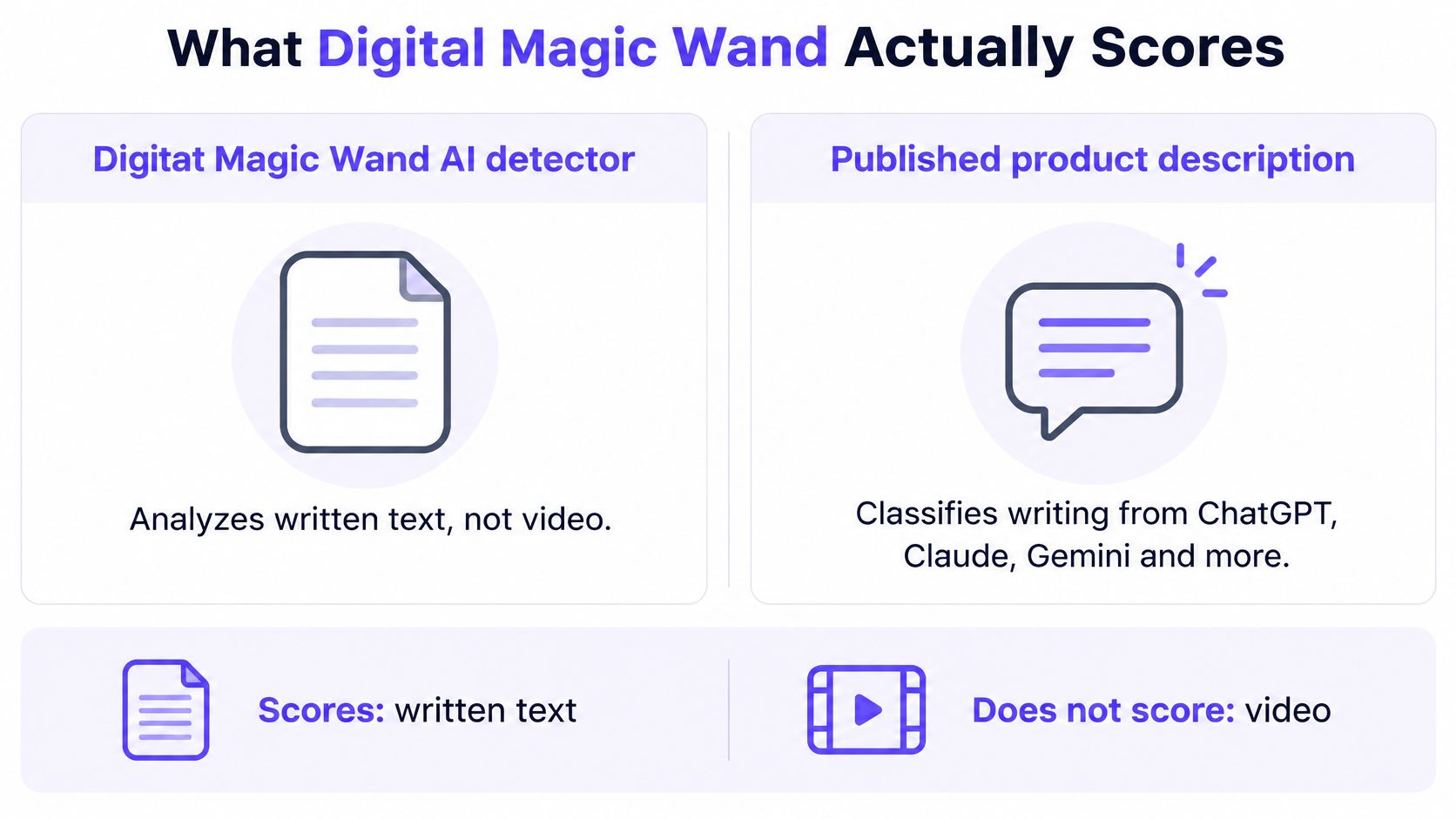
Putting a text classifier next to a video authenticity check makes the mismatch unmistakable across inputs, forensic signals, and practical use cases.
Text Detector Compared With Video Authenticity Checks
| Feature | Digital Magic Wand AI Detector | Video authenticity check |
|---|---|---|
| Input | Written text | Video files |
| Signals analyzed | Writing patterns across more than 20 AI models | Frame-level artifacts, temporal consistency, audio signals and file metadata |
| Output | Probability score for AI-written text | Confidence score for AI-generated or altered footage |
| Accuracy claim | 96% or higher per vendor page, benchmark details undisclosed | Strong results on controlled benchmark sets, weaker performance on compressed or re-uploaded footage |
| Best use | Screening written submissions | Triage of clips before publication or evidence review |
The last row deserves attention. A detector tuned for one input type does not degrade gracefully on another; it produces a number divorced from the evidence you need.
Why Text Signals Never Transfer to Footage
A text classifier inspects the handwriting of an essay, measuring word choices, sentence cadence, and phrasing habits. A video authenticity check inspects the camera, the lighting, the motion of people on screen, the audio track, and the underlying file container.
That distinction carries an immediate operational consequence. Say a journalist receives a viral clip of a public official alongside a written press statement. Pasting the transcript into a text tool tells you nothing about whether the footage was generated, dubbed, or face-swapped. The transcript can score as machine-written while the video is genuine, or the reverse, because the two artifacts carry entirely separate forensic evidence.
One wrong inference follows from ignoring this. Teams sometimes assume a high-confidence text result lends credibility to the accompanying video, as if trust in one file transfers to the other. It does not. Each file demands its own analysis against signals it contains.
If the file on your desk is a video clip, you need a video-specific forensic check. Before you rely on any detector's percentage in an editorial, legal, or compliance review, confirm the tool's actual input type on the vendor's product page so you don't apply a writing score to a visual question.
How the Text Classifier Reads a Passage
A text classifier operates much like a document examiner comparing an unsigned letter against shelves of known samples, some drafted by people and others produced by machines. Rather than checking facts or tracing who typed the words, the model estimates how closely the statistical texture of a passage resembles machine output.
Digital Magic Wand doesn't publish its internal feature list, so analysts can't inspect its exact scoring weights. Across modern text classifiers, however, evaluation generally centers on four measurable writing signals:
- Word predictability: Language models select high-probability next words, producing smoother, less surprising phrasing than most human drafts.
- Sentence rhythm: Human writers tend to mix clipped observations with sprawling explanations, whereas synthetic prose often falls into uniform sentence lengths.
- Phrase repetition: Generated text frequently recycles transitional formulas, hedging language, and tidy summary clauses across paragraphs.
- Structural symmetry: Automated drafts often organize arguments into evenly balanced points with predictable opening and closing beats.
Four Steps From Paste to Score
Running a passage through a text detector follows a straightforward path, though reading the output properly takes more care than clicking a button.
- Paste or upload the text. Enter the complete draft rather than isolated lines, because very short excerpts lack enough linguistic patterns for stable scoring.
- Wait for section-level scoring. The classifier breaks the submission into segments and calculates probability estimates across the document.
- Read the headline percentage. Note the overall score as an initial screening signal, not a verdict on authorship.
- Check paragraph-by-paragraph variance. Look for sharp jumps between sections, which often tell a more accurate story than the document average.
What Mixed Scores Look Like in Practice
Consider a purely illustrative example: a hypothetical 400-word essay submitted for review. Suppose the opening paragraph and conclusion look cleanly human, while the middle two paragraphs trigger a much higher synthetic score.
That split doesn't hand you a simple yes-or-no label. It points toward a mixed-authorship draft, heavy AI-assisted editing in the body, or a human writer leaning on boilerplate phrasing in the middle section. Real numbers vary widely by topic, writing style, and tool, because the score is only a probability estimate about text patterns, never a log of who sat at the keyboard.
Reading the 96% Accuracy Claim Carefully
A headline accuracy percentage sounds decisive until you ask what sat inside the test set. Suppose 95% of an evaluation dataset is human-written essays and only the small remainder is AI-generated passages. A useless classifier that labels every single submission "human" still achieves 95% accuracy while failing to catch a single synthetic text.
That math explains why missing evaluation details matter so much. As documented in AIChecker Pro's Digital Magic Wand review, the product page states an accuracy rate of 96% or higher. Without published details on dataset composition, class balance, confidence intervals, false-positive rate, or test protocol, an outside reviewer can't verify how the detector handles formal prose, non-native English writing, or lightly edited drafts.
Independent testing highlights how unstable text scores become once writing is revised. In a test reported by Tenorshare's Digital Magic Wand review, a 400-word ChatGPT passage processed through Digital Magic Wand received AI scores ranging from 46% to 100% across external detectors, with GPTZero still classifying the humanized output as 100% AI-generated. Paraphrasing alters surface cues that one model relies on while leaving deeper statistical patterns that another classifier still detects.
Practical rule: A high score can't prove AI authorship with certainty, and a low score can't prove a human wrote every sentence.
How to Test a Detector on Your Own Material
Blind reliance on opaque scoring models creates familiar failure modes well beyond writing checks. As NeoTeo's look at AI moderation flaws illustrates, automated classification systems routinely generate costly false flags when organizations trust black-box outputs without auditing how error rates behave on real content.
If your team plans to use the Digital Magic Wand AI detector in a recurring workflow, calibrate it yourself before enforcing policies around its numbers:
- Build a small in-domain validation set: Collect labeled examples that match your workload, such as student essays, technical documentation, or translated news copy.
- Separate the four error metrics: Track precision, recall, false-positive rate, and false-negative rate independently rather than collapsing everything into one accuracy figure.
- Re-test after edits: Run human drafts that underwent light grammar polishing alongside raw AI drafts so you see how easily legitimate editing trips false alarms.
How Video Authenticity Checks Analyze Footage
Checking whether a video is genuine requires layering independent forensic signals rather than trusting a single visual guess. Synthetic media generators leave distinct traces across pixels, sound waves, frame transitions, and file headers, and a thorough check inspects all four layers before producing a confidence estimate.
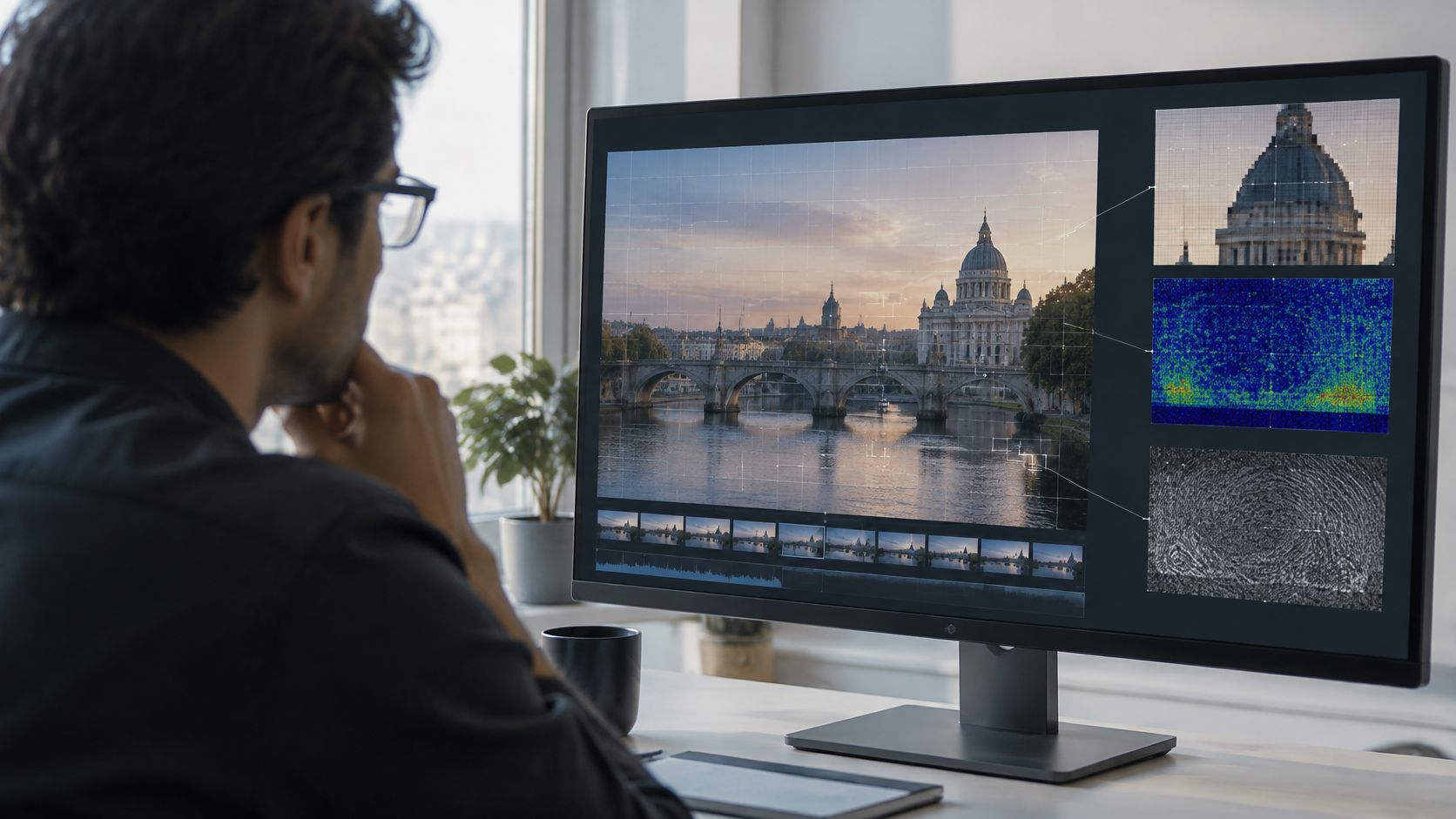
Four Forensic Layers Behind Video Verification
Each layer looks for a different category of manipulation, compensating when one signal gets weakened by editing or poor lighting.
- Frame-level analysis scans individual images for generation artifacts, including subtle GAN fingerprints and diffusion artifacts left in textures, skin pores, and edges.
- Audio forensics examines the soundtrack for synthetic spectral anomalies, unnatural breathing cadences, or acoustic mismatches between a voice and the room shown on screen.
- Temporal consistency tracks motion, shadows, and lighting from one frame to the next to spot subtle flicker, warped facial geometry, and motion discontinuities.
- Metadata inspection audits the file container, codec chain, and encoding irregularities to check whether the clip's technical history aligns with a genuine camera recording.
Why Whole-Video Scanning Beats Single-Frame Checks
Evaluating a full sequence yields far stronger evidence than testing one frozen screenshot. In an arXiv study on AI-generated video detection, every evaluated detector achieved an average area-under-the-ROC-curve (AUC) of at least 0.93 across the tested video generators, while the strongest architecture, MISLnet, reached 0.983.
The same study quantified why broad spatial and temporal sampling matters. Aggregating information across 80 video patches produced a 72.2% relative error reduction compared with patch-level detection, and one reported configuration delivered an AUC improvement of 0.452 alongside a 96% relative error reduction. Pulling evidence across multiple regions and frames smooths out local noise that throws off isolated frame checks.
Even strong academic numbers belong inside experimental boundaries, because new generators appear quickly and shift the underlying artifacts. That's why professional teams read video scores as probabilities backed by multiple signals rather than permanent accuracy guarantees.
At AI Video Detector, operated by WriteHuman, LLC, doing business as AI Video Detector, our AI detection models are trained on millions of samples to evaluate uploaded footage across frame, audio, temporal, and metadata layers. Before trusting any commercial platform's confidence score, compare its disclosed signal coverage and evaluation details against those four forensic layers.
Why Recompressed Clips Lower Detection Results
A huge gap separates clean laboratory files from the compressed videos people forward in group chats and newsrooms. Synthetic-video evaluation has gradually shifted toward messy real-world circulation, as documented in an arXiv analysis of synthetic-video benchmarks covering Deepfake-Eval-2024, which compiled synthetic and manipulated clips from 88 websites across 52 languages.
In the SAFE synthetic-video-detection challenge cited in that same analysis, leading systems posted AUC scores from 0.88 to 0.93, well ahead of the 0.74 baseline detector. Yet applying ordinary video augmentations dropped detection accuracy by approximately 5 to 25 AUC points compared with unaltered source files.
Everyday Edits That Strip Forensic Cues
Real-world footage almost never reaches an analyst untouched. Before anyone runs a check, a clip has usually passed through several destructive steps:
- Messaging app forwarding: Services like WhatsApp aggressively shrink bitrates and downscale resolution on every resend.
- Social-platform cropping: Re-framing horizontal footage into vertical feeds discards edge pixels and triggers a fresh encode.
- Frame-rate conversion and overlays: Changing frames per second, burning in subtitles, swapping audio tracks, or capturing a screen recording overwrites original pixel and temporal relationships.
Each pass introduces compression noise that masks fine generator traces, which explains how video compression artifacts degrade forensic signals long before an investigator uploads the file. According to an ACM review of synthetic media detection robustness, cross-compression can reduce state-of-the-art detection AUC by 15% to 40%. That paper also notes a separate review finding a 10% to 15% performance decline in out-of-distribution settings, warning that image detectors run frame-by-frame often miss flicker, unnatural motion, and broken inter-frame coherence.
Detection Conditions and Reported Performance Effects
| Condition | Reported figure | What it means |
|---|---|---|
| Leading detectors on benchmark files | AUC 0.88 to 0.93 | Best-case results on controlled, unaltered files |
| Baseline detector in SAFE evaluation | AUC 0.74 | Reference point for weak detection |
| Common video augmentations | 5 to 25 AUC points lower | Resizing and re-encoding weaken results |
| Cross-compression | 15 to 40% lower AUC | Messaging or social re-uploads are harder to judge |
| Out-of-distribution settings | 10 to 15% performance decline | Unfamiliar sources reduce reliability |
A detector that looks strong on pristine benchmark files can fail on the compressed copy sitting in a journalist's inbox, making robustness and calibrated uncertainty more valuable than a headline score.
The practical takeaway is straightforward. The same video clip can produce a clear synthetic flag right after creation, an inconclusive score after social-platform compression, and a misleading low score after someone screen-records it on a phone. Never treat a single upload of a late-stage copy as the complete picture.
How to Verify a File With Either Tool
Whether you're screening a suspect essay with a text classifier or checking a leaked video clip, an automated score only holds weight inside a documented workflow. As outlined in a Springer cognitive research study on deepfake verification, relying on a single detector blurs statistical screening with formal authentication; defensible review treats any detector as one auditable layer alongside preserved originals, chain-of-custody logs, model records, corroborating evidence, and expert escalation.
The first two habits in that chain protect every step that follows, keeping the raw evidence intact before any software touches it.
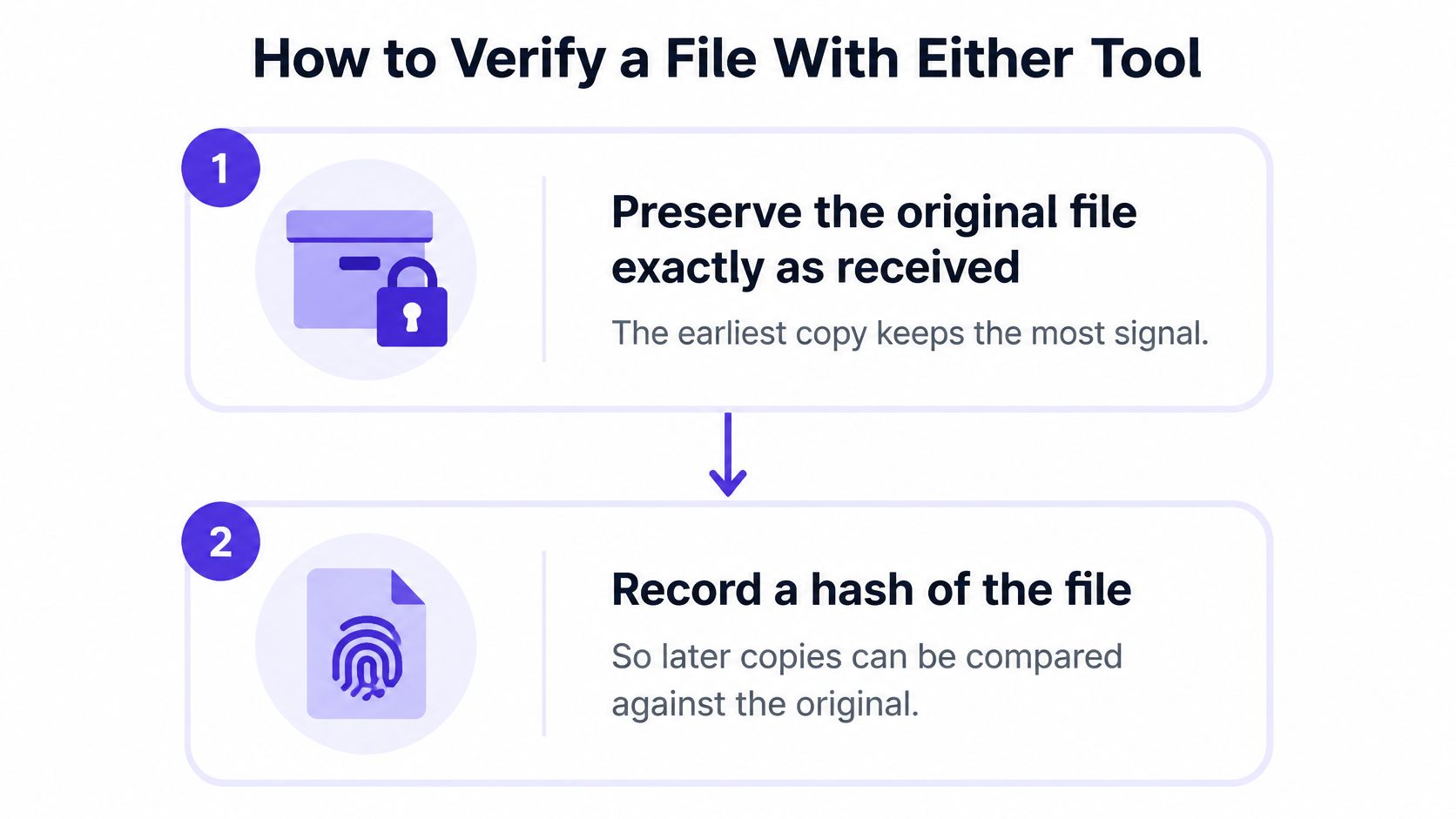
Nine Steps to Build a Defensible Audit Trail
- Preserve the original file untouched. Save the raw attachment in a read-only folder before previewing or exporting it, because the earliest version retains the strongest forensic signal and intact container fields for checking a file's metadata description.
- Record a cryptographic hash. Generate a file hash of the preserved original immediately so you can prove later copies match bit for bit.
- Log the file's intake history. Write down who sent the item, the exact date and time received, and every platform, email client, or messaging app it traveled through.
- Analyze the earliest available copy first. Heavy recompression erodes detection signals, so run your initial check on the version closest to the camera or original author.
- Test across two or three encodings. If you possess both a raw upload and a compressed social repost of the same clip, scan each version separately to see how strongly re-encoding shifts the confidence score.
- Route text and footage to their matching tools. Run accompanying scripts, captions, or written statements through a text detector such as the Digital Magic Wand AI detector, and send the video file itself to a dedicated video authenticity platform.
- Document the exact tool output. Record the vendor name, model version if displayed, test date, and full confidence score instead of saving an unlabeled screenshot.
- Gather external corroboration. Track down raw camera files, witness accounts, geolocation clues, or document revision histories that sit outside any automated classifier.
- Escalate borderline or conflicting cases. Route low-confidence scores, or files where written and visual checks disagree, to a trained forensic reviewer before making a publication or disciplinary call.
Every step produces an entry a second reviewer can verify independently. That repeatable paper trail is what separates a defensible audit from a single screenshot of a percentage.
What a Detector Score Can and Cannot Prove
A percentage is a triage signal, not a finding of fact. It does not establish authenticity, authorship, intent, or courtroom admissibility. The Digital Magic Wand AI detector scores writing, not footage. A high text score does not prove a human never touched the draft, and a low score does not rule out AI after paraphrasing. Neither result names who made a clip or whether an edit was meant to deceive. A text score cannot settle a video question.
That limit is easy to miss when editorial or compliance teams treat what a percentage AI checker actually measures as a verdict in a high-stakes review. The number estimates statistical similarity to patterns in the classifier's training data. It does not record what happened to the file.
Accuracy claims around these tools are often undisclosed. A vendor may publish a headline percentage without stating the test set, the model version, or how paraphrasing and later edits change the result. Without those conditions, a confident label is a marketing claim, not evidence an auditor can reconstruct.
When Human Judgment and Software Disagree
Eye review is not a clean second opinion. Reviewers miss synthetic cues and also flag ordinary edits. Clear technical guidance can sharpen that judgment. Vague or wrong cues push the same reviewer toward a worse call.
If instinct and software conflict, do not pick the answer that feels stronger. Log the tool score beside the human note, then send the file for source checks that sit outside both.
Detection Versus Provenance and Admissibility
Policy discussions increasingly separate statistical detection from cryptographic provenance, since provenance records show where a file came from while detection only estimates whether it looks synthetic.
Privacy-first analysis with no image storage can limit exposure of sensitive material during screening. Those privacy settings do not create provenance, and they do not make a score admissible. The chain-of-custody record has to carry that weight on its own.
Reporting language: "The score indicates a likely synthetic edit with moderate confidence, pending source-file verification."
Calibrated wording stops a probabilistic signal from being read as a yes-or-no verdict.
Choose the Right Check for Your Next File
Match the verification tool to the asset sitting in front of you instead of forcing one platform to answer every question:
- Written text: Use the Digital Magic Wand AI detector to screen articles, essays, captions, or statements, treating its score as a signal to corroborate with document history and human review.
- Video clips: Skip text classifiers entirely, since they return zero evidence about footage, and run a video authenticity check that inspects frames, audio tracks, temporal motion, and file metadata.
- Mixed evidence: When a submission includes both video footage and a written transcript or statement, run each asset through its appropriate detector and escalate any conflicting outputs.
Always re-run your check on the earliest available copy and store the result inside your intake log rather than isolating a single number from its context.
If you have a video clip that needs verification today, start by uploading your earliest copy to AI Video Detector and comparing the output against your preserved source-file record. The AI video detector analyzes a clip frame by frame to estimate whether it was created or altered using AI, and gives a confidence score, while the free plan includes basic AI detection scores and privacy-first analysis with no image storage. Keep that confidence score alongside your file hash, intake log, and corroborating evidence, because a clearly stated uncertainty is always more useful than a binary verdict, and confidence is not certainty.