

Percent AI Checker: What the Score Really Means

A percent AI checker score estimates how closely a text matches patterns learned from AI-written and human-written samples, not the share of words an AI wrote. If the checker never watched the writing happen, what does its percentage establish?
That gap matters when a teacher reviews an essay, an editor questions a contributor, or a security team assesses suspicious footage. A confident-looking number can make an uncertain inference feel like a measurement. Reading it responsibly means separating pattern similarity, authorship evidence, and the decision you're considering.
What the Percentage Really Tells You
A percent AI checker produces a probability-style signal, not an inventory of AI-written words. Its output tells you how the submitted material fits the tool's classification system, but that isn't the same as reconstructing how someone created it.
Think of a fever thermometer. It measures temperature, but a high reading doesn't identify its cause. Infection, exercise, and environmental heat require different follow-up questions. An AI checker needs similar interpretation, with an additional limitation: its percentage may not even be calibrated to a real-world probability.
What a percentage can and cannot tell you
| Question | Can the score answer it? | Why |
|---|---|---|
| Was the text written by AI? | Only as a probability | Scores estimate pattern similarity, not authorship |
| What share of the words came from AI? | No | A small AI edit can move the score far more than its word share |
| Is a low score proof of human writing? | No | Paraphrasing or unfamiliar models can hide the signals |
| Is the percentage a calibrated probability? | Not by default | It needs calibration against a representative reference population |
Read the label before interpreting the number
Different interfaces can attach percentages to different things. A document-level confidence score, a proportion of flagged passages, and an estimated likelihood aren't interchangeable. Read the tool's definition before deciding which interpretation applies.
Calibration means checking whether the score corresponds to observed outcomes on suitable reference material. A system can rank suspicious documents reasonably well while attaching misleading probability labels to them. A polished gauge doesn't establish that this validation happened.
Practical rule: Write down what the percentage measures before writing down what you think it proves.
Also identify the threshold, the boundary at which the software changes its label from likely human to likely AI. A result near that boundary deserves different handling from a result supported by extensive independent evidence.
The detection score represents probability, not certainty, and no detection is perfect. Before using one, complete this sentence: This tool reports a score representing… If you can't finish it from the documentation, don't translate the number into an accusation.
How Detection Scores Are Produced
Between pasting a paragraph and receiving a result, the software performs a sequence of comparisons. The details differ by detector, but the main decisions are easier to grasp as a path: capture the submission, describe it numerically, compare that description with learned patterns, then turn the comparison into a display.
The infographic shows the core path from submitted content to a displayed score.
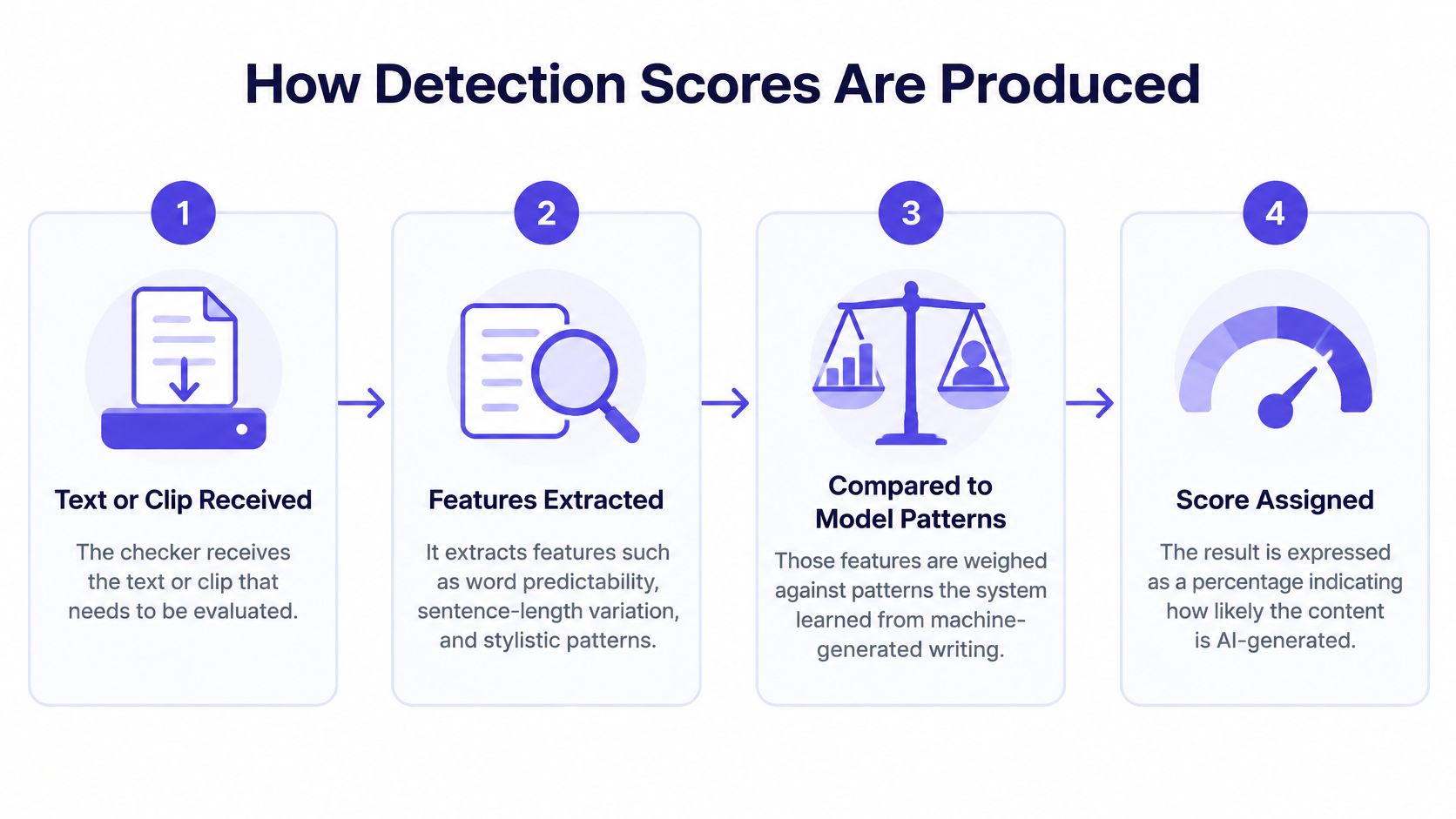
From content to comparison
- The checker receives the material. For text, it needs usable language to analyze; for a clip, it needs visual or audio information. The submitted version matters, so preserve the original rather than testing an edited copy without recording the change.
- It extracts features. Text features may include word predictability, sentence-length variation, repetition, and stylistic regularity. A video system may instead examine frame consistency, motion, sound, temporal flickering, or unnatural textures. These are mathematical descriptions of an artifact, not observations of the person using a particular application.
- It compares those features with learned patterns. The model weighs similarities to examples used during development. A feature is useful because of an observed association, and that association can be strong without being exclusive to humans or machines.
From comparison to label
- The system assigns a score. It converts its internal assessment into the percentage or confidence display you see. The guide to confidence calibration explains why a convincing display and a well-calibrated estimate can be different things.
- A decision rule produces the visible label. The software, or the organization using it, chooses where a score becomes a flag. That choice sits after feature extraction and scoring, so two interfaces can show similar internal evidence and still apply different cutoffs.
Statistical detection works like a sorting machine that has seen many envelopes and learned which ones tend to contain machine-written text. It estimates resemblance. Provenance marking uses a different mechanism: information attached to content about its origin or processing history.
Media workflows make that separation useful. A workflow such as learning to turn family photos into art can begin with human-created source material and later apply AI-assisted transformation, so where the material came from and what was changed afterward must be assessed as separate questions.
A text score and a clip score may share the same percentage format while resting on different evidence. Treat the interface label, the modality, and the decision rule as parts of the result before treating the number itself as meaningful.
Why One Number Can Mislead
The tempting interpretation is that more AI involvement should produce a proportionally higher AI percentage. That would make the score resemble a fuel gauge, showing how much machine-generated material is in the document. Controlled editing tests challenge that assumption.
In a 2025 benchmark of 12 detectors using APT-Eval's 15,000 texts, the GLTR detector flagged 26.85% of samples after only 1% of the text had been modified by AI, according to the ACL benchmark paper. The flagged-sample rate isn't a document's displayed AI score. It shows how little editing could change classification across the tested material.
Small edits needn't produce small changes
An edit can affect more than the words directly replaced. Rewriting a transition, simplifying a sentence, or regularizing a passage can change the predictability and stylistic variation the detector evaluates.
A paint-match analogy helps. A few drops of tint can alter the appearance of an entire mixture, but examining the resulting shade doesn't tell you how many drops went in. Likewise, the strength of a writing pattern doesn't reveal the quantity of AI assistance that produced it.
The reverse problem matters too. Translation, paraphrasing, unfamiliar subject matter, or output from a generator outside the detector's familiar examples can weaken recognizable signals. An absence of detected patterns isn't a verified creation history.
A checker evaluates the submitted artifact. It doesn't observe every decision that produced it.
Ask for uncertainty, not decorative precision
A responsible interface should distinguish a score from the uncertainty surrounding its interpretation. Useful information includes calibration evidence, confidence intervals where statistically justified, and an insufficient-evidence state.
That last option matters. Software shouldn't have to force every submission into a confident human-or-AI category when the material falls outside its validated use.
For consequential decisions, choose a threshold according to the error you're willing to tolerate, then examine independent evidence such as revision history, provenance, and metadata. Disciplinary, legal, and employment decisions require more than a numerical resemblance to machine-associated writing.
Error Rates, Accuracy Figures and Base Rates
Sensitivity is the share of AI-generated texts a detector catches. Specificity is the share of human-written texts it correctly clears. Their corresponding failures are false negatives and false positives.
Those measures answer different questions. A tool that catches more generated content may also flag more human work, while a tool configured to protect human writers may miss more generated submissions.
A peer-reviewed education study cites a Bloomberg assessment of GPTZero and Copyleaks that found approximate false-positive rates of 1% to 2% on essays written before generative AI became widespread. Applied to 100,000 human-authored documents, those rates imply about 1,000 to 2,000 wrongly flagged submissions. These are expectations under those assumed rates, not predictions for every school or publishing workflow.
Why the content mix changes the meaning of a flag
The base rate is how common AI-generated content is in the pool being checked. It matters because false alarms come from the human-written pool, which may be much larger than the AI-written pool.
The comparative detector evaluation reports an operating point of 92.4% sensitivity and 90.8% specificity at a cutoff of 79.32; applied to a hypothetical mix of 10 AI texts and 90 human texts, that yields about 9.2 correctly flagged AI texts and 8.3 wrongly flagged human texts. Nearly half the flags would therefore be false alarms, despite the apparently strong sensitivity and specificity.
The table translates these cited rates into expected counts.
Expected errors at scale
| Scenario | Items checked | Expected result |
|---|---|---|
| Human documents at a 1% false-positive rate | 100,000 | About 1,000 wrongly flagged |
| Human documents at a 2% false-positive rate | 100,000 | About 2,000 wrongly flagged |
| Human texts in a 10/90 mix, 90.8% specificity | 90 human texts | About 8.3 wrongly flagged |
| AI texts in the same mix, 92.4% sensitivity | 10 AI texts | About 9.2 correctly flagged |
These are expected values, so fractional documents represent averages across repeated comparable batches. They don't imply that part of a document receives the classification.
Why headline accuracy isn't enough
Overall accuracy combines correct decisions across the tested class mix. It doesn't tell a teacher how frequently human essays are accused, or tell an editor how many generated articles slip through. A benchmark dominated by one class can make that combined figure especially unhelpful.
Likewise, ROC-AUC summarizes how well a detector separates classes across thresholds. It isn't the probability that a particular flagged submission was generated by AI. For operational choices, the precision and recall trade-off guide helps distinguish catching more AI content from making each accusation more trustworthy.
Before deployment, require an evaluation that matches the intended task:
- Set the error budget first. Decide how much risk of falsely accusing a human writer the workflow can tolerate.
- Publish threshold-specific results. Ask for sensitivity and specificity at the settings people will use.
- Validate relevant material. Test the languages, genres, and document types your organization receives.
- Monitor changes. Recheck performance when generation methods, submission patterns, or detector versions change.
- Provide review and appeal. Give a named person responsibility for resolving contested results.
A percentage becomes operationally useful only when readers know the decision rule, the evaluation population, and the consequences of getting it wrong.
Who Gets Flagged Unfairly
Can a high AI percentage reflect my language proficiency, editing style, or genre rather than AI authorship? Yes, that's a legitimate concern, not an excuse that reviewers should dismiss.
A 2025 PeerJ study on detector bias reported accuracy-bias trade-offs, including stronger bias against non-native authors and certain academic disciplines; the evidence summarized alongside it also identifies ACL findings connecting CEFR English proficiency and language environment with detector performance, and greater misclassification of easy-to-read text. Together, those findings challenge the assumption that a single threshold treats all writers equally.
Who bears the cost of an error
A writer learning English may deliberately use familiar sentence structures. An academic author may follow the conventions of a narrow discipline. A professional editor may remove irregular phrasing to make instructions easier to understand.
None of those choices establishes machine authorship. Yet a reviewer who treats stylistic regularity as proof can ask writers to defend precisely the clarity or consistency they were encouraged to develop.
Don't ask a writer to make their prose worse to satisfy a detector. Ask whether the detector has been validated for that writer's task.
A fair review starts with relevant comparison material. Test thresholds separately across languages and genres, rather than assuming performance on general prose transfers to multilingual essays, technical abstracts, or concise professional copy.
Build a process that writers can answer
Avoid automatic penalties. Preserve drafts and revision history where available, and let the writer explain their planning, sources, and editing choices before anyone makes a consequential decision.
Teachers can use the AI checker guidance for educators to turn a flag into a structured review rather than an immediate misconduct finding. Missing draft records shouldn't automatically count as guilt, either; not every legitimate writing process produces a detailed digital trail.
Fairness reporting should identify false-positive performance for English learners, multilingual writers, short text, academic prose, and professional copy. An organization can't meaningfully assess equal treatment from a universal accuracy figure that hides which groups receive the false accusations.
Reading a Score in Three Real Situations
The following hypothetical cases illustrate interpretation, not measured detector performance. In each, a reviewer needs to connect the displayed result with the actual creation process.
A joint review should focus on the evidence behind a result, not just its label.

A student essay receives a high score
A student writing in a second language submits an essay that a general-text checker flags. Their revision history shows arguments developing over several days, with notes and sources supporting the progression.
The appropriate reading is a reason to ask questions, not a penalty. Record the tool name, version, testing date, threshold, and result, then note that the drafts support a developing writing process and that the detector's relevance to this student's language background remains unresolved.
A newsroom article receives a middling score
A journalist drafts an article independently, then uses substantial AI-assisted grammar and structural editing. The editor's task is to establish whether that assistance complied with newsroom policy, not to convert the score into a word count.
The review record should identify the tool, date, threshold, and result, alongside the writer's account and available pre-edit draft. The workflow and disclosure policy determine the next action.
Use the accompanying video as a prompt for discussing how your team communicates uncertain results.
A generated clip receives a low score
A short clip comes from a generator outside the detector's validated coverage. The result offers little support for an authenticity claim.
Document the tool, date, threshold, and result, but also record the source account, original-file availability, and provenance checks. Don't describe an unsupported low-risk result as verified human origin.
Before accepting any of these interpretations, ask:
- Which system? What tool, version, and threshold produced the result?
- Which validation? What error evidence applies to this content type?
- Which corroboration? What independently supports or contradicts the proposed conclusion?
Using a Score as One Signal in Your Decision
Use a documented review process before acting. Galliot's explanation of how analytics drives business decisions provides useful context for connecting an analytical output with a decision rather than treating the output as the decision itself.
- Record the result. Save the tool, version, threshold, score, and testing date alongside the exact material checked.
- Assess the error risk. Compare the intended action with your acceptable false-positive rate and the content population being reviewed.
- Gather independent evidence. Examine drafts, revision history, metadata, sources, and provenance rather than collecting detector scores alone.
- Require human review. Assign a reviewer who can assess contradictory evidence before disciplinary, legal, or employment action.
- Document the resolution. Record the reasoning and give the writer or submitter a meaningful chance to respond.
The European Commission's AI Act overview sets 2 August 2026 as the scheduled application date for Article 50 synthetic-content transparency obligations, with limited transitional arrangements for certain existing systems. Those marking and disclosure duties shouldn't be confused with a requirement to accept a commercial detector's verdict.
For video reviews, our detector analyzes a clip frame by frame and gives a confidence score, looking for generation-associated patterns including diffusion artifacts and unnatural textures. Keep that result alongside source checks and provenance.
Review your next flagged item before acting on it. Save the original, complete the review record, and choose whether to act, gather more evidence, or hold the decision. For suspicious footage, use AI Video Detector as an additional check, then base your conclusion on the complete evidence, not the percentage alone.