

6 Deepfake Video Examples: Visual and Audio Clues

A colleague forwards a 40-second clip. The face is familiar, the voice sounds right, and the caption says it was recorded this morning. You have maybe ninety seconds before it lands in a group chat that includes your boss.
That's the situation these six deepfake video examples are built around. They run from labeled art projects and public education campaigns to a fabricated wartime address and a corporate fraud that cost a Hong Kong engineering firm tens of millions. Each one is handled the same way: what happened, which signal exposed it, and what you can check on the next suspicious clip that reaches you.
Every entry ends with a replicable step, and none of them needs a forensic lab. Most take under five minutes and work on any deepfake video example you're likely to meet: a political address, a celebrity endorsement, an executive on a video call, or a file that has been re-uploaded so many times the original is gone.
1. Jordan Peele and BuzzFeed Obama Public Service Announcement (2018)
In April 2018, BuzzFeed published a short video in which Barack Obama appears to address the camera and warn that synthetic media would let anyone put words in anyone else's mouth. The voice belongs to the comedian Jordan Peele. The face and mouth movements were synthesized with FakeApp, a consumer face-swap tool built on deep learning, and the clip carried a label making clear it was a fake.
It was made to raise awareness rather than to deceive, which is exactly why it still works as a training sample. The production values were modest, the tool was off the shelf, and the result convinced a large share of viewers long enough to generate headlines.
What the 2018 fake reveals about recognition limits
The uncomfortable part is how well the trick works on people. In a benchmark that tested viewers on real and generated video, participants identified AI-generated video with 52.6% accuracy, against 76.0% for recognizing real footage, and the strongest detectors in that evaluation performed close to random chance on visual-only material, according to the benchmark's authors. That evaluation excluded audio and lip-sync, which is where a lot of practical evidence now lives.
Practical rule: Treat a familiar face as context, not evidence. The features you recognize are precisely the ones a face-swap model is trained to reproduce.
Three checks that work on this clip
- Teeth and jawline during speech: pause on a frame where the mouth is open. Look for teeth that blur into one another or a jaw that moves without the cheek above it following.
- Skin texture at the face boundary: the seam usually shows at the hairline, the ear, or the neck, especially when the head turns.
- Comparison against source footage: pull an official clip of the same person from their own channel and match speech rhythm, not just appearance.
If you want the mechanics before you start comparing frames, our explainer on what a deepfake is and how the pipeline works covers generation order, which tells you where artifacts tend to appear.
2. @deeptomcruise TikTok Deepfake Series (2021)
The account launched in February 2021 and did something the research literature had not managed: it made synthetic video entertaining. Short clips showed a convincing Tom Cruise doing magic tricks, falling over, and riffing at a golf course. Chris Ume of the visual effects studio Metaphysic built the deepfakes, and an actor who resembles Cruise, Miles Fisher, supplied the performance, with face and voice modeling layered over it.
That division of labor is the detail worth remembering. A small team with modest resources, one performer, and a post-production pipeline produced clips that millions of viewers watched without suspicion. Major news outlets covered the account as proof that the capability had gone mainstream.

Why the TikTok format hides artifacts
Platform processing does more damage to evidence than most viewers realize. Every upload is re-encoded, and a detector that scores well on a clean benchmark file can stumble after that treatment. A robustness study that re-encoded test videos at H.264 constant-rate-factor levels of 23 and 40 found heavy compression substantially undermined all three evaluated methods, though one SBI-based approach declined by only 0.6% when it had been trained on compressed data.
The Cruise clips also came from a bespoke pipeline rather than a stock tool, and generalization across generators is uneven. A review of cross-generator detection performance reports an average improvement of only 1.90 AUC points when adapting models to unfamiliar fakes, with cross-dataset tests showing AUC of 0.79 in one direction against 0.64 in the reverse.
- Blinking and micro-motion: watch a full ten seconds. Natural blink rates vary; synthetic ones can cluster or disappear.
- Hairline shimmer: the edge of the hair is where warping shows first, particularly against a busy background.
- Lighting agreement: compare the light on the face with the shadows in the room. They should come from the same direction.
The video below shows the series as audiences met it, short and casual, with no obvious tells at phone size.
3. Fake Zelensky Surrender Video (March 2022)
In March 2022, weeks into the Russian invasion, a video began circulating that appeared to show President Volodymyr Zelensky telling Ukrainian soldiers to lay down their arms. It was posted to a hacked Ukrainian news website and pushed out through social media. Zelensky denounced it within hours through his own channels, and platforms removed copies.
The speed of the official denial mattered more than any frame-by-frame analysis. This is the clearest case in the set where the strongest evidence was contextual: an unfamiliar domain, an implausible announcement, and a government that contradicted the clip immediately.
Context signals beat pixel forensics
Manipulated video of political leaders spreads before verification catches up, and that gap is the whole attack. The 2019 clip of Nancy Pelosi, slowed and distorted rather than synthetically generated, reportedly accumulated more than 2.5 million views on Facebook, according to Security.org's deepfake statistics collection, which treats it as a benchmark for distribution risk from a single altered file.
Viral reach is not evidence of authenticity, and altered context can be as influential as a fully generated face.
A verification order that works under deadline
- Check the domain's history: a legitimate outlet's page that suddenly hosts a single dramatic video, or a URL that mimics a real news site, is a compromise signal.
- Go to the leader's own accounts first: official channels are the fastest correction available, and they usually post within hours.
- Timestamp the first appearance: note when and where the clip surfaced, then compare with the official record rather than with other shares.
For newsroom workflows around fabricated announcements, our guide to AI misinformation and how it spreads sets out the escalation steps between spotting a clip and publishing a correction.
4. Arup Hong Kong Video Conference Fraud (2024)
An employee at the engineering firm Arup in Hong Kong joined what looked like an ordinary internal video call. The chief financial officer was on screen, along with several colleagues. Every other participant was synthetic, and the employee was walked through a series of transfers before anyone realized what had happened.
The scale made it a reference case: DataVisor's 2024 fraud review reports that a Hong Kong company lost HK$200 million, approximately US$25.6 million, after fraudsters used deepfakes of multiple employees during a video conference.
The decisive signal was procedural
Nobody needed to catch a warped jawline or a bad lip-sync frame. The instruction carried urgency, arrived inside a meeting that felt authenticated, and attached senior faces to a payment request. That combination suppressed the ordinary pause before money moves. Consumer voice tools such as AI vocal cloning for remixers show why a familiar voice should be treated as data to verify, not proof of identity.
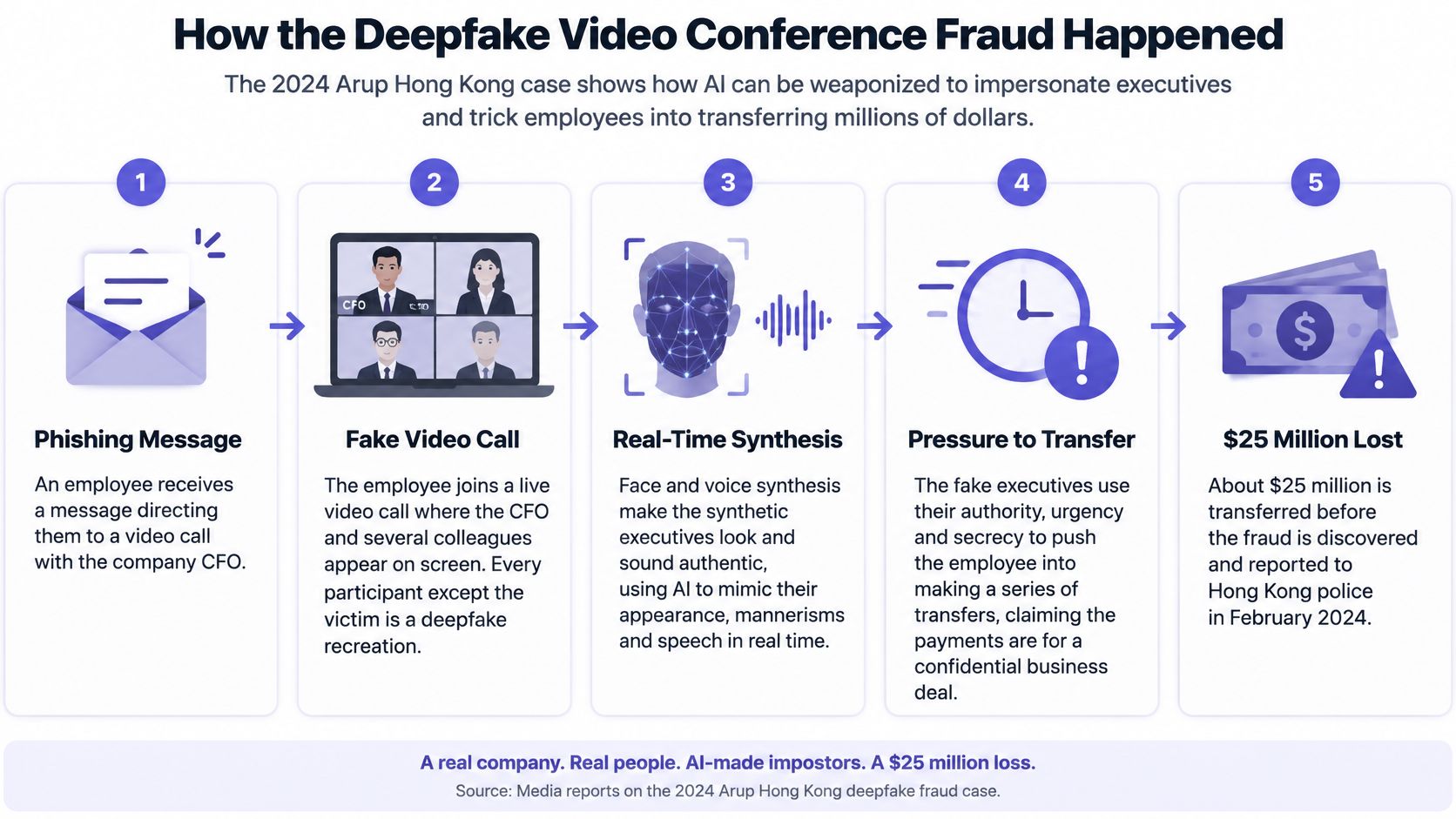
Control that actually stops this: any payment request that arrives by video, voice, or chat gets verified by a callback to a number already in the finance system. Never a number supplied in the meeting.
- Second approver above a set threshold: no single person, however senior, releases a large transfer alone.
- Code phrase for high-value instructions: agreed in advance, stored offline, changed after any staff departure.
- Treat urgency and secrecy as fraud indicators: both are used to override process, and both are unusual in genuine finance operations.
- Preserve the meeting file: if a recording exists, keep it and scan it. Our guide to deepfake fraud and payment-verification controls covers what to capture before the file is overwritten.
The repeatable check is independent of the clip quality: separate identity from channel, then confirm the instruction through a path the attacker did not choose.
5. Channel 4 Alternative Christmas Message with a Deepfake Queen (2020)
On Christmas Day 2020, the British broadcaster Channel 4 aired its alternative Christmas message with a synthetic version of Queen Elizabeth II. The program was explicitly labeled as a deepfake and used the format to explore what the technology could do and what it might cost. The synthetic monarch appeared on a major public broadcaster, and that placement is what made it a discussion point in media ethics.
Disclosure was central to how audiences received it. A viewer who knew they were watching a construction could enjoy the joke and still absorb the warning. The same footage stripped of its label behaves differently.
What disclosure does and doesn't solve
A label travels with the original broadcast, not with every copy of it. Someone films a television with a phone, or records a streaming window, and the resulting file carries visible interference patterns called moiré. Those patterns are an acquisition artifact, not a generation fingerprint, and they distort detector output. A benchmark of 15 high-performing detectors found real moiré artifacts reduced performance by as much as 25.4%, while synthetically added moiré caused a 21.4% accuracy decrease.

Moiré tells you how a clip was captured, not who made it.
- Require persistent labels: a disclosure burned into the frame survives re-upload better than a caption or a description field.
- Document provenance and disclosure decisions: editorial review needs a record of what was labeled, when, and by whom.
- Classify capture conditions first: distinguish a screen recording from native camera footage before scoring authenticity, or display patterns will dominate the result.
6. Bill Posters and Daniel Howe Zuckerberg Video (2019)
In June 2019, the artists Bill Posters and Daniel Howe posted a short video to Instagram in which Mark Zuckerberg appears to boast about controlling users' data. The voice was synthesized with Canny AI, the body belonged to a real speaker, and the piece was part of their Spectre project on data power and synthetic media. It was shared widely and pushed platform moderation policy for manipulated video into public argument.
The clip's importance is historical. It arrived at the moment deepfakes stopped being a technical curiosity and became a policy problem for the platforms distributing them.
The year the numbers changed
The surrounding data explains why. By August 2019, researchers had identified approximately 14,600 deepfake videos online, the overwhelming majority on adult-entertainment sites rather than political or commercial channels, and Google searches for the term were about five times higher at the end of 2019 than a year earlier, with interest peaking around release of the fabricated Zuckerberg clip, Reuters reported.
The curve since then has steepened rather than flattened. More than 8 million deepfakes were estimated to have been shared in 2025, compared with 500,000 in 2023, according to figures attributed to the UK government and compiled by Market Intelligence Tools. Detection capacity has not scaled at the same rate.
Audio is the weak link in a talking-head fake
- Check the verified account: a public figure's statement appears on their own channels. A screenshot of an account with a similar handle is not confirmation.
- Listen for prosody: synthesized speech tends to flatten emphasis and drop breath sounds at the ends of long sentences.
- Watch head turns: boundary artifacts appear when the face rotates relative to the lighting, which a static frontal shot can mask.
Verification habit: if a platform policy only removes fully synthetic video, it misses the cheaper manipulation, which is real footage carrying a false claim.
How the six deepfake video examples compare by setting, detection clue, and lesson
Read across the rows and the six cases split by intent. Some were labeled demonstrations, parody, broadcast, or art projects. The Zelensky and Arup clips hid provenance and pushed viewers toward belief or action, so the decisive clue sits outside the pixels.
| Item | Year | Setting | Key Detection Clue | Main Lesson |
|---|---|---|---|---|
| Jordan Peele and BuzzFeed Obama Public Service Announcement | 2018 | Disclosed public-awareness video using consumer face-swap software | Mismatches around skin texture, teeth, jawline, and mouth movements | Face-swap tools can convincingly alter public figures; verify clips against authentic footage |
| @deeptomcruise TikTok Deepfake Series | 2021 | Labeled parody videos shared on TikTok | Hairline shimmer, temporal flicker, or lighting inconsistencies | High-quality deepfakes can reach mainstream audiences; check disclosure and source authenticity |
| Fake Zelensky Surrender Video | 2022 | Disinformation shared during the invasion of Ukraine | An unfamiliar news domain and an announcement the government denied within hours | Verify crisis statements through official channels and trusted sources |
| Arup Hong Kong Video Conference Fraud | 2024 | Corporate video call used to pressure an employee into transfers | Live video treated as proof of identity, with urgency and secrecy around transfers | Confirm unusual payments through a separate, trusted channel |
| Channel 4 Alternative Christmas Message with a Deepfake Queen | 2020 | Clearly labeled educational broadcast on British television | Moiré patterns in a re-filmed copy, which show how the clip was captured rather than who made it | Transparent labeling helps audiences interpret synthetic media |
| Bill Posters and Daniel Howe Zuckerberg Video | 2019 | Social-media art project shared on Instagram | Speech cadence and facial-boundary artifacts as the head or lighting changes | Viral manipulated clips need source checks and clear labeling |
The practical sort is three-way: provenance clues such as domain and denial, capture or generation clues such as moiré and flicker, and behavioral clues such as secrecy around money. Naming the clue first makes the next check obvious.
Turning Deepfake Examples into a Repeatable Verification Habit
Six cases, one routine. Check the source before you check the pixels, because a hacked news site or a stripped label explains more clips than any artifact does. Then look at the media itself, in this order: capture conditions, motion consistency, audio behavior, and the request the clip is making.
Technical checks belong in that routine, but they settle less than people expect. Detector performance drifts as generators change. In 2024, open-source detectors' video AUC declined by 50% on the Deepfake-Eval-2024 benchmark, according to the benchmark's statistics summary. A score is a signal to weigh, not a verdict to publish.
That distinction matters most when stakes are high. A detector flag on a clip of a chief executive authorizing a transfer doesn't settle anything, and neither does a clean score. What settles it is a callback on a number you already hold, a second approver, and a preserved original file.
Three habits cover most of it. Verify identity through an independent channel whenever money, access, or reputation is on the line. Preserve the file you received before you convert or re-upload it, since compression destroys the evidence you'd want later. And record what you concluded and why, so a colleague can review the reasoning rather than repeat the work.
For the technical layer, AI Video Detector runs a suspicious clip through frame-level analysis and audio forensics and returns a confidence score, with basic detection available without registration and uploaded videos processed without being stored. It's one input among several, and it's most useful when you've already written down what you expect to find.
If you work in an institution where clips arrive with a claim attached, whether a committee hearing, a school board, or a newsroom tip line, the discipline is the same as recognizing false claims in committee: name the claim, name the evidence that would support it, then test that evidence against a source you chose rather than one the clip supplied.
Pick one clip from this list this week and run the full sequence on it, including the source check. The method is what transfers, not the example. The next fake you meet will be one nobody has written about yet.


