

Deepfake Fraud in 2026: Scale, Signs, and Defenses

Deepfake attempts occurred about once every five minutes worldwide in 2024, according to Entrust's fraud research. That's a rate of attempts, not successful thefts. For anyone approving payments, publishing footage, or handling evidence, the important shift is operational: a convincing face or voice can no longer serve as the final check.
How Often Deepfake Fraud Strikes and What It Costs
The operating picture is broader than fake executive videos. Criminals can combine synthetic voices and faces with falsified records, then present the pieces as if they independently confirm one another. A document that matches a video doesn't establish identity when the attacker supplied both.
The figures below measure different things: attempted attacks, reported targeting, and losses within surveyed businesses. They can't be added together or treated as a single global loss estimate.
Deepfake fraud scale reported for 2024
| Measure | Figure | Source | What it does not mean |
|---|---|---|---|
| Deepfake attempt rate | About once every five minutes, roughly 105,120 attempts a year if constant | Entrust, 2024, cited above | Not successful thefts or victim counts |
| Digital-document forgeries | Up 244% year over year | Entrust, 2024, cited above | Not deepfake video alone |
| Businesses reporting a financial loss | 92% of surveyed businesses, in a study of 575 decision-makers | CFO's reporting on Regula's study with Sapio Research | Not a global census of all firms |
| Average related loss | Nearly $450,000 across surveyed industries | Regula's Deepfake Trends 2024 report | Not the Arup wire or a median |
| Payment or executive-impersonation targeting | 22% of surveyed professionals said their organizations were targeted | American Bankers Association reporting on Trustmi's survey | Not confirmed successful payments |
| Both audio and video deepfakes | 49% of surveyed companies reported experiencing both | Regula's survey findings | Not a split of dollars lost by medium |
Read the attempt-rate row as an indicator of recurring exposure. Its annual equivalent assumes a constant rate throughout the year; it isn't a separately observed annual total. Read the business-loss rows as findings about the surveyed organizations, not the probability that any randomly selected company will lose money.
The distinction between average loss and targeting matters for budget decisions. A targeting response describes exposure even when staff stopped the request. An average loss describes financial impact within the survey's scope, but it doesn't describe the typical outcome for every organization.
Budget for authentication, not just awareness
For a broader business-risk discussion, Blowfish Technology on business fraud provides useful context for treating fraud prevention as an operating responsibility rather than an isolated technical purchase.
Assign authentication to the decisions that matter: releasing funds, onboarding customers, granting a new hire access, publishing footage, or accepting media as evidence. Each needs an owner who can stop the action without first proving that the media is fake.
Official loss totals also miss incidents filed under other crime labels. That makes disciplined internal records important even when an organization can't confidently identify the technology used.
What Deepfake Fraud Is and How the Scam Is Built
Deepfake fraud uses AI-generated or AI-altered audio, video, or identity media to deceive someone into moving money, granting access, publishing a claim, or accepting false evidence. Synthetic media is not fraudulent by nature. The fraud arises when someone uses it to misrepresent identity, authority, or events.
Think of a forged signature that appears able to answer questions on a call. The attacker isn't merely copying someone's appearance. They're trying to reproduce the reassurance that normally comes from interacting with that person.
The components can appear separately or together.
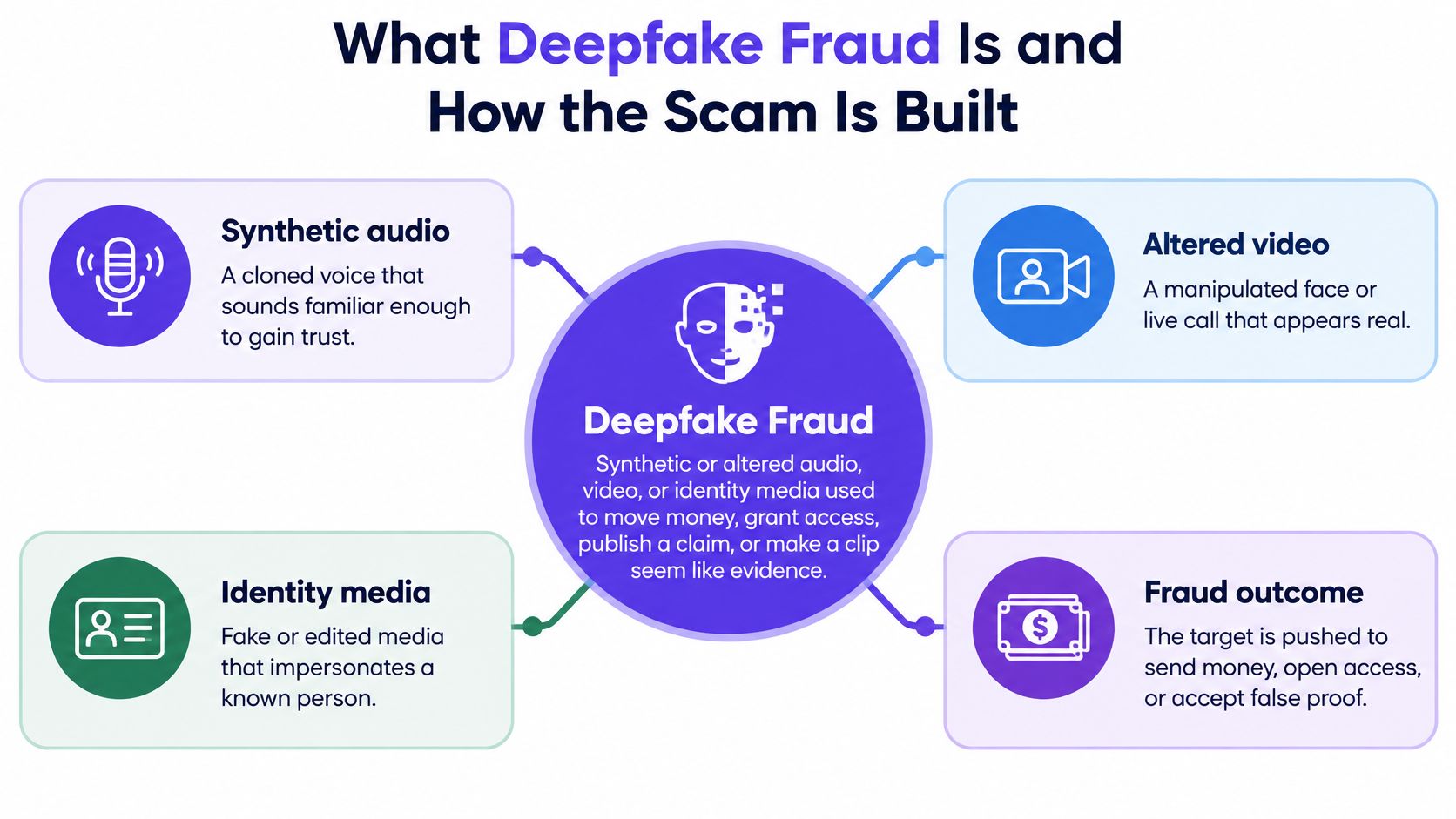
A request that appears to verify itself
Consider a hypothetical finance employee who receives a confidential payment request apparently sent by an executive. The employee questions the message, so the sender offers a video meeting. A familiar face appears, uses the right terminology, and confirms the instruction.
A scam like this can follow a recognizable chain:
- Gather reference material. Public interviews, presentations, social posts, and earlier recordings provide material that resembles the intended identity.
- Construct the impersonation. Synthetic audio or altered video depicts an executive, colleague, applicant, official, customer, or relative.
- Establish a plausible story. An email or chat introduces urgency, confidentiality, or an apparently routine administrative task.
- Supply apparent confirmation. A recorded message or live call reassures the recipient through the same attacker-controlled interaction.
- Obtain the action. The target sends funds, shares credentials, or releases information before making an independently initiated check.
The employee may believe they've checked twice: first by email, then by video. But changing media doesn't necessarily change who controls the communication.
Practical rule: A second channel is useful only when you establish it independently, not when the person making the request supplies it.
Separate the technology from the offense
The deepfake is the deceptive material inside the scam. The underlying offense may still be business-email compromise, investment fraud, identity theft, or impersonation. Keeping those concepts separate helps staff describe both what happened and how the attacker made it convincing.
Kons Law's guidance on recognizing social engineering fraud targeting investors is useful context for the persuasion side: assess the requested action and claimed authority, not just the polish of the presentation.
Recognizable phishing might contain an implausible sender address or awkward language. A synthetic-media scam can instead present coherent documents, a familiar voice, and an apparently responsive person. Staff shouldn't need to identify the generation method before enforcing an approval rule.
Seeing and hearing someone familiar is an observation, not independent verification of their authority to make the request.
Attack Patterns by Sector and the Trust They Borrow
Different teams face different decisions, but attackers can borrow the same trust cues. An executive's apparent authority helps with a wire request. A candidate's apparent continuity helps with hiring. A clip's apparent immediacy pressures an editor to publish.
The following comparison describes scenarios to prepare for, not a ranking of the most frequently attacked industries. The controls deliberately avoid asking whether the face looks convincing.
Deepfake fraud patterns by sector
| Pattern | Typical target | Trust cue borrowed | Control that ignores looks |
|---|---|---|---|
| Live executive video call | Finance and enterprise treasury | Authority plus urgency | Callback on a pre-stored number and dual approval |
| Synthetic voice payment request | Finance staff | A known executive's voice | Callback on a known number, not the incoming call |
| Synthetic applicant and forged ID | Banks, fintech, and KYC teams | A matching face, voice, and document | Document checks plus liveness that is not the submitted clip |
| Remote hiring interview | HR and access provisioning | A convincing candidate on camera | Independent identity check before access is granted |
| Manipulated news or user footage | Newsrooms and platforms | Timeliness and realism | Keep the original file and test more than one forensic signal |
| Investment, romance, travel, or official impersonation | Consumers and customer support | Relationship, scarcity, or authority | Refuse in-channel payment or credential requests |
Identify the decision being borrowed
For treasury staff, confidentiality can become a pretext for bypassing colleagues. A purported executive might insist that involving another approver would compromise a deal. The relevant warning is the requested exception, whether or not the speaker's face appears genuine.
For onboarding teams, matching materials can create false reassurance. A face, voice, and identity image may agree because someone constructed them together. Document examination and an independently controlled identity session answer different questions and shouldn't substitute for each other.
Hiring creates a continuity problem: the person interviewed must be linked to the person receiving access. A polished interview doesn't settle that connection. Keep identity confirmation separate from a manager's assessment of competence.
Newsrooms have a different pressure point. A dramatic clip can appear valuable precisely because there's little time to verify it. Editors need a hold-and-review route that preserves the original submission without turning uncertainty into an accusation.
Keep the control outside the performance
Consumers may face a relationship-based appeal rather than corporate authority. A romantic contact requests emergency travel money; an apparent official demands credentials; a listing agent insists on an immediate deposit. In each scenario, the safe decision concerns the payment destination, credential request, or independently established relationship.
For organizations connecting these decisions across departments, an enterprise fraud-prevention framework can help assign responsibility rather than leaving each employee to improvise.
The shared failure is a policy that accepts a familiar face or voice as confirmation. The shared defense is a decision rule that remains enforceable even when the impersonation looks flawless.
The Arup Video Call and the Earlier Voice Theft
A routine-looking conference can create a powerful sense that colleagues have already reviewed a request. The image below illustrates that familiar working environment, not footage from the incident.

In early 2024, an Arup employee authorized approximately US$25 million after a video conference featuring deepfaked versions of the company's chief financial officer and other colleagues, according to IBM X-Force's account. The same account describes about 200 million Hong Kong dollars, distributed through 15 transfers to five bank accounts, and contrasts the case with a 2019 synthetic-audio theft of about US$243,000 from a UK company.
Suspicion gave way to apparent confirmation
The Arup sequence began with a phishing message that appeared to come from the company's UK office. It requested a confidential transaction. The employee initially suspected fraud, which is an important detail: simple awareness that scams exist wasn't enough.
The video conference appeared to resolve the doubt. Familiar faces and voices supplied reassurance that the message alone hadn't provided. The employee then acted on the request before the deception was discovered.
That sequence distinguishes the case from a story about someone blindly trusting an email. The employee sought confirmation, but the apparent confirming participants were part of the deception. Several apparent colleagues on the same call didn't provide independent authorization.
A meeting can contain several apparent approvers while still offering no independently verified approval.
The embedded video offers additional viewing alongside the case discussion.
What the voice-only predecessor adds
The earlier UK theft shows that an attacker doesn't need a video conference to exploit executive authority. Audio alone can provide the apparently personal instruction that makes an unusual request feel legitimate.
GoSafe Dark Web monitoring's explanation of how to detect voice phishing attacks helps distinguish the voice-based social-engineering channel from the email that may introduce it. For teams examining recordings, deepfake audio detection addresses the technical analysis side.
Neither case establishes an average loss, and neither converts global attempt rates into theft totals. Their value is in exposing a specific failure point: social engineering supplied the transaction story, while synthetic media supplied false confirmation.
Out-of-band confirmation, transaction limits, dual authorization, and technical authentication belong around that failure point. The central lesson isn't that employees should scrutinize faces harder. It's that an attacker-controlled performance must never acquire the authority to waive the payment process.
Forensic Markers and Why One Detector Is Not Proof
Forensic review looks for signal families, not a universal facial defect. A useful assessment separates evidence within individual frames from evidence across time, sound, and the file's technical history.
- Spatial signals include unnatural textures, blending boundaries, diffusion artifacts, and generator fingerprints.
- Temporal signals include identity flicker, interrupted head movement, and disagreement between lip motion and speech.
- Audio signals include unusual spectral patterns that warrant examination beyond how familiar the speaker sounds.
- Metadata and encoding signals describe file structure, editing traces, and compression history, when those details remain available.
These categories guide analysis, but an anomaly isn't automatically evidence of deception. Ordinary editing, poor connections, and platform processing can complicate interpretation.
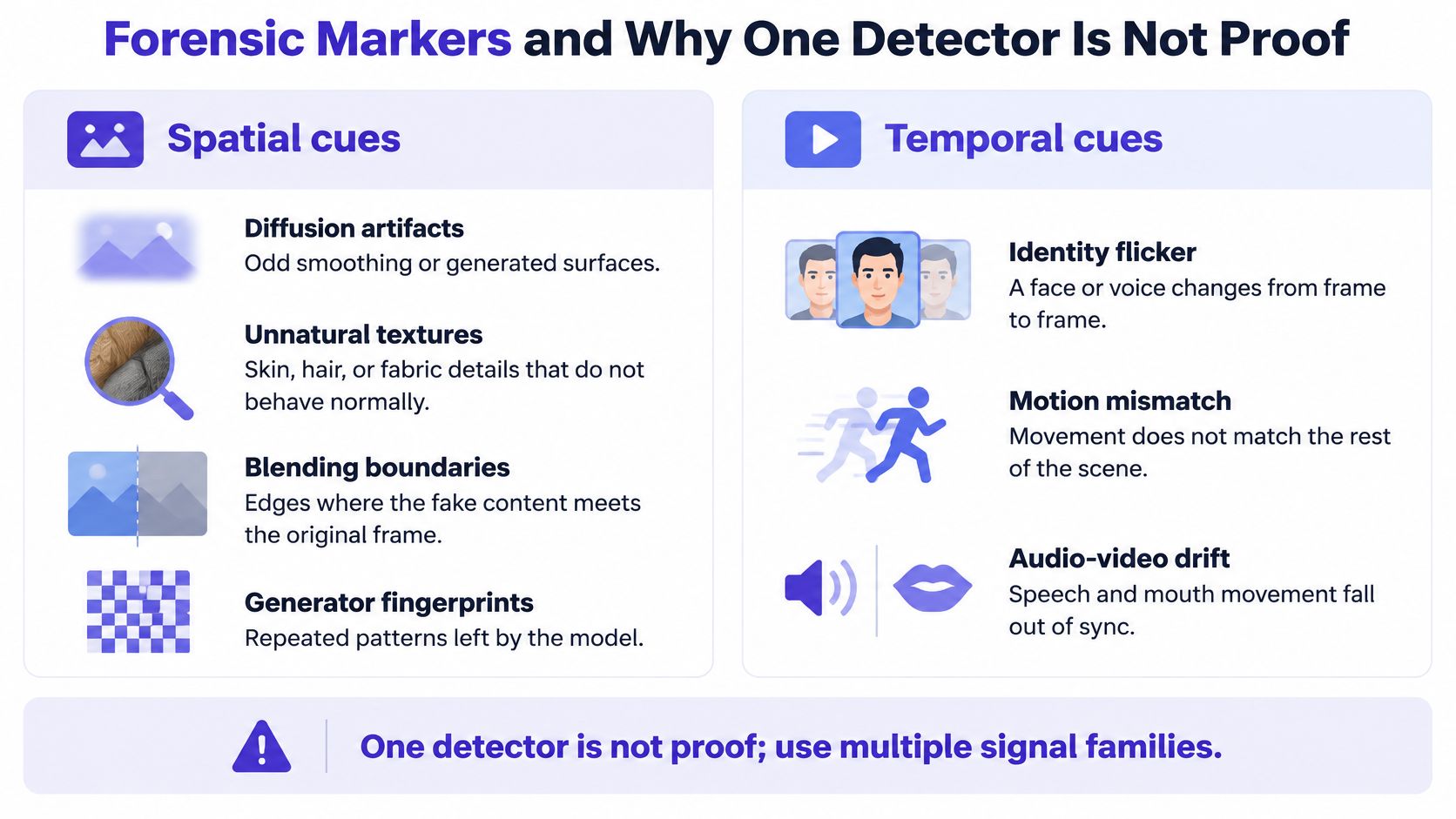
Performance changes with the fake family
In a cross-generation detection study published through the CVF, the approaches labeled A, B, and C below achieved AUC values of 96%, 75%, and 51% on diffusion fakes, compared with 80%, 99%, and 92% on talking-head fakes.
Detector results by fake family
| Approach | AUC on diffusion fakes | AUC on talking-head fakes |
|---|---|---|
| Approach A | 96% | 80% |
| Approach B | 75% | 99% |
| Approach C | 51% | 92% |
AUC describes how well a method separates classes across decision thresholds. It isn't the probability that a particular uploaded clip is fake. The reversal in relative performance matters more operationally than choosing the largest value: a strong result for one manipulation family doesn't establish universal reliability.
A detector may learn recognizable traces from its training set rather than properties that transfer to unfamiliar media. A review of detection research reports typical accuracy losses of 10–15% on a different data distribution and finds that training with realistic distortions, including compression, can improve transfer while preserving most original-benchmark performance.
Ask what happened to the file
A clean source video and a messaging-app copy aren't equivalent analytical inputs. Re-encoding, cropping, screen recording, and metadata removal can change or conceal signals. A newer generator may also produce artifacts unlike those represented in a detector's training material.
For a high-risk impersonation recording, examine lip–audio alignment, head-motion continuity, speech-spectrum characteristics, and identity stability together. For a social-media clip, assess how recompression affects the result and whether the original file is available. Work on copies so testing doesn't alter the preserved evidence.
Buyers should request evaluation against unseen generators and degraded samples, plus documented false-positive and false-negative behavior. A headline benchmark score doesn't answer how the system will handle a cropped, forwarded recording.
Interpretation boundary: A detector score is an investigative lead. A clean result on a degraded file is not proof of authenticity.
Use the result to decide what requires further review, not to certify a person's honesty or authorize an irreversible action.
Why Deepfake Fraud Disappears from the Loss Figures
A single global deepfake-loss figure is unreliable because incident labels often describe the crime rather than the technology. An investigator may correctly record business-email compromise, investment fraud, identity theft, account takeover, or government impersonation without recording suspected synthetic media.
Veriff's account of the FBI's 2025 Internet Crime Report cites 22,364 complaints containing AI-related information and $893 million in adjusted losses, while noting an undercount because AI involvement often isn't identified when victims report. Those are AI-related complaints and losses, not a deepfake-only global total.
Record the offense and the suspected technique
Internal ownership can become unclear for the same reason. Security may see impersonation, finance may see payment fraud, and legal may see an evidence issue. Assign an incident owner while retaining each relevant classification.
Build an evidence package that another reviewer can understand:
- Original media: Preserve the received file and available metadata without editing or resaving it.
- Integrity record: Calculate a SHA-256 hash, record the tool used, and retain the value with the file.
- Communication context: Save full email headers, chat exports, attachments, and meeting details rather than isolated screenshots.
- Decision history: Record who requested, approved, or performed each action and when.
- Separate descriptions: Document the underlying suspected offense and the reasons synthetic media is suspected.
A hash supports later integrity checks against that preserved file. It doesn't establish that the depicted event happened.
Avoid turning uncertainty into an accusation
Newsrooms, platforms, and legal teams can harm someone by publishing an unsupported assertion that a clip is fabricated. They can also mislead people by describing a low-risk detector result as authentication.
Report the tool's output, input limitations, and observed anomalies without overstating the conclusion. Keep restricted evidence out of public explanations, and verify retention and confidentiality requirements before uploading sensitive material.
Reporting categories and evidence requirements differ by jurisdiction. Use the appropriate fraud or cybercrime channel and obtain qualified guidance where evidentiary use is involved. A probabilistic result isn't a finding of guilt, and using a tool beyond its supported purpose creates a separate risk of misrepresentation.
Confirm the Person Before You Move Money
A qualitative study published through USENIX found that social familiarity increased perceived credibility and delayed fraud detection. The practical response is a formal verification procedure that still works when the person on screen seems entirely familiar.
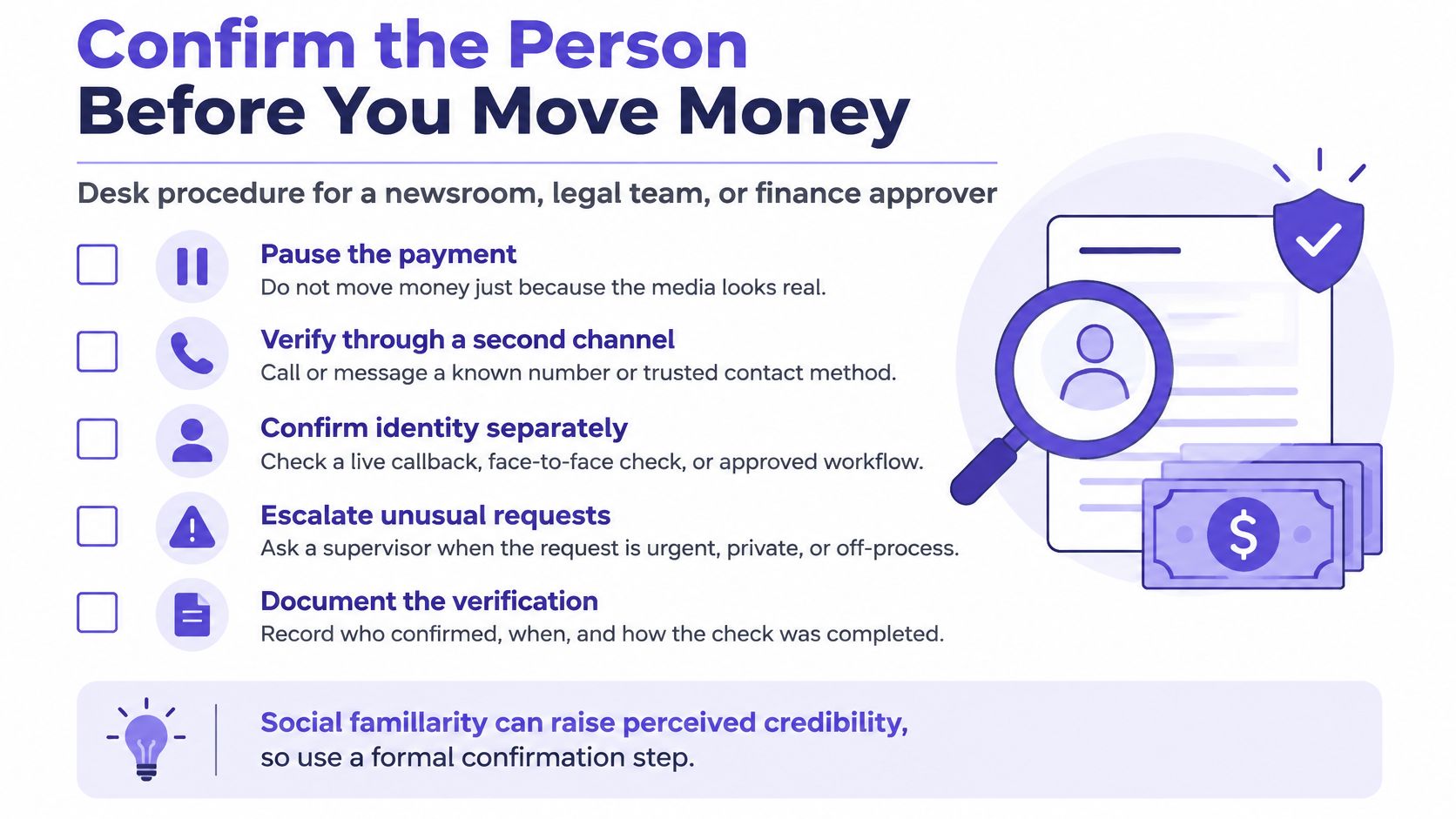
Use a decision procedure, not a visual test
Pause the action. Hold the payment, publication, access grant, or evidentiary use. Don't require staff to prove manipulation before requesting review.
Initiate independent contact. Call a number saved before the suspicious thread, not one supplied inside it. Refuse payment or credential instructions that depend on staying within the requester's channel.
Require independent authorization. Keep transaction limits in force and obtain another approver for high-value or irreversible actions. For onboarding, combine document checks with an approved liveness session; before granting employee access, use an independent identity check, in person or through the approved multi-factor workflow.
Preserve the evidence package. Retain the original file, metadata, hash, and complete thread using the documentation method described above. Analyze a working copy.
Check complementary signals. Compare frame-level artifacts, audio characteristics, temporal consistency, and encoding details. Our AI Video Detector provides an uploaded-video check, but its score represents probability, not certainty. Basic detection requires no registration, and we don't store uploaded videos. Listed uses include viral misinformation, impersonation, travel scams, dating safety, fake listings, and identity fraud.
Escalate uncertainty. A recompressed file, unavailable original, or unclear result needs further review. No detection is perfect; a clean score doesn't authorize payment or publication.
Record and report. Document the verification outcome, suspected synthetic-media involvement, and underlying offense. Route the incident to the responsible internal owner and appropriate reporting authority.
For executive-payment workflows, CEO fraud prevention can help turn these checks into standing approval requirements.
Before the next urgent request arrives, assign a backup approver, confirm trusted callback details, and rehearse a payment or publication hold. When suspicious video does arrive, use AI Video Detector as an additional review step, then authorize the action only through your independently verified workflow.


