

CEO Fraud Prevention How to Stop Impersonation Attacks

A finance manager receives a message that appears to come from the CEO. The request is short, urgent, and confidential. A supplier's bank details have changed, a transfer must go out immediately, and the executive is about to enter a meeting. The manager replies, receives a phone call from a familiar voice, and starts the payment.
Nothing in that sequence requires malware. The attacker only needs to make one employee treat an unverified instruction as payment authorization. Effective CEO fraud prevention therefore starts with a different question: not “How do we block phishing?” but “What must happen before anyone can release money?”
Why CEO Fraud Still Works and What It Costs
Business email compromise, or BEC, succeeds by borrowing authority. An attacker may spoof an executive's address, compromise a real mailbox, imitate a vendor, or combine email with text, voice, and video. The message reaches someone who already has a legitimate business reason to act, then uses urgency, secrecy, and a plausible transaction to suppress normal checks.
Finance employees, executive assistants, payroll teams, and accounts-payable staff sit directly in that pressure path. They're often expected to respond quickly, and they may receive genuine urgent requests from senior leaders. If company policy treats an email from an executive as sufficient approval, the security perimeter becomes irrelevant. The employee's judgment becomes the final control, and the attacker is trying to overwhelm it.
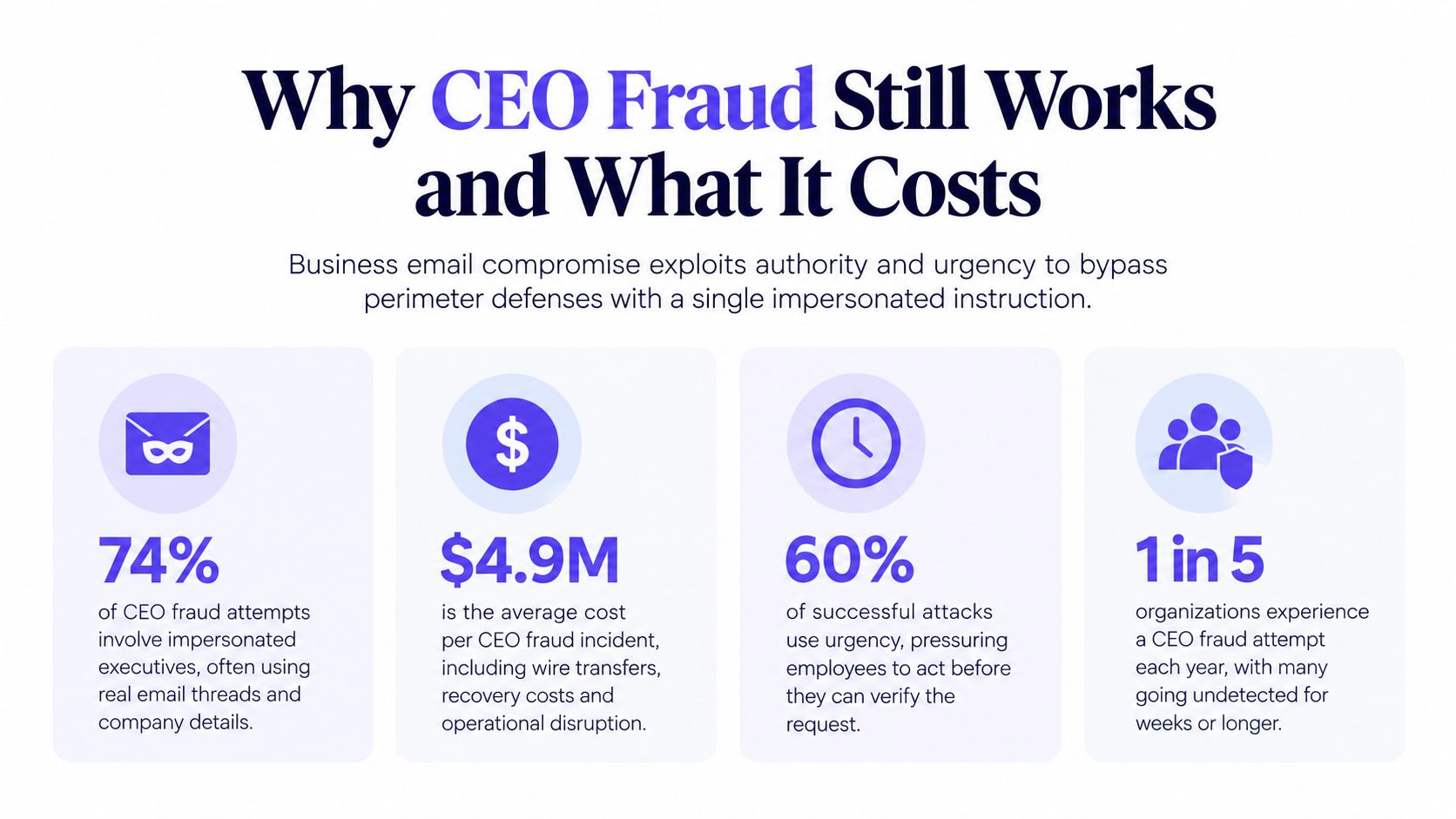
The FBI's IC3 reported that BEC generated 305,033 domestic and international incidents and $55,499,915,582 in exposed losses from October 2013 through December 2023. U.S. victims accounted for 158,436 cases and $20,089,561,364 in losses during that period, according to the FBI IC3 annual report. Earlier FBI guidance put the average loss for BEC victims at about $130,000, which shows why a single payment-authorization failure can become a board-level event.
Authority is the attack surface
The tactic has remained durable because attackers exploit business behavior, not just software flaws. A fabricated request can reference a real project, imitate an executive's writing style, and arrive when the recipient expects a decision. A compromised mailbox makes the message even more convincing because the attacker can observe conversations and answer follow-up questions.
The FBI began tracking BEC scams in late 2013. By February 2017, it reported a 1,300 percent increase in identified exposed losses since January 2015, with losses exceeding $3 billion, as documented in its business email compromise overview. In 2024, BEC ranked seventh by complaint volume with 21,442 complaints, but second by dollar loss with nearly $2.8 billion reported lost. Reported losses from 2022 through 2024 totaled almost $8.5 billion, showing that complaint volume alone doesn't describe the risk.
Treat CEO fraud as a payment-risk discipline. Email security, identity protection, approval policy, employee behavior, bank coordination, and incident response must reinforce one another. For broader governance context, teams can also review guidance on corporate integrity and compliance in Israel, especially where fraud controls intersect with legal and organizational accountability.
Practical rule: An executive's identity can start a payment request, but it must never complete the authorization.
How to Spot CEO Impersonation Across Email Phone and Video
Speed matters during triage, but instinct isn't a control. A suspicious request should trigger a short inspection that looks for inconsistencies across the sender, the request, and the communication channel.
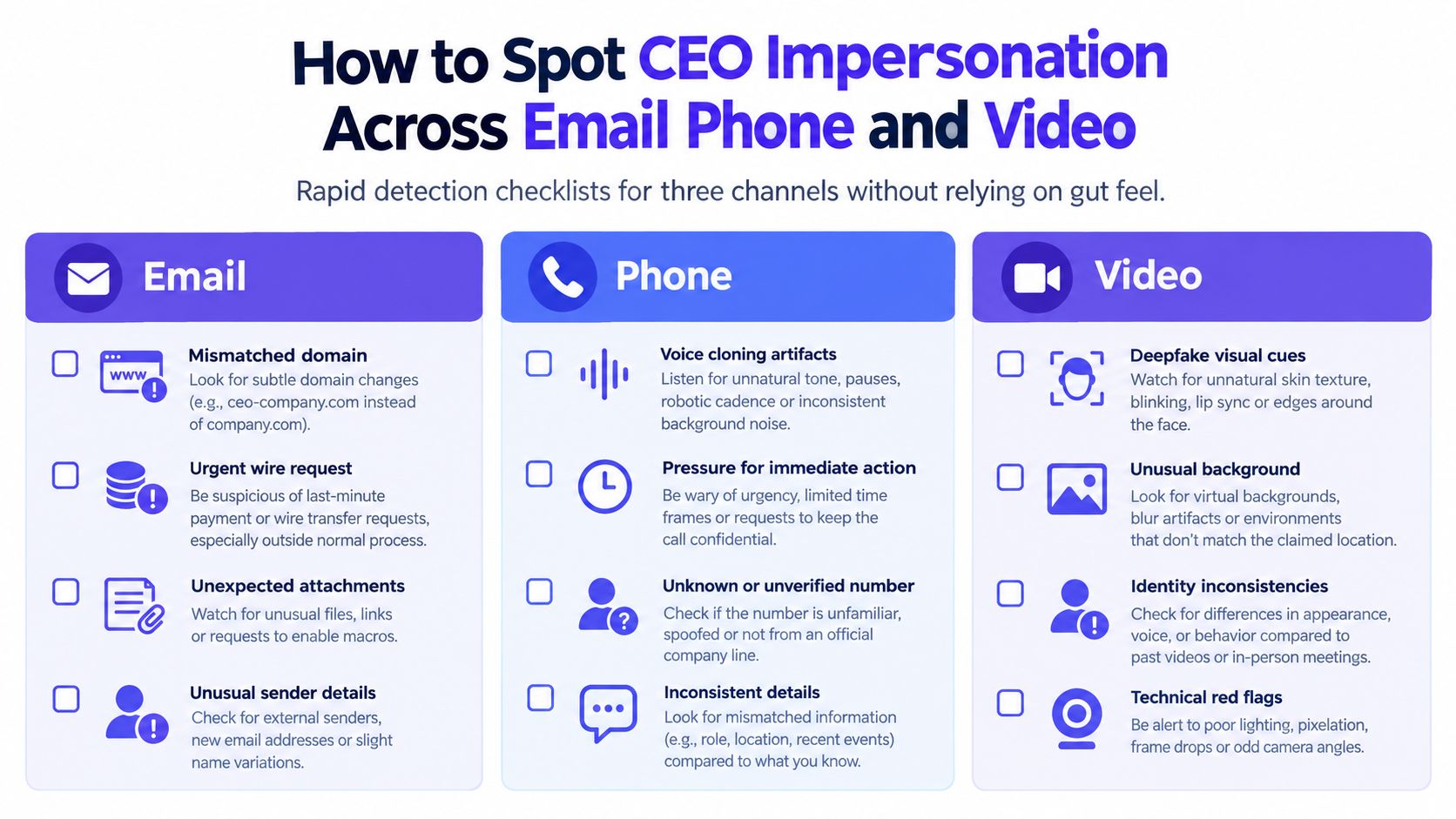
Email signals
Start with the actual sender details, not the display name. Check for:
- Lookalike domains: A substituted character, added word, or unusual domain extension can make a fake address appear familiar.
- Reply-to mismatches: The visible sender may look legitimate while replies route to a different address.
- External-mail indicators: An internal executive request marked as external deserves immediate escalation.
- Payment changes: New beneficiary details, changed invoices, unusual transfer destinations, or requests to bypass a normal approval path carry elevated risk.
- Pressure language: “Keep this confidential,” “don't call,” and “handle this before the meeting” are process-bypass signals, not proof of legitimacy.
A real executive may write urgently, so tone alone can't establish fraud. The meaningful combination is an unusual financial action, a request for secrecy, and resistance to independent confirmation.
Phone and voice signals
A phone call doesn't automatically validate an email. Attackers can use caller-ID manipulation, compromised phones, stolen calendars, and voice cloning. Treat a voice request as untrusted when the caller:
- Rejects a callback: Call the executive using a number already stored in the company directory or another established source.
- Creates artificial scarcity: The caller says the transfer must happen before a meeting, closing, or deadline.
- Demands secrecy: Confidentiality is used to prevent the employee from involving a colleague.
- Changes the channel: An email request suddenly becomes a text or call, especially when the new channel avoids normal approval records.
- Avoids specific questions: A genuine requester should tolerate confirmation of the amount, beneficiary, purpose, and approval route.
Never call the number in the suspicious message. A callback only helps when the number comes from a trusted record.
Video and live-call signals
Video adds confidence, not authentication. Look for lip-sync problems, unnatural blinking, facial edges that shift during movement, inconsistent lighting, strange reflections, audio artifacts, frozen backgrounds, or a face that looks correct while the behavior feels unusually scripted.
Behavior remains important. The caller may know the executive's schedule and appearance but still pressure the employee to act outside policy. Ask the executive to confirm a pre-agreed challenge or to approve the transaction through the organization's controlled payment system. Don't rely on a visual appearance, a familiar voice, or a live presence alone.
For teams that need a deeper technical explanation of controls around suspicious calls, the video call security guidance provides useful background.
A two-minute triage should end in one of two outcomes: the request passes through an established authorization path, or it pauses for trusted-channel verification. Replying in the original thread is not verification because the attacker may control the thread.
Technical Controls That Block Impersonation Before It Reaches Inbox
Technical defenses reduce the number of convincing requests employees must inspect. They don't replace payment controls, but they can stop spoofed messages and compromised identities earlier in the chain.
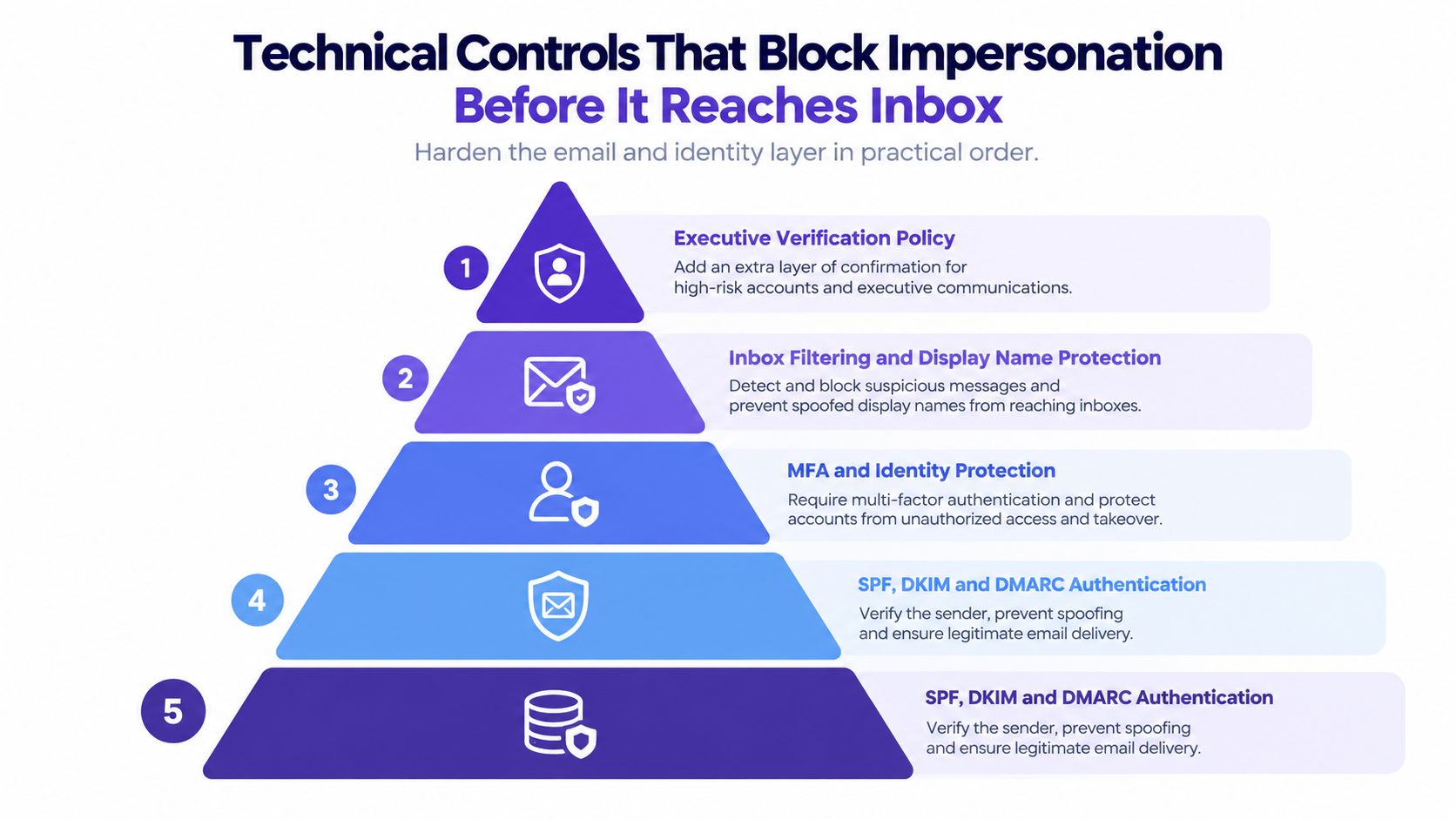
Build the email identity layer first
Deploy SPF, DKIM, and DMARC, then move beyond monitoring toward enforcement after validating legitimate senders. These controls help receiving systems evaluate whether messages claiming to come from the organization align with authorized sending infrastructure and cryptographic signatures.
That protects against direct domain spoofing, but it won't stop every CEO fraud attempt. Lookalike domains, compromised accounts, and trusted third-party services can still produce messages that pass basic authentication. Add:
- External-mail labeling: Make internal and external messages visually distinct in every mail client used by finance and leadership.
- Display-name protection: Flag messages that use executive names while originating outside approved domains.
- Lookalike monitoring: Register close-variant domains where appropriate and monitor for similar sender extensions.
- Reply-path inspection: Detect mismatches between the visible sender, reply address, and authentication results.
- Mailbox alerts: Notify security staff about suspicious forwarding rules, unfamiliar sign-ins, and changes to executive accounts.
Teams dealing with suspicious calling infrastructure can also use an explainer on what STIR/SHAKEN is to understand how caller identity attestation fits into the wider verification picture. It isn't a substitute for a callback to a trusted number, but it can inform the telecommunications control layer.
Protect the accounts that move money
Require multi-factor authentication for executive, finance, treasury, accounts-payable, and payment-approval accounts. Prefer phishing-resistant methods where the environment supports them, and monitor unusual sign-ins, mailbox rules, session changes, and delegated access.
Then separate duties. The person who creates or changes a beneficiary shouldn't be the only person who approves the payment. Use transaction-specific approvals, controlled payment portals, and digital signatures where practical. A signature should bind an authorized person to a defined transaction, not merely confirm that an email was read.
For organizations designing this layer, digital signature validation offers relevant implementation context.
What doesn't work: Annual phishing training by itself. Training helps people recognize patterns, but it can't compensate for a payment system that allows one rushed approver to redirect funds.
Verification Workflows That Survive Urgency and Deepfakes
The most reliable control is a policy that removes improvisation. Every wire transfer, beneficiary change, sensitive data release, or unusual payment request should enter the same verification workflow, regardless of who appears to have sent it.
The FBI recommends calling the sender back using a previously known number, confirming through a second communication channel, and adding secondary sign-off for vendor payment changes. The FBI guidance on business email compromise also warns against using contact details embedded in the suspicious message.
The operating procedure
- Pause the transaction. The employee tells the requester that company policy requires independent verification. This language protects the employee from appearing disloyal and makes the pause routine.
- Check the underlying request. Compare the amount, beneficiary, invoice, purchase order, project, and prior payment history. A familiar project doesn't validate a new bank account.
- Call back independently. Use a number from the corporate directory, an established contact card, or a previously trusted conversation. Don't use the number provided in the request.
- Use a second channel. Confirm through a known collaboration account, an in-person check, or the organization's controlled approval system. A second channel controlled by the same attacker isn't independent.
- Require dual approval. A second authorized employee reviews the request and records how verification occurred.
- Document the exception. If an urgent payment is approved, retain the approvers, verification channel, transaction rationale, and evidence.
Deepfake calls require an extra layer because a live face or familiar voice can be manufactured. Define in advance which requests may be approved remotely, which require an established challenge, and which require an in-person or system-based confirmation. Ask for a transaction detail that isn't present in the message, then complete approval through a trusted system rather than accepting a verbal “yes.”
| Request Type | Risk Level | Required Verification | Tool Check |
|---|---|---|---|
| Routine payment to an existing beneficiary | Moderate | Confirm against the approved invoice and normal workflow | Check sender identity, payment history, and approval record |
| New beneficiary or changed bank details | High | Independent callback and secondary sign-off | Review domain, reply path, account-change history, and vendor record |
| Urgent wire with secrecy request | High | Pause, call a known number, and obtain dual approval | Inspect mailbox activity and transaction anomalies |
| Voice request from an executive | High | Verify through a trusted channel and controlled payment system | Treat caller identity as unproven |
| Video request or recording involving payment | High | Confirm outside the call before acting | Upload suspicious media to AI Video Detector for frame, audio, temporal, and metadata analysis, then escalate any concern |
A detector can support analysis, but it shouldn't become the approval authority. A clean result doesn't override a missing approval, an unfamiliar beneficiary, or a request that violates policy.
Incident Response Checklist for the First Hour After a Suspected Attack
Assume the organization may still be inside an active conversation. The attacker could be monitoring a compromised mailbox, sending follow-ups, or trying to prevent staff from contacting the executive.
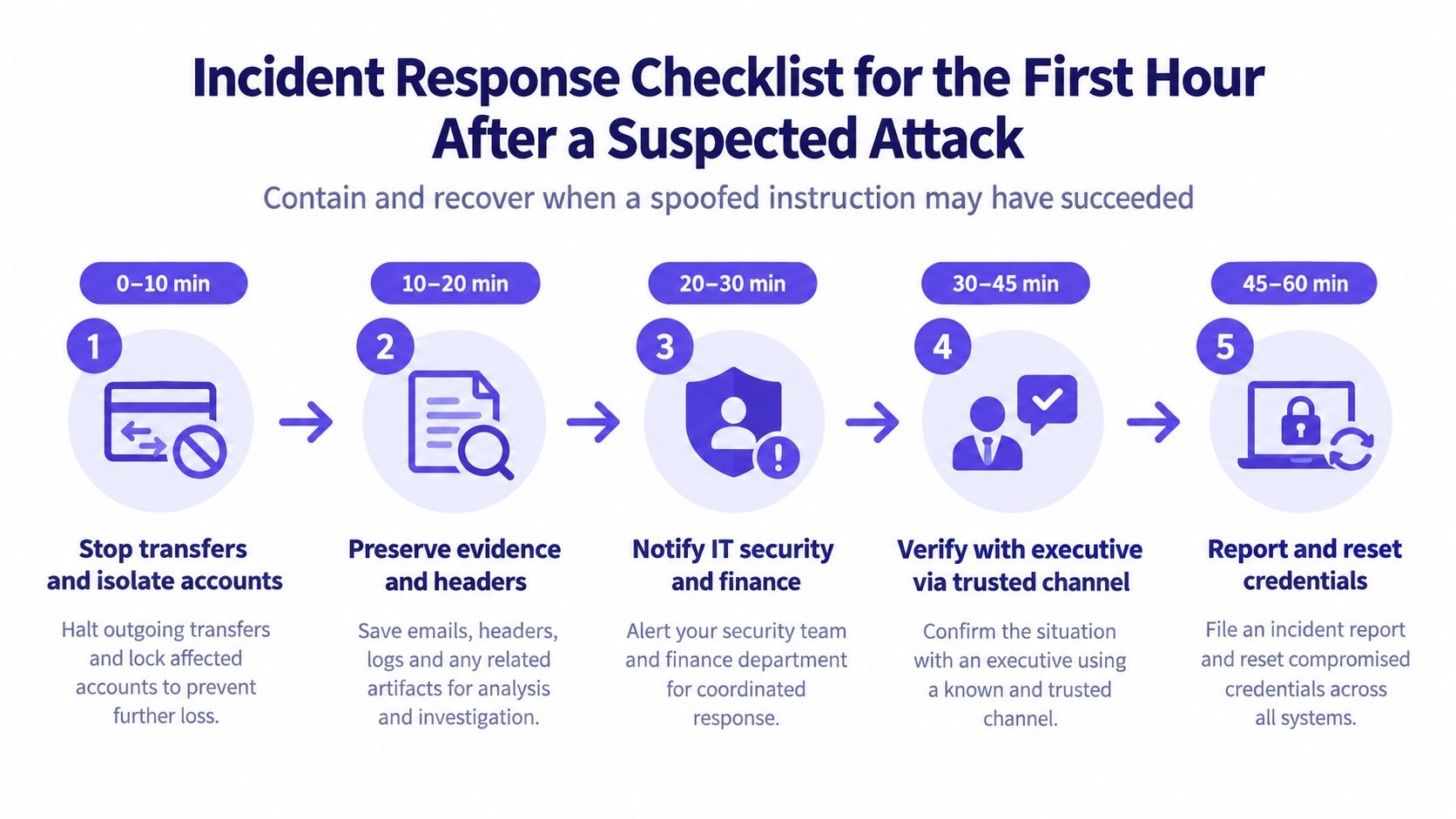
First actions
Stop financial movement immediately. Contact the bank's fraud team through an established channel. Ask whether pending transfers can be held, recalled, or flagged, and freeze the affected payment workflow while finance determines what was authorized.
Preserve the original evidence. Save the complete email with headers, attachments, links, timestamps, message IDs, chat logs, call details, and original video files. Don't forward only a screenshot and don't edit or re-encode media before preserving the source.
Notify the right people. Bring together security, finance, treasury, legal, executive leadership, and the incident commander. Assign one person to communicate with the bank and another to maintain the evidence record.
Confirm, contain, coordinate
Verify the executive's status using a trusted channel that the suspected attacker doesn't control. If an account may be compromised, reset credentials, revoke active sessions, inspect forwarding rules, review delegated access, and check whether other executives or finance users received related messages.
If a deepfake video or voice recording was involved, preserve the media and its surrounding context. Record who received it, how it arrived, what was said, and whether the employee took action. A technical analysis can inform triage, but legal and security teams should retain the original evidence and control access to sensitive recordings.
Do not delete the suspicious message. Deletion removes context that banks, investigators, legal counsel, and responders may need.
The response sequence
- At discovery: Stop transfers and suspend unusual payment changes.
- During containment: Preserve email headers, recordings, chat history, and transaction records.
- During escalation: Notify security, finance, legal, leadership, and the bank.
- During validation: Confirm the executive request through a trusted channel and identify affected accounts.
- During recovery: Reset credentials, review related activity, document decisions, and coordinate any required reporting or disclosure.
A synthetic-media event may be a fraud incident, a security compromise, a disclosure issue, and a brand emergency at the same time. Fortune's coverage recommends a disclosure protocol and tabletop exercises that include executive likeness misuse. Trustpair's 2026 fraud report says 71% of U.S. companies saw more AI-powered fraud attempts in the previous 12 months, while 47% of finance leaders identified AI-generated fraud as one of their biggest challenges, as reported in Fortune's coverage of board readiness for deepfakes. Those figures reinforce the need to rehearse response, not only prevention.
Building Lasting CEO Fraud Resilience Across Your Organization
Resilience comes from making the safe action easier than the rushed action. Employees should know exactly where to send a questionable request, which number to call, who can approve an exception, and what evidence to preserve. A policy that requires employees to invent the process during a crisis won't hold.
Use three connected layers:
- Technical hardening: Authenticate domains, protect identities with MFA, monitor lookalikes, label external mail, and detect suspicious mailbox activity.
- Payment discipline: Require independent callbacks, dual approval, beneficiary-change controls, and transaction-specific authorization.
- Practiced response: Run exercises involving spoofed email, cloned voice, and manipulated video. Test whether staff can stop a transfer and preserve evidence without waiting for informal permission.
Training should use realistic scenarios rather than generic warnings. Give finance employees a request that resembles normal work, then evaluate whether they inspect the sender, reject the embedded phone number, use the approved callback process, and record the verification. Include executive assistants and treasury staff because attackers target the workflow around authority, not only the executive's inbox.
The World Economic Forum reporting cited in coverage of cyber-enabled fraud as a CEO concern says 73% of CEOs reported that they or someone in their network was personally affected in 2025. AFP's 2026 survey found 74% of organizations experienced BEC and 85% received spoofed emails in 2025, according to the same source. Use those benchmarks to justify executive sponsorship, while measuring your own program through practical indicators such as bypassed approvals, time to independent verification, unresolved beneficiary changes, and response readiness.
For enterprises formalizing this program, enterprise fraud prevention guidance can help place video authenticity checks within a wider control framework. Use AI Video Detector only as one supporting assessment, alongside trusted-channel verification and documented approval.
Start the next 30 days with a focused plan: inventory who can release funds, enforce MFA on those accounts, document the callback and dual-approval workflow, review executive and vendor lookalike exposure, and run one exercise involving a suspicious video call. CEO fraud prevention works when employees can pause without fear, managers support verification, and payment systems refuse to treat urgency as authorization.
Ask your security, finance, and treasury leads to schedule a payment-verification drill this month. Test one email request, one voice request, and one video scenario, then close every gap you find in the approval path.


