

10 Deepfake Detection Companies Compared for 2026

A shaky clip lands in a reporter's inbox at 9 PM. An official appears to say something explosive, the audio sits half a beat behind the lips, and the source wants an answer before the morning meeting. Two floors up, a finance team is on a video call with someone who looks and sounds exactly like their CEO and is asking for an urgent transfer. On a platform's trust and safety queue, the same clip is picking up ten thousand shares an hour.
In every case the question is identical. Can this footage be trusted, and who is allowed to say so?
The ten companies below answer that question in very different ways. Some are built for the moment a file lands on your desk. Others watch live meetings, screen inbound calls before they reach an agent, or sit inside an identity check at account opening. Several are free to try, a few never publish a price, and one carries a beta label that should change how you use it.
I've sorted them by the job each one fits rather than by benchmark claims, because a detector that wins a leaderboard can still be the wrong instrument for a 9 PM deadline.
1. AI Video Detector
A detector earns the first slot by removing friction, and this one removes nearly all of it. Free basic detection runs without registration: upload a file, get a confidence score, and never create an account. It also publishes a price, which several vendors later in this list refuse to do. The service lives at AI Video Detector.
Uploads take MP4, MOV, AVI, or WebM files up to 500MB, and the service says videos are never stored, which matters when the clip is evidence or footage of a private individual. Results come back with a confidence score, typically under 90 seconds. Two limits to know before you rely on it: the 500MB ceiling excludes long screen recordings, and anything outside the four supported containers needs converting first.
What the four signals catch
The analysis runs on four tracks instead of a single frame. Frame-level review looks for diffusion artifacts, unnatural textures, and inconsistent facial micro-expressions. Audio forensics runs spectral analysis on voice and background sound to catch synthetic speech. Temporal checks hunt for flickering and motion discontinuities that a still image cannot show. Metadata inspection flags encoding irregularities that point to a re-render.
Four tracks matter because each one fails in predictable ways. Compression erases faceswap artifacts. A cloned voice passes a purely visual check untouched.
A confidence score ranks a file for follow-up. It does not clear it for publication.
That caution has evidence behind it. In a UK government evaluation of deepfake detection technology, the strongest detector reached an AUC of 73.67% on 173 externally verified real-world political deepfake videos and 74.78% on 232 images posted between 2018 and September 2025. Well above chance, well short of the near-perfect figures lab benchmarks advertise.
The interface below shows what a first pass returns: the score plus the signal breakdown.
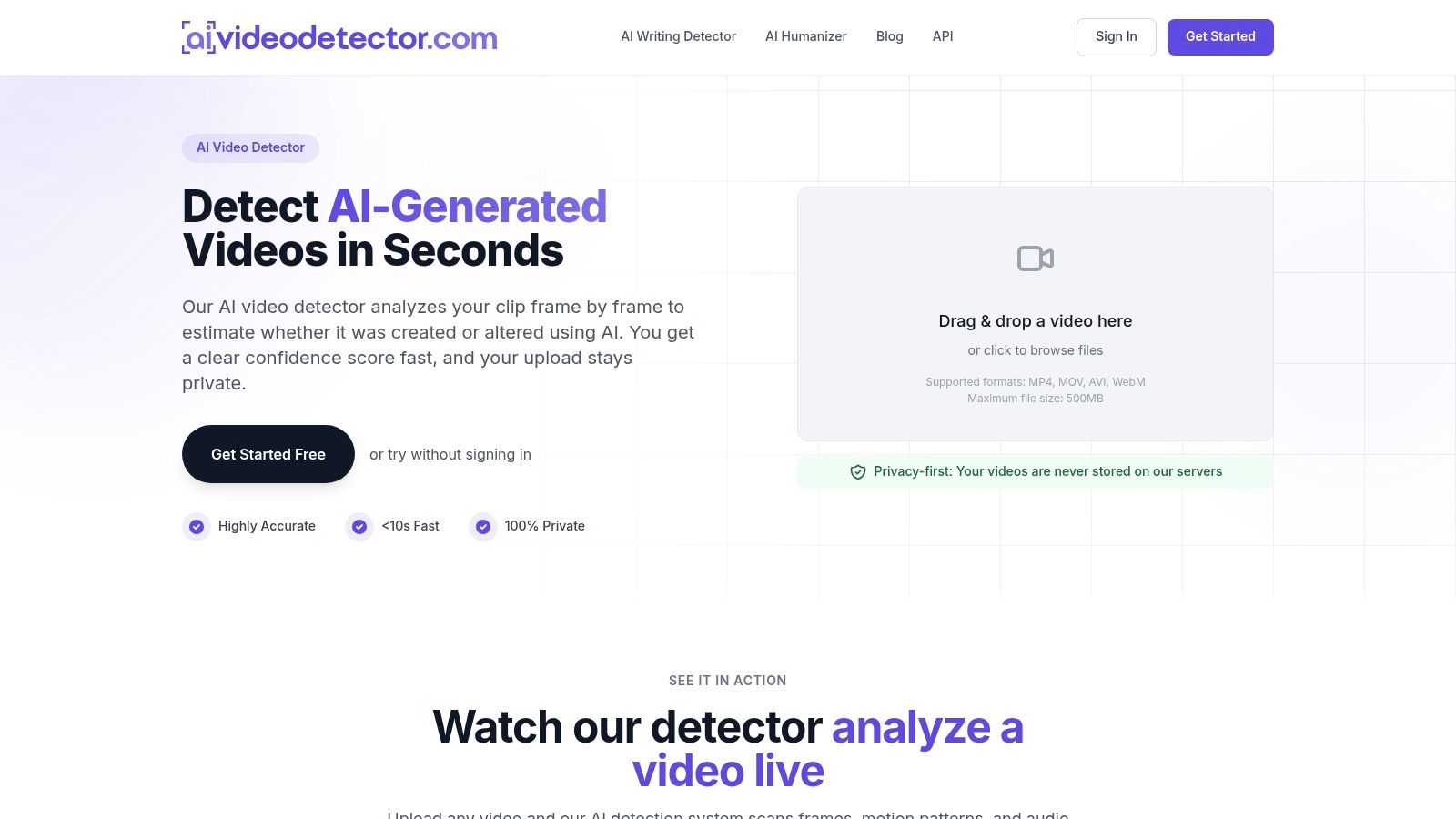
The Pro plan costs $19 per month, billed in US dollars. The service is operated by WriteHuman, LLC, which says its models train on millions of samples and are updated as new generators appear. Newsrooms run user-submitted tips and wire footage through it, legal teams triage exhibits, and fraud teams check impersonation clips; the listed use cases also cover dating safety, fake listings, and travel scams, and the company says thousands of journalists, researchers, and everyday users rely on it. When a fake does slip past a check, the cleanup shifts from verification to reputation work, and TheBestReputation on video and reputation covers that side. For the file already sitting in your inbox, this is the fastest door in.
2. Reality Defender
Reality Defender sells detection as infrastructure rather than as a website. Its API and SDK analyze uploaded audio, video, and images and return verdicts with supporting detail, so the output can drop straight into a case management system or an upload pipeline instead of a chat window.
The free developer tier is the honest way to evaluate it. That tier includes 50 monthly scans, up to three seats, and image analysis.
The free tier's real limit
Image-only access is a narrow test. A newsroom that wants to see how the engine handles a compressed video tip, or a bank that needs voice screening, never touches the part it needs on the free plan. Audio and video sit behind paid plans, and public pricing above the free tier isn't listed, so budget conversations start with sales.
Best fit: engineering teams embedding detection into an existing product, platform integrity groups, and enterprises that already run an API-first security stack.
Where it strains: casual one-off checks, and any workflow that needs a human-readable report without integration work. For a broader look at how the category splits between API vendors and standalone tools, this guide to deepfake detection software covers the trade-offs.
3. GetReal Security
The most expensive deepfake is rarely a viral video. It's a familiar face on a call asking for a transfer, a credential reset, or a wire release. GetReal Security builds for that moment, with Protect covering live Microsoft Teams, Cisco Webex, and Zoom meetings and Inspect handling forensic review of uploaded media afterward.
The product checks for face swaps, synthetic audio, and identity mismatches during the session, then hands investigators contextual evidence and replay so a security team can see exactly what triggered the alert and act inside its existing response workflow.
Why consent slows the rollout
Live meeting detection is not a drop-in feature. Three things have to happen before it protects anyone:
- Organizational deployment: the integration has to be installed and configured across accounts, not just on one laptop.
- Participant consent: recording and analyzing meeting participants carries legal obligations that vary by jurisdiction, and works councils in some countries will want a say.
- Identity baselining: mismatch detection only works once the system knows what the person looks like and sounds like.
Best fit: executive protection, finance teams exposed to CEO fraud, and security operations centers that want detection and investigation in one place.
Where it strains: pricing isn't public, and this is not a self-service upload checker. If you need to check one suspicious clip tonight, look elsewhere first.
4. Sensity AI
Sensity approaches the problem as a forensic examiner would. The platform analyzes video, images, and audio, checks for face manipulation, synthetic content, voice cloning, and file-structure anomalies, and returns confidence scores with visual explanations rather than a bare label.
Cloud and on-premises deployment options make it one of the few entries here that can satisfy an organization that won't send evidence to someone else's servers. API documentation is available for developers who want to automate the checks.
Where forensic reports stop
Forensic depth is not the same as certainty, and the research is blunt about the gap. A 2026 survey in Artificial Intelligence Review reported 10 to 15 percent performance degradation in out-of-distribution scenarios, and found that forensic tools tend to show high recall but poor specificity while AI classifiers show stronger specificity but miss some fakes. The same evaluation found professional human evaluators reaching 94 percent accuracy, 15 percent ahead of the best tested tool.
That combination argues for pairing a platform like this with a named human reviewer who can defend the conclusion in a witness statement.
Best fit: investigators, legal teams, and on-premises environments with strict data-handling rules.
Where it strains: pricing isn't published, some features require a subscription or sales engagement, and you should confirm before purchase that the report format meets your own evidentiary standard.
5. Resemble AI
Resemble's detection product, Resemble Detect, covers synthetic or manipulated audio, images, and video, with single-file and batch analysis plus streaming audio detection for live pipelines. Optional watermark checks, including SynthID, let a team confirm whether a clip carries a provenance mark before it bothers with statistical detection.
Public usage-based pricing is a genuine advantage here. You can estimate costs before signing anything, though video processing gets expensive once volume climbs.
The 150MB ceiling and what it means
The documented quick start specifies files under 150 MB. That is generous for audio and tight for long video, so plan on segmenting anything lengthy before submission. Accounts and API access are required, which rules it out as a no-friction first check.
Compression is the bigger constraint. A 2026 evaluation of audio detectors found models were notably more vulnerable to audio modifications and compression than to ordinary noise, especially when neural codecs were in the chain, as the study on real-world audio detection sets out. A voice note that has passed through a messaging app's codec is a harder target than the clean sample in a demo. For a deeper look at the audio side specifically, see this guide to deepfake audio detection.
Best fit: teams with audio-heavy workloads, batch processing, and developers who want attack-type detail alongside a score.
6. Pindrop
Pindrop Pulse lives where the money moves: the contact center. It detects synthetic voice on inbound calls and integrates with Pindrop's fraud detection and authentication products, so a flagged caller can be routed to verification rather than to an agent who is about to reset a password.
Pulse for Meetings extends the same signals to live meeting audio and video. That makes Pindrop one of the few vendors covering both the phone channel and the video call inside one fraud workflow.
Test on your own call recordings
Vendor-published performance figures are usually measured under conditions a real call center never sees. Your lines carry hold music, IVR prompts, compression, background noise, and the specific accents your customers have. A detector that performs well on a clean corpus can behave differently at 2 AM on a bad mobile connection.
Procurement rule: ask for a test against a sample of your own recorded calls, including the messy ones, before you believe any published rate.
Best fit: banks, insurers, telecoms, and any contact center where account takeover starts with a phone call.
Where it strains: it isn't a general-purpose file checker, pricing isn't public, and voice-only coverage leaves a suspicious uploaded video unaddressed. If you just need to check a voice clip, a free AI voice detector is a faster starting point than a platform contract.
7. Hive
Hive operates at moderation scale. Its AI-generated content detection covers images, video, and audio, with APIs built for high-volume review and additional tools for scanning uploads, URLs, and social content. A public browser extension and an X bot give non-technical staff a way to check something without opening a ticket.
That mix suits a trust and safety team that needs both an automated pipeline and a quick manual escape hatch.
Ask for recall at a fixed false-positive rate
Scale changes which number matters. Deepfake-Eval-2024, an in-the-wild benchmark assembled from media circulating in 2024, contains about 45 hours of video, 56.5 hours of audio, and 1,975 images collected from social platforms and detection users, according to the Deepfake-Eval-2024 benchmark paper. Its authors note that detectors often score well on older academic datasets and less reliably on current manipulations.
For a platform, a single overall accuracy figure hides the only thing that matters: how many real videos get flagged. Even a small false-positive rate overwhelms human reviewers at volume. Ask for recall at a 0.1% or 1% false-positive rate, and insist on a time-split test set, because performance decays as generators change.
Best fit: platforms, marketplaces, and trust and safety teams with engineering support.
Where it strains: platform-scale pricing isn't listed publicly, and deployment usually means integration work plus a sales conversation. Treat every flag as a review cue, never as proof.
8. DuckDuckGoose
A synthetic applicant passes the selfie step, the liveness check clears, and the account opens. DuckDuckGoose is built for that failure mode: its DeepDetector API and related products target face swaps, manipulated identity media, spoofed camera feeds, and liveness-bypass attacks.
That makes it an onboarding control for KYC and fraud review. Banks, identity providers, and fraud teams need to know whether the person behind the flow is physically present and whether the camera path itself has been instrumented.
Thresholds that match the decision
Identity work lives or dies on false positives because every bad flag is a real customer locked out. Ask vendors for true-positive rates at fixed false-positive rates of 1% and 0.1%, measured on attacks that resemble your flow rather than a cherry-picked demo set.
Then compare the answer to the cost of friction. A bank can tolerate some step-up checks; a low-margin signup flow cannot. A vendor that cannot separate those operating points is asking you to absorb the risk.
Best fit: banks, fintechs, identity providers, and KYC teams. Limited free trials are available for evaluation.
Where it strains: it is a poor fit for one-off consumer checks or newsroom verification, public pricing is not listed, and vendor claims should be tested against the attacks your own onboarding flow attracts.
9. Hiya
Hiya comes at deepfakes from speech and telephony rather than video forensics. Its free Chrome extension checks whether a voice in audio or video playing in your browser may be AI-generated, which is about as low-friction as verification gets.
The commercial AI voice detection product and APIs serve carriers, businesses, and communications platforms, including real-time call protection. Detection is tuned for voice and telephony conditions rather than studio audio.
Free checks and their ceiling
The extension is browser-specific and voice-only. It won't tell you that a face has been swapped, and it won't help with a video file you've already downloaded. What it will do is give a producer or a researcher a quick read on a suspicious voicemail played in a tab.
Developer documentation exists for commercial integrations, though API access and pricing may require a sales or developer arrangement.
Best fit: communications platforms, carriers, call-protection products, and anyone who needs a fast voice-only sanity check.
Where it strains: no visual analysis, no forensic reporting, and no published pricing for the business tier.
10. Deepware
Deepware offers the simplest entry on this list: a free public scanner for checking whether a face in a video has been manipulated or swapped, plus API and SDK options for teams that want to automate it.
Its scope is deliberately narrow. The detector focuses on facial manipulation, and the company's own FAQ is clear that it doesn't assess whether a voice is fake and doesn't catch every form of synthetic video.
Beta means read the terms
The service is described as beta, which changes how you use it. Its FAQ states that videos up to 10 minutes are supported, and that submitted samples may be shared with partners and used to improve the systems.
That last point is the one to act on. Confidential footage, evidence in an open matter, or anything showing a private individual should not go through a public scanner with those terms.
Best fit: a quick first look at a suspected face swap, and developers who want a free sandbox before building anything.
Where it strains: no voice detection, beta reliability, and data handling that rules out sensitive material. Use it to form a hypothesis, then verify elsewhere.
How the Deepfake Detection Companies Differ by Use Case, Access, and Pricing
| Item | Primary Detection Focus | Free Option | Best For | Public Pricing |
|---|---|---|---|---|
| AI Video Detector | Video frames, audio, motion, and metadata | Free basic detection; no signup required | Fast, privacy-focused checks of video files | Basic detection is free; paid pricing not stated |
| Reality Defender | Deepfake detection for audio, video, and images | Developer tier with 50 monthly scans and up to three seats; image analysis only | Organizations integrating detection through APIs or SDKs | Paid pricing not stated |
| GetReal Security | Deepfakes and identity threats in live meetings and uploaded media | Not stated | Enterprise security teams investigating meeting-based fraud | Not publicly listed |
| Sensity AI | Forensic analysis of video, images, audio, and files | Not stated | Investigators needing detailed media analysis and deployment options | Not publicly listed |
| Resemble AI | Synthetic or manipulated audio, images, and video | Not stated | Teams needing API-based analysis and usage-based pricing | Public usage-based pricing |
| Pindrop | Synthetic voice fraud and live meeting deepfakes | Not stated | Contact centers and enterprise communications | Not publicly listed |
| Hive | AI-generated and deepfake images, video, and audio | Public browser extension and X bot | Platforms screening high volumes of user-submitted media | Platform-scale pricing not publicly listed |
| DuckDuckGoose | Deepfakes targeting identity verification and fraud prevention | Limited free trials | KYC, onboarding, and identity fraud workflows | Not publicly listed |
| Hiya | AI-generated voice in online audio, video, and calls | Free Chrome extension | Basic voice checks and commercial voice-detection integrations | Business pricing not stated |
| Deepware | Face manipulation in video | Free public scanner | Initial checks of suspicious face-swap videos | Free public access; API pricing not stated |
Match the Detector to the Risk Before You Trust the Score
A detection score is only as good as the fit between the tool and the decision you have to make. Start from the risk, then pick the instrument.
Newsrooms and legal teams: begin with multi-signal video analysis on the file itself, then corroborate. Find the original upload, check the source's history, and ask who benefits. The score narrows the question, while corroboration and chain of custody answer it, and a custody record often carries more weight in a courtroom than a classification label. Check format and file-size ceilings before anything else, because a scanner capped below your footage forces a re-encode that can wash out the very artifacts you need preserved.
Enterprises facing impersonation: prioritize live-meeting and voice protection. Fraud arrives through a call or a video conference far more often than through a public post, and a tool that only works after the incident is already late.
Platforms and marketplaces: test API throughput and false-positive behavior on your own media volume before signing. A model that performs well on a curated benchmark can bury your reviewers in flags on day one.
Identity teams: demand threshold-specific metrics at 0.1% and 1% false-positive rates, plus documented handling of spoofed camera feeds.
The market you're buying from is young, and that shapes your expectations. Dozens of vendors compete here, most of them small and few of them mature. A meaningful share publish no pricing at all, which means an early sales call before you can even compare costs, and several are effectively beta products wearing an enterprise label. Expect thin documentation, model versions that shift between pilots, and accuracy claims that outrun the published evidence.
Before committing to anything, run a short calibration. Assemble ten clips you know are real and ten you know are fake, including compressed and re-encoded versions. Push them through two or three shortlisted tools and write down where the results disagree. Those disagreements tell you more about fitness than any accuracy figure, and the discipline of how to decide under pressure applies directly when a story is moving and the clock isn't stopping. Then confirm pricing, file limits, data retention, and escalation paths in writing, because the answer you get from a sales engineer at 4 PM should match the one in the contract.
If a clip is sitting on your desk tonight, run it before you run the story. AI Video Detector scans an upload across four independent signals and returns a confidence score in under 90 seconds, with no account and no sales call, so the first pass happens tonight rather than after a procurement cycle. Then do the part no detector replaces: call the source, find the original file, and ask who benefits if you believe what you're looking at.