

Deepfake Detection Software for Professional Teams

Choosing deepfake detection software by the highest advertised accuracy is poor advice for professional teams. A score doesn't tell an editor whether to publish unfamiliar footage, an investigator whether an analysis can be reproduced, or a security analyst whether a suspicious request should trigger a payment hold.
A more useful comparison starts with the evidence behind the result and the controls around its use. Ask what the software examined, which conditions it was tested under, what it couldn't assess, and whether your team can preserve and explain the outcome without exposing sensitive material.
Why Detection Accuracy Is Not Enough
A detector's verdict answers a narrower question than most buyers assume. It reflects how a model interpreted the available signals, not whether the recording provides a truthful account of an event. For high-stakes work, classification and authentication shouldn't be treated as interchangeable.
A clip may arrive without a reliable source, an editing history, or enough usable information to support a confident conclusion. Your procurement criteria should account for that uncertainty rather than reward software for always returning a decisive label.
| Buying shortcut | Better evaluation question |
|---|---|
| Choose the highest accuracy | Under what test conditions was that result obtained? |
| Prefer a simple real/fake verdict | Can the system identify insufficient evidence? |
| Count detection features | Can reviewers inspect what each signal contributed? |
| Trust an impressive demonstration | Can your team reproduce the result on its own files? |
Define the decision before choosing the detector
Start with the action an analyst might take. Flagging footage for further investigation requires a different evidentiary standard from publicly accusing someone of fabrication. Likewise, an internal review queue and a legal submission need different documentation.
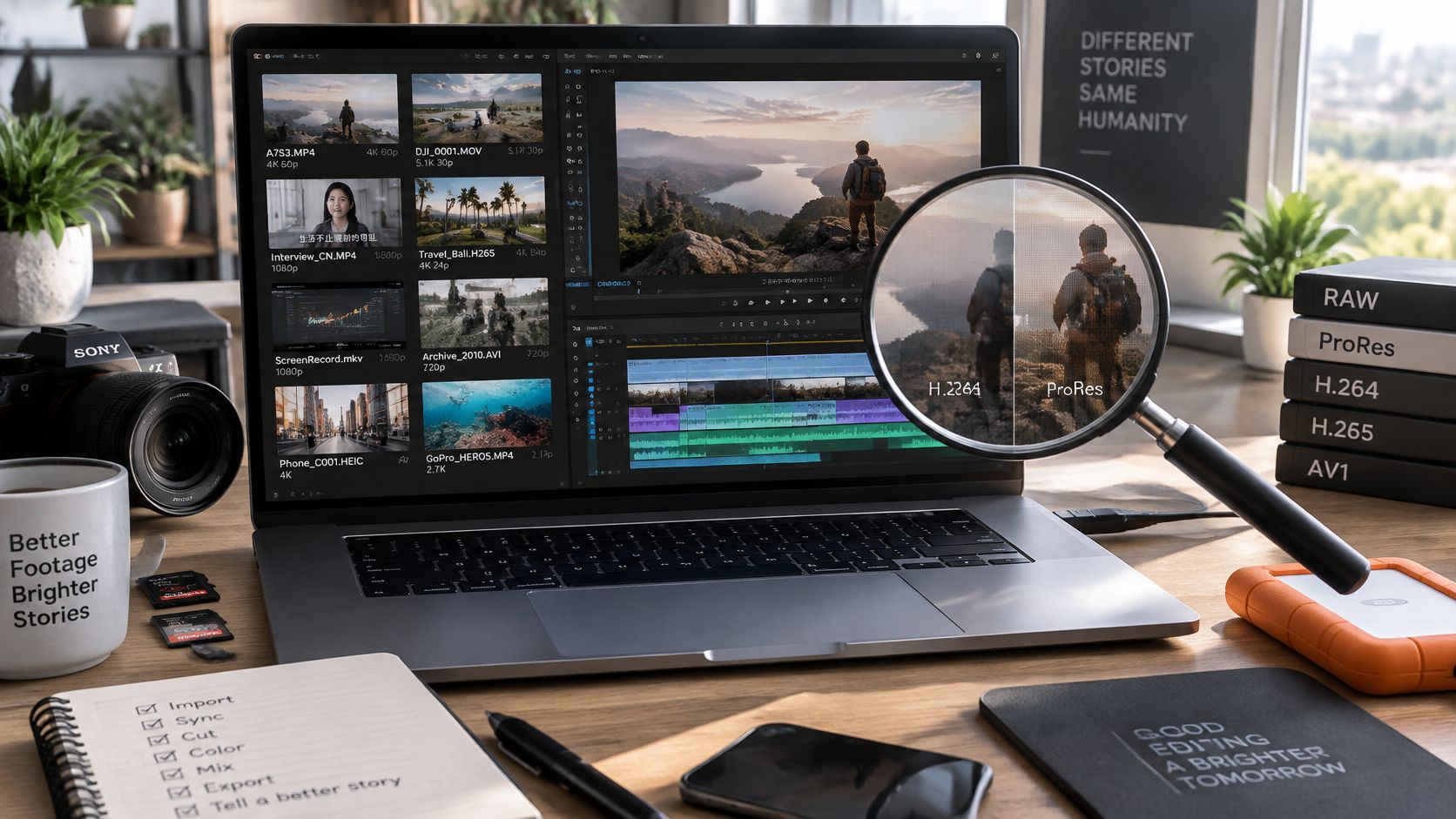
A workspace for comparing footage is only the beginning of that review.
Require vendors to distinguish a model score from a validated probability. The practical questions in this guide to confidence calibration belong in procurement discussions, not just technical documentation.
Procurement principle: Buy support for a defensible decision, not the appearance of certainty.
Smaller organizations should also place media verification within their broader security procedures. MY CYBER GUARD's AI cyber security guide for small business is a relevant companion resource when assigning responsibilities for suspicious AI-enabled communications.
The strongest selection process therefore begins with an explicit boundary: what the team may conclude from a detector result, and what still requires corroboration. Without that boundary, even technically capable software can be used to justify decisions its evidence doesn't support.
How Deepfake Detection Software Evaluates Video
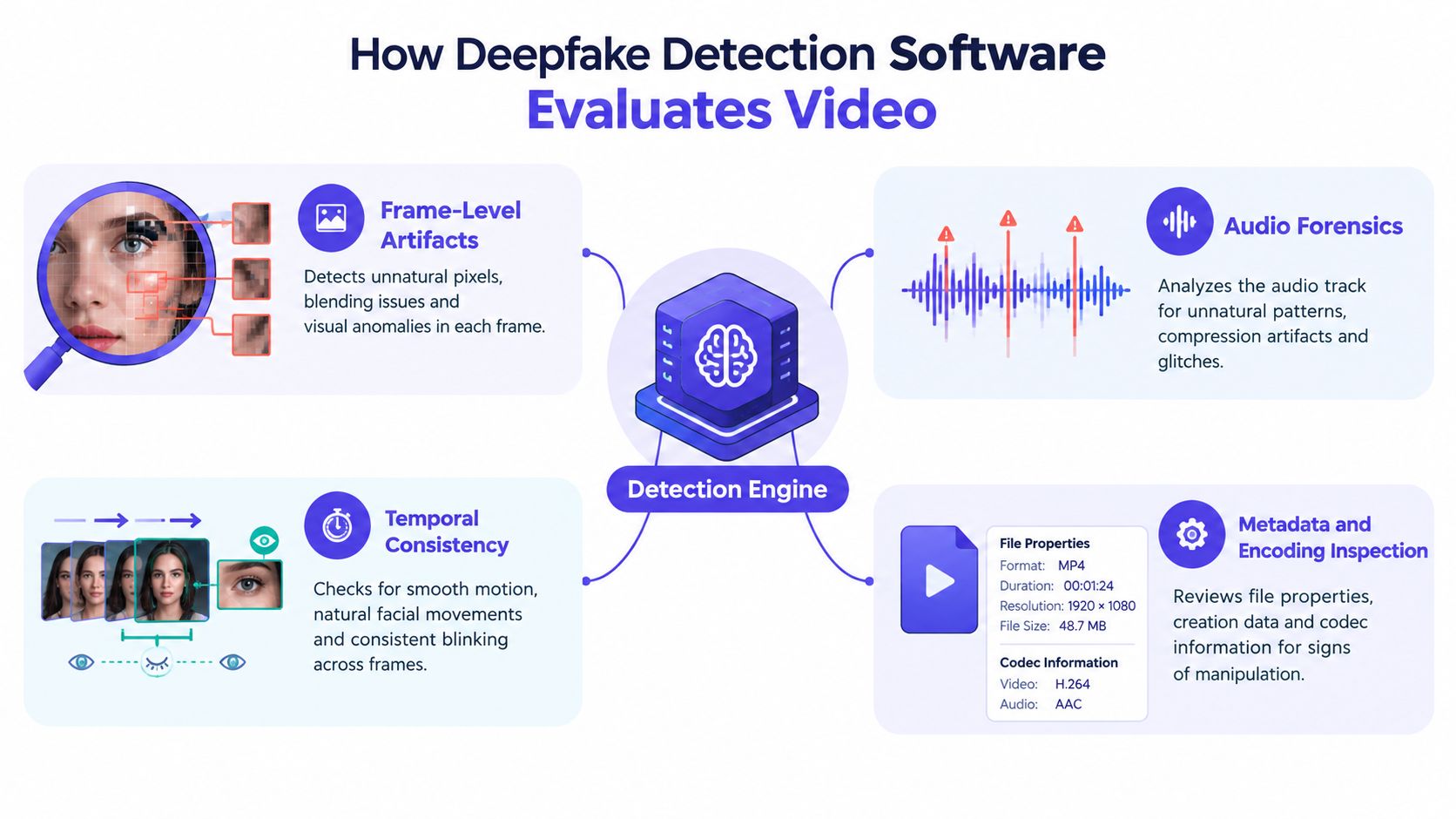
Professional evaluation starts by asking what the software examines. A visual classifier, an audio detector, and a system that compares sound with motion address different questions. A label such as multi-signal analysis is useful only when the vendor explains the underlying inspections.
The main branches provide a practical map for that discussion.
Understand the inspection layers
- Frame-level analysis examines individual images for spatial or frequency patterns associated with manipulation. Ask whether findings can be located in a particular region or timestamp.
- Audio forensics examines the soundtrack for acoustic anomalies. Require a separate audio result rather than assuming a video classification covers the voice.
- Temporal consistency evaluates relationships across successive frames. Its purpose differs from checking whether an isolated image looks suspicious.
- Metadata and encoding inspection examines the file's technical structure and recorded history. Treat those observations as contextual evidence, not a substitute for content analysis.
These are investigative avenues, not a checklist of definitive symptoms. A highlighted region gives an analyst somewhere to investigate; it doesn't explain the cause by itself.
Why dataset history matters
Standardized datasets made it possible to compare detectors beyond small laboratory samples. A review of deepfake detection research describes FaceForensics++, introduced in 2019, with more than 1,000 original videos manipulated using DeepFakes, Face2Face, FaceSwap, and NeuralTextures.
The same review discusses later datasets, including Google Deepfake Detection, Deepfake Detection Challenge, and Casual Conversations, reflecting broader attention to recording conditions and demographic variation. The procurement implication is straightforward: ask which manipulation methods and populations were represented, not whether a model was trained on a large collection.
Generation tools also provide useful material for designing authorized synthetic test samples. ClipNova AI's consistent character AI video generator is a relevant example to consider when planning such a test collection, without assuming any particular detector will recognize its output.
Signal coverage should match the material under review. If the file contains no usable speech, an audio branch can't contribute the same evidence as it would for a clear interview. Ask the vendor to show unavailable or unusable inputs explicitly instead of presenting a complete-looking result.
Compare Detection Signals and Performance
A meaningful software comparison separates what the detector inspects from how its performance was measured. Neither a long feature list nor an isolated benchmark result is sufficient.
Use the following criteria to request evidence rather than accept feature labels.
Deepfake Detection Software Comparison Criteria
| Evaluation criterion | What to inspect | Why it matters | Professional proof point |
|---|---|---|---|
| Signal depth | Spatial, frequency, temporal, audio, and metadata coverage | Different inspections address different manipulation hypotheses | Signal-level outputs with timestamps and limitations |
| Clip-level assessment | Frame sampling and aggregation method | Suspicious moments need context within the recording | Documented video-level decision method |
| Accuracy evidence | Within-dataset and cross-dataset evaluations | Familiar test material doesn't establish transfer | Results on held-out sources and generators |
| Supported inputs | Containers, codecs, duration, and audio requirements | A format label may conceal processing restrictions | Successful tests on representative native files |
| Speed | Upload, queue, analysis, and reporting time | Analysts need an end-to-end turnaround estimate | Measured completion times in the intended workflow |
| Privacy behavior | Retention, processing location, and secondary use | Submission can expose sensitive information | Written processing terms and deletion controls |
| Integrations | Export, API, access controls, and version identifiers | Results must fit existing review systems | A working integration test |
| Professional suitability | Explanations, uncertainty, and escalation | Reviewers must justify consequential actions | A reproducible case report |
Read benchmark scores precisely
DeepfakeBench's published evaluation framework standardizes comparisons across 15 detectors and 9 datasets, reporting frame-level AUC, video-level AUC, accuracy, equal error rate, precision-recall, and average precision.
Its published averages include 95.37% average top-3 AUC for UCF, 94.50% for Xception, 94.49% for F3Net, and 93.89% for EfficientB4, within that benchmark framework.
Those are AUC results, not interchangeable real-world accuracy claims. AUC summarizes discrimination across thresholds; it doesn't establish the error rate at the threshold your team will use. Ask vendors to identify the metric, evaluation split, aggregation method, and operating threshold behind every headline figure.
Frame-level scoring can help reviewers locate suspicious segments. A practical clip-level assessment also needs a documented method for combining observations across time. Ask whether a short anomalous segment dominates the result, whether long recordings dilute localized findings, and how the system handles unexamined portions.
A detector with a transparent, limited scope can be easier to evaluate than a broader system whose combined score conceals missing inputs and conflicting findings.
Don't assume that adding signal branches automatically improves performance. Require evidence that the combined system contributes useful discrimination under the intended conditions. Otherwise, a multi-signal interface may offer more output without providing stronger grounds for a decision.
The useful comparison is therefore capability plus demonstrated behavior, not capability alone.
Test Performance on Unfamiliar Videos
Consider a hypothetical newsroom receiving a reposted interview from an unknown account. The editor doesn't possess the camera original, and the clip's production history is unclear. Testing the detector on a pristine demonstration file won't establish how it will behave on that submission.
A 2025 evaluation spanning 13 deepfake benchmarks found that generalization to unseen manipulation techniques remains difficult, with some detectors achieving AUC below 0.6 on unseen deepfake types. That finding makes unfamiliar-source testing a procurement requirement, not an optional stress test.
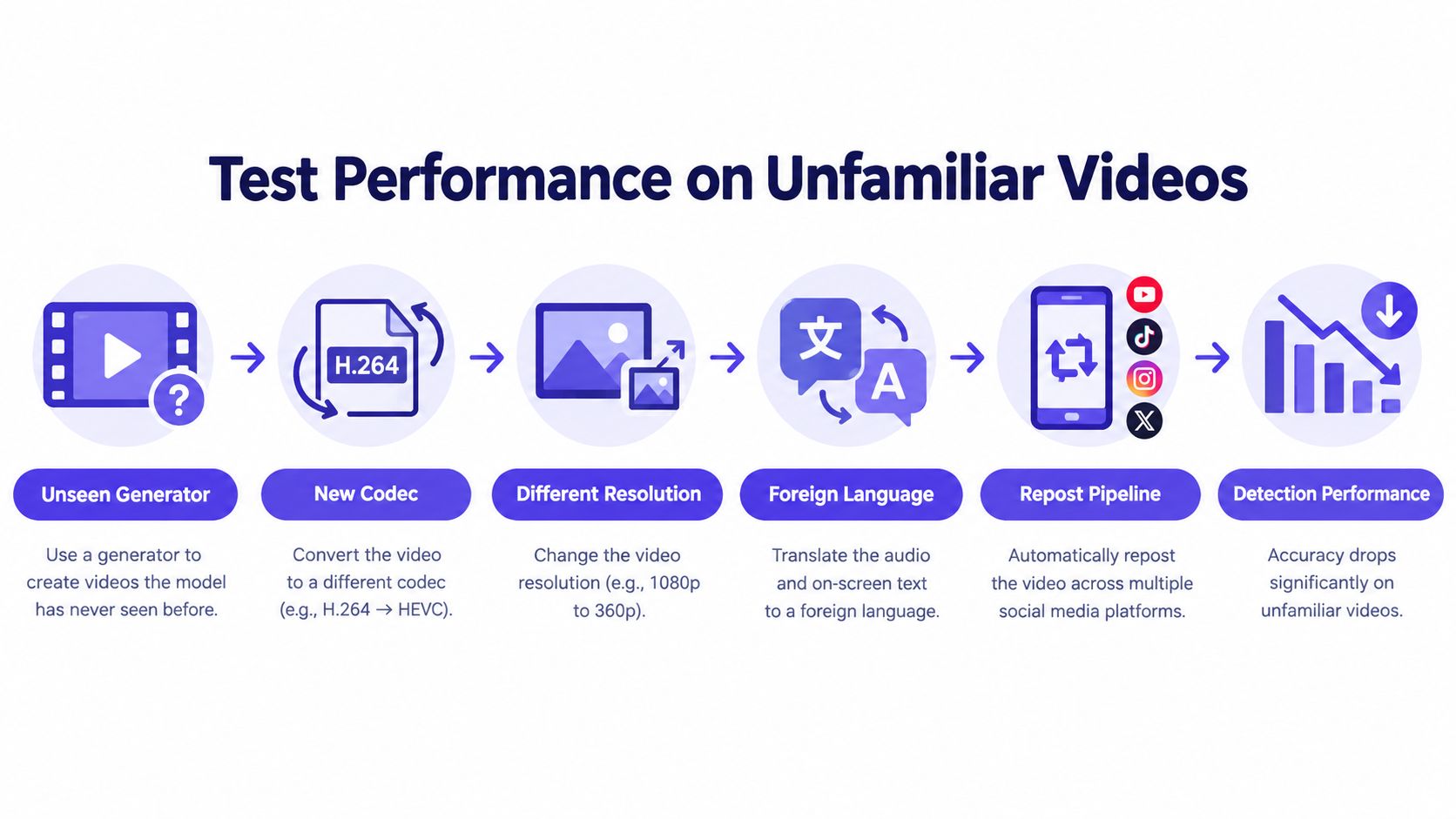
The following diagram identifies conditions to vary during evaluation, rather than a guaranteed sequence of performance decline.
Use scenarios to expose different failures
For the newsroom example, compare an authorized original with versions that reproduce the publication pipeline. Keep the underlying content fixed while changing compression, resolution, or encoding. Record whether the decision changes and whether the software acknowledges reduced evidentiary quality.
A legal team should pose a different hypothetical: can an authentic recording become suspicious after an ordinary export? A fraud team should ask whether an unfamiliar synthetic speaker receives a reassuring result. An educator should include legitimate edited teaching material, while moderators should test excerpts as well as complete clips.
These aren't case studies or predictions. They're test designs intended to distinguish failure modes.
Measure consequences at the review threshold
- False positives require attention to authentic material incorrectly flagged. Assess the resulting investigation burden and potential harm.
- False negatives require examination of synthetic material that passes the chosen threshold. Identify which manipulation categories the system misses.
- Calibration should be assessed using held-out material, with score ranges compared against observed outcomes.
- Abstention should be tested deliberately. Include files that are too degraded or incomplete to support the intended analysis.
Use a benchmark dataset selection guide when assembling evaluation material, but preserve a separate collection that reflects your organization's submissions. Public benchmarks and internal operational tests answer different questions.
Don't keep adjusting thresholds against the same evaluation files until the results look acceptable. Reserve material for a final assessment after configuration decisions are complete.
The important outcome isn't a single winning score. It's a documented boundary between conditions where the tool supports routine triage and conditions where an analyst must seek additional evidence.
Match Tools to Professional Use Cases
Choose software around the decision owner and the available response window. A newsroom editor, a forensic examiner, and a security operations analyst shouldn't inherit the same default workflow merely because they inspect video.
AI Video Detector is an uploaded-video option that states it combines frame-level analysis, audio forensics, temporal consistency, and metadata inspection. Treat that stated coverage as a candidate capability to test, not independent proof of suitability for every professional setting.
Match the output to the action
Newsrooms should prioritize quick triage with findings that an editor can inspect. A pilot should establish who contacts the submitter, who requests original material, and who can approve publication when technical findings remain unresolved.
Legal and law-enforcement teams should prioritize original-file handling and reproducible documentation. Require a sample report before purchasing, then ask a qualified examiner whether it contains enough information to assess the method and its limitations. Don't equate a downloadable report with legal admissibility.
Enterprise security teams should distinguish retrospective file analysis from intervention during a live interaction. For suspected executive impersonation, connect alerts to an established verification procedure rather than treating a detector result as authorization to proceed.
Workflow boundary: Software that analyzes an uploaded recording shouldn't be assumed to protect an active video call.
Pilot the work, not just the upload
Platforms and educators need repeatable review procedures tied to their policies. For a moderation pilot, require reviewers to distinguish synthetic origin from the separate question of whether content violates a rule. For educational use, avoid turning a detector flag directly into an accusation of misconduct.
Developers should test the entire integration contract:
- Result handling should distinguish completed analysis, unsupported input, partial analysis, and processing failure.
- Version tracking should identify changes that might alter downstream decisions.
- Access permissions should restrict who can submit sensitive files and retrieve reports.
- Escalation routing should send unresolved cases to an accountable reviewer.
Evaluate these tasks with the people who will perform them. Ask editors to review the explanations, investigators to reconstruct the analysis, and engineers to exercise failure paths.
A technically capable detector can still be the wrong purchase if its output doesn't support the team's next action. Professional fit is demonstrated through completed review tasks, not through a successful upload alone.
Implement a Controlled Detection Workflow
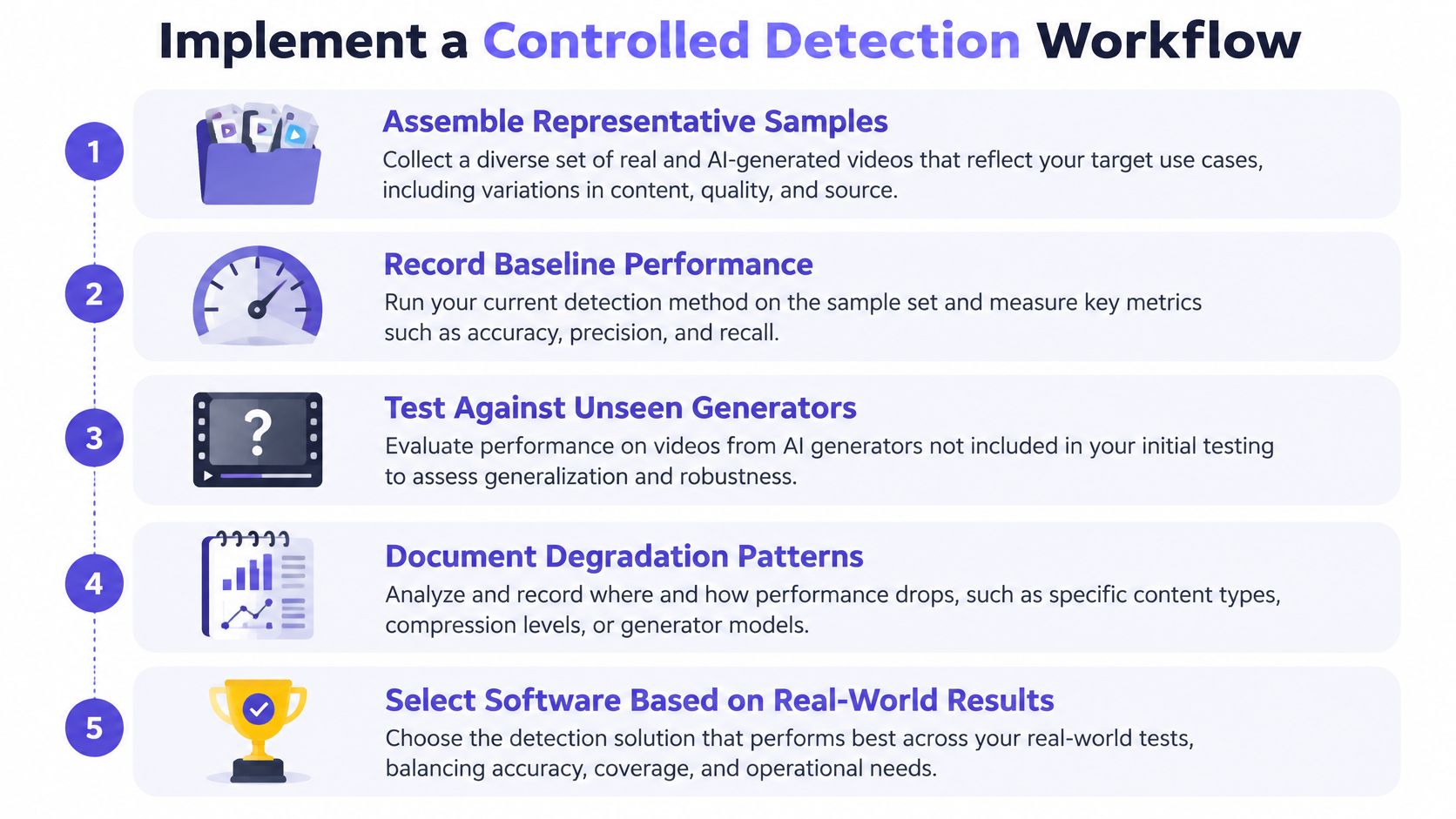
A controlled deployment requires a record of how files entered the process, how the software assessed them, and how reviewers reached their conclusions. Separate product screening from formal forensic validation. An internal pilot can identify operational problems without establishing fitness for every evidentiary purpose.
Use the following workflow as a screening structure.
Preserve the input and record the method
Retain the received original separately from working copies. Where appropriate, calculate and record a cryptographic hash so reviewers can verify which file was analyzed. A matching hash supports file identity; it doesn't establish that the depicted event occurred.
Document the source, acquisition circumstances, known editing history, and any transformations your team performs. Link each test variant to its parent file rather than letting compressed exports become indistinguishable from originals.
Maintain a case record with:
- Input identity including the original file reference and hash where used.
- Analysis settings including tool version, configuration, and review threshold.
- Processing coverage including unavailable tracks, skipped segments, and errors.
- Reviewer reasoning including conflicting signals, alternative explanations, and disposition.
Validate the operating point
NIST's forensic-evaluation framework recommends testing detectors trained on older manipulations against newer techniques and degraded media, using ROC curves and AUC, and assessing operating points such as sensitivity at a fixed false-positive rate.
Translate that into an acceptance protocol before testing begins. Specify which failures make the tool unsuitable, which require restricted use, and which can be managed through review. Preserve unsuccessful results alongside successful ones so the procurement record doesn't become a collection of favorable examples.
Review audio and video findings separately before accepting their combined interpretation. Where they disagree, require the analyst to record the disagreement rather than flatten it into an unexplained verdict.
Use the accompanying video as a discussion prompt during reviewer training.
Set a change-control policy for deployment. When a vendor changes the model or processing pipeline, rerun the relevant acceptance tests before relying on the revised output for consequential decisions.
The deployment decision should include a named owner, approved uses, prohibited uses, and a review schedule. That turns a promising demonstration into a bounded operational capability.
Choose Software for Evidence and Privacy
A detector can pass technical screening and still fail procurement because its data handling is unacceptable. Treat privacy as an acceptance condition, not a feature to balance against an attractive score.
Ask for written answers covering uploads, extracted frames, audio derivatives, reports, logs, backups, and secondary use. Temporary file processing doesn't by itself answer what happens to every derivative or record. The contract and technical documentation should describe the complete processing lifecycle.
Make privacy requirements testable
Vigil Security's privacy page, how your training data is protected, is a relevant reference when framing questions about submitted data and training use. Don't transfer assurances from one service to another; obtain explicit commitments from each candidate vendor.
Use this video privacy protection guide to structure your internal review, then require evidence for the controls your organization needs.
- Retention controls should specify what is retained, for what purpose, and how deletion is handled.
- Processing location should identify where sensitive media and derived data are processed.
- Access restrictions should explain staff access, customer permissions, and incident procedures.
- Reporting controls should let your team preserve necessary findings without unnecessarily redistributing sensitive footage.
A privacy-first upload service with the multi-signal coverage discussed earlier is a candidate when file-based triage matches the requirement. Approval should remain conditional on verified input support, acceptable processing terms, usable explanations, and successful operational testing.
Require a defensible exit from uncertainty
No artifact-based detector can guarantee authenticity after transcoding or deliberate adversarial editing. The appropriate purchasing question is whether the software helps your team recognize when its evidence is insufficient, not whether it promises to eliminate uncertainty.
Require provenance checks and qualified human review for ambiguous, consequential cases. A reviewer should be able to explain the limits of the result without reverse-engineering the vendor's interface or interpreting a confidence label as proof.
Choose the tool whose limitations your team can document and manage. A candid unsupported-input message, an explicit abstention, or a clearly qualified finding may be more useful than an unsupported definitive verdict.
Before approving a purchase, ask each shortlisted vendor to analyze your authorized test collection and deliver a complete sample report. Have your technical lead, privacy owner, and operational reviewer jointly sign off on the results, the processing terms, and the escalation procedure. Proceed only when all of them can explain how the software will support the next real decision.