

Consistency vs Texture in AI Video Detection Explained

Visually convincing footage is often the most dangerous kind. When a clip looks clean, steady, and polished, people relax too early and start trusting the wrong signal.
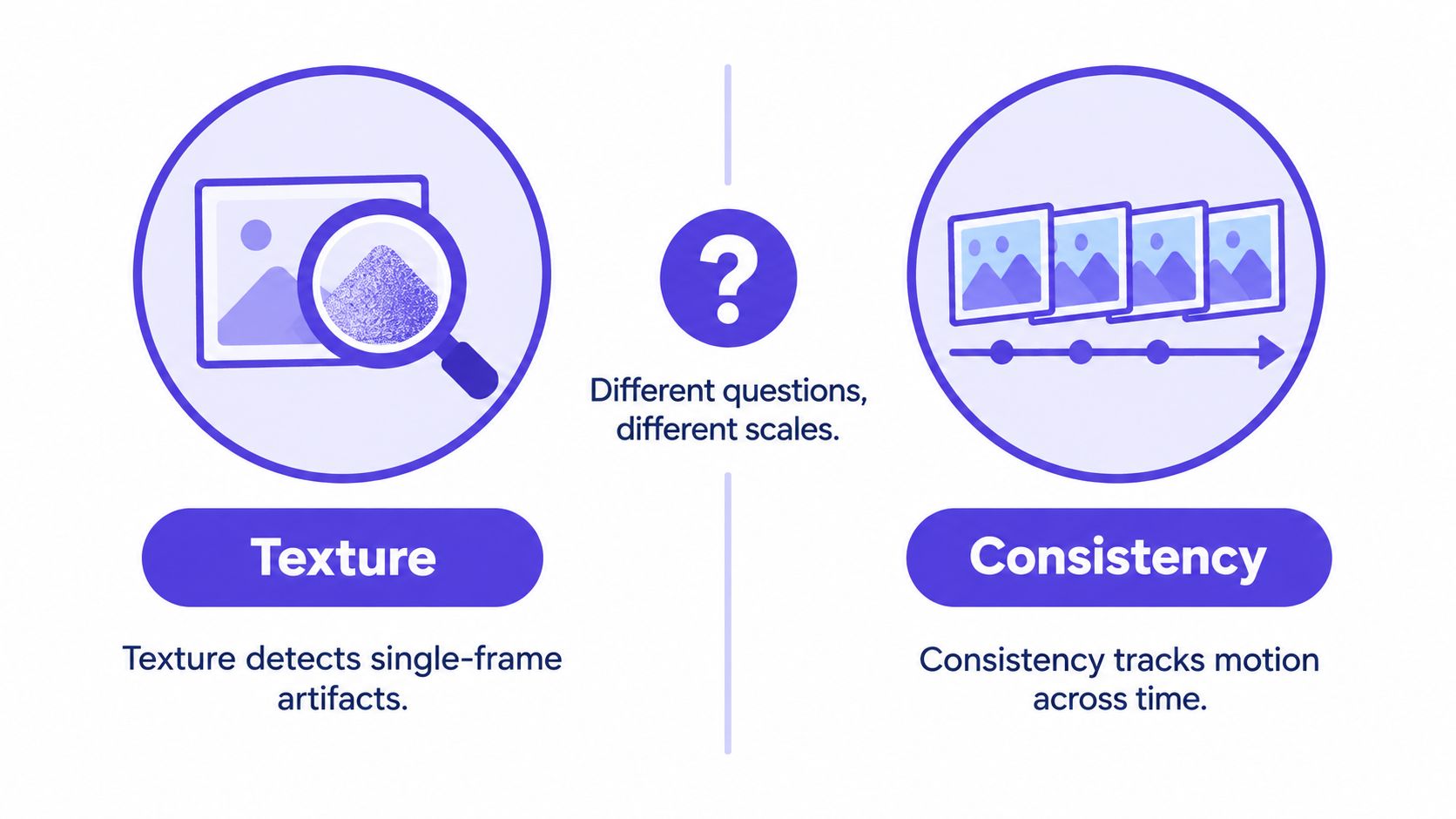
That is the core mistake in consistency vs texture debates. Texture tells you whether a single frame looks plausible. Consistency tells you whether the sequence behaves like a real event over time. Those are different questions, and confusing them is how reviewers get fooled by synthetic video that passes the eye test while breaking down in motion.
| Criterion | Texture Signals | Temporal Consistency Signals |
|---|---|---|
| Scope | Single frame | Multiple frames across time |
| Best use | Close-up inspection of local artifacts | Motion, timing, and identity checks |
| Weak point | Can collapse under compression or resizing | Needs enough usable sequence length |
| Strongest clue | Fine-detail anomalies, blending errors, frequency artifacts | Motion continuity, landmark stability, audio-video timing |
| Practical risk | A frame can look authentic while the sequence is fake | Short clips can hide deeper failures |
For a practical overview of the broader divide between generative vs AI-assisted video, this explainer from Tutorial AI is a useful companion because it frames the production context before you start hunting for forensics signals.
Why Consistency vs Texture Is the Wrong Frame
The most convincing fake does not present obvious skin warping or jittery edges. It encourages a quick glance, then fails when you track what the body, face, and audio are doing across the whole clip.
Different questions, different scales
Texture asks, “Does this frame look physically plausible?” Consistency asks, “Does this event stay plausible from one moment to the next?” That distinction matters because a frame can carry clean texture and still sit inside a sequence that violates motion, timing, or identity rules.
A journalist reviewing a reposted protest clip might see smooth faces and natural lighting, then miss the fact that the crowd motion doesn't line up across cuts. A legal reviewer might see a noisy frame and overreact, even though the file was heavily recompressed before it reached them. The error in both cases is the same, texture gets treated like a verdict instead of one signal among several.
Practical rule: if the clip has already been compressed, reshared, or cropped, start with temporal behavior before you trust what the pixels look like.
The old habit is to ask which detector wins. That question is too crude. A better workflow is to ask which signal answers the risk in front of you, a face close-up, a moving crowd, a talking head, or a live incident recording. Texture can help, but it cannot carry the whole judgment on its own.
Why the “looks real” instinct is risky
A polished frame is seductive because it feels immediate. The eye notices smooth skin, stable lighting, and clean edges, then stops searching. That is exactly where synthetic clips benefit, because they only need to survive the first impression.
If you need a mental model, think in layers. Texture is the frame-level layer. Consistency is the sequence-level layer. Authenticity depends on whether those layers agree, not on whether one of them looks good in isolation.
What Texture-Level Signals Actually Detect
Texture analysis works at the single-frame level, so it catches the fingerprints generators leave behind in local detail. That includes GAN fingerprints, diffusion noise patterns, spectral anomalies in the frequency domain, edge irregularities, strange skin rendering, and blending errors around manipulated regions.
What the frame can reveal
A frame can still give away a lot. Hair edges may look too uniform, skin pores may flatten into a plastic surface, or a mouth boundary may show subtle mismatch where a face swap was stitched in. Those are the kinds of local abnormalities that texture-based methods are built to notice.
That said, not all texture clues mean the same thing. Some are tied to a particular generator family, while others are more general signs of manipulation. In practice, the useful question is not “does this frame look weird?” but “what class of artifact is showing up, and does it survive the way this file was delivered?”
A photo-like close-up is where texture tends to perform best. A compressed re-upload from a messaging app is where it gets less dependable. If the clip was resized, re-encoded, or stripped of detail, the texture score can miss what was once obvious.
The internal signal map in fingerprint feature analysis is a good reminder that local evidence should stay local. It's valuable, but it doesn't tell the whole story.
Where texture breaks down
Texture cues are vulnerable in three familiar ways. First, compression can wash out the very patterns you wanted to inspect. Second, a stronger generator can reduce or hide the artifact class you were trained to spot. Third, noise can be added to authentic footage in ways that make it look less trustworthy without changing the underlying event.
For teams building explainable checks, a text-to-video generator for corporate training is a reminder that not every synthetic clip is trying to deceive. Some are created for legitimate production workflows, which is why the forensic question has to stay focused on integrity, not on whether a frame merely looks polished.
What Temporal Consistency Actually Measures
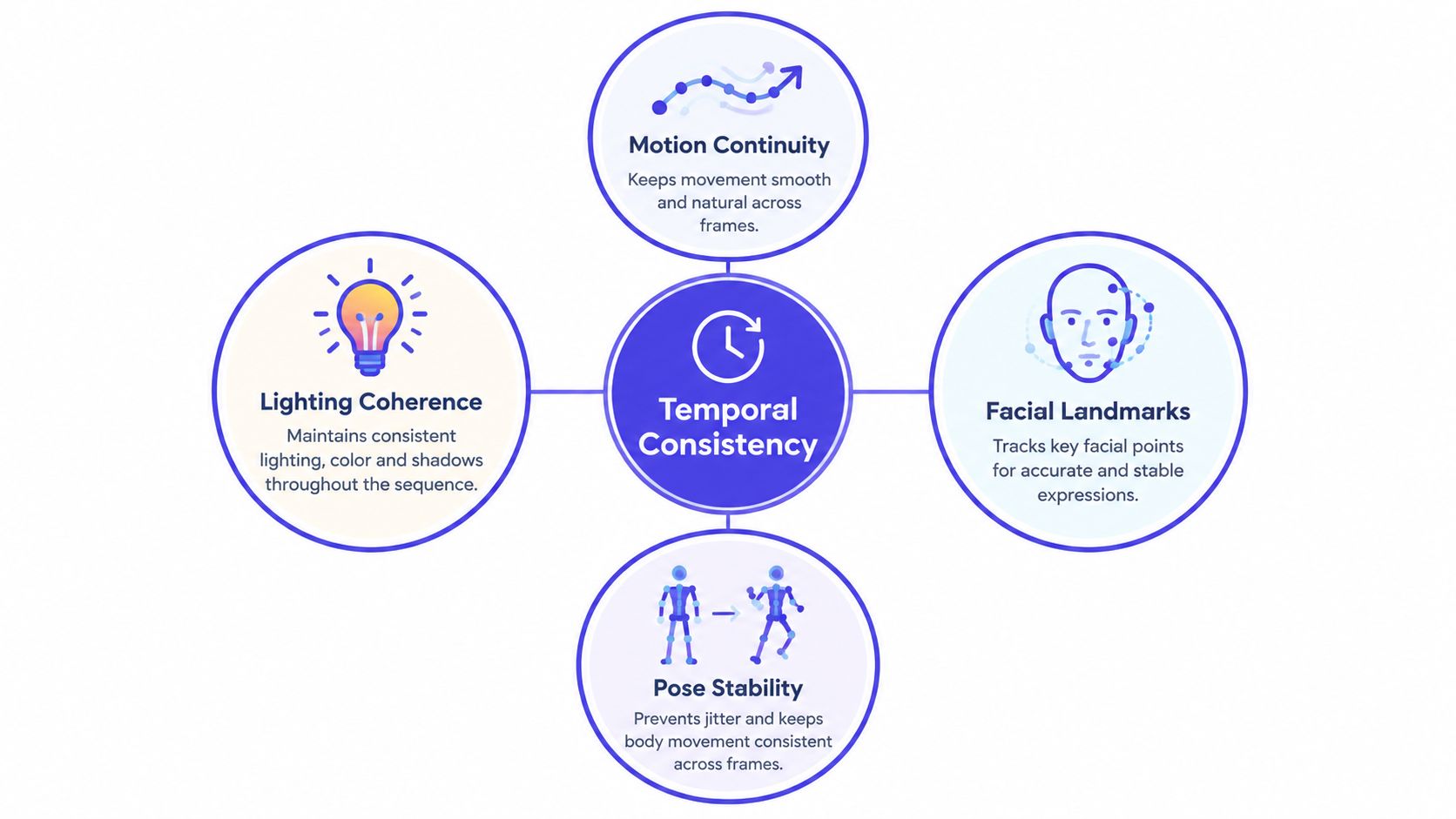
Temporal consistency is broader than flicker detection. It covers whether motion, body geometry, lighting behavior, and audio timing stay coherent as the video unfolds.
The signals that matter most
The first layer is motion continuity. A head turn should unfold smoothly, not snap between positions in a way that breaks natural movement. The second layer is facial landmark trajectories, where mouth, eyes, jaw, and cheeks should move in ways that match the speaker's action. The third is optical-flow stability, which checks whether motion in the full frame behaves like a real scene rather than a patchwork of local corrections. The fourth is audio-video synchronization, where mouth movement, breath, and ambient timing should line up.
A clean face in one frame means very little if the next ten frames don't agree with each other.
Whole-action analysis matters. Short windows can look fine, especially if the subject is mostly still. Longer sequences expose the places where a synthetic clip starts to drift, such as repeated micro-motions, inconsistent head pose, or motion that feels physically too neat across the entire event.
A static talking head asks for close attention to lip sync, eye motion, and small facial dynamics. A sports clip needs object permanence, camera motion, and acceleration checks. A surveillance clip demands a different standard again, because the scene has more environmental motion and less controlled framing.
For a deeper look at motion-based verification, optical flow analysis is the right companion topic.
Why clip length changes the verdict
A short clip can hide a lot. It may show enough visual smoothness to pass a casual review while still missing the longer motion pattern that reveals the manipulation. Compression can make that even harder, because recompression blurs subtle transitions and weakens the evidence you'd want to compare frame to frame.
That is why temporal checks shouldn't stop at a single obvious glitch. The better question is whether the sequence maintains believable structure across the whole available action, not just across the first few frames.
Side by Side on Five Decision Criteria
Working professionals usually need a decision rule, not a philosophical distinction. Five criteria matter most in live review, compression resilience, generator vulnerability, usable time window, explainability, and content dependence.
| Criterion | Texture Signals | Temporal Consistency Signals |
|---|---|---|
| Compression and resize | Weaker after heavy recompression, resizing, or low bitrate delivery | Usually more robust when motion still survives, though severe quality loss still hurts |
| Modern generators | Can miss cleaner outputs from newer models | Better at catching sequence-level failures that still leak through |
| Time needed | Can produce a quick frame-level read | Needs enough frames to judge motion and timing responsibly |
| Explainability | Easy to point to a suspicious edge, patch, or frequency pattern | Easier to explain when you can show motion mismatch, timing drift, or pose instability |
| Content dependence | Strongest in face close-ups and high-detail originals | Strongest in talking heads, full-body scenes, action clips, and messy real-world footage |
Texture wins when you have a high-quality original and a close-up face. It gives a reviewer something concrete to inspect, and that can be enough in narrow cases. Consistency wins when the clip has been redistributed, compressed, or cropped, because the sequence still has to behave like the event it claims to be.
A newsroom vetting a user-submitted clip from a messaging app should treat temporal consistency as the heavier signal. A legal team with the original file should run both, then treat disagreement as a reason to escalate. A security team reviewing a live call should care most about mouth timing, micro-movement, and cross-modal alignment, because the codec has already changed the visual surface.
The rule of thumb
- Use texture first when the file is clean, the subject is close to camera, and the visual detail is still intact.
- Use consistency first when the clip is short on context, likely recompressed, or contains motion that should stay physically coherent.
- Treat both as incomplete when the evidence has been reposted, cropped, or partially overwritten by platform encoding.
The practical mistake is to overvalue whatever signal looks easiest. Easy isn't the same as reliable.
How a Fused Detector Combines Both Signals
A fused detector earns trust by checking whether the clip's surface and its timing tell the same story. The first pass looks at the frame. The second pass asks whether the action still holds together across time.
A two-stage workflow
The first stage looks for texture and frequency anomalies. That includes local artifacts, odd edges, abnormal detail distribution, and other frame-level cues that often appear after a generator or editor changes the image. The second stage checks temporal consistency fusion, where inter-frame feature correlation, landmark displacement, optical-flow residuals, and audio-visual timing are combined into a sequence-level judgment.
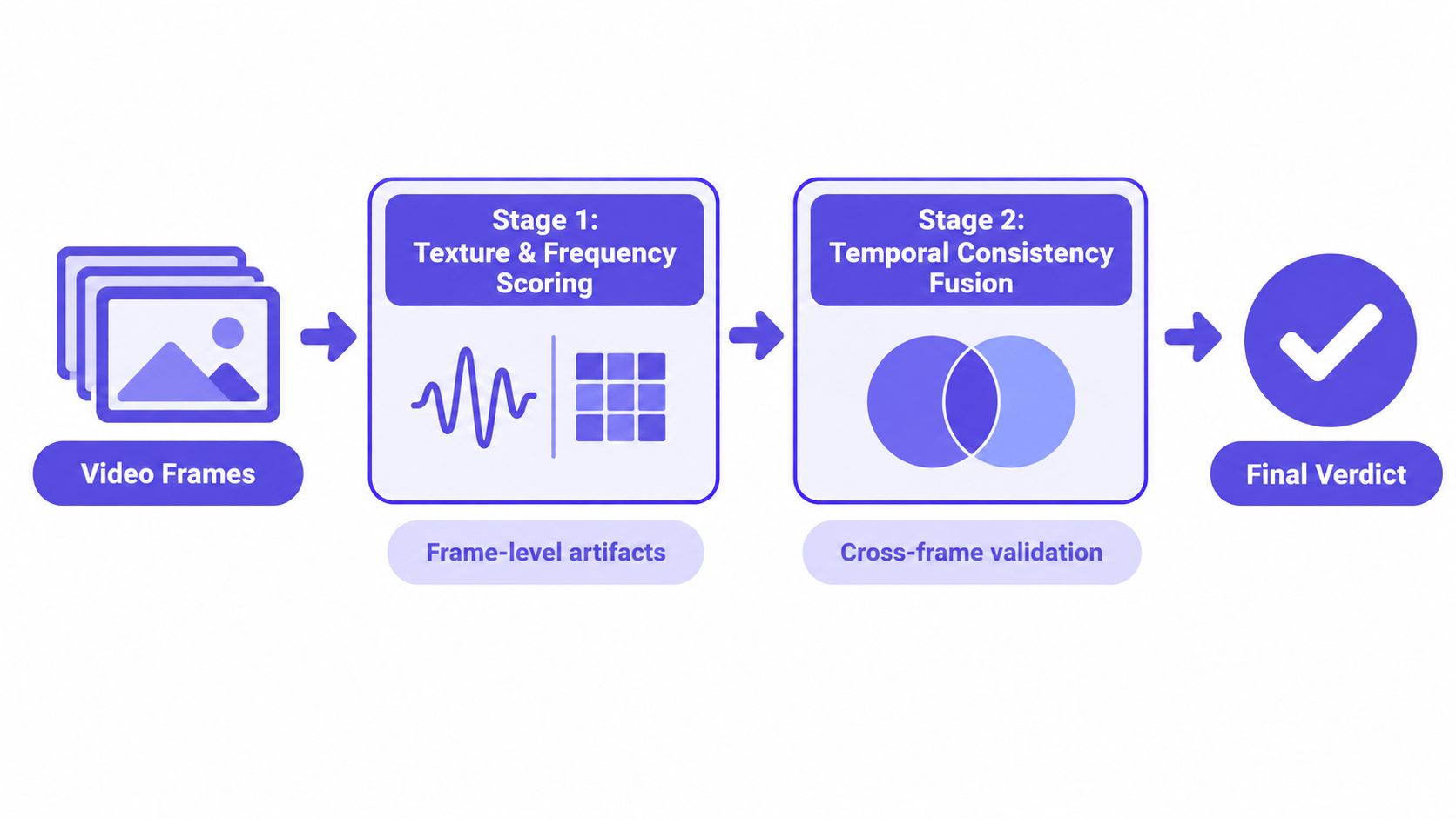
That order matters. Clean texture does not clear the clip if consistency breaks. Smooth motion does not clear it either if local artifacts still show up. Confidence should rise only when the independent signals line up.
The stronger systems keep the two readings separate instead of collapsing them into one opaque label. Separate subscores let a reviewer see whether the frame-level evidence and the time-based evidence support the same verdict. In practice, that is easier to defend in a newsroom, a legal memo, or an incident report.
Why separation improves judgment
A single score can hide disagreement. Separate subscores force the reviewer to ask which signal is carrying the verdict and which one is just noise. That matters because a synthetic clip can look convincing in one channel and fail in another.
The published multi-cue evaluation on FaceForensics++ and the Deepfake Detection Challenge dataset reported an F1 score of 90.6% and an AUC of 98.5% when localized spatial evidence and long-range temporal dependencies were combined, as reported in the multi-cue fusion study. That kind of result is why fused systems matter, especially when compression, occlusion, or low resolution make any single signal easier to fool.
The trap is convincing texture. A polished frame can make a synthetic clip feel safe long before the action starts to drift, and that is where professionals lose time. Whole-action consistency gives the better edge, because it tests whether the event still behaves like itself from one moment to the next.
The most useful detector is the one that shows its subscores, so the reviewer can defend the verdict later.
Reading Results in Three Real Workflows
A score only matters when it lands inside a real job. The same texture and consistency outputs can lead to different decisions depending on who is holding the clip and what's at stake.
Newsroom review
A journalist getting a user-submitted protest video through a messaging app should assume recompression has already happened. In that setting, texture can still help, but consistency deserves heavier weight because the file's visual surface may have been damaged by redistribution.
The right move is to preserve the original upload path, if possible, then check whether the motion stays coherent across the whole sequence. If the audio and mouth timing drift while the face still looks polished, that's a warning sign. The newsroom should not publish until the strongest available evidence agrees.
Legal authentication
A legal team has a different standard. If the original file exists, both texture and consistency should be examined, and disagreement should trigger escalation rather than averaging. That is important because evidentiary review depends on the chain of signals, not on a single reassuring score.
Here the reviewer should document which frames show local artifacts, which stretches of motion remain stable, and whether the audio track lines up with the visible action. The point is not to “win” a detector debate. The point is to explain why the file is or isn't reliable enough for the case file.
Enterprise security
A security team screening a video call for impersonation fraud has to think in real time. Texture artifacts often won't survive the live codec in a way that's useful, so the more useful signals are mouth timing, micro-movement consistency, and audio-video sync.
In that environment, a clean visual surface isn't reassuring. It's expected. The operational question is whether the person on screen behaves like a live speaker over time, or whether the call contains the subtle drift that comes from a manipulated source.
When to Trust Texture Alone and When Not To
Texture is still decisive in narrow situations. If you have a high-resolution original, a static face close-up, and a known generator family with recognizable fingerprints, frame-level analysis can carry a lot of weight.
That doesn't mean texture is obsolete. It means texture is best used where the file still preserves the details it needs to reveal. In those cases, a suspicious edge, skin pattern, or blending seam can be enough to justify deeper review.
Outside those conditions, consistency should lead. Reposted clips, full-body footage, crowded scenes, and compressed social uploads all favor time-based analysis because the frame surface is too unstable to trust on its own.
Three traps that keep showing up
- Trusting a clean texture score on a short clip. Short clips can hide deeper problems because they don't give the motion enough room to fail.
- Treating smooth motion as proof of authenticity. Smoothness inside a short window can still sit inside a longer sequence that breaks physical logic.
- Ignoring audio because the picture looks plausible. That's a common miss, especially in talking-head footage where the audio track often carries the clearest mismatch.
One more point matters for practitioners who hear that newer generators have made texture detection useless. That claim goes too far. Better generators do reduce some visual artifacts, but they don't erase the value of texture when the source file is good and the manipulation leaves local traces. They just make temporal consistency the more reliable edge in most post-distribution cases.
Practical Questions to Ask Before You Trust a Score
Before you rely on any detector, ask whether you're looking at the original file or a downloaded copy. If the clip came through WhatsApp, YouTube, TikTok, or another platform that recompresses media, you're no longer looking at untouched evidence, and that changes how much weight you can give a texture result.
The next question is simple. Does the tool report separate texture and consistency subscores, or does it hide everything behind one confidence number? For high-stakes work, separate signals are easier to audit and easier to explain.
You should also ask how the system handles short clips and degraded files. A useful vendor answer will describe what happens when the available sequence is too brief for stable temporal analysis, and how the model reacts when compression has erased part of the evidence. The confidence score guidance is useful here because any score needs context before it can support a decision.
A working habit helps more than a checklist. Preserve the original, inspect the whole available action, and treat any single-signal result as preliminary until the other evidence agrees.
If you're reviewing a live clip today, start by preserving the original file, then test whether the motion, timing, and frame-level detail all tell the same story. Don't let convincing texture talk you into a fast yes. If the signals disagree, keep the case open, document the mismatch, and run the full verification workflow before you publish, file, or act.