

Audio Video Forensics: Authenticate Digital Media

A reliable audio-video forensic conclusion requires more than listening to a clip or trusting a detector score. Early voice-identification methods produced 40% to 60% error rates in repeat studies, while a reported CNN-LSTM system reached 98.05% accuracy on ASVspoof 2019 but fell to 95.46% on WaveFake, showing why laboratory performance can't stand in for real-world reliability.
A newsroom receives a short video during a breaking story. The image looks clean, the speaker's mouth follows the words, and the clip has already been reposted widely. Yet the background hum changes abruptly, the room reverberation disappears for a few syllables, and the file has passed through several compression stages. Under deadline pressure, the temptation is to ask whether the video “looks real.” The better question is whether its independent signals agree.
Audio video forensics is a multidisciplinary process involving signal analysis, documentation, speaker comparison, and preservation of evidentiary integrity. A convincing recording isn't necessarily an authentic one, and an unusual artifact isn't automatically proof of manipulation. The analyst's job is to establish what the file can support, identify what remains uncertain, and preserve enough material for another person to reproduce the examination.
The Reality of Digital Media Verification
A visually polished clip can still contain an audio problem that the eye won't catch. A face may remain stable across frames while a voice-conversion system introduces a narrow spectral discontinuity, or while an editor replaces one sentence and leaves a different acoustic environment around it. The result can sound plausible to a listener, especially when the clip is short and emotionally charged.
Human perception is useful for triage, not authentication. Viewers notice obvious lip-sync failures, unnatural blinking, or an abrupt change in lighting, but they rarely detect encoding history, subtle waveform discontinuities, or a mismatch between a speaker and the surrounding reverberation. Reposting makes the task harder because platforms can alter the file before an analyst receives it.
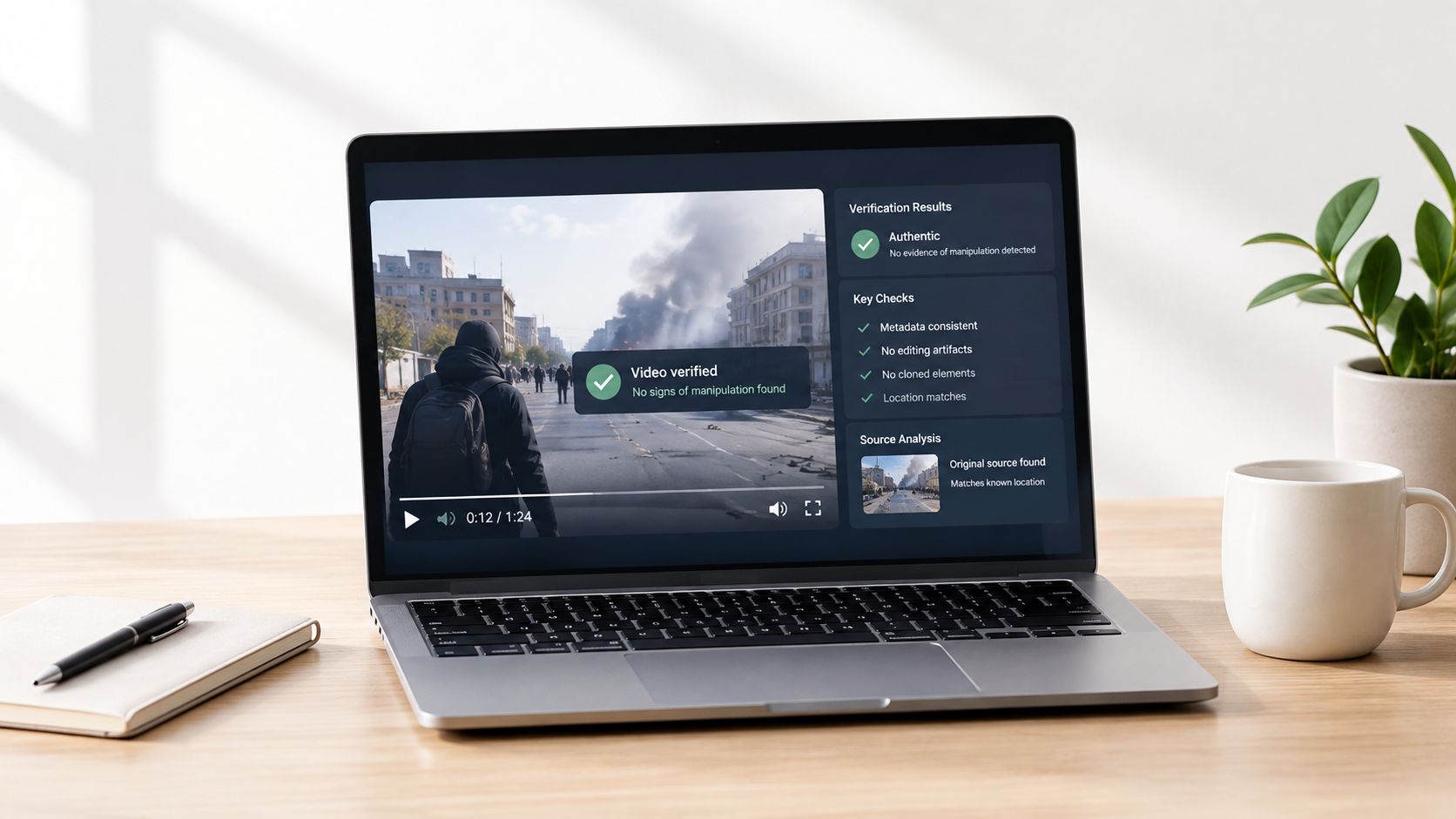
Why a plausible image isn't enough
Modern examination starts with preservation and documentation, then moves through several forms of analysis. The video track may reveal duplicated frames, inconsistent motion, or local pixel changes. The audio track may expose altered spectral structure, an unnatural pause, or a voice that doesn't share the expected acoustic relationship with its environment. Metadata and container information can add context, although their absence or alteration doesn't settle authenticity by itself.
The history of audio forensics reinforces this discipline. Sound recording and the sound spectrograph made it possible to capture, replay, visually represent, and analyze speech during the first half of the 20th century. Researchers later learned that a visual resemblance between spectrograms wasn't equivalent to the stable individualization associated with fingerprint evidence.
Practical rule: Treat every detector output as an investigative lead until the file, its provenance, and independent technical signals support the same conclusion.
That approach matters in publication as much as in court. A newsroom may decide that a clip is too weak to publish, even when it can't prove fabrication. An investigator may report evidence consistent with editing without claiming to know who performed it. Those are careful conclusions, not failures of analysis.
Evolution of Audio Forensic Techniques
The early history of audio examination explains why modern practitioners distrust visual shortcuts. During World War II, researchers developed an early speaker-identification approach by comparing spectrograms of linguistically identical utterances. Spectrography pioneers Gray and Kopp introduced the label “voiceprinting” in 1944, and Lawrence Kersta formalized forensic discussion of voiceprints in 1962 according to the National Institute of Justice account.
The method was attractive because it appeared to transform speech into a visible signature. Analysts could place two displays beside each other and look for matching patterns. But the underlying assumption was too strong. Speech changes with microphones, channels, background conditions, health, emotion, speaking style, and the words being spoken. A visual pattern can support comparison, but it doesn't automatically identify a person.
The failure of visual voiceprints
Repeat studies reported by the National Institute of Justice produced error rates ranging from 40% to 60%, a result that exposed the gap between an appealing visual analogy and dependable forensic performance. The lesson wasn't that spectrograms were useless. It was that no single representation should carry more evidentiary weight than its limitations justify.
The field moved toward acoustic, linguistic, and statistical comparison. Analysts began asking which measurable speech properties remain informative under the recording conditions, how similar the questioned and known samples are, and how uncertainty should be expressed. That shift also separated speaker comparison from simple recognition. A forensic conclusion must account for both the characteristics of the voice and the quality of the available sample.
From listening to documented examination
The FBI has maintained audio-forensics expertise since the early 1960s, particularly in speech-intelligibility enhancement and recording authentication. The Audio Engineering Society published AES27 in 1996 to standardize management of recorded audio materials intended for examination, followed by AES43 in 2000 for authenticating analogue audio tape recordings, as described in the review of forensic speech and audio analysis.
Contemporary examination can include visual inspection of the medium, auditory analysis, magnetic-pattern assessment for tape, narrow-band spectral analysis, and high-resolution waveform analysis. Digital work may also consider compression history, microphone characteristics, reverberation, discontinuities, and processing traces.
The enduring principle is straightforward: a recording that sounds convincing has not yet been authenticated. The analyst must connect observations to preserved material, documented methods, and a conclusion that another qualified examiner can challenge.
Core Signals in Modern Authentication
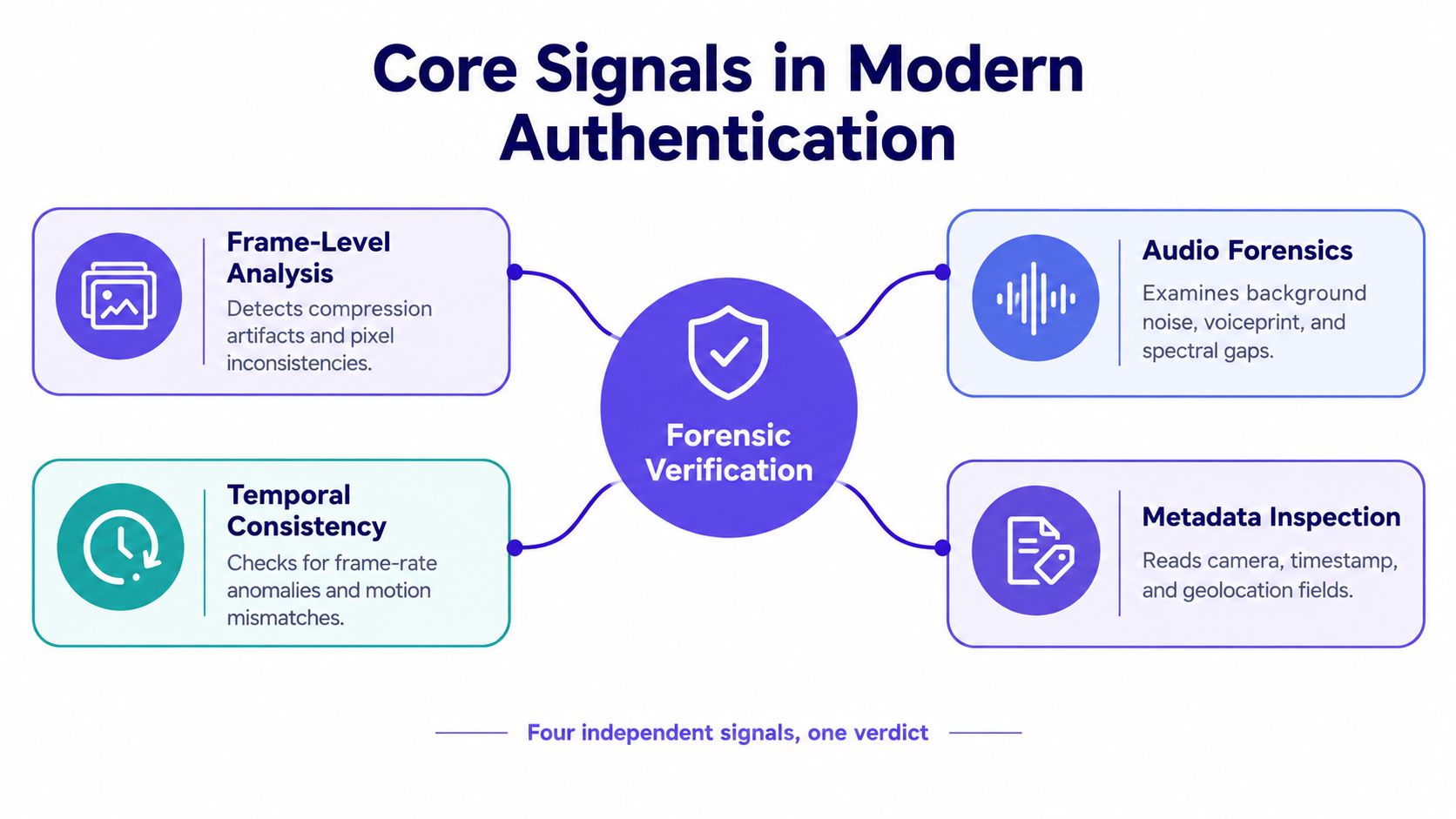
A practical workflow separates the file into independent evidence streams before combining them. The four most useful signals are frame-level analysis, audio forensics, temporal consistency, and metadata inspection. None is infallible, and agreement between them is more informative than an isolated anomaly.
Frame-level analysis
Start with the visual track at the frame or short-segment level. Look for compression inconsistencies, unnatural edges, changing texture, pixel-level discontinuities, and details that behave differently from nearby content. A generated face may appear convincing globally while a local region changes subtly during speech or head movement.
The analyst shouldn't treat every artifact as synthetic. Re-encoding, resizing, screen recording, and social-platform processing can create ordinary distortions. The useful question is whether an anomaly is localized, repeatable, and consistent with the file's technical history.
Audio forensics
Audio deserves its own examination rather than serving as background to the video. Systems may analyze short-term features such as MFCC, LFCC, and log-power spectra; longer-term features such as CQCC; prosodic variables including fundamental frequency, energy, and duration; and learned embeddings such as XLS-R. These representations capture different failure modes, from vocoder irregularities to unnatural timing and higher-level speaker or phonetic structure, as discussed in research on spectral analysis.
Preserve the original waveform and create synchronized time-frequency views. Compare segment-level scores instead of forcing one decision across an entire clip. A splice or regenerated phoneme may occupy only a short interval, and global averaging can dilute precisely the evidence an investigator needs.
Temporal consistency
Check whether motion, frame rate, audio timing, and scene changes form a coherent sequence. A video can contain plausible individual frames while motion between them appears irregular. Audio may lead or lag visible speech, or a cut may preserve the voice while changing the acoustic space.
Temporal review is especially valuable after editing or reposting. It helps distinguish a generation artifact from a normal compression effect because the analyst can ask whether the anomaly follows a meaningful boundary, persists across adjacent frames, or coincides with a known transformation.
Metadata inspection
Read the container and available metadata for camera, timestamps, encoding software, and other fields. Metadata can support a provenance narrative, reveal a re-export, or identify a mismatch between the claimed source and the file's technical history. It can also be missing, rewritten, or stripped by ordinary platforms, so it should rarely determine the verdict alone.
For practical guidance on the broader problem of record authenticity in 2026, focus on how provenance, file handling, and technical examination work together. The strongest workflow doesn't ask which signal wins. It asks whether the signals corroborate one another and whether the result remains explainable after compression and repurposing.
Practical Tools for Media Investigation
Tools are most useful when they make uncertainty visible. A platform that returns a binary “real” or “fake” label may be convenient for triage, but it gives an investigator little help when a clip has been recompressed, clipped from a longer recording, or generated with an unfamiliar system. The operational requirement is a report that shows which signals were examined and where the evidence is weak.
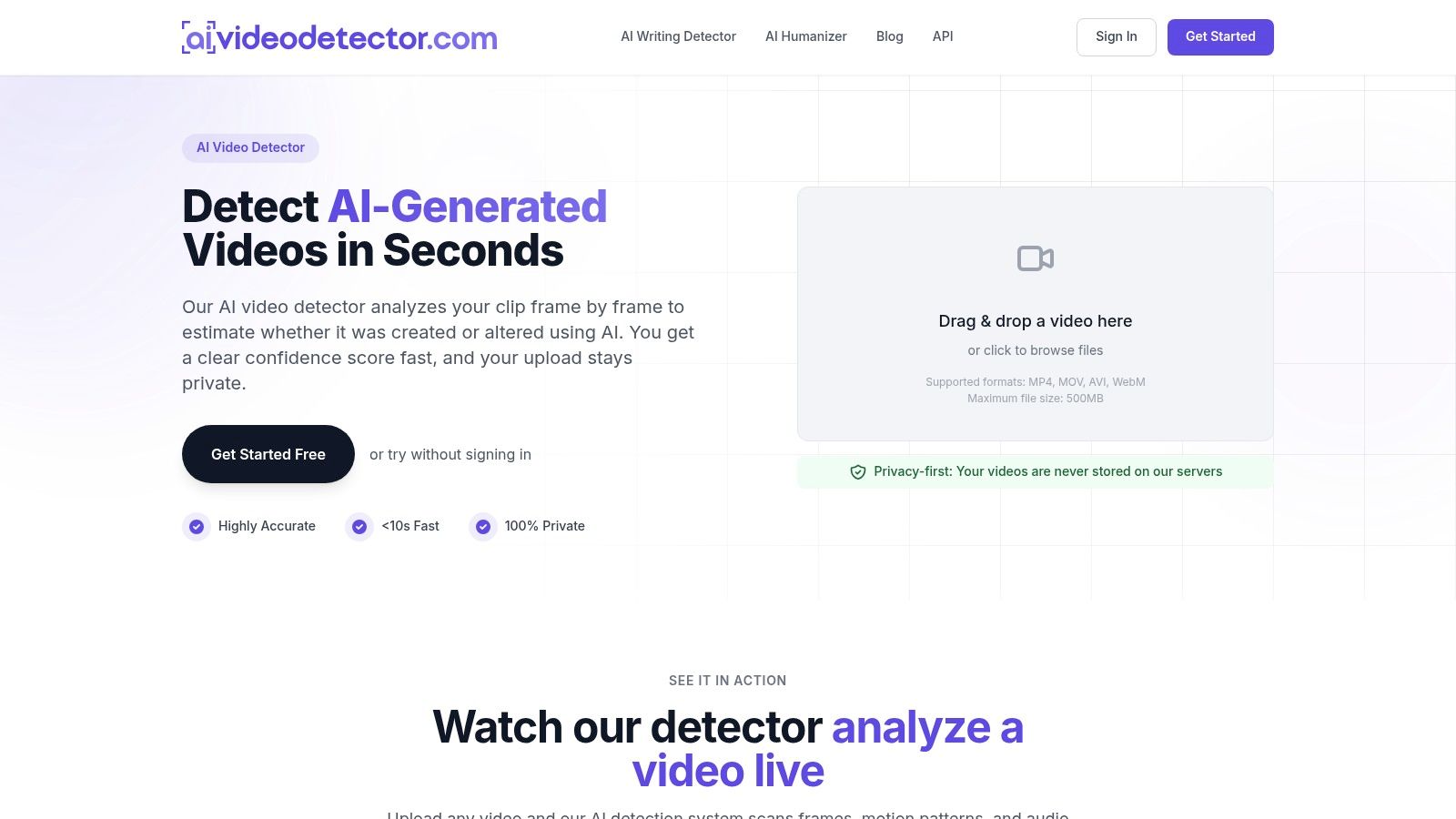
A privacy-first workflow begins by preserving the submitted file, recording its hash and acquisition context, and working from a copy. AI Video Detector is one available option for multi-signal screening. Its stated workflow examines frame-level content, audio, temporal consistency, and metadata, and it supports uploaded videos up to 500MB with results delivered in under 90 seconds, according to the platform's published product information. Those capabilities can help a newsroom or security team prioritize review, but they don't replace source verification or expert examination.
Match the tool to the decision
A journalist checking a user-submitted clip needs rapid triage and a clear escalation path. A legal team needs preserved originals, reproducible artifacts, and an explanation that can survive challenge. An enterprise fraud team may care about whether a video-call recording contains synthetic speech or identity substitution, then route the event into an incident-response process.
For voice-focused work, a dedicated forensic voice analysis software workflow can organize speech comparison and audio indicators more effectively than a general visual review. The output should still be treated as one component of the examination, especially when the sample is short or has passed through a telephone or social-media channel.
The following sequence works under deadline pressure:
- Preserve first. Save the received file unchanged, calculate a hash, record who supplied it, and note the transfer method.
- Inspect broadly. Review the container, codec, duration, frame rate, audio streams, and visible edit points.
- Score locally. Examine suspicious segments rather than relying only on a clip-wide result.
- Corroborate externally. Search for the earliest available upload, longer versions, alternate angles, original witnesses, or source-device material.
- Report uncertainty. Separate observations, tool outputs, interpretations, and unresolved questions.
A detector can accelerate the second and third steps. It can't tell you whether the supplied file is the original, who created a manipulation, or whether a platform transformed the evidence before collection.
For a visual demonstration of a multi-signal review workflow, the following video can help orient analysts before they build their own protocol.
The Gap Between Lab Accuracy and Reality
Benchmark results describe performance under a defined distribution. They don't guarantee that a detector will handle a reposted phone video, a noisy interview, a replayed recording, or a synthesis method absent from training. The difference becomes clear when the same general approach moves from controlled material to conditions that resemble actual investigations.
On the ASVspoof 2019 logical-access benchmark, one reported CNN-LSTM spectrogram system achieved 98.05% accuracy, 95.20% AUC, and a 4.80% equal-error rate. On the more difficult WaveFake dataset, the same reported results declined to 95.46% accuracy, 93.82% AUC, and a 6.41% equal-error rate, as documented in the comparative evaluation of audio deepfake detection under realistic conditions.
Why the input distribution changes
Real footage brings complications that clean benchmarks can underrepresent:
- Channel changes: Telephone audio, screen captures, microphones, and platform codecs reshape the signal.
- Environmental noise: Wind, traffic, rooms, music, and overlapping speech can mask or imitate synthetic artifacts.
- Replays and edits: A loudspeaker recording or a clipped repost may contain several transformations before analysis.
- Unseen generators: A detector trained around one synthesis architecture may fail against another.
- Partial manipulation: Only a sentence, face region, or short transition may be altered.
An in-the-wild fraud evaluation reported 23.34% EER, 84.29% AUC, and 66.37% F1 for the LFCC-based SpecRNet model on its real-world dataset. That result doesn't make the model useless. It shows why operating points must be calibrated for the communication channels and fraud scenarios that matter to the investigator.
What to do with a borderline result
Don't convert a borderline score into a binary claim. Mark the segment for manual review, compare it with clean and degraded reference samples where available, and test whether the same signal survives changes in codec or playback conditions. If the output changes sharply after ordinary processing, report that sensitivity rather than hiding it.
High confidence also isn't proof of authenticity. A detector may recognize a familiar generation pattern, but an authentic recording can contain unusual compression, and a manipulation can fall outside the model's experience. The defensible result is often “evidence consistent with manipulation,” “no reliable manipulation indicator detected,” or “inconclusive under the available conditions.”
Building Defensible Evidence Workflows
A technical score becomes evidence only when another person can understand how it was produced. That requires more than exporting a screenshot from a detection platform. It requires a controlled record of the original file, every working copy, the tools used, the parameters selected, and the reasoning behind the conclusion.
Preserve the object of examination
Start with the earliest available file, not a screen recording or messaging-app download if a closer source can be obtained. Create a forensic hash, record acquisition date and method, identify the custodian, and keep the untouched original separate from enhancement or presentation copies. If a file is exported, transcoded, cropped, or denoised, preserve the export history and label the derivative clearly.
Metadata can support the account, but it isn't a substitute for chain of custody. A missing timestamp doesn't prove editing, and a coherent timestamp doesn't prove that the file was never altered. Resources such as CCTV recording guidance from Wisenet Security Ltd are useful reminders that recording systems, retention processes, and evidence handling affect what an examiner can later establish.
Record the examination, not just the conclusion
Log the analyst's qualifications, software name and version, model or detector version, input hash, extracted streams, preprocessing, selected segments, and output files. Store waveform views, spectrograms, frame samples, metadata exports, and any comparison material used to reach the interpretation.
A useful report separates four layers:
- Observation: A spectral discontinuity appears at a defined time interval.
- Method: The analyst inspected the waveform, synchronized spectrogram, and adjacent speech segments.
- Interpretation: The discontinuity is consistent with a splice or processing boundary, but alternative explanations remain possible.
- Conclusion: The finding supports further investigation and doesn't establish authorship or timing.
The evidence documentation workflow should make those layers easy to audit. Don't lead with an unexplained confidence percentage. Lead with the file identity, the reproducible artifacts, and the limits of the method.
Authentication and manipulation detection answer different questions. A detector can indicate that content changed without proving who changed it, when the change occurred, or whether the submitted file is the original.
This distinction matters in court and in editorial review. A finding that a clip contains an edit isn't proof that the entire event is fabricated. Conversely, the absence of a detected artifact isn't proof that the recording is authentic. The report should state what was examined, what was found, what wasn't tested, and what independent evidence would resolve the remaining uncertainty.
Future Directions in Forensic Reliability
The next phase of audio video forensics won't be defined by one perfect detector. It will be defined by workflows that test models outside their training distribution, compare paired real and synthetic material, and preserve independent evidence streams for later review. Research across multiple datasets has found that systems can perform well on their own test sets yet generalize poorly to older or different benchmarks, which is why cross-generator evaluation matters.
For an analyst facing a compressed social-media clip, the practical mindset is conservative but not passive. Preserve the best available source, isolate suspicious intervals, inspect audio and video separately, compare the file with other versions, and ask whether the observed anomaly could result from ordinary platform processing. Then document the answer so another investigator can repeat the path.
Uncertainty is part of the result
A newsroom may publish a clip with a qualified description, hold it pending source confirmation, or reject it because the provenance is too weak. A law-enforcement team may use a detector output to guide interviews and device collection without presenting it as final proof. An enterprise may block a suspicious request while escalating the recording for human examination.
Those decisions are stronger when the organization defines its escalation criteria before a crisis. Broader work on how companies adapt to AI threats can provide useful context for connecting media authenticity checks with security operations, but the forensic record still needs its own technical detail.
The practitioner standard is simple to state and demanding to apply: corroborate independent signals, preserve the original, calibrate confidence to the actual channel, and say exactly what the evidence cannot establish. A borderline detector result isn't the end of an investigation. It's a reason to slow down the claim while speeding up the collection of better evidence.
If you're reviewing a suspicious recording now, preserve the earliest file, calculate its hash, document its source, and keep all derivatives separate. Then run a multi-signal examination, isolate borderline segments, and have a qualified analyst turn the findings into a reproducible report before publication, litigation, or an operational decision.


