

Discover the ai video summarizer: Turn hours into highlights

An AI video summarizer is a tool that automatically boils down long videos into a short clip or a text summary. Imagine having an expert assistant who can watch hours of footage for you and instantly hand over a highlight reel of only the most important parts. That's what these tools do—they cut through the noise so you don't have to.
We're Drowning in Video Content
Let's face it: we're creating and watching more video than ever before. Think about it—endless corporate meetings, hours of security footage, online courses, and a constant stream of social media content. Trying to manually review all of that isn't just a drag; it's practically impossible for one person to handle.
This is exactly where an AI video summarizer steps in. It acts like an intelligent filter, sifting through the mountain of video to pull out the truly meaningful moments.
By analyzing everything from the visuals to the spoken words, these tools can pinpoint key themes, identify who is speaking, and track important actions to build a concise overview. This means you can get the gist of a two-hour webinar in a few minutes or find that one specific comment from a day-long recording without having to scrub through the timeline endlessly.
How Does It Actually Work?
At its core, an AI summarizer blends a few powerful technologies to understand video content almost like a person would. It’s not just snipping random clips together.
- Computer Vision: This is how the AI "sees." It can identify objects, recognize faces, and interpret actions happening within each frame of the video.
- Natural Language Processing (NLP): This is the "listening" part. The AI processes the audio, transcribes the dialogue, and figures out the main topics being discussed.
When you put these two together, the system gets a deep, holistic understanding of what the video is about, allowing it to intelligently pick out the segments that matter most.
The need for this kind of efficiency is why the market is growing so quickly. The AI video generator market, a related space, is expected to jump from USD 716.8 million in 2025 to a massive USD 3,350 million by 2034. This boom is driven by businesses looking for smart solutions to save precious time. You can dig into the complete analysis on AI video trends from Fortune Business Insights to see the full picture.
An AI video summarizer doesn't just shorten a video; it extracts value. It turns raw footage from a time-consuming liability into an accessible, searchable asset, giving you back your most valuable resource—time.
The impact of this technology is felt across many different fields. The table below gives a quick snapshot of how professionals are using AI summarization to work smarter and make faster decisions in their day-to-day jobs.
Key Benefits of AI Video Summarizers Across Industries
| Industry/Role | Primary Use Case | Key Benefit |
|---|---|---|
| News & Media | Reviewing press conferences, interviews, and raw field footage | Quickly find soundbites and key quotes, accelerating story production. |
| Legal Professionals | Analyzing witness depositions, interrogations, and courtroom video | Pinpoint critical testimony and evidence in hours of recordings, saving on billable hours. |
| Enterprise/Corporate | Condensing all-hands meetings, training sessions, and customer calls | Make important information accessible on-demand for employees who missed the live event. |
| Education & Academia | Summarizing long lectures, research interviews, and academic seminars | Help students review key concepts and allow researchers to quickly scan qualitative data. |
As you can see, the core advantage is always the same: turning an overwhelming amount of video into actionable intelligence, saving countless hours of manual work.
How AI Finds the Story Hidden in Your Videos
An AI video summarizer isn't just randomly chopping up clips. It works more like a seasoned analyst, meticulously examining different layers of information to grasp the real story. It has to see the action, listen to the conversation, and then—this is the clever part—put it all together to figure out what truly matters.
This process lets the AI build a summary that gets right to the point, saving you from having to sit through hours of footage. It’s a synthesis of visual and audio intelligence.
Seeing the Action: Keyframe and Scene Extraction
First, the AI needs to make sense of the visuals. It scans the video frame by frame, looking for significant changes—a new person walking in, a switch in location, or a sudden burst of action. This is called keyframe and scene extraction.
Think of it like a storyboard artist pulling out the single most important frames that drive a movie's plot forward. Instead of treating every second of a video as equally important, the AI isolates these pivotal moments. This ensures the summary isn't cluttered with filler; it’s a highlight reel of what actually happened on screen.
This approach is what allows the AI to connect sight (computer vision) with sound (NLP) to deliver its main benefit: saving a massive amount of time.
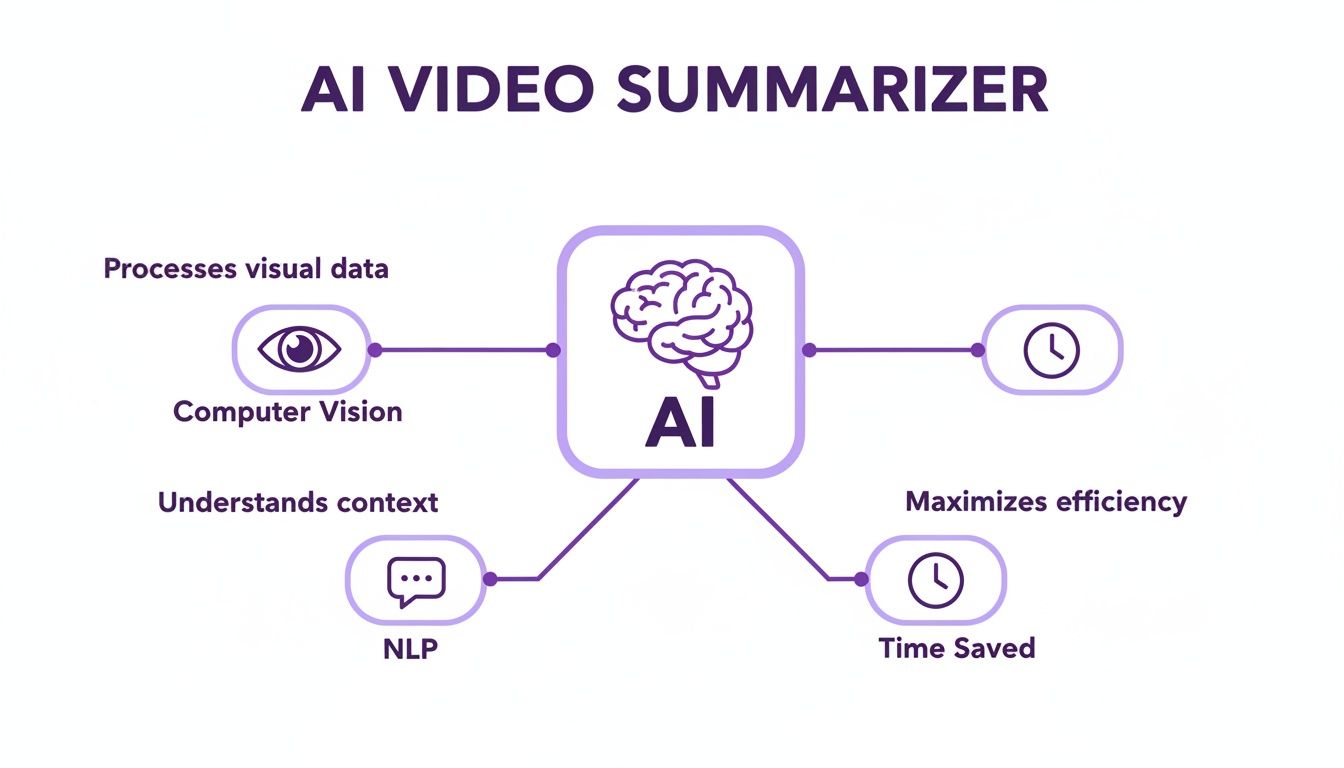
As you can see, the two core technologies work in tandem to create an efficient, intelligent overview.
Listening for Clues: What the Audio Reveals
Visuals are only half the picture. In meetings, interviews, and lectures, the most critical details are almost always in the dialogue. That's where speech-to-text comes in, transcribing every spoken word into a clean, searchable text file.
But the AI doesn't just stop at a raw transcript. It then applies Natural Language Processing (NLP) to actually understand the conversation. This allows the system to:
- Pull out the main topics and recurring themes.
- Identify who is speaking and what companies or products are mentioned.
- Flag important questions, decisions, or action items from the discussion.
This layer of audio analysis is indispensable. It's how the AI can tell you the five key takeaways from a one-hour webinar without you ever hitting play. For a closer look at how AI interprets video evidence, the principles used in forensic video analysis software offer a fascinating parallel.
A great summary isn't just shorter—it's smarter. By understanding both what is shown and what is said, an AI can produce an overview that is not only concise but also contextually rich and accurate.
Putting It All Together: Multimodal Understanding
This is where the real magic happens. Multimodal understanding is just a technical way of saying the AI combines everything it has learned. It cross-references the visual data from keyframes with the contextual data from the transcript.
For instance, if the transcript mentions a "quarterly sales spike" right as the video shows a slide with an upward-trending graph, the AI connects those two pieces of information. It recognizes that this moment is probably important and prioritizes it in the summary.
This holistic approach is what gives the summary genuine depth. It’s not just a collection of clips and quotes; it’s a cohesive narrative built from a deep, human-like comprehension of the entire video.
Real-World Uses for AI Video Summarization
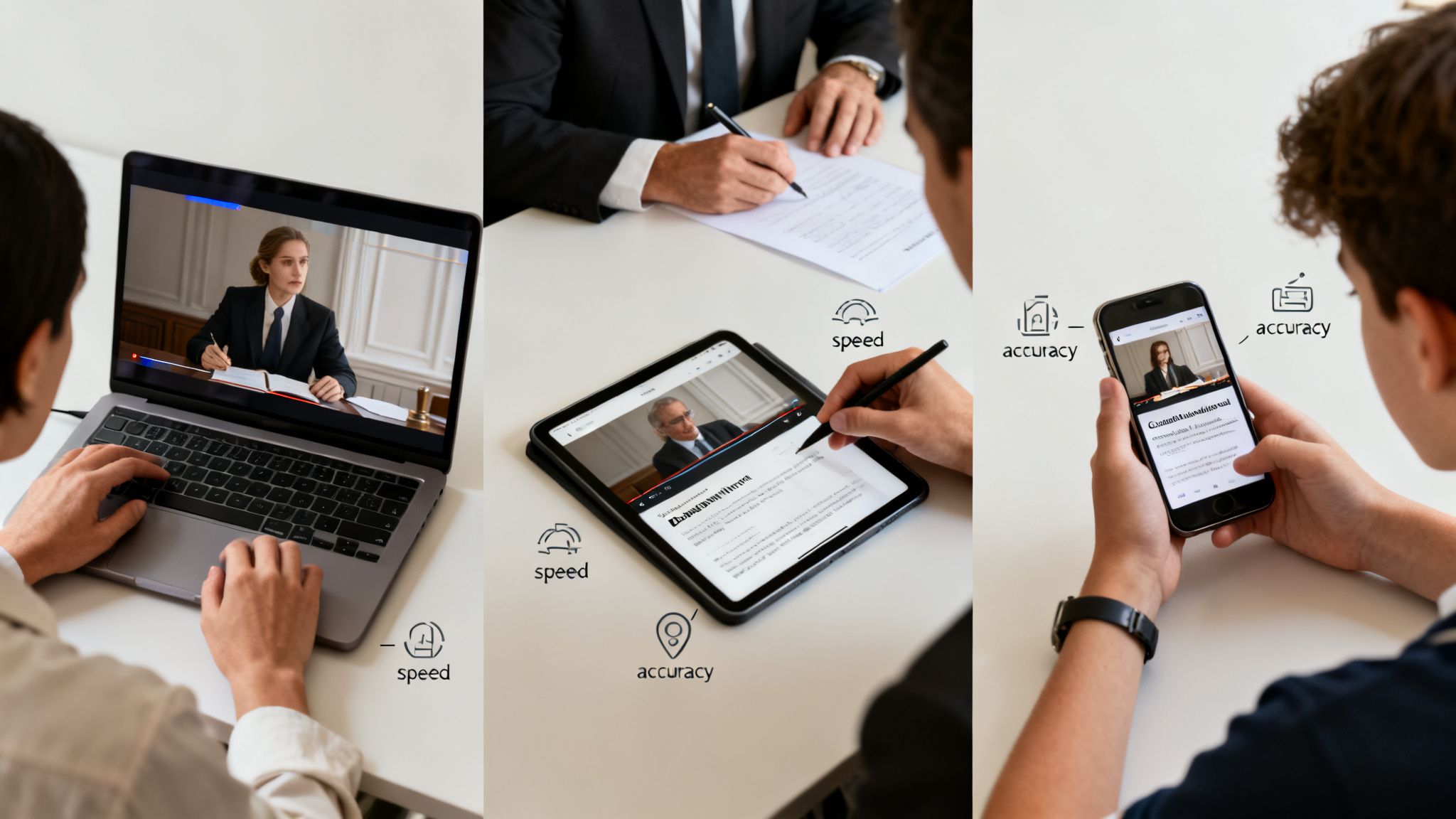
The real test of any new technology isn't how clever it is, but how it solves actual problems. An ai video summarizer is a perfect example of this. It’s moved from being a neat idea to a must-have tool for anyone swimming in a sea of video content. From fast-paced newsrooms to high-stakes courtrooms, these tools are delivering a serious boost in speed and clarity.
Picture a journalist chasing a deadline. A flood of raw footage from a live event hits their inbox. Instead of painstakingly scrubbing through hours of video, they can run it through an AI summarizer. Instantly, they get a text breakdown and a highlight reel of the most important moments. This lets them verify facts and get the story out that much faster.
This move from manual slog to automated insight is a game-changer. It’s why the Text-to-Video AI market, valued at USD 323.7 million in 2023, is expected to explode to USD 2,479.7 million by 2032. You can dig into the numbers yourself in this detailed analysis of the text-to-video AI market.
Speed and Precision in High-Stakes Fields
In jobs where every second counts and mistakes are costly, an ai video summarizer offers a decisive edge. It gives professionals a way to find that needle-in-a-haystack piece of information buried in hours of recordings.
Think about these real-world scenarios:
- Legal Teams: A paralegal is tasked with finding a single crucial statement from a week’s worth of deposition videos. The AI transcribes the whole thing and flags key testimony, cutting down what could have been days of work to just a few minutes.
- Corporate Security: An analyst gets an alert about a potential inside threat. They can summarize hours of recorded meetings to spot suspicious language or behavior, all without alerting the people involved.
- Customer Support: A manager needs to get a handle on common customer complaints. By summarizing video calls with support agents, they can quickly pinpoint recurring frustrations and use that feedback to improve their product or training.
In each of these situations, the technology turns a massive, time-draining task into a quick, targeted search. There are countless other practical applications for AI video analysis that show just how versatile these tools have become.
The real power of an AI video summarizer isn't just saving time—it's about enabling deeper focus. By handling the tedious work of sifting through footage, it frees up human experts to do what they do best: analyze, interpret, and make critical decisions.
Making Knowledge More Accessible
The impact isn't just confined to corporate offices or law firms. In the world of education, an AI video summarizer can be a student's best friend.
Imagine a college student cramming for a final. They have a dozen hour-long lectures to review. Instead of re-watching every single one, they can generate a tight summary for each lecture that pulls out the core concepts and key terms the professor emphasized. Now that's efficient studying.
It works for researchers, too. Someone analyzing video interviews can generate transcripts and summaries to quickly spot common themes or powerful quotes, which dramatically speeds up their data analysis. Whether for personal learning or academic work, the ability to pull the most important insights from video makes knowledge easier to find, digest, and act on. It’s like having a personal assistant who never misses a detail.
Understanding the Risks of Summarizing Video
An AI video summarizer can be an amazing productivity booster, but it's not a magic wand. Like any automated system, it has its blind spots—gaps in understanding that can lead to misinterpretations or even serious security issues if you're not careful. Knowing what those limitations are is the first step to using this technology the right way.
The most common pitfall is a loss of nuance. AI models are trained on massive datasets to spot patterns, but they often fumble the subtle, unwritten rules of human communication. Things like sarcasm, irony, or complex emotional cues can get completely lost in translation.
Imagine a sarcastic remark in a meeting being taken at face value. The AI summary might report it as a sincere statement, twisting the entire meaning of the conversation. This happens because the AI is hunting for explicit keywords and obvious visual signals, not the implicit context a person picks up on automatically. That’s why summaries should be treated as a starting point for your analysis, never the final word.
The Dangers of Summarizing Manipulated Media
A much bigger danger pops up when these tools process manipulated or completely synthetic content, like deepfakes. Here’s the core problem: an AI summarizer does its job on any video you give it, whether it's real or fake. It will dutifully pull out key scenes, transcribe dialogue, and spit out a perfect summary of a video that might be pure fiction.
This creates a scary situation where the summary itself ends up validating misinformation. For instance, a deepfake video of a public figure making an outrageous claim could be summarized and shared. The summary, now detached from its fabricated source, becomes a new and seemingly credible piece of disinformation that spreads even faster.
A perfect summary of a fake video is still a dangerous piece of misinformation. It lends an air of legitimacy to fraudulent content, making it even more convincing to those who don't see the original source.
The Growing Threat in a Crowded Digital Space
The scale of this problem is exploding. The market for AI video analytics, which includes summarization tools, is on a rocket ship—projected to hit USD 6.19 billion by 2026 and then jump to USD 17.24 billion by 2031. You can find more details on this growth in this AI video analytics market report from Mordor Intelligence.
What's driving this? An overwhelming need to make sense of the tidal wave of video content hitting the internet. Just think about it: over 500 hours of video are uploaded to YouTube every single minute.
Floating in this digital ocean are deepfakes and other forms of synthetic media, which pose a massive threat. If you run a video through a summarizer without first checking if it's real, you risk amplifying a harmful narrative instead of getting clarity. This is why a new best practice is emerging: treat every video as untrustworthy until proven otherwise. A summarizer is a tool for efficiency, not a substitute for verification.
A Secure Workflow for Video Analysis
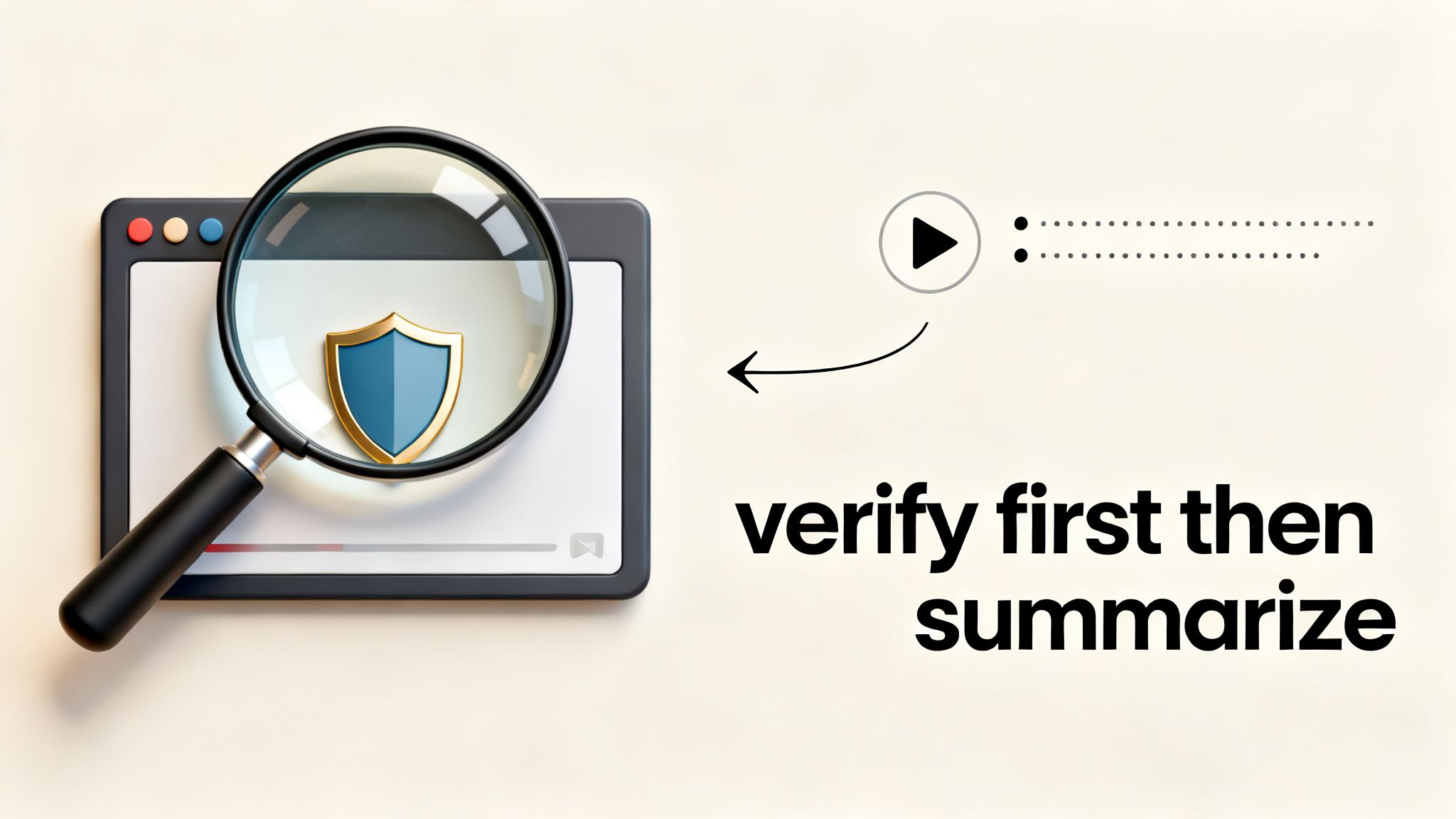
So, with all the risks of manipulated media floating around, how can you actually use an ai video summarizer safely? The solution is surprisingly straightforward: adopt a simple, powerful two-step workflow. Verify First, Then Summarize.
This approach flips the script by treating every video as potentially unreliable until proven otherwise. It’s less about distrusting technology and more about building a foundation of trust in your source material before you sink time and resources into analyzing it. Just like a journalist fact-checks a source before running a story, you need to validate your video. After all, a summary is only as good as the video it’s based on.
Step 1: Verify Authenticity with a Dedicated Detector
Before you even think about hitting the "summarize" button, your first move must always be verification. Run the source video through a dedicated AI video detection tool to scan for any red flags or signs of manipulation. For any high-stakes use—from legal evidence to corporate security—this step is absolutely non-negotiable.
A good detection tool does more than just a quick scan. It performs a deep, forensic analysis, digging into multiple layers of the video's data to generate a complete authenticity score.
This deep dive typically includes:
- Frame Consistency Checks: Looking for tiny artifacts or inconsistencies between frames that are invisible to our eyes but are dead giveaways of digital editing.
- Audio Anomaly Detection: Scanning the audio for weird frequencies, spectral oddities, or other artifacts left behind by voice cloning or sloppy audio splicing.
- Metadata Inspection: Combing through the file’s hidden data for strange encoding signatures or mismatched timestamps that suggest someone has been tampering with it.
By putting the video through this wringer first, you establish a baseline of trust. If it gets flagged as manipulated or synthetic, you know to stop right there.
Step 2: Summarize with Confidence
Only after a video has been confirmed as authentic should you pass it to an ai video summarizer. Once you get the all-clear from the detector, you can move forward and extract insights, confident that the information you’re getting is based on reality.
This simple two-step process completely changes how you work with video. You’re no longer just blindly trusting the content. Instead, you're making a calculated decision to analyze a video that has already passed a crucial security check. This transforms the summarizer from a tool with potential risks into a genuinely powerful and reliable asset.
Adopting a 'Verify First' mindset is the single most important practice for responsibly using AI video analysis tools. It ensures your insights are derived from truth, not from sophisticated fiction.
This workflow is especially critical in a professional setting. For a legal team, summarizing unverified video evidence could be catastrophic in court. For a newsroom, it’s the difference between breaking a story and accidentally amplifying disinformation. Making verification your default first step protects your decisions, your reputation, and your entire organization from the very real threat of manipulated media.
For a helpful starting point on handling video files, check out our guide on how to get an MP4 file from any URL.
Frequently Asked Questions
Jumping into the world of AI video analysis can feel overwhelming. As these tools become a staple in more industries, it's natural to have questions about what they can actually do, where they fall short, and where they're headed. Let's tackle some of the most common ones.
How Do I Choose the Right AI Video Summarizer?
Finding the right tool is a balancing act. You'll want an ai video summarizer that's fast enough for your workflow but doesn't sacrifice accuracy for speed. Nobody wants a summary that's quick but wrong.
Once you've got a handle on performance, here are a few other critical things to check off your list:
- Supported Formats: Make sure it can actually handle your files. Does it work with the common ones like MP4 and MOV, or do you use something more specific like WebM?
- Integration Capabilities: A great tool is useless if it doesn't fit into your current setup. Look for a solid API or other integrations that let you plug it directly into the software you already use.
- Data Privacy: This one is non-negotiable. Scrutinize the provider's privacy policy. You need to know exactly how your video data is being handled, where it’s stored, and who has access. Security has to be front and center.
Ultimately, the best tool is one that solves your technical problems without creating data security headaches.
Can AI Summarizers Handle Niche or Technical Topics?
This is a great question, and the honest answer is: it depends entirely on what the AI was trained on. A general-purpose model that learned from YouTube videos is going to get lost pretty quickly trying to decipher a conversation about quantum computing or a medical lecture on surgical procedures. It will likely stumble over jargon and miss the crucial context.
But the good news is the technology is getting much smarter. Some of the more advanced platforms are now being trained on highly specific datasets for industries like finance or law, making them far more capable of understanding technical language. Some even let you upload a custom glossary to give the AI a little cheat sheet. So while context is still a tough nut to crack, these tools are getting better at handling specialized content every day. If your needs are highly specific, it's worth looking for a solution built for your field.
The future of AI video analysis isn’t just about making things faster—it’s about a deeper, more nuanced understanding. We're moving toward systems that can interpret sentiment, emotion, and subtle context with almost human-like accuracy, which will make summaries incredibly rich and insightful.
What Is the Future of AI Video Summarization?
The next few years are going to be really exciting. One of the biggest game-changers will be real-time summarization for live events. Just think about it: instant, automated highlights and key takeaways from breaking news, live sports, or a company all-hands meeting, delivered as it's all happening.
We're also going to see much more sophisticated analysis, like tools that can track the emotional arc of a conversation. But most importantly, we’ll see a much tighter integration between summarization and authenticity detection. This creates a secure, end-to-end workflow where a video is automatically verified as genuine before a summary is even generated. It makes the whole process faster, safer, and fundamentally more trustworthy. This blend of speed, depth, and security is what will define the next generation of video intelligence.