

Que Es Sustantivos Comunes in Spanish Grammar Explained

A sustantivo común is a noun that names any member of a general class rather than one unique individual, like ciudad (city) instead of Madrid. But if estudiante (student) is also described as “common in gender,” does common still mean the same thing?
That's the confusion behind many searches for “que es sustantivos comunes.” Spanish grammar uses similar terminology for different questions: what a noun names, and how its gender works. Keeping those questions separate makes the terminology easier to understand and agreement easier to get right.
What a Common Noun Actually Is
A common noun gives you a category, not an individual's name. When you say persona (person), animal (animal), or río (river), you tell your listener what kind of thing you mean without supplying its identity.
Think of a common noun as a label on a classroom drawer. A label reading “books” tells you what belongs inside, but it doesn't identify a particular book. Similarly, libro (book) names a category that can include many different members.
La Real Academia Española trata sustantivo común y nombre común como términos equivalentes en su grammatical definition of common nouns. Si su libro de texto usa nombre común mientras que su profesor dice sustantivo común, están discutiendo la misma clasificación.
Categories you can recognize
Common nouns aren't limited to things you can pick up or point at.
- People and animals: persona means person, and perro means dog.
- Objects and places: libro means book, and ciudad means city.
- Abstract ideas: justicia means justice, and democracia means democracy.
- Information and time: información means information, and tiempo means time.
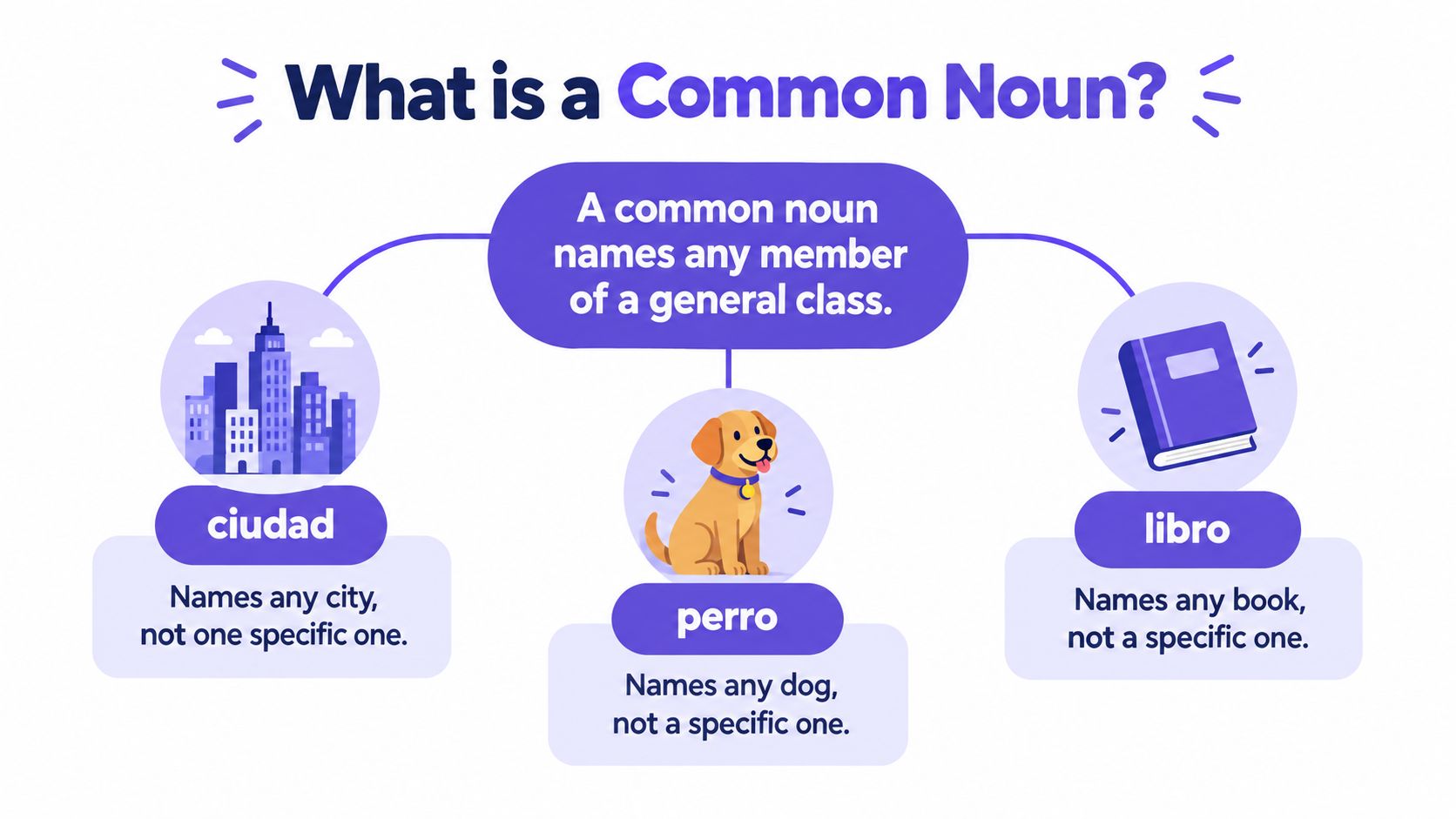
Notice what these words have in common: each supplies a useful description without requiring a unique name. You can discuss a city you've never visited, an animal you can't identify, or an idea you can't physically touch.
Recognition shortcut: Ask whether the word names a kind of person, place, thing, or idea, rather than serving as an individual name.
For classroom practice, you can find Spanish revision questions through MasteryMind and use noun identification as a focused revision task. Start by finding category words in a sentence before worrying about their endings.
That habit helps you recognize common nouns across descriptions, conversations, and explanations, not just vocabulary lists.
Common Nouns Versus Proper Nouns
Is Madrid a different kind of noun from ciudad (city)? Yes. Ciudad names a category, while Madrid gives one member of that category its individual name. The same distinction applies to persona (person) and María, or río (river) and Amazonas.
| Common noun | English meaning | Proper noun |
|---|---|---|
| ciudad | city | Madrid |
| persona | person | María |
| río | river | Amazonas |
The distinction concerns how the noun names something, not how much detail the sentence provides. A common noun stays common even when the speaker means one particular person, place, or thing.
Take perro (dog). In el perro del vecino (the neighbor's dog), the article and the phrase del vecino identify a particular dog. They do not turn perro into a proper noun. The introduction to the main classes of nouns explains the distinction between common and proper nouns.
The noun names the category; the rest of the phrase can point to a specific member.

Read these examples aloud:
- La ciudad es grande. means “The city is large.” The noun ciudad names a category.
- Madrid es una ciudad. means “Madrid is a city.” Madrid is the name; ciudad identifies its category.
- La ciudad que visitamos means “the city we visited.” The phrase identifies a particular city, but ciudad remains common.
Capitalization can help you spot a proper noun, but it is only a clue. At the start of a sentence, ciudad takes a capital letter too, without becoming a proper noun.
To practise sorting the two types, try this common and proper nouns worksheet. In María visita una ciudad (María visits a city), María supplies the individual name, while ciudad names a category.
Gender Rules You Need to Know
Common versus proper describes reference. Masculine, feminine, and common in gender describe grammatical behavior. These are separate axes, so don't treat them as competing labels.
A noun can be common because it names a category and also common in gender because its form stays unchanged. Estudiante illustrates both classifications.
When the noun changes and when it doesn't
With niño (boy) and niña (girl), the noun itself changes. That visible -o/-a contrast is helpful, but it isn't a reliable shortcut for every noun.
With estudiante (student), the noun stays the same:
- Masculine agreement: el estudiante aplicado, the diligent male student.
- Feminine agreement: la estudiante aplicada, the diligent female student.
The RAE identifies estudiante, testigo (witness), and cónyuge (spouse) as examples of nouns that are common in gender. Articles, demonstratives, and adjectives express the relevant agreement information.
Gender Behavior in Common Nouns
| Noun Type | Example | Masculine Form | Feminine Form |
|---|---|---|---|
| Changing noun form | Child | el niño | la niña |
| Common in gender | Student | el estudiante | la estudiante |
| Common in gender | Witness | este testigo | esta testigo |
| Common in gender | Spouse | el cónyuge | la cónyuge |
Think of the unchanged noun as a box and the determiner as a label attached to it. The box stays the same, while the label gives you information that the noun's spelling doesn't reveal.
Don't guess a person's gender from the noun's ending alone. Read the whole noun phrase.
For example, the final -o in testigo doesn't prevent esta testigo from being feminine. Likewise, estudiante doesn't need a different noun ending when paired with la.
The practical habit is to learn a noun together with a complete phrase. Instead of memorizing only estudiante, practice el estudiante aplicado and la estudiante aplicada. You'll notice which parts remain unchanged and which parts need agreement.
Singular and Plural Made Simple
What changes when libro becomes libros? The noun shifts from one book to more than one, and the rest of the phrase often changes with it. This is number, a feature that applies whether a noun is common or proper. It is separate from gender: number tells you singular or plural, while gender affects agreement.
Start with libro/libros (book/books). Nouns ending in an unstressed vowel commonly add -s. Many nouns ending in a consonant add -es. These patterns give you a useful starting point, though some forms need a closer look.
| Singular | Plural | English meaning |
|---|---|---|
| libro | libros | book/books |
| ciudad | ciudades | city/cities |
| vez | veces | time/times, as in an occasion |
| crisis | crisis | crisis/crises |
Notice how vez changes: its final z becomes c before -es. Crisis keeps the same spelling in both numbers, like a label that doesn't change shape. The article makes the distinction clear: la crisis means “the crisis,” while las crisis means “the crises.”
Some plurals also shift the accent mark. Régimen becomes regímenes (regime/regimes), so check the plural spelling rather than attaching an ending and keeping the singular accent.
Agreement extends through the phrase. El libro interesante becomes los libros interesantes. The article changes from el to los, and the adjective interesante adds -s. Read the whole phrase aloud: los libros interesantes means “the interesting books.”
Try the change in a sentence: El libro interesante está aquí (The interesting book is here) becomes Los libros interesantes están aquí (The interesting books are here). The verb changes too, from está to están. Check every word that refers to the plural subject, not only the noun.
Why Common Nouns Dominate Real Texts
In La biblioteca conserva manuscritos (“The library preserves manuscripts”), biblioteca and manuscritos name categories. Proper nouns, by contrast, identify particular people or places. Keeping that distinction clear helps explain why common nouns appear so often in Spanish: everyday writing refers to people, objects, institutions, events, and ideas.
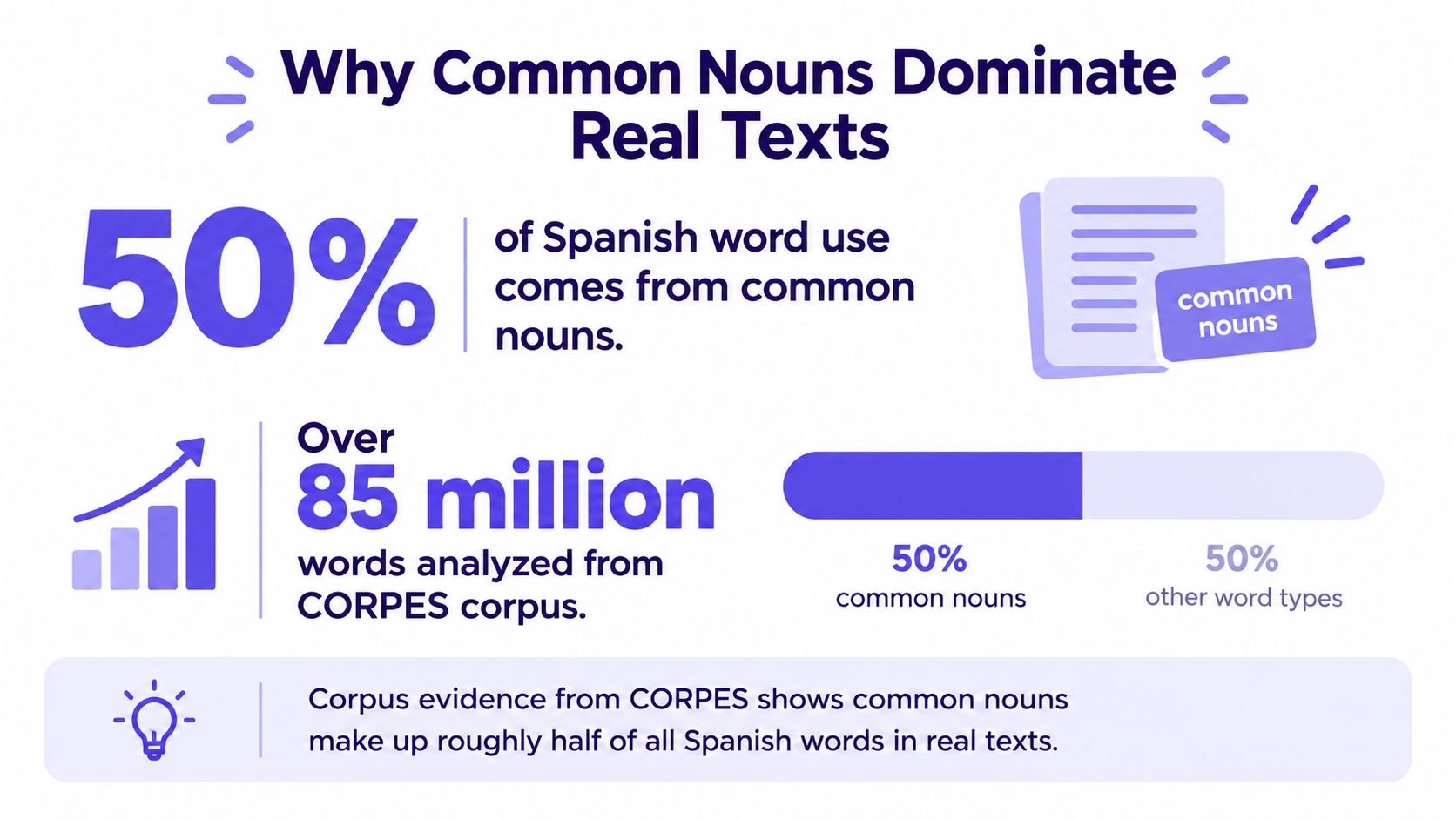
A CORPES analysis covering approximately 380 million word forms reports 85,569,202 common-noun occurrences, a normalized frequency of 223,846.23 per million elements, and approximately 46.11% of the analyzed grammatical-class distribution, according to Guillermo Rojo's statistical analysis of word classes.
What the figures describe
The corpus size tells you how much material was studied. The occurrence count records common nouns in that material, while the normalized rate makes comparisons on a shared basis. The percentage refers specifically to the analyzed grammatical-class distribution. It does not mean that exactly half of every Spanish sentence consists of common nouns.
The graphic rounds the finding for a visual summary. Read its figure as a broad illustration of the analyzed distribution, alongside the reported occurrence count, rather than as a measure of every sentence.
This frequency has practical uses. In writing, recognizing a noun helps you check related words. In translation, knowing whether a word names a general category or a specific entity helps clarify what it refers to. Search and annotation systems also use that distinction when sorting concepts from named entities.
Try reading a short passage and spotting the common nouns. In La médica explica el tratamiento (“The doctor explains the treatment”), médica and tratamiento name categories, while the sentence shows how nouns carry much of the passage's meaning. Practising with full texts helps you recognize that work in context.
Common Mistakes With Common Nouns
Knowing the label sustantivo común doesn't automatically prevent errors. You still need to distinguish classification, agreement, and spelling when reviewing a sentence.
The RAE's explanation of gender classes and their characteristics distinguishes common-in-gender nouns from other gender patterns. A noun's ability to refer to either sex doesn't, by itself, make it common in gender.
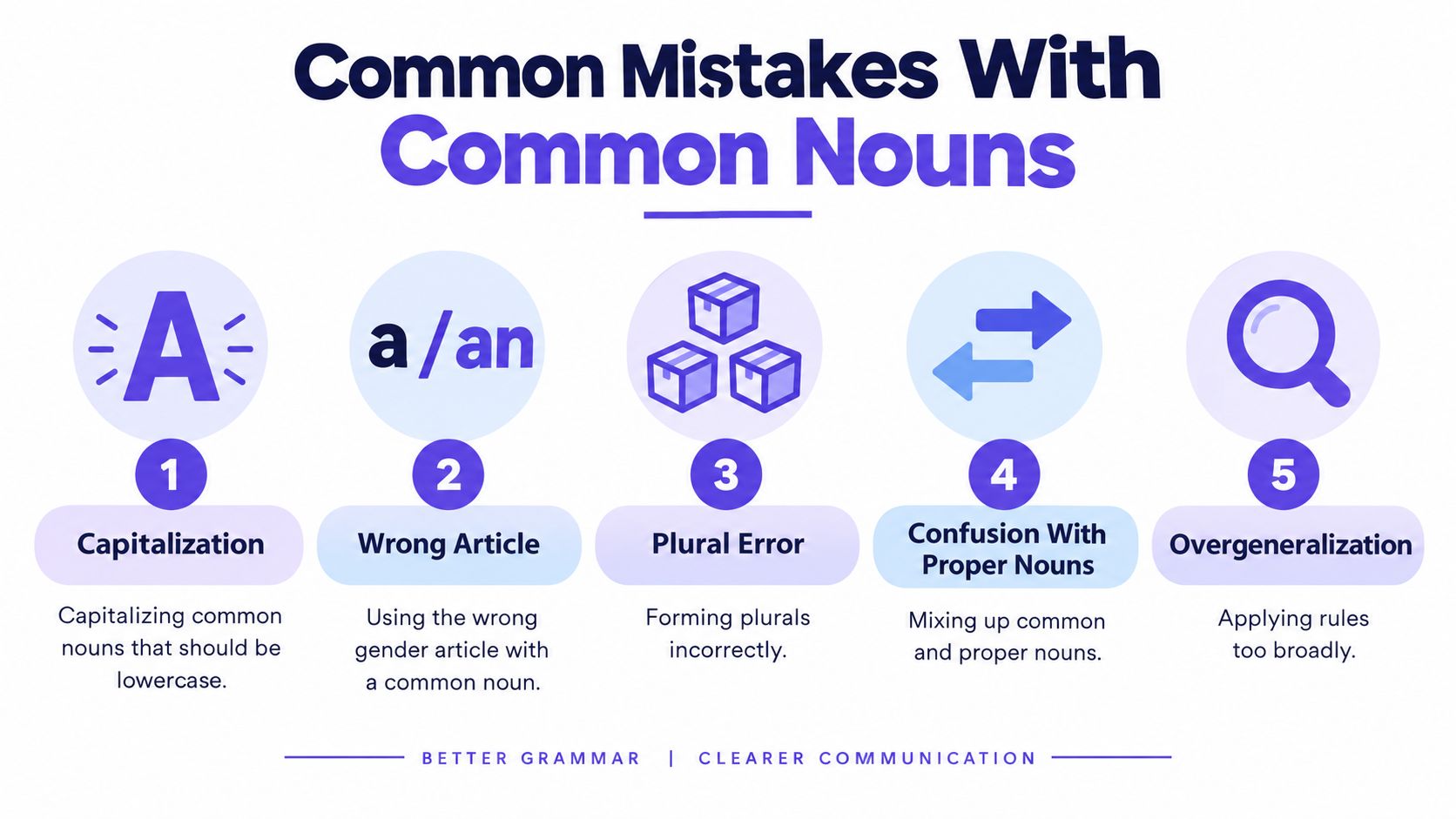
Corrections that reveal the problem
| Problem | Incorrect example | Correct example | What to check |
|---|---|---|---|
| Unnecessary capitalization | Visito una Ciudad. | Visito una ciudad. | Category word inside a sentence |
| Adjective mismatch | la artista famoso | la artista famosa | Feminine agreement |
| Missing article in this sentence | Libro está aquí. | El libro está aquí. | Intended reference to the book |
| Incorrect noun substitution | la estudianta aplicada | la estudiante aplicada | Unchanged noun form |
| Incorrect plural accent | régimenes | regímenes | Plural spelling |
Don't turn the article example into a rule that every common noun always needs an article. The correction addresses a particular sentence meaning “The book is here”; context matters.
Avoid the gender shortcut
An epicene noun isn't interchangeable with a common-in-gender noun. Don't automatically switch its article merely because you're describing a male or female referent. Check the noun's grammatical pattern rather than applying the estudiante model everywhere.
Likewise, changing an adjective's ending won't fix a misclassified proper noun, and capitalization won't fix an agreement error. Diagnose the kind of problem before choosing the correction.
For a separate spelling comparison, the publisher's analisar or analizar spelling guide is a reminder to check language-specific forms rather than rely on visual similarity. Keep that spelling task distinct from deciding whether a Spanish noun is common or proper.
Practice Exercises to Lock It In
Try these exercises without looking back immediately. Say each phrase aloud, then explain your choice in plain English.
Identify the noun type
Classify ciudad (city), Madrid, perro (dog), María, río (river), and Amazonas as common or proper nouns.
- Explain your decision: Which words supply categories, and which supply individual names?
- Test reference: Does adding el to a category word automatically turn it into a proper noun?
Repair agreement
Rewrite La estudiante aplicado está aquí so it means “The diligent female student is here.” Then change El libro interesante está aquí to refer to books rather than a book.
Don't change every word automatically. Identify which forms need adjustment and which can stay.
Choose the determiner
Complete ___ testigo aplicada for a female witness and ___ estudiante aplicado for a male student. Use the adjective as a clue, then check the unchanged noun.
For another way to organize practice around meaningful situations, Zemith's discussion of why real-world learning sticks offers a relevant learning resource. Try writing a classroom description using the phrases you've practiced.
Confidence comes from making choices you can explain, not just recognizing terminology.
Put the lesson into practice today: write a short Spanish paragraph, underline its common nouns, and check their agreement. If you're also selecting video material for teaching, use AI Video Detector to assess a clip's authenticity before sharing it with learners.