

Analisar Ou Analizar: Language Guide

Analisar with an s is the correct Portuguese spelling, while analizar with a z is the correct Spanish spelling. Mixing them up is a common phonetic trap, because the Portuguese word sounds like it has a z even though it's written with s.
Have you ever heard the sound first and trusted it more than the spelling? That's exactly where writers, translators, and product teams get caught, especially when they move between Portuguese and Spanish interfaces.
The Core Spelling Difference
Which spelling belongs to which language? The rule is straightforward once you separate sound from spelling. In Portuguese, analisar is the standard verb for examining something systematically, while in Spanish, analizar is the standard form for the same idea Portuguese reference, Spanish reference.
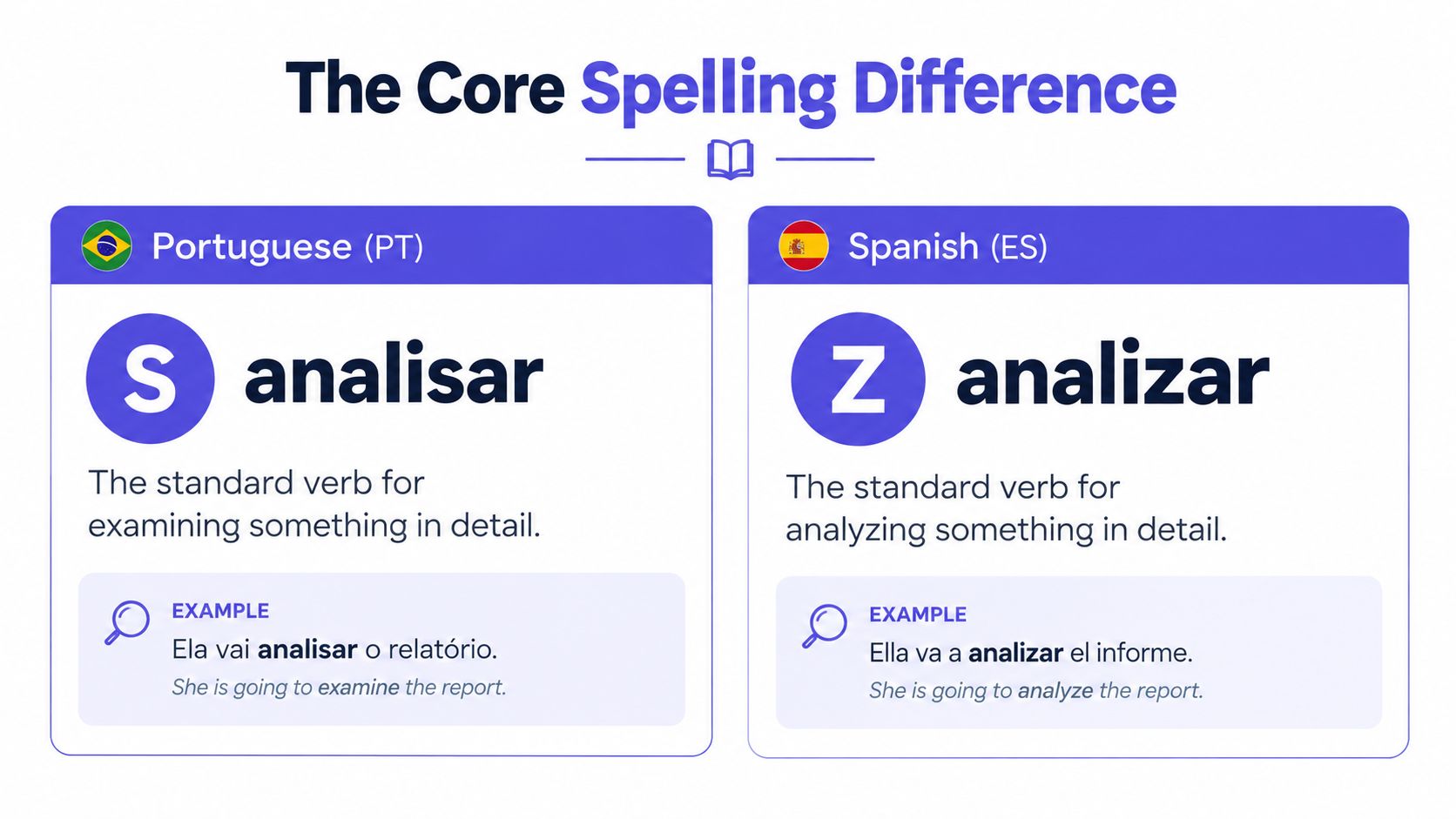
What to write in each language
Use Analisar vídeo in a Portuguese interface. Use Analizar video in a Spanish interface. That single letter carries language identity, and it helps keep product copy aligned with the rest of the locale.
Practical rule: do not choose the form by ear. In Portuguese copy, the correct word is analisar. In Spanish copy, the correct word is analizar.
The mistake is easy to make because the pronunciation can mislead the eye. A Portuguese s often sounds close to a z, so writers may hear one thing and type another. For localization teams, that kind of mismatch affects more than spelling. It can make a button, help message, or search filter feel like it came from the wrong language set.
Why product teams care
UI text reveals this error quickly. Buttons, onboarding steps, help copy, and filters all signal locale, and one wrong verb can make the interface look inconsistent. If a Portuguese CTA says Analizar vídeo, it reads as a Spanish word in Portuguese context. If a Spanish CTA says Analisar video, the reverse problem appears.
The safest workflow is simple. Check the locale first, then choose the verb form that matches that language.
Historical Roots of Orthographic Standards
Why does one letter keep causing trouble across Portuguese and Spanish? The answer starts with standardization. Portuguese went through major orthographic reform in 1911, and later the Portuguese-speaking world pursued the Portuguese Language Orthographic Agreement signed in Lisbon on 16 December 1990 to reduce differences between national written standards orthographic agreement overview.
That agreement was designed for Portuguese-speaking countries and was scheduled to enter into force on 1 January 1994 after ratification procedures, although adoption was uneven across the community. Some countries implemented it, while others did not complete adoption.
Why standardization matters for one verb
The goal of these reforms was not to change speech. They established written conventions, not new pronunciation or syntax rules. In practical terms, the stable conclusion for analisar remains the same, contemporary Portuguese writes it with s, not z orthographic agreement overview.
Spanish followed its own standardization path through the Royal Spanish Academy, which preserves analizar with z as the regular form. A simple letter swap does not work across languages. The verbs look almost identical, but they belong to different orthographic systems.
Editorial takeaway: spelling rules in related languages often reflect separate histories, not interchangeable options.
For global teams, the practical lesson is straightforward. A shared root does not guarantee a shared spelling. When workflows support Portuguese markets and Spanish-speaking markets, store the language code first and the copy second. That prevents editors from “correcting” a valid Portuguese s into an incorrect Spanish z, or the reverse.
The Phonetic Trap and Pronunciation Rules
Why does analisar sound like it should use z? The trap comes from Portuguese phonetics: between vowels, s often takes a /z/ sound, so the ear hears one thing while the spelling keeps s. The same pattern appears in words like arrasar and atrasar Priberam entry.
Why sound doesn't equal spelling
That gap between sound and writing is where editors get tripped up. A transcript, voice note, or speech-to-text draft may look plausible, yet still carry the wrong letter if someone edits by ear alone.
The safest rule is straightforward, trust the standard spelling first. Hearing a z-like sound does not mean the word should be rewritten with z. In Portuguese, the verb remains analisar, and its related forms keep the same s pattern, including analiso, analisando, and analisados.
This matters in audio-driven workflows, too. When teams review captions, transcripts, or interface text pulled from speech, the written form still needs orthographic checking. For a practical example of how language-heavy outputs can need review before publication, see AI Video Detector's analysis of AI-generated content.
A quick rule for learners
If you hear the /z/ sound in Portuguese, check whether the word belongs to the -isar group. That habit helps separate pronunciation from spelling, which is where many multilingual copy errors begin.
Conjugation Patterns and Noun Forms
The infinitive is only part of the picture. In Spanish, the regular gerund is analizando, and the related noun is análisis. In Portuguese, the corresponding forms are analisando and análise.
| Form | Portuguese | Spanish |
|---|---|---|
| Infinitive | analisar | analizar |
| Gerund | analisando | analizando |
| Noun | análise | análisis |
Why these forms matter in real writing
These differences affect more than grammar drills. They shape search queries, button labels, product instructions, and knowledge-base articles. A Portuguese help article should say analisar dados or análise de resultados, while a Spanish one should use analizar datos or análisis de resultados.
The noun distinction is especially easy to miss because many teams translate the verb correctly and leave the noun behind. The result looks almost right, but it still sounds foreign to native readers. In user-facing product text, that near-match can reduce trust.
Rule of thumb: translate the verb and the noun together. Don't mix análise with analisar, or análisis with analisar.
For SEO teams, the same split affects keyword mapping. If you are building content for Portuguese readers, the noun análise belongs in page architecture, headings, and metadata. Spanish content needs análisis instead. Treat them as separate targets, not alternate spellings of the same keyword.
A practical comparison helps when writers move between markets:
- Portuguese search intent: language around analisar and análise for review, examination, and evaluation
- Spanish search intent: analizar and análisis in documentation, product education, and support content
That separation keeps the language natural and the indexing consistent.
Impact on Global Localization and SEO
A single wrong letter can create outsized problems in product copy. Search tools, spellcheckers, and automated language systems often treat analisar in Portuguese as nonstandard, which can weaken clarity and make content harder to maintain across teams. For Portuguese, consistency matters even more because the language is officially used across eight countries and has approximately 267 million native speakers Portuguese language overview.
That reach makes orthographic discipline a business issue, not just a grammar issue. Educational publishers need stable terminology, software teams need predictable locale strings, and marketing teams need pages that read naturally in each market. A copied verb in a dashboard, help center, or landing page can spill into UI text, internal search, and translation memory.
What breaks when teams mix forms
The usual failure is drift. A writer uses the right form in a heading, a translator repeats the wrong form in body copy, and a developer copies that text into a button label. QA teams then have to catch the inconsistency wherever it appears.
Use language-specific workflows instead of character-level edits. The same logic applies if you need to translate and distribute your book, because Spanish and Portuguese need separate editorial treatment even when the root words look familiar.
Operational insight: treat language selection as a content decision, not a find-and-replace task.
The same rule applies to AI-generated drafts and automated edits. If a system suggests the wrong form, human review still needs to check locale, audience, and product context. A useful companion read is AI Video Detector's guidance on what counts as AI-generated content, since multilingual teams increasingly rely on automated drafts before final editorial approval.
The SEO side is straightforward. Use the correct spelling for the target language, keep it consistent across titles and snippets, and do not let cross-language similarity blur your keyword strategy. For Portuguese, that means analisar. For Spanish, that means analizar.
Quick Reference Checklist for Editors
Which spelling should you choose first, the one that sounds right, or the one that belongs to the language? Start with the locale. If the page is Portuguese, use analisar and análise. If it is Spanish, use analizar and análisis.
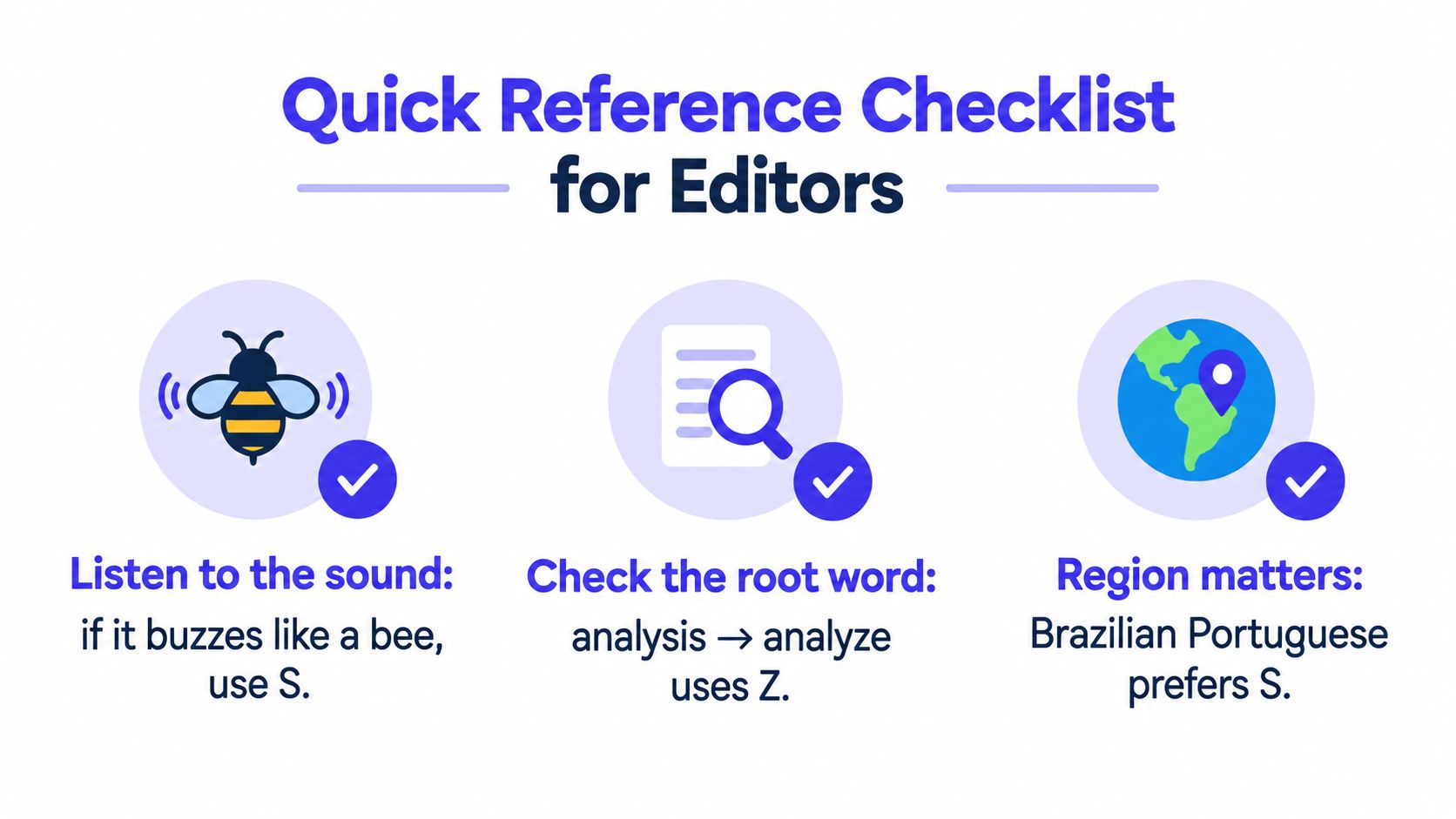
Fast checks for writers and developers
Confirm the locale first. The verb and the noun must belong to the same language system. A Portuguese page should not mix analisar with Spanish forms, and a Spanish page should not mix analizar with Portuguese forms.
Do not rely on sound alone. Portuguese can make s sound like /z/ in this word, so the ear can mislead the eye.
Check the nearby terms. A clean edit keeps the verb, noun, and surrounding UI text in one language. That matters in headings, buttons, tooltips, and error messages, where one stray form can make the copy feel translated instead of localized.
Review the full workflow, not one line. Content teams, translators, and QA should compare the verb against the glossary, metadata, and page context. For editorial style consistency, see this guide on passive voice misuse.
Keep the editorial rule simple. Use the approved form everywhere, then lock it into your content process. That is where strategic content writing guidance helps, because it reinforces consistency, audience fit, and review.
If your team manages a multilingual product, audit the Portuguese and Spanish instances together, update the glossary, and check UI strings, metadata, and support content in the same pass. A clean separation between analisar and analizar reduces rework and keeps the page credible across markets.