

Proof of Authenticity in Digital Media: How It Is Verified

How do you know a convincing video is real if neither your eyes nor a detector can establish where it came from? A museum faces a similar problem with a painting: convincing brushwork isn't enough without a record connecting the canvas to its creator and history.
Proof of authenticity is evidence that a file is what its source claims, established through its origin, history, and integrity. For digital media, the useful question isn't whether something looks real. It's which claims you can support, how you checked them, and what remains unknown.
What Proof of Authenticity Means for Digital Media
A painting's provenance records who made it, who owned it, and where it has been. Curators examine that history alongside the physical object because a plausible appearance can't replace a documented connection to its origin.
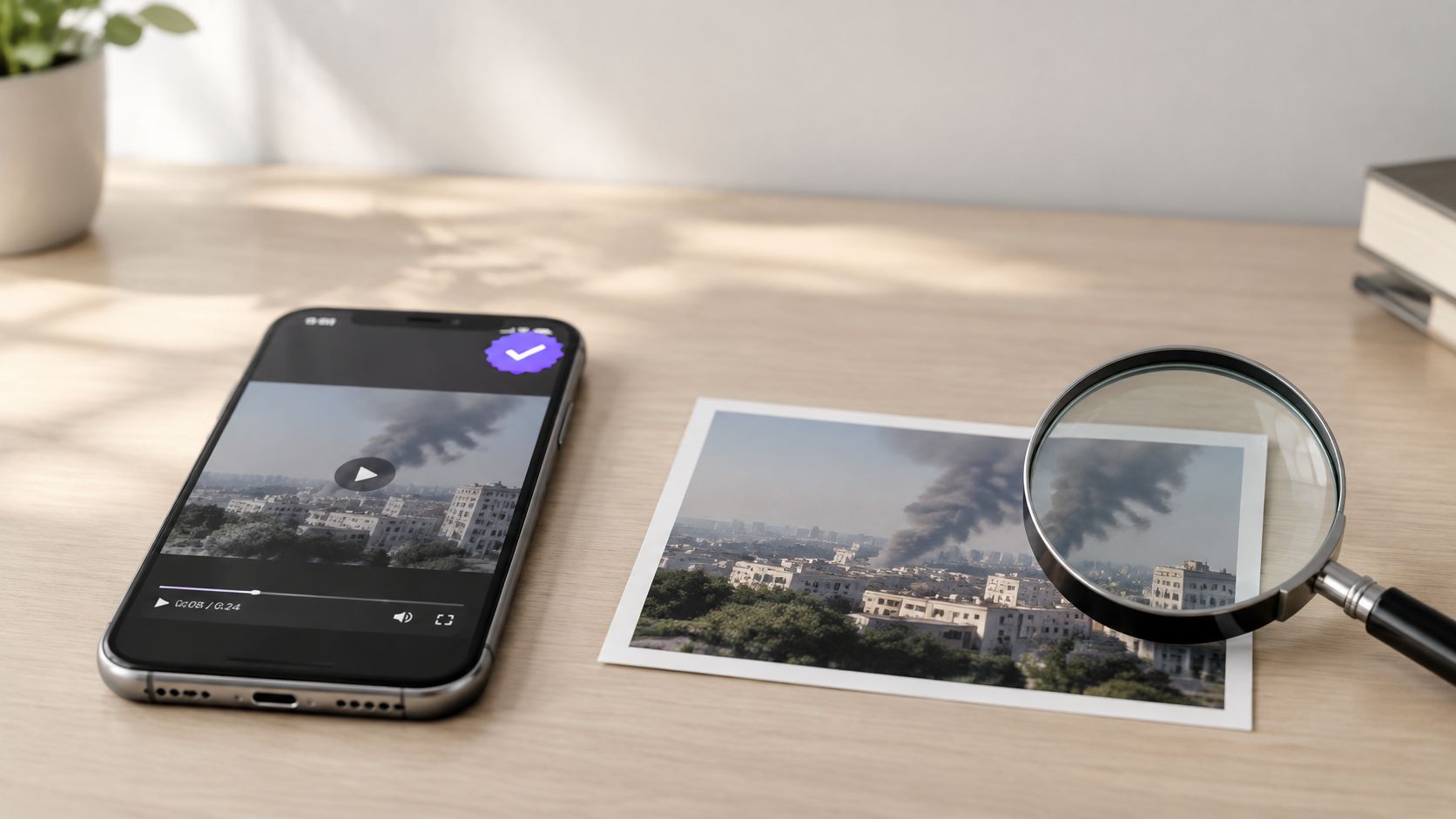
Apply that reasoning to a phone video showing smoke rising from a city building. The scene looks convincing, but the file arrived through an anonymous repost. Before treating it as evidence of today's fire, you need to establish who recorded it, where it was captured, and whether the version you received preserves the relevant content.
Origin, Integrity, and History
These questions separate authenticity into practical parts:
- Origin: Who created the recording, when, and on which device?
- Integrity: What evidence shows whether the file changed after capture or acquisition?
- History: How did it move through exports, transfers, platforms, and reposts?
The UNESCO Memory of the World guidelines assess whether a document is what it appears to be and whether its identity and provenance can be reliably established. They also recognize that a copy can remain authentic when its relationship to earlier versions is documented.
That's important because authentic doesn't always mean original. A documented copy can faithfully preserve a recording, while a genuine camera original can still carry a misleading caption.
Why Appearance Isn't Enough
Digital copies are easy to create, originals can disappear, and manipulation may leave no visible trace. Likewise, account verification shouldn't substitute for file verification; Gamerplug's explanation of what a verified badge hides offers a useful prompt to ask what a trust signal checks.
The stakes include financial harm: documented deepfake fraud losses exceeded $1.28 billion in 2025, according to Resemble AI's annual Deepfake Threat Report. A 2025 preregistered study of 1,276 participants, reported by Communications of the ACM, found mean detection performance of 38.8% for media containing synthetic content, compared with 64.6% for fully authentic media.
For decisions involving misinformation, impersonation, fake listings, or identity fraud, use a stricter working definition: authenticity is a documented relationship between a file and a specific claim about it.
The Four Verdicts a Real Check Can Give
Authenticity verdicts and what each one proves
| Verdict | What It Means | What It Does Not Prove |
|---|---|---|
| Verified original | Capture hash matches and chain of custody is intact | That the events shown were accurate |
| Valid provenance from a trusted signer | Content credentials verify and the signer is known | That the signer's statements are true |
| No detected manipulation | Detection and review found no signs of AI generation or editing | That the file is unedited at its origin |
| No verifiable provenance | No credentials, source or history can be traced | That the file is fake |
These verdicts describe progressively narrower evidence, not interchangeable versions of a real-or-fake label. They can also overlap: a file may carry valid credentials and receive a clean technical assessment without qualifying as a verified original.
Verified original is appropriate only when the capture reference itself is trustworthy. Matching a hash calculated after an investigator received a file establishes continuity from receipt, not automatically continuity from capture.
Valid provenance from a trusted signer identifies a verifiable record and its accountable signer. No detected manipulation describes an examination result, while no verifiable provenance describes an evidentiary gap rather than a finding of fabrication.
Authentication Is a Foundation, Not Absolute Certainty
Under Federal Rule of Evidence 901, authentication requires evidence sufficient to support a finding that an item is what its proponent claims it is. The rule's examples include testimony from someone with knowledge, distinctive characteristics, and evidence that a process or system produces accurate results.
For a recording, that foundation might combine the camera operator's testimony, documented extraction, and reproducible file comparisons. It isn't a requirement to eliminate every imaginable doubt, nor does authentication resolve every question about admissibility or the truth of the scene.
Choose Wording That Matches the Claim
Say a camera records someone handing over an envelope. Establishing the recording's integrity doesn't establish what the envelope contained, why it changed hands, or whether the participants were acting.
Practical rule: Name the verified property, not a broader conclusion the evidence can't support.
Useful reporting language includes:
- Credential result: Valid provenance from a trusted signer.
- Technical result: No manipulation detected in the tested copy.
- Custody result: File unchanged since documented acquisition; capture history unconfirmed.
Precise wording lets an editor, investigator, or reader distinguish a supported conclusion from an inference.
Four Evidence Types That Build the Case
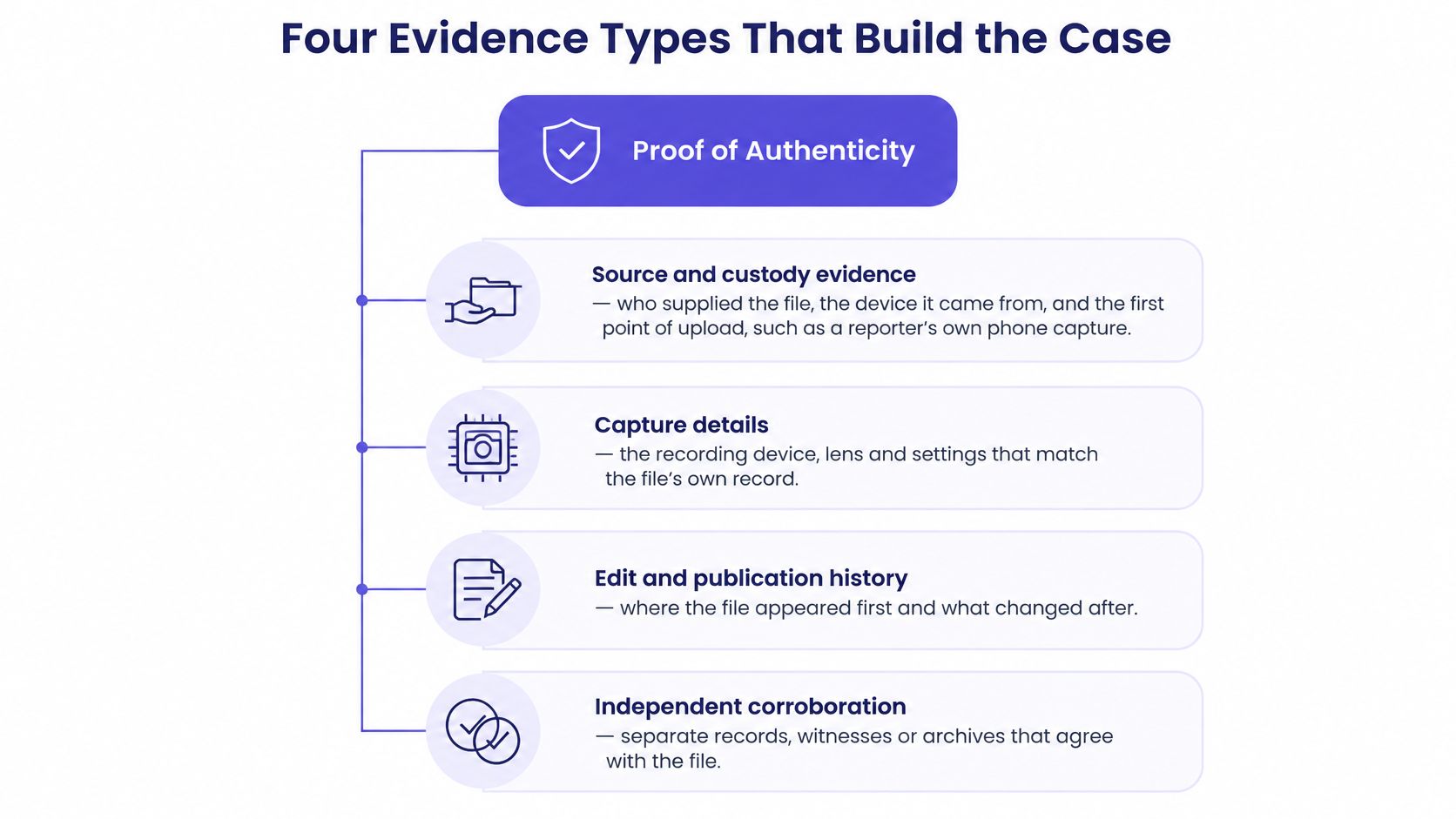
An authenticity assessment combines evidence about the file with evidence outside it. For the smoking-building example, a reliable investigation connects the recording device, the file's editing history, the location, and any technical anomalies instead of relying on a single persuasive detail.
Source and Custody Evidence
Source and custody evidence identifies who supplied the recording, the device it came from, and its route to the analyst. A reporter handing over a file directly from their phone provides a more accountable starting point than an anonymous account forwarding a download.
Ask the sender to describe the capture and transfer process, then compare that account with the file's characteristics. A practical explanation of video metadata helps distinguish capture-related fields from export and container information. The limit is that editable metadata and an unsupported personal account don't independently establish origin.
Cryptographic Provenance
Cryptographic provenance makes recorded history tamper-evident. The C2PA specification represents creation and editing information in a signed manifest whose assertions can include origin, modifications, tools, and AI use, bound cryptographically to the media.
Verification involves several distinct checks:
- Signature validity: Confirm the manifest hasn't been changed after signing.
- Content binding: Establish that the manifest belongs to the inspected asset.
- Signer trust: Determine whether the signing identity is recognized and appropriate.
- Recorded history: Examine edits and relationships to earlier assets for unexplained gaps.
For example, a newsroom signature might establish that an organization issued a particular version. It doesn't establish that every caption or assertion the organization attached is correct.
The limit is the signer: a dishonest or compromised signer can attest to false information. Missing credentials also don't make a file fake.
Independent Corroboration
Corroboration tests the claimed event using separate evidence. A bystander's recording from another street, a witness account, and location features matching the building can support different parts of the claim.
Check whether those sources are independent. Several accounts sharing the same upload still lead back to one recording, and matching architecture establishes location more readily than capture time. The limit is that corroboration supports particular details, not necessarily the whole narrative.
Technical Analysis
Technical analysis examines frame artifacts, motion across frames, audio-video synchronization, and spectral patterns in sound. An analyst might investigate whether a mouth moves inconsistently with speech or whether a suspicious boundary persists across adjacent frames.
An automated system may return a confidence score; a human examiner should identify the tested material and the observations behind the assessment. Its limit is that ordinary processing can conceal or imitate suspicious patterns.
Together, these evidence types help distinguish a traceable recording from a plausible-looking file. None should be treated as universally decisive.
Why Detection Scores Fail on Real-World Footage
A clean-looking score can mislead when the detector hasn't been validated on footage like yours. A system tested on pristine files may encounter very different signals in a messaging-app download, a surveillance export, or a recording of a screen.
Compression, resizing, blur, and noise can suppress fine textures and boundary details that detectors inspect. They can also introduce ordinary encoding anomalies resembling manipulation, making the file harder to classify in either direction.
NIST's Guardians of Forensic Evidence program evaluates challenges including newer manipulation methods, Gaussian blur, and video compression, emphasizing representative content and degraded evidence. Understanding what deepfake detection examines helps explain why a score needs an operating context.
Real-world conditions that change detection results
| Condition | Effect on Detection | Check to Run |
|---|---|---|
| Heavy compression on social platforms | Suppresses texture artifacts and adds encoding noise that can look like manipulation | Test the original and the recompressed copy separately |
| Resolution reduction | Removes boundary detail that detectors rely on | Record the resolution in the report |
| Screen recording | Creates a new recording layer; filming a display can add camera-to-screen artifacts, while original metadata may be lost | Treat original provenance as unavailable unless separately recovered, and seek corroboration |
| Cropping or reposting | Removes context and sometimes the original frame edges | Locate the widest available version |
| Audio transcoding | Alters the spectral patterns used in audio checks | Test the audio from the original container |
| Frame-rate change | Disrupts temporal-consistency checks | Compare motion across frames in the original |
Follow the Transformations
Heavy compression and resolution reduction can remove precisely the detail an examiner wants around hair, eyes, and moving boundaries. A smooth-looking face may therefore reflect aggressive encoding rather than either genuine capture or synthetic generation.
Screen capture creates a new asset with its own recording characteristics. Cropping removes potentially useful context, including surrounding people, landmarks, and the edges of a composited region.
Audio conversion changes the signal used for voice analysis, while frame-rate conversion can introduce duplicated or interpolated frames. Neither condition should be interpreted without considering the export process.
Validate the Condition, Not Just the Model
A responsible testing program separates clean originals from recompressed uploads, screen recordings, low-resolution footage, crops, altered frame rates, and transcoded audio. Analysts should report whether the inspected file falls within the detector's tested conditions.
If it doesn't, mark that limitation and require human review rather than translating a score into certainty. Agreement between detectors isn't a substitute for knowing whether they share the same blind spots.
A result on a downloaded copy describes that inspected copy. It doesn't certify an unavailable original or establish that the claimed event occurred.
How to Run an Authenticity Check Step by Step
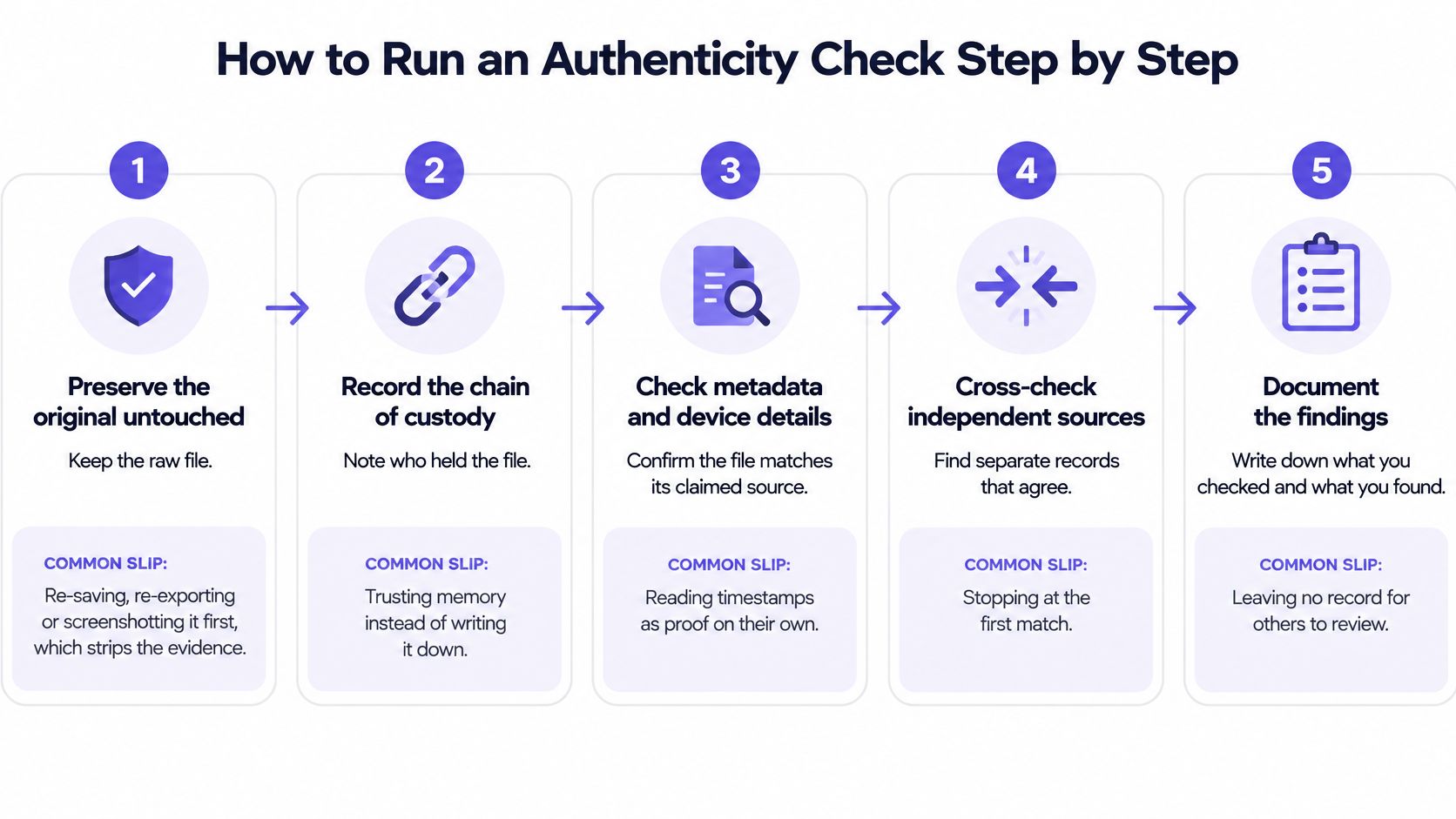
A strong check works like a chain of custody. Each step adds a small piece of context, and the final verdict should reflect the strength of the whole chain.
Use this visual workflow as a reminder of the main preservation and review tasks.
Secure the Material
Preserve the original untouched. Request the source file through a transfer method that preserves it, retain an untouched master, and inspect working copies. A platform download, screenshot, or re-export can help with review, but it should be labeled as a copy rather than treated as the camera original.
Calculate a SHA-256 hash before processing. Use a hashing utility such as Windows PowerShell's
Get-FileHashor macOS'sshasum, and record the result with the filename. The hash gives the preserved file a fingerprint for later comparison. It establishes the state of the file at intake, not the full capture history.Record acquisition context. Note who sent the file, when it arrived, how it was transferred, and what the sender claims it shows. An unknown reposter does not become an eyewitness because the clip spreads widely.
Validate available content credentials. Check the signature, the binding to the inspected file, and the signer's trust status. A credential-free file has one less route to verification, so examiners should look for other evidence before drawing any conclusion.
Examine and Corroborate
Inspect the edit history. Compare recorded tools and transformations with the claimed source and intended use. A valid signature does not erase the need to explain an unexplained export, a missing predecessor, or a new platform copy.
Run detection under documented conditions. AI Video Detector analyzes a clip frame by frame to estimate whether it was created or altered using AI, and gives a confidence score. The review looks for patterns linked to modern AI video generation models, including diffusion artifacts and unnatural textures, along with inconsistent facial micro-expressions, synthetic audio spectral patterns, and temporal flickering in AI-generated clips. Test the preserved source file where available, then assess a recompressed comparison copy separately when useful. Attach each score to its actual input rather than transferring the result between versions.
Seek independent confirmation. Find another recording, a direct witness, or a separate record supporting the location and timing. Reposts of the same clip do not count as independent evidence. The same habit of checking the process behind a claim applies when people check a breeder is real instead of trusting attractive listing media alone.
Write the supported verdict. Use the scoped categories in The Four Verdicts a Real Check Can Give. If results conflict or sit near a borderline score, send the material for qualified human review. A bare authentic label hides the limits of what the check established.
The accompanying video provides an additional viewing resource for the verification workflow.
Keep the acquisition notes open throughout the process. Write each decision when you make it, while the reason is still clear, instead of rebuilding the reasoning after someone challenges the result.
Keeping an Authenticity Assessment Auditable
Suppose a newsroom receives the smoking-building footage directly from the person who recorded it. The analyst preserves the phone file, logs its hash, tests both that file and a platform version, and finds separate recordings supporting the timing.
The conclusion still needs a record someone else can examine. The academic survey of deepfakes and forensic evidence emphasizes that generation, platform processing, and distribution can remove or alter forensic evidence, making provenance, context, and human review complementary rather than optional.
Build the Note Around Reproducible Actions
A hypothetical newsroom summary could read:
The source supplied the file from the recording phone. Its intake hash is recorded in the acquisition log. Detector outputs for the source file and platform copy are retained separately, with tool versions and input conditions. Independent bystander recordings support the reported timing. No manipulation was detected in the tested files; the account of what caused the incident remains unverified.
The archive supporting that summary should contain:
- Preserved file and hashes: Retain the acquired master and identifiers for every analyzed derivative.
- Acquisition context: Record the source, receipt time, transfer route, and sender's account.
- Device and export history: Separate confirmed details from assumptions or missing information.
- Transformation log: Describe every conversion, extraction, crop, or enhancement applied to working material.
- Tools and settings: Preserve versions, configuration, raw outputs, and relevant validation information.
- Analyst reasoning: Explain why observations supported, weakened, or didn't affect the conclusion.
- Uncertainty documentation: Record reported confidence or uncertainty ranges when available, with the tested condition; don't invent a range from a score.
- Corroboration records: Preserve independent sources and explain exactly which details each supports.
Preserve the Reasoning, Not Just the Result
Good digital evidence handling lets another examiner connect a conclusion to a specific file and reproduce the relevant operations. A screenshot of a detector result without the input identifier or tool version can't do that.
For legal use, certification of copied electronic data under Rule 902(14) concerns a reliable process of digital identification by a qualified person. A repeatable acquisition and comparison record helps explain that process, but an analyst shouldn't assume a technical report automatically satisfies every procedural requirement.
End the assessment with the verdict, its scope, and the remaining uncertainty. In this scenario, an intake hash and direct source account don't alone justify claiming that a trustworthy capture hash was verified.
Confirm the Verdict Before You Publish or Act
A release decision works like a final gate check. Before publishing, posting, or acting on a clip, confirm that someone has reviewed custody, credentials, corroboration, and technical analysis. Make final review before publishing tours an explicit release task rather than an assumption, then keep the actual authenticity review separate from any general publishing checklist. A detector score can inform that review, but it cannot carry the whole decision.
Match the Action to the Evidence
- Verified original with intact custody: Consider publication with scoped wording and appropriate source disclosure, subject to editorial, privacy, and safety checks. File integrity supports the file's handling, not every claim about the scene.
- Valid provenance from a trusted signer: Identify the signer and state which factual claims remain independently unconfirmed.
- No detected manipulation without provenance: Hold the file or clearly label it unverified while seeking its source and corroboration.
- Manipulation flagged: Escalate to qualified human review and don't publish the disputed claim until the flag is resolved.
An unresolved absence of provenance gives no basis to accuse someone of fabrication. Reassuring technical results also give no reason to skip source checks when a publication could damage a person's reputation or trigger a financial decision.
Keep the release decision separate from the tool output. The responsible editor or investigator should be able to explain why the documented evidence supports the intended use, not merely point to a reassuring interface. Treat the outcome as a scoped verdict: what the evidence supports, what it does not, and what remains uncertain.
For a questionable clip, preserve the source file and acquisition notes, then use AI Video Detector for the technical-analysis step. It analyzes a clip frame by frame to estimate whether it was created or altered using AI and returns a confidence score. Save that result alongside the custody record, credentials review, and corroboration. Then write the scoped verdict and remaining uncertainty before you publish or act.