

How to Spell Analyse: British vs American Forms

Analyse is the spelling for British, Irish, Australian, New Zealand, and South African English, and analyze is the spelling for American English. Canada accepts both, and Canadian publications more often favour analyze.
You have a report open, the cursor is on the verb, and the spell-checker has drawn a red line under one version and not the other. A London client will expect one form. A Chicago editor will expect the other. Neither of you is failing a test. You are choosing a standard for a reader, then holding that standard from the first heading to the last line of metadata.
Which Spelling of Analyse Fits Your Audience
Write analyse for British, Irish, Australian, New Zealand, and South African readers. Write analyze for American readers. Canada sits in the middle: both spellings are in use, and analyze is the more common form in Canadian publications.
Both words name the same verb, meaning “to examine something in detail.” The split is regional, not semantic. Wiktionary treats analyse as chiefly British and analyze as U.S. English, and it lists the same grammatical jobs for each, only the letters change. In British usage those jobs are analyses, analysing, and analysed. In American usage they are analyzes, analyzing, and analyzed. The noun stays analysis in both, and the plural noun is analyses, said differently from the verb.
| Variety or audience | Preferred spelling | Notes |
|---|---|---|
| United Kingdom and Ireland | analyse | analyze appears in some UK publications |
| Australia, New Zealand and South Africa | analyse | follow the local style guide |
| United States | analyze | the standard in U.S. writing |
| Canada | analyze or analyse | analyze more common in Canadian publications |
| International website or mixed readership | pick one and apply it everywhere | match the dominant audience |
British English can permit analyze in some publications, so a house style beats a guess. A London agency writes “We analyse the survey results.” A Chicago newsroom writes “We analyze the survey results.” Same claim, two conventions.
Search volume does not settle the choice. In 2024, Google Trends data reportedly recorded 1.8 million monthly searches for “analyze” and 290,000 monthly searches for “analyse,” according to figures published by Rewritify. More people look up the American form. That does not make the British form a typo.
Find your audience in the table, then apply that spelling to everything you publish for them.
British and American Verb Forms Compared
“The team analysed the results” is the British past tense. “The team analyzed the results” is the American one. Six written forms exist. Only the verb's letters move.
| Form | British English | American English |
|---|---|---|
| Base verb | analyse | analyze |
| Third-person singular | analyses | analyzes |
| Past tense and past participle | analysed | analyzed |
| Present participle | analysing | analyzing |
| Noun, singular | analysis | analysis |
| Noun, plural | analyses | analyses |
Two traps on the same page
Analyses does two jobs. As a verb it is third-person singular: “She analyses the data each Monday.” As a noun it is the plural: “two analyses of the same survey.” Check the role before you “correct” the word. The singular noun analysis never picks up a regional ending. Only the verb does.
The sound will not save you. Both verb spellings are said the same way, so reading the sentence aloud cannot show which letters belong. A related spelling question in Portuguese, analisar or analizar, has the same shape: one meaning, a letter choice that has to stay consistent.
Match every slot once the variety is set.
- Base: “Please analyse the file” or “Please analyze the file.”
- Third person: “She analyses attendance” or “She analyzes attendance.”
- -ing: “They are analysing turnout” becomes “They are analyzing turnout” in American copy. That ending is the one writers forget after they fix the base form.
Memory Aids and Pronunciation Tips for the Ending
Your ear cannot choose the letters. Analyse and analyze both sound like AN-uh-lyze, with stress on the first syllable and an ending that rhymes with “size.”
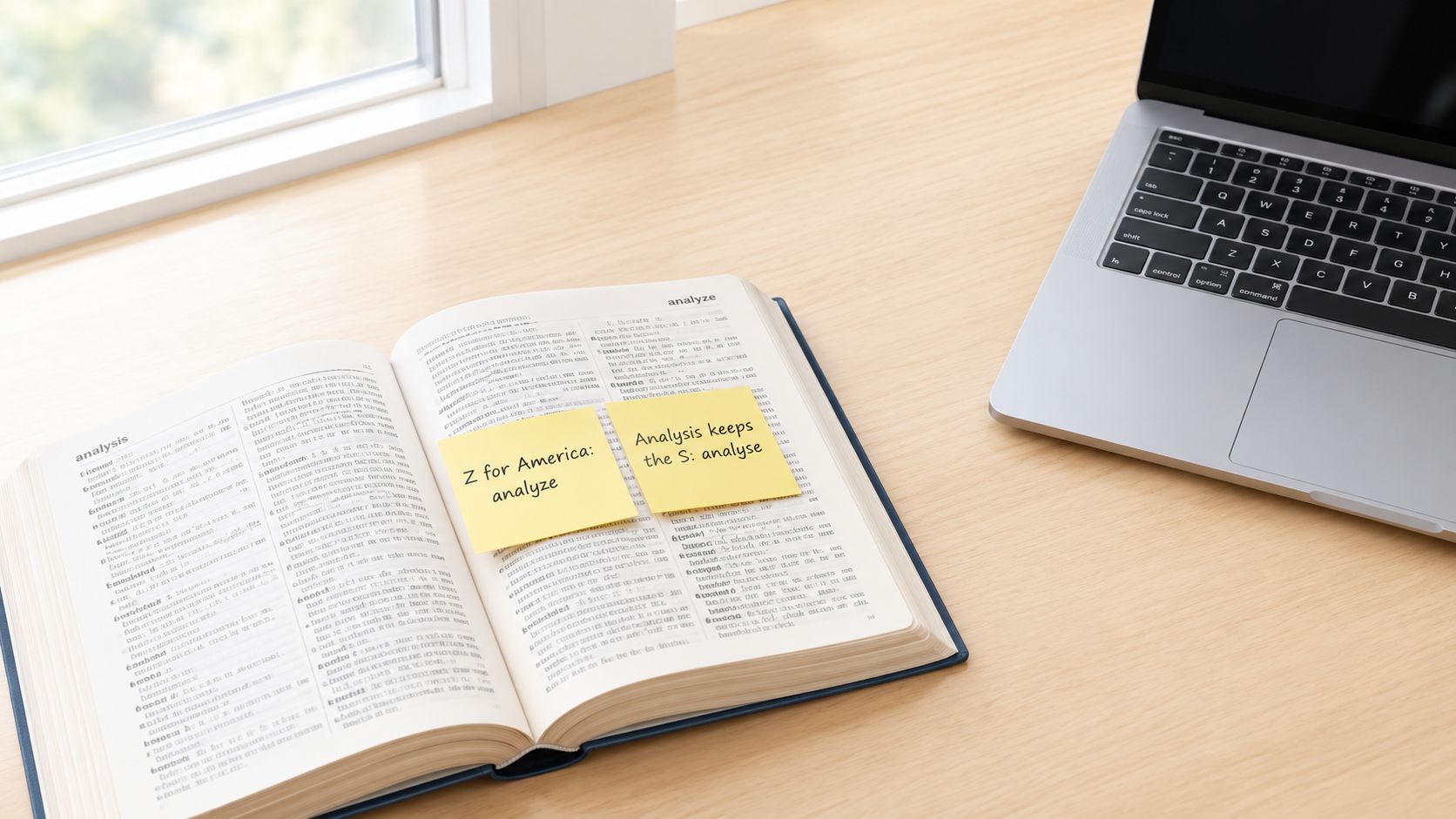
Say the word slowly, with the same vowel in both versions, then spell from a memory group rather than from the sound. People who want to connect English spelling with spoken sounds get further when the group is visual, because this pair will never split in the mouth.
Two groups, two readers
The -yse group pairs analyse with paralyse, dialyse, and catalyse. Use it when you write for UK or Commonwealth clients. If the brief is British, the whole family keeps -yse.
The -ize group pairs analyze with organize, recognize, and realize. Use it for American copy. One family, one suffix.
These aids cover the verb only. Analysis does not join either group, and forcing an -ise or -ize ending onto the noun creates a word nobody prints.
A short self-test: write three -yse words and three -ize words from memory, then check them in a dictionary such as Oxford or Merriam-Webster before you trust the habit. If one word from the wrong family slipped in, the aid is not stuck yet.
A two-minute walk-through of the same ending helps when the groups still blur on the page.
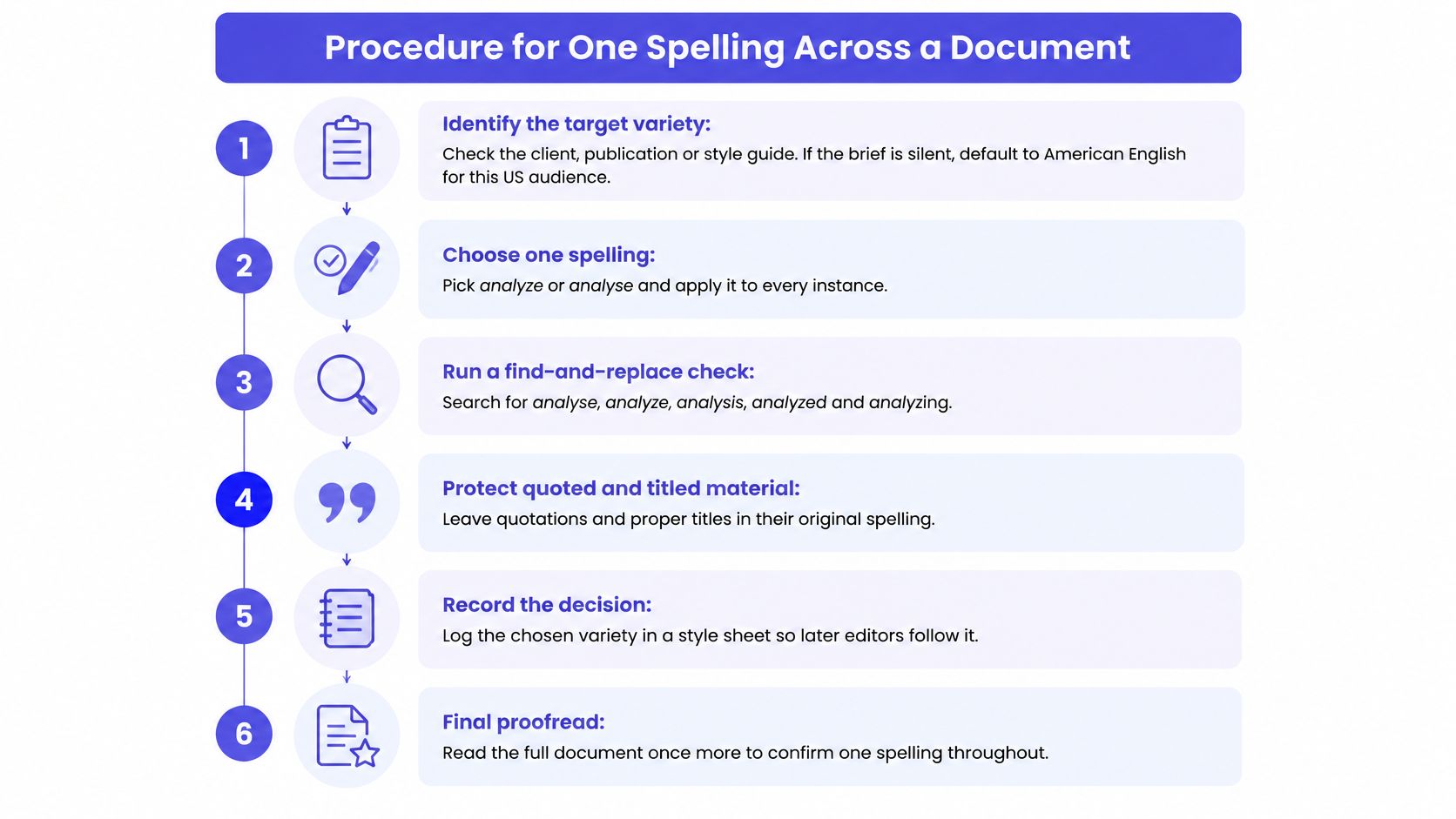
Procedure for One Spelling Across a Document
A mixed international readership is not a reason to mix spellings. Quillbot's UK-versus-US note puts the practical question plainly: follow the style guide or the dominant audience, then apply that choice to related forms, search keywords, quotations, and localization. British English can permit analyze, and Canadian usage may accept both, with analyze especially common in Canadian publications. Analyse is not a misspelling in UK-oriented work.
Hold the choice steady with three moves: identify the variety, select the suffix, and inflect every form the same way. The British set is analyses, analysed, and analysing, and the American set keeps the same shapes with a z. Cambridge Dictionary lists analyse as the British spelling of the verb, so a UK file is where stray z-forms hide. The same regional pattern shows up in catalyse and catalyze.
The six checks
- Identify the target variety from the client, the publication, or the style guide before you draft. If the audience is mixed, use the largest readership or the journal's guide. Decide first so later pages do not drift.
- Choose the suffix. British English takes -yse. American English takes -yze. Write the choice at the top of the file so anyone who edits after you sees the same instruction.
- Search the draft for "analys." One stem catches the base, the third person, the past, and the -ing form in a single pass: analyse, analyses, analysed, analysing. Searching only "analyze" misses the British family.
- Replace each hit to match, including related verbs such as catalyse or catalyze. Do not stop at the base form. A leftover analysing in American copy is the usual miss.
- Apply the same standard outside the body. Headings, titles, file names, alt text, meta descriptions, navigation, and product copy all count. In software, keep separate locale files, such as
en-GBanden-US, instead of mixing both spellings in one language file. - Set the spell-checker to en-GB or en-US and run a last search for the rejected ending. Quoted material stays exactly as published. A British report can quote an American study and keep analyze inside the quotation marks while the narration uses analyse.
Practical rule: Write the chosen standard on a one-page style sheet, and check the draft against that sheet before you publish.
The same pass catches other consistency slips. A sentence that flips voice halfway through is a different problem, and a check for passive-voice misuse belongs in that final read, not in a second argument about -yse and -yze.
Both spellings sit in print every day, so the dictionary was never the risk. The risk is drift inside one document, and six checks close every place drift can enter. One document, one suffix.
Common Mistakes and Their Fixes
Most red lines on this verb are audience mistakes, not vocabulary mistakes. Fix the standard, then fix the sentence.
Treating analyse as always right. In British copy it is the expected form, so “correcting” it to analyze for a UK client creates the error. Before: “We analyze the survey” on a London agency site. After: “We analyse the survey.”
Mixing the two in one piece. Headlines drift first. Before: a title says “Analyse the quarter” and the deck says “We analyze revenue.” After: both lines use the variety you chose in step 1.
Right ending, wrong form. American copy still picks up analysing, and British copy still picks up analyzing. Before: “The lab is analyzing samples” in a Manchester methods section. After: “The lab is analysing samples.”
Verb versus plural noun. “She analyses the logs” is a verb. “Three analyses of the logs” is a plural noun, and it is pronounced differently. Do not run one replace-all across both.
Checking by sound. Both verbs are AN-uh-lyze. Sound is not evidence. Spell from the variety, not from the recording.
Reviving analize. Etymonline notes that forms such as analize appeared in the seventeenth century, and that older British dictionaries also printed analyze, before analyse settled as the chiefly British modern form. Analize is not current. Before: “Analize the sample.” After: analyse or analyze, never the obsolete middle spelling.
Editing inside a quotation. A direct quote keeps the author's letters. Before: changing “We analyze risk” inside a cited U.S. paper. After: leave the quotation, and use your own standard only in the sentence around it.
Before you send the next client draft, run one search for “analys,” set the checker to the variety on your style sheet, and read headings and meta text as carefully as the body. If that draft includes lecture clips or training video you need to trust, AI Video Detector can scan an uploaded file for synthetic video signals in under 90 seconds, without storing the video, so the spelling is clean and the footage is checked before anyone cites it.