

Forensic Audio Analysis Near Me: How to Vet an Examiner

The voicemail is nine seconds long, and one word in the middle decides what happens next. It might be a threat left on a receptionist's line, an instruction buried under café noise, or a voice note that sounds like your finance director asking for a bank transfer. So you searched for forensic audio analysis near me, and a page of firms appeared, each promising voice identification, cleanup, and court-ready reports.
Distance is the weakest filter on that page. What decides whether the work survives scrutiny is how the examiner validated their methods, how they treat the original file, whether their conclusions carry uncertainty, and whether they've testified in the court you'll be standing in.
Nobody competent listens to nine seconds of compressed audio and hands back a verdict of real or fake. You'll get a graded finding with limitations attached, and reading that finding correctly is the skill you need before any money changes hands.
Criteria That Separate Qualified Examiners
A disputed recording rewards a boring, documented approach. Before any technique matters, the person you hire should be able to answer six questions, about method, evidence handling, quality systems, reporting, testimony and turnaround, in roughly that order of importance.
Method validation sits at the top because it's where confident claims collapse. Voiceprint matching is the cautionary case: Montana State University's chapter on forensic audio records one reported experiment with an error rate of 3%, and later replication studies that produced error rates ranging from 40% to 60%. The method looked precise until somebody checked it. Ask for validation results produced on recordings like yours, reported with error or cost metrics, and treat a promise of perfect accuracy as a reason to keep looking.
Here is the summary to keep on your phone during every first call.
| Provider vetting criteria at a glance | ||
|---|---|---|
| Criterion | Strong signal | Red flag |
| Method validation | Validation results on recordings like yours, reported with error or cost metrics | Claims of perfect accuracy with no published or shareable data |
| Evidence handling | Written intake record, hash of the original, work only on verified copies | Accepts forwarded files with no intake record or hash |
| Quality system | Accreditation to ISO/IEC 17025 or a written quality manual with documented procedures | No written quality procedures |
| Reporting | Graded conclusions that state limitations and competing explanations | A binary real or fake verdict |
| Testimony | Prior testimony in the courts where your matter will be heard | Has never testified or avoids explaining methods |
| Turnaround | A written quote issued after the examiner screens the file | A same-day guarantee on a contested matter |
Evidence Handling and Quality Systems
Evidence handling is mechanical rather than impressive. You want a written intake record, a cryptographic hash of the original, and work performed only on verified copies. The SWGDE best practices for digital audio authentication, a document the group initiated on September 15, 2011 and revised through several stages including 2015, frames the central question as whether a recording is consistent with the way it's claimed to have been made. That question gets answered with file structure, metadata, compression history, signal continuity and network-frequency evidence, not with a hunch.
A quality system is the paper trail behind those answers: accreditation to ISO/IEC 17025, or a written quality manual with documented procedures, proficiency testing and a record of corrective actions. A lab that can't produce written procedures on request is leaning on one person's habits, and habits don't survive cross-examination.
Reporting, Testimony and Timing
Reporting separates the professionals from the performers. A graded conclusion states which hypothesis the evidence supports, how strongly, and what stays unresolved. It separates observation from interpretation, because the two get conflated in a hurry when a client wants a clean answer.
Testimony history matters more than postcode. Ask which courts the examiner has appeared in, in what kind of matters, and whether they can explain their method under pressure without retreating into jargon. If your case involves sworn evidence, the expert witness guidelines for technical evidence set out what a usable report contains before counsel can rely on it.
Turnaround comes last because it's the easiest thing to advertise. A written quote issued after the examiner has screened the file is the honest version. A same-day guarantee on a contested recording isn't speed, it's a warning.
Find and Shortlist Providers for Your Court
A contested recording arrives in a folder with a deadline attached. The solicitor needs an examiner in three weeks, the client searches for whoever is closest, and the nearest result is a generalist lab that has never testified in the relevant venue. Distance is a logistics detail. Venue experience is the case.
A four-step sequence keeps the search honest.
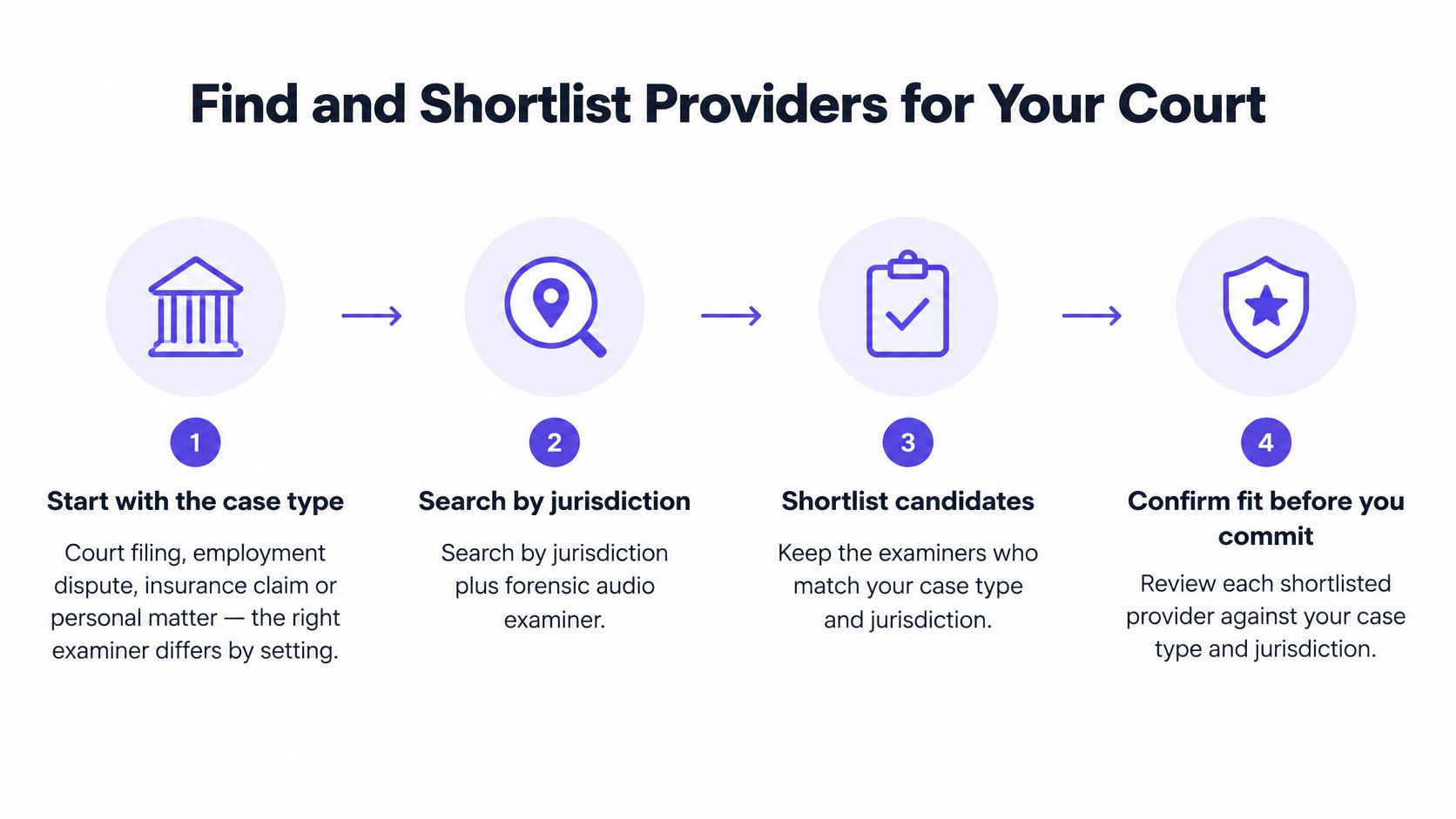
- Start with the case type. Write down the forum before you write down the question, because "is this recording genuine" and "who is speaking" pull different methods and different report structures. A family court filing, an employment dispute, an insurance claim and a criminal charge each carry different expectations about the examiner's role.
- Search by jurisdiction, plus forensic audio examiner. A city name returns whoever bought the advertising. A court or region name returns people who have worked in that venue, which is the filter money can't buy.
- Shortlist candidates on evidence. Open each lab's own website and check the accreditation certificate and the staff listing rather than trusting a directory summary. Ask for a CV and a testimony history naming courts and case types, then ask whether the examiner knows your court's authentication requirements and the report and export formats it accepts.
- Confirm fit before you commit. Request a written scope of work and a quotation issued after the examiner has screened the file, then compare three providers line by line against the criteria table above.
Technical skill alone doesn't settle admissibility. The 2025 SWGDE core competencies for forensic audio require practitioners to know the evidence rules and authentication requirements of the relevant jurisdiction. That kind of work takes weeks rather than days, since the file has to be screened before anyone can say what the examination involves. A provider who quotes a firm turnaround before seeing your recording is quoting blind.
An examiner who can enhance speech beautifully has not thereby shown that a recording is authentic. Enhancement and authentication answer different questions, and a provider who blends them has told you something useful about how they'll testify.
If your matter is criminal and sits in Connecticut, choosing a Connecticut criminal defense attorney runs alongside this decision, since local counsel's read on court practice shapes the questions your examiner is asked to answer.
The shortlist you want names three examiners, each with documented methods, a written fee structure and a written scope of work. Two of them will often be outside your city, and that is fine. Evidence travels by courier and secure transfer; competence doesn't care about distance.
Preserving the Recording Before the Examiner Sees It
Everything an examiner can do depends on what you hand over, and the most useful thing you can hand over is an untouched original.
- Keep the original device or file intact. Don't trim it to the relevant minute, don't denoise it, don't export it to another format. Any of those steps permanently removes detail an examiner needs, and none can be undone.
- Write down the acquisition details. The device, the app or source, the date and time, who recorded it and how it reached you. Those notes answer the first question any opposing expert asks.
- Stop forwarding it. Each pass through a messaging app re-encodes the audio, and repeated compression erases evidence that may already be thin.
- Copy it once to a second location and hash it. A documented hash lets every later copy be checked against the original, which is the difference between a verification and a guess.
- Log every handler. Name, date, and what they did with the file, including the point at which they made derivatives.
Two traps catch people who are trying to be helpful. Metadata alone is the first: the ENFSI best-practice manual for digital audio authenticity analysis notes that metadata can be rewritten during ordinary export, messaging or editing, while re-encoding can erase or introduce spectral evidence. The second is enhancement before preservation, which can destroy the original signal characteristics the whole analysis rests on.
The cheapest protective step is a hash and a written log. It costs nothing and it answers the first question anyone will ask about your file.
Ask the provider for a chain-of-custody form before you send anything, and for a report that documents every derivative file, who made it and what processing touched it. The same discipline applies to physical evidence a case turns on, and examining crime scene and lab evidence from Law Office of Bryan Fagan PLLC shows how courts treat an unbroken chain. For the transfer and storage mechanics, how to preserve digital evidence covers what to record and where to keep the copies.
Questions to Ask Before You Send Anything
Many clients assume the report will end with a name and a percentage. It shouldn't, and five questions asked verbatim expose whether a provider understands why.
| First-call questions and what the answers signal | ||
|---|---|---|
| Question | Good answer | Vague answer |
| Which techniques will be used, and were they validated on recordings like mine? | Named methods validated on comparable recordings | Proprietary software with no validation data |
| Do you report likelihood ratios or graded conclusions? | An LR or a graded scale, explained as support for competing hypotheses | A single percentage, or a plain "it's fake" |
| How was the validation done? | Separate development and test data, same-speaker and different-speaker pairs, Cllr or EER reported | "We have years of experience" |
| Is the questioned speech long enough for a meaningful result? | Examiner states the duration limit and its effect on the result | No discussion of speech length |
| What can you not conclude? | A clear list of limits, such as who created the recording | Certainty about everything |
For speaker comparison, the technically appropriate output is a likelihood ratio, and it's worth understanding what that means before an examiner uses the phrase. A peer-reviewed validation of the E3 forensic speech system describes the LR as a comparison of how probable the observed voice evidence is under the same-speaker hypothesis and the different-speaker hypothesis. It is not the probability that your suspect is the speaker, and an examiner who presents it as one has misread their own field. In that validation the reported Cllr was 0.208, and for only 5 seconds of questioned net speech the validation supported LR magnitudes into the hundreds, but not arbitrarily extreme values.
Ask how the numbers were produced: representative same-speaker and different-speaker pairs, development and test data kept strictly apart, metrics such as calibrated log-likelihood-ratio cost or equal-error rate reported in full. Then ask about conditions, because results depend heavily on recording conditions, language, channel, background noise, speech duration and population match. A provider who can't answer those five questions plainly comes off the shortlist, and that's the whole point of asking them before you send a file.
Handling Uncertain Results and Voice Clones
Start with the uncomfortable number. A survey cited in the European Parliament's 2025 briefing on detecting manipulated audio found that 70% of respondents were unsure they could distinguish cloned voices, and the same briefing records the UK National Assessment Centre's assessment that it is almost certain criminals will increasingly use generative AI, including voice cloning, for fraud against individuals and businesses. Listening is not a screening method, however sharp your ear feels in the moment.
A real examination produces a report of this shape.
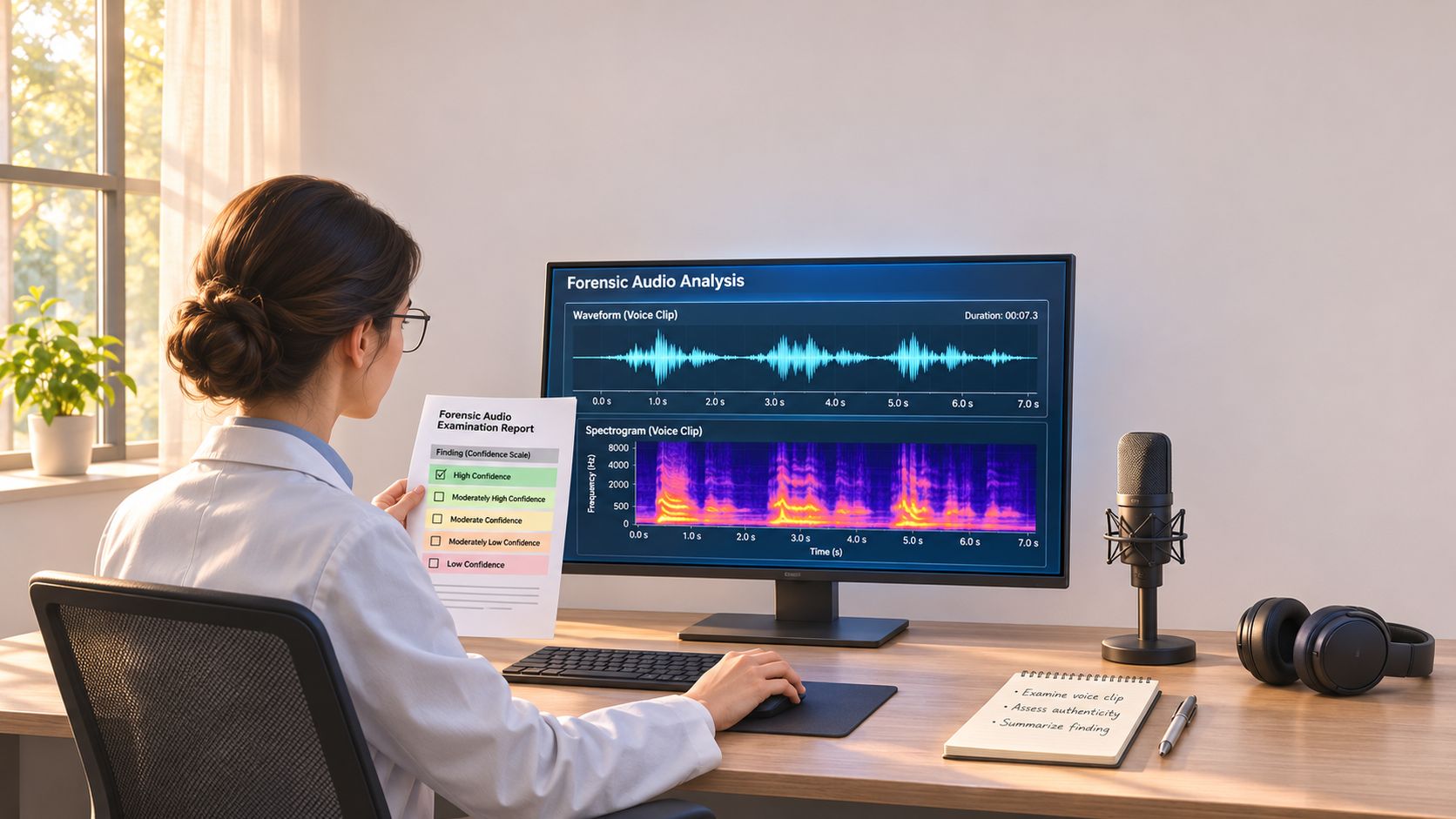
Expect graded findings, and expect confidence to drop when the material is weak: compressed messaging-app audio, clips of a few seconds, a recording replayed through a speaker, heavy background noise, or a missing original. The briefing also notes that detection methods built on machine learning, forensic analysis and hybrid approaches have important limitations, especially for voice calls. A finding that leaves questions open isn't a failure, it's the honest shape of a thin clip. Understanding what forensic voice analysis can and cannot establish helps you read that finding without overclaiming.
When a recording arrives with a payment request attached, work through this order:
- Stop forwarding it, and preserve the original as described above.
- Record who sent it, when, through which channel, and what decision it's pushing you toward.
- Verify the request through a number you already hold, never one supplied in the message.
- Engage a qualified examiner when the legal or financial stakes justify it, and ask for unresolved questions listed alongside the conclusion.
For video clips, audio findings belong next to other evidence rather than above it. AI Video Detector performs spectral analysis of voice and background audio, and the detector identifies inconsistent facial micro-expressions, synthetic audio spectral patterns and temporal flickering in AI-generated clips. Read those signals together. When a finding will end up in a courtroom, Ticket Shield forensic evidence guidance explains how reliability testing is argued, which is the standard your examiner's method will be measured against.
Costs, Scope and Remote Options
Ask how the fee is built before you ask how much it is. A flat fee for a defined examination is easiest to compare across providers. An hourly rate suits open-ended work but needs a cap in writing. A screening fee charged before a full quote is normal practice, and it's fair to ask whether any of it is credited back if you decide not to proceed.
The quote itself should itemize rather than summarise. Look for intake and preservation, analysis time, the written report, work on derivative files, testimony preparation, court attendance and travel. A quote covering only "analysis" will grow once your matter gets a hearing date.
Scale doesn't price your case. The global forensic audio authentication market was valued at USD 452.6 million in 2024, according to Growth Market Reports, and that figure describes an industry rather than your invoice. Only a written quote from an examiner who has screened your file tells you what your matter costs.
Remote Work Changes the Handoff, Not the Standard
Remote examination works for most recordings: you transfer the preserved original, and only by the method the examiner specifies, with a hash check confirming that what arrived matches what left. In-person attendance earns its cost when the device itself needs inspection, or when the original has never left someone else's custody.
Ask before you sign: who holds the files and copies, where they're stored, how long they're kept, and how they're destroyed once the matter closes.
Rush work exists and it costs more, so get the standard and expedited timing in writing. Keep the quote, the scope and the chain-of-custody form in one folder before anything leaves your hands.
Confirm the Provider and Book Your Examination
Two calls usually settle it. Confirm accreditation and staff details on the lab's own website rather than a directory entry, request the validation summary and the chain-of-custody form, and check the testimony record against the court you'll be in. Then ring each shortlisted examiner with the five questions and note who answered directly. A provider that stalls on validation data has answered you already.
Three habits undo careful work before the call happens. Stop forwarding the file again, stop running it through consumer enhancement or denoising tools, and stop deleting the message thread that establishes where the recording came from and when. Each one destroys something an examiner would have used.
If the recording sits inside a video clip, AI Video Detector's free basic detection needs no registration and no sign-in, so you can screen the file yourself and arrive at the intake call knowing what kind of material you're holding. Agree the scope and the quote in writing first. Send only the preserved original or a verified copy, and only after the examiner has confirmed the transfer method and hash process.
The action for this week: book the intake call with your top-ranked examiner, ask for the chain-of-custody form in writing, and leave the original untouched until that call happens. If the disputed material is a video with an audio track, upload it to AI Video Detector first, where audio forensics runs beside frame-level, temporal and metadata checks, so no single signal is treated as the answer. Then let the examiner's graded conclusion, limitations included, carry the weight it can bear.