

Evidence Video: A Practical Guide to Collection and Court

An evidence video isn't authenticated by appearance alone. Earlier video-authentication methods reported average detection accuracy of 84% for frame-removal attacks and 79% for frame-addition attacks, which shows both the value and the limits of technical analysis.
The more difficult question is usually not “Does this clip look real?” It's “Can someone prove where this file came from, which device created it, who handled it, and whether its encoded contents changed?” A convincing image can support an investigation, but the file's provenance, metadata, device information, and chain of custody determine whether that image can withstand a serious challenge.
That distinction matters in courtrooms, newsrooms, insurance investigations, internal fraud reviews, and law-enforcement work. A copied clip with no source history may contain useful information, yet it gives an opposing party room to question its integrity. A properly preserved original, supported by technical examination and independent corroboration, gives reviewers a defensible basis for their conclusions.
The Evolution of Video Evidence Authentication
For years, investigators often treated a recording as a direct window onto an event. The assumption was simple: if the footage showed something clearly, the footage itself did most of the evidentiary work. That assumption no longer survives routine scrutiny because editing software, transcoding, synthetic media, and repeated platform sharing can change a file without leaving an obvious visual warning.
Video authentication has therefore become a formal forensic discipline, not an informal exercise in spotting strange faces or broken motion. The SWGDE best-practices guidance for digital video authentication defines authentication as examining the provenance or history of how a digital video file was created. That framing moves attention away from the clip alone and toward the complete evidence history.
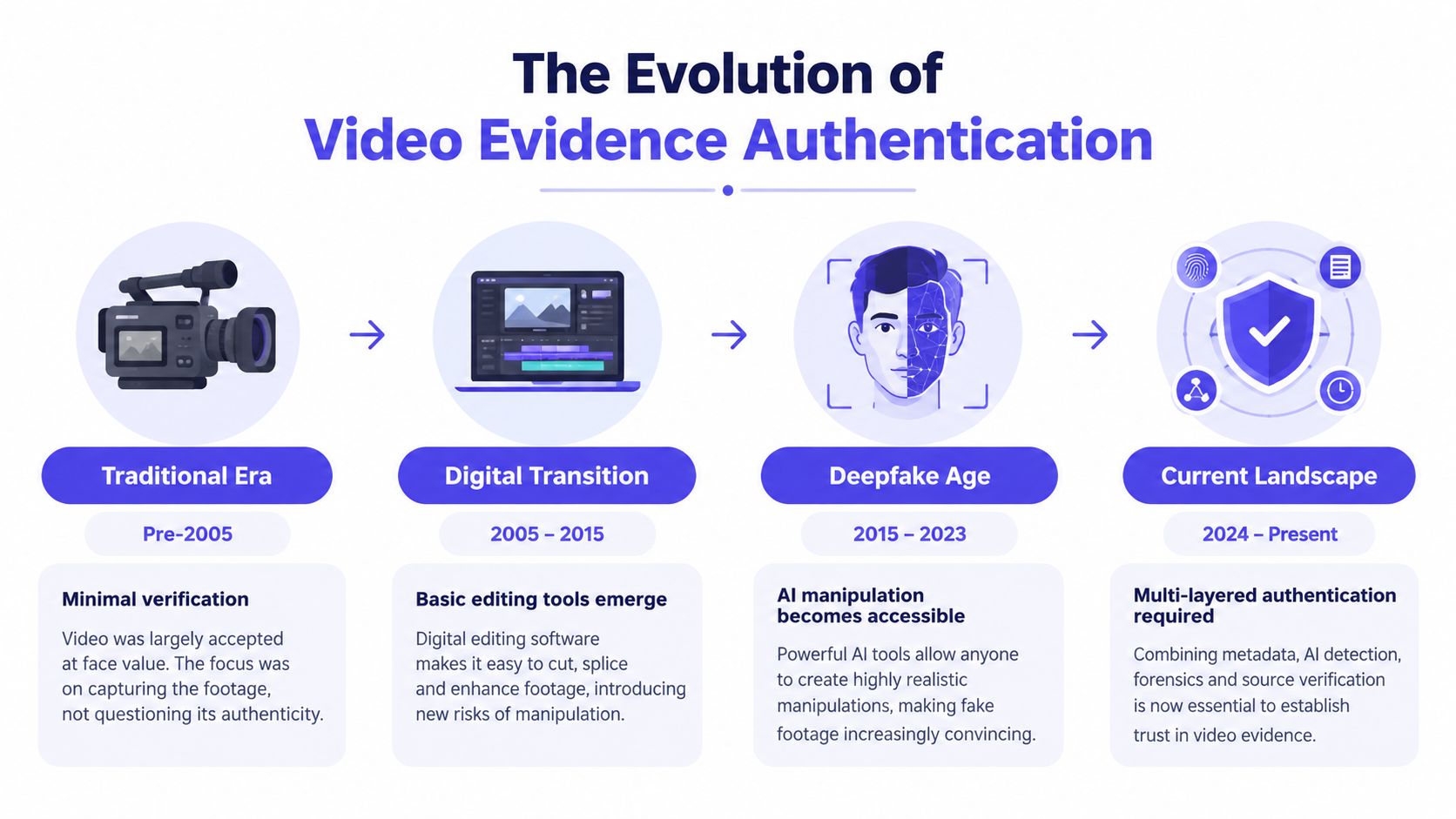
From visual confidence to forensic proof
Modern examination separates several questions that people often collapse into one:
- Provenance: Where did the file originate, and how was it transferred?
- Source identification: Does the file correspond to the claimed camera, phone, recorder, or platform?
- Content integrity: Do the encoded streams show signs of alteration, insertion, removal, or re-encoding?
- Context: Does other evidence support the claimed time, location, people, and event?
These questions produce a stronger result than merely asking whether a clip “looks edited.” A file can look clean while having an unclear transfer history. Conversely, a file can contain compression defects caused by ordinary sharing rather than deliberate manipulation.
The history of video forensics also shows why confidence must remain measured. A 2017 survey documented reproducible performance benchmarks for manipulated video, but the results varied by attack type, codec, and method. That variability is not a weakness unique to one tool. It is a reminder that forensic conclusions depend on the quality and history of the material being examined.
Practical rule: Treat the video as an item with a history, not as a self-authenticating picture.
A rigorous examiner starts by defining the precise authenticity question. “Is this real?” is too broad to guide an examination. “Was this file edited after it left the source device?” or “Does the file's encoding structure support a continuous recording?” gives the reviewer something testable. A detailed video forensics analysis workflow can help teams frame those questions before they interpret visual content.
Secure Collection and Chain-of-Custody Procedures
A technically detailed examination can't repair careless collection. If someone trims the source file, exports it through a messaging application, or records a screen instead of acquiring the original, the handling process may remove or overwrite artifacts needed later. The first objective is preservation, not enhancement.
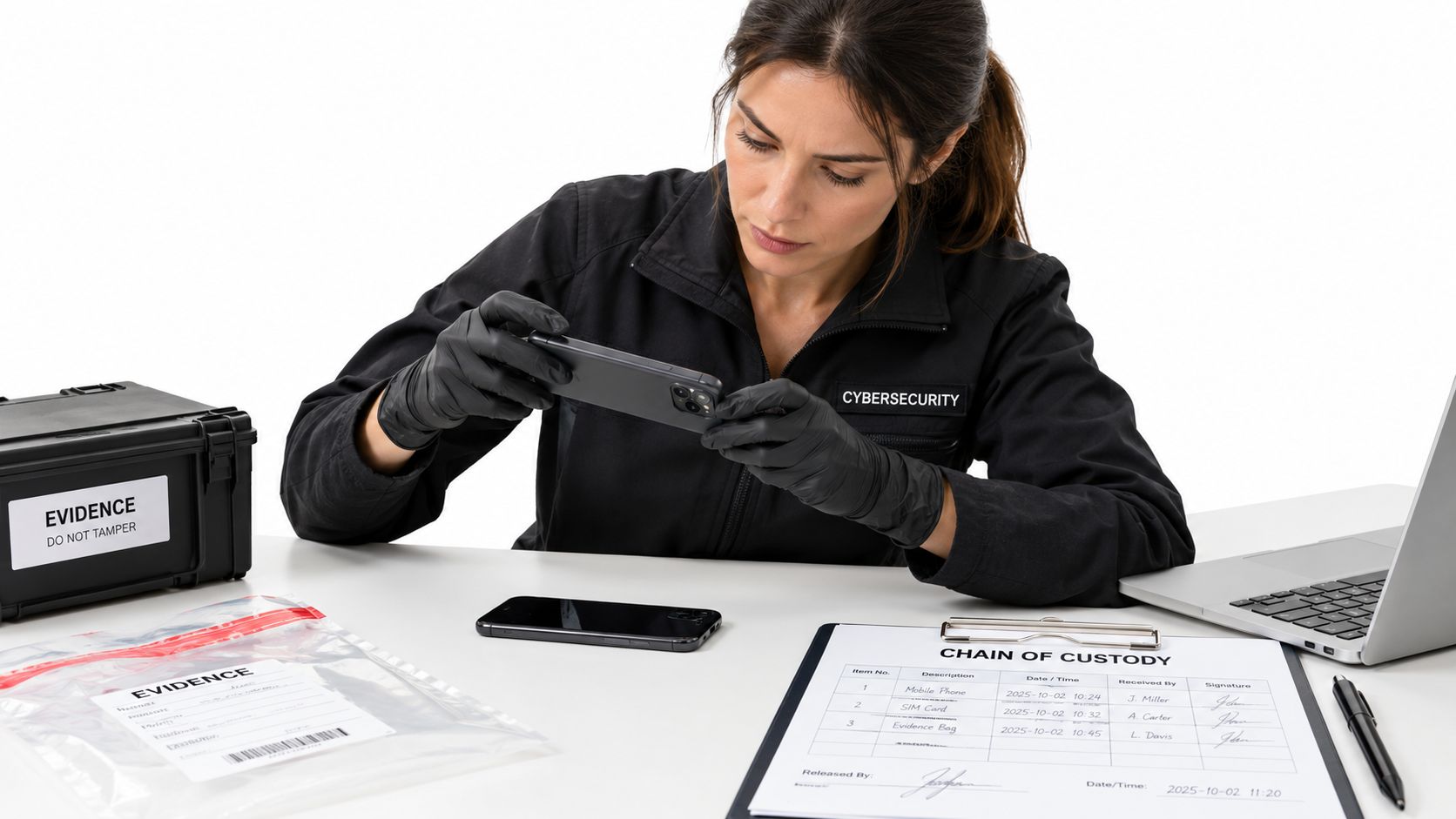
Preserve the source before viewing for convenience
Start with the device or storage location that holds the earliest available version. Record the device identity, operating condition, date and time shown by the system, storage location, and the person who supplied it. Don't open the file in an application that may automatically rewrite metadata, and don't create a cleaned-up version for analysis before preserving the original.
Create a forensic working copy and calculate a cryptographic hash for the acquired file. A hash gives the team a repeatable way to demonstrate that the working copy still corresponds to the preserved acquisition. It doesn't prove that the original recording depicts the claimed event, but it helps show that the examined copy wasn't changed after acquisition.
A sound evidence log should identify:
- The item received: Record the filename, format, storage medium, device details, and any visible file properties.
- The transfer event: Note who released the item, who received it, when the handoff occurred, and how the transfer took place.
- The preservation action: Document the acquisition method, hash result, storage destination, and access restrictions.
- Every later access: Log examinations, exports, conversions, redactions, and transfers separately from the preserved master.
The original should remain untouched and access-controlled. Analysts can work from verified copies, while any presentation export should be clearly labeled as a derivative. This separation prevents a common failure: an edited exhibit becoming confused with the original evidence video.
Make every handoff explainable
Chain of custody isn't administrative decoration. It connects the file examined by a specialist with the file received from a witness, investigator, employee, or platform. If the record contains an unexplained gap, the examiner should disclose it rather than silently treating the file as continuous.
Organizations building repeatable workflows may also benefit from documented audit trail compliance by Blocsys Technologies, particularly where system actions and evidence access need to be independently recorded. The resource is useful for understanding how cryptographic records can support accountability, but it doesn't replace forensic judgment about the video itself.
A practical chain-of-custody template should separate what happened to the evidence from what the analyst concluded about it. The first is a factual handling record. The second is an expert interpretation. Teams can use this chain-of-custody template for digital evidence to structure the handling record before analysis begins.
The following media illustrates the broader principle: collection is a technical process, not merely a file download.
Don't enhance, crop, subtitle, or re-encode the master to make it easier to watch. Create a documented derivative when necessary, preserve the source separately, and make clear which version appears in a report or hearing.
The Three-Pillar Authentication Framework
Authentication isn't a single yes-or-no test. A reliable examination separates the story surrounding the file, the equipment that may have created it, and the integrity of the encoded content. These areas support one another, but a strength in one doesn't automatically resolve a weakness in another.
The SWGDE digital video authentication workflow recommends defining the authenticity questions, developing a plan, obtaining reference videos, and assessing technical attributes before comparing provenance, source identification, and content integrity. It also warns that metadata shouldn't be relied on in isolation.
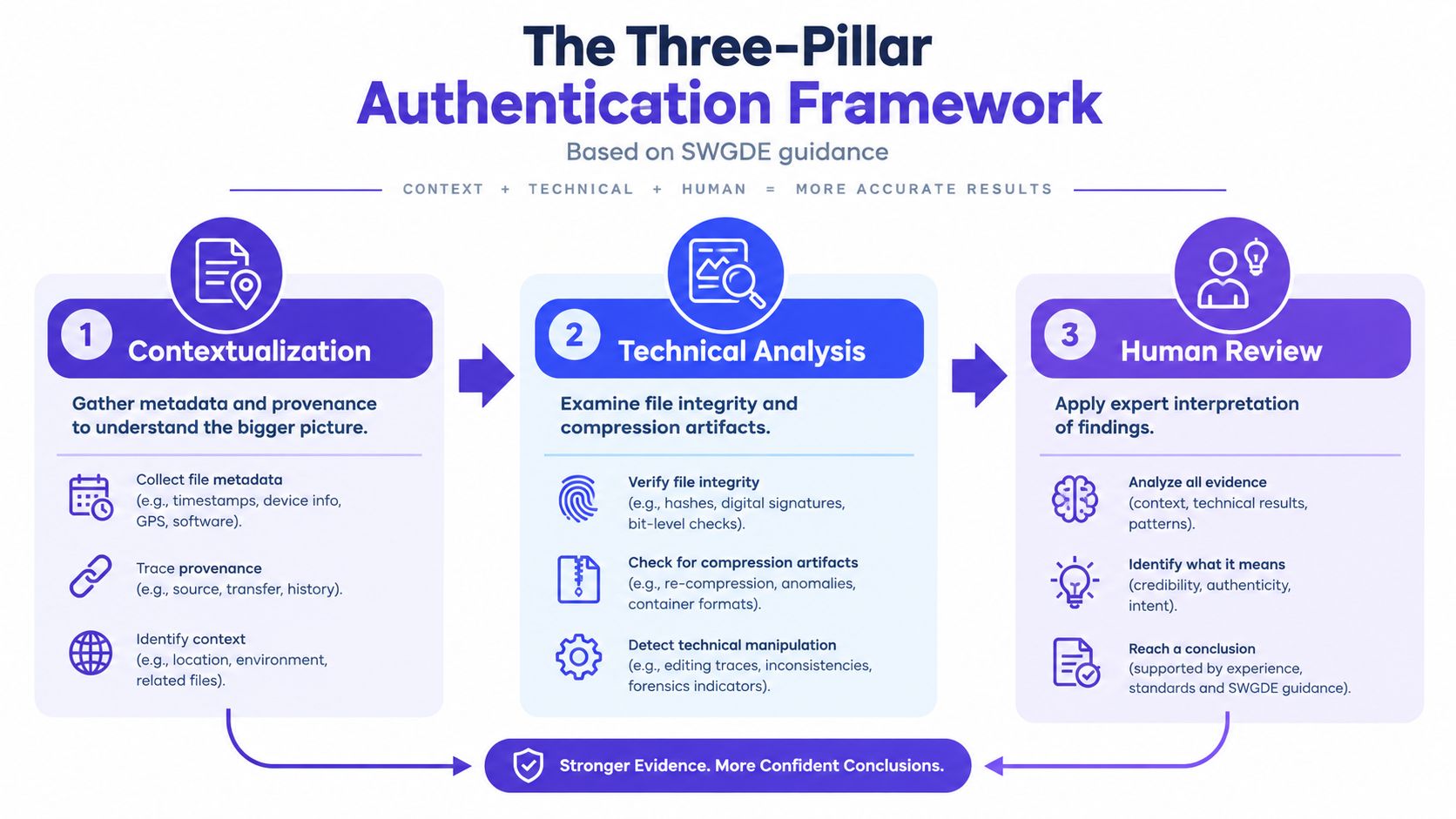
Contextualization
Contextualization asks how the file entered the investigation. The examiner gathers information about the source person, device, recording circumstances, transfer route, and relationship to the alleged event. Other material may include witness accounts, surrounding recordings, platform records, or the physical scene.
This pillar doesn't require every detail to be certain before analysis begins. It requires the reviewer to identify what is known, what is reported, and what remains unverified. A claimed timestamp, for example, is a lead for comparison, not conclusive proof of when the camera captured the scene.
Source identification
Source identification tests whether the technical characteristics are consistent with the claimed equipment. Reference material from the same camera or phone can reveal expected resolution, codec behavior, audio characteristics, file structure, naming conventions, and other recurring properties.
The comparison must remain cautious. A device model shown in metadata may be informative, but it can be changed, inherited from an export process, or disconnected from the device that recorded the scene. The examiner should compare multiple attributes and explain both supporting and contradictory findings.
Content authentication
Content authentication examines whether the encoded streams are internally consistent. The review may consider frame order, unusual transitions, compression behavior, audio continuity, duplicated material, and signs that portions were inserted or removed.
These pillars work best as a sequence rather than isolated opinions. Context identifies the claim, source analysis tests the claimed origin, and content analysis examines the file's internal behavior. Human review then interprets the combined record and states what the evidence supports, what it doesn't support, and what cannot be determined.
A metadata field can support a conclusion. It cannot carry the conclusion by itself.
That restraint matters because authenticity may be partial. An examiner might find that a file came from a particular device while remaining unable to establish when it was recorded. Another examination might show that a clip contains an uninterrupted encoded segment but not prove that the scene itself occurred as described. A defensible report preserves those distinctions instead of forcing a binary label.
Human Forensics Versus AI Detection Tools
Human examination and automated detection solve different problems. An automated system can process frames and audio consistently, flag patterns for review, and help prioritize a large evidence set. A forensic examiner can evaluate collection history, compare reference files, investigate contradictions, and explain the significance of a result in context.
The most useful comparison is therefore not “human or machine.” It is screening versus interpretation.
| Human forensic analysis | Automated detection |
|---|---|
| Reconstructs provenance and handling history | Processes technical signals consistently |
| Selects relevant reference material | Flags possible visual, audio, or temporal anomalies |
| Explains alternative causes for artifacts | Helps prioritize files for closer review |
| Connects findings to an investigative question | Produces a result that still needs contextual interpretation |
A platform such as AI Video Detector can analyze uploaded video for frame-level, audio, temporal, and metadata signals. That kind of screening may help a newsroom, investigator, or legal team identify material that deserves manual examination, but its result shouldn't replace acquisition records, source comparison, or expert assessment.
What benchmark results actually tell you
Research has established that manipulated video can leave measurable traces, but benchmark performance varies with the manipulation and the test conditions. The 2017 survey of video content authentication techniques reported average detection accuracy of 84% for frame-removal attacks and 79% for frame-addition attacks. In one evaluated method, frame-insertion detection achieved 95.4% recall and 95.3% precision.
Those figures don't mean an examiner can apply one percentage to every new clip. They describe evaluated methods under particular conditions. A file that has been compressed, reposted, converted, or altered in a different way may produce a different result. The correct operational response is to use automated output as one finding among several and preserve the underlying file for independent review.
Human examiners are especially important when the result conflicts with the evidence history. A detector may flag an unusual encoding pattern that comes from an ordinary export. It may also miss a manipulation that leaves weak or unfamiliar traces. The reviewer must ask what the signal means, whether another explanation fits, and whether the conclusion answers the actual investigative question.
Privacy matters too. Teams should establish who may upload evidence, where processing occurs, whether videos are retained, and how sensitive material is removed from the workflow. A convenient tool is not automatically appropriate for confidential legal, medical, employment, or personal footage.
Presenting Video Evidence for Court and Newsrooms
Authentication loses practical value if nobody can understand the examination. A judge, jury, editor, or investigator usually needs a clear account of what was received, what was preserved, what was tested, and what the findings do and don't establish.
A strong report distinguishes observations from interpretations. “The file contains a change in encoding parameters at this point” is an observation. “This proves that a person edited the event” is a much broader conclusion that may not follow without additional evidence. Reports should use plain language, identify limitations, and avoid presenting a confidence score as a substitute for reasoning.
Build a defensible evidence package
Include the preserved-file identifier, acquisition notes, hash results, chain-of-custody entries, technical properties, reference material, examination steps, findings, and derivative files used for viewing. If an AI or other automated tool was used, record the tool, version or configuration when available, input file, output, and the analyst's interpretation.
For playback, prepare a clearly marked derivative that the courtroom or newsroom system can open reliably. Keep the original separate. If enhancement, redaction, cropping, or annotation is necessary, retain the unaltered source and explain exactly what changed in the presentation copy.
A concise presentation checklist helps prevent avoidable confusion:
- Identify the source: State who supplied the file and what is known about the recording device.
- Show the handling history: Explain each significant transfer and preservation step.
- Separate versions: Label the original, working copy, and presentation derivative.
- Explain technical findings: Translate metadata, encoding, and hash information into ordinary language.
- State limitations: Identify gaps, uncertain timestamps, missing source material, or unexplained transfers.
- Connect evidence carefully: Distinguish what the video depicts from what corroborating evidence establishes.
Legal teams often need the same discipline for their broader technology processes. Guidance on IT efficiency for law firms can help organizations think about access control, documentation, and reliable workflows, although operational IT guidance doesn't replace a forensic video examination.
The guide to authenticating evidence video should be treated as a workflow aid, not a courtroom conclusion. The final report belongs to the examiner who reviewed the file, records, references, and limitations.
Avoiding the Single-Signal Trap
The most dangerous shortcut is to let one reassuring feature settle the question. A clean face, plausible voice, intact timestamp, or favorable detector score can create confidence without proving provenance. The opposite shortcut is just as weak: one visual glitch doesn't automatically establish fabrication.
Why visual inspection fails
Modern files often pass through cameras, editing programs, messaging services, social platforms, screen-recording tools, and export utilities. Each stage can affect resolution, compression, frame timing, metadata, or audio. Reposting may remove useful source information while also hiding or distorting visible manipulation traces.
A viewer may therefore see a clip that looks natural even though the available file is not the original. The absence of an obvious artifact is not proof of an unaltered recording. It only means that visual inspection hasn't revealed one.
Metadata creates a similar trap. Device models, modification times, software identifiers, and location fields can help establish a line of inquiry, but they don't independently prove capture history. The SWGDE guidance discussed earlier specifically treats metadata as evidence that must be corroborated with other file elements.
Combine independent signals
A thorough review combines signals that fail in different ways. The exact mix depends on the question, source, and available references, but a practical examination may include:
- Provenance analysis: Trace the source device, original location, transfer route, and people who handled the file.
- Spatial inspection: Look for inconsistent edges, lighting, texture, facial geometry, or other frame-level irregularities.
- Temporal analysis: Examine motion continuity, frame order, repeated sections, and transitions across adjacent frames.
- Audio review: Compare speech, background sound, waveform continuity, and alignment between mouth movement and vocal sounds.
- Encoding examination: Look for changes in compression behavior, stream structure, frame types, or other file-level inconsistencies.
- Reference comparison: Compare the file with recordings from the claimed device, platform, camera setting, or surrounding event.
- Human interpretation: Assess whether the combined findings support authenticity, indicate alteration, or remain inconclusive.
These signals shouldn't be treated as a checklist where every anomaly becomes a finding of fraud. Compression can create blockiness. Camera systems can produce unusual timestamps. A platform export can alter metadata. The examiner's task is to distinguish an artifact from an explanation supported by the complete file history.
Benchmarks don't replace case-specific reasoning
Deepfake benchmarks have improved evaluation by bringing detectors and datasets into a more consistent testing environment. They also expose a persistent problem: performance can change sharply across datasets and manipulation types. A detector that performs well on familiar training artifacts may respond less reliably to a reposted evidence video with different compression or an unfamiliar manipulation process.
For that reason, cross-dataset evaluation and temporal analysis matter. A static frame may appear convincing while motion between frames reveals inconsistent geometry or timing. Audio-video synchronization can add another independent signal, especially where a synthetic face or altered speech track must remain aligned over time.
The same caution applies to older influential datasets. The benchmark literature notes that FaceForensics++ contains more than 1.8 million manipulated images and can bias models toward known manipulation families and compression patterns. That figure describes the dataset's scale, not the reliability of a detector on every real-world file. Benchmark familiarity can create false confidence when the evidence conditions differ.
Preserve uncertainty instead of manufacturing certainty
Court-oriented and law-enforcement guidance emphasizes that authenticity depends on preserving the original file, metadata, device information, and chain of custody. The discussion of accessing and authenticating truth in the era of digital deception also highlights an important legal distinction: gaps in a recording may affect the weight assigned to it rather than automatically determining admissibility.
That distinction doesn't make collection gaps harmless. It means the reviewer should describe their consequence accurately. If the source device is unavailable, say so. If the file arrived through an unverified transfer, document it. If the available copy is a repost rather than the original, don't present it as a native camera file.
The strongest conclusion may be that the file is consistent with the claimed history, that it shows signs of alteration, or that the available material cannot resolve the question. A qualified conclusion supported by preserved evidence is more useful than false precision.
If you're handling an evidence video, preserve the earliest available file now, record every transfer, calculate a hash for the acquisition, and separate the working copy from the presentation version. Then have a qualified reviewer examine provenance, source characteristics, content integrity, audio, temporal continuity, and corroborating evidence together before you rely on the clip in court, publication, or an investigation.


