

Deepfake Video Detector How It Works and How to Use It

A newsroom editor receives a video that appears to show a public official making a serious announcement. At the same time, an enterprise security team gets a video call from someone who looks and sounds like the chief executive, asking for an urgent action. In both situations, the pressure is immediate, the footage seems plausible, and a mistake could spread misinformation, compromise evidence, or trigger fraud.
Human judgment alone isn't a dependable safeguard. Research on deepfake perception found overall human detection accuracy of 55.54%, with a 95% confidence interval from 48.87% to 62.10%, an interval that crossed the chance level. Audio-only detection reached 62.08%, while image-based detection reached 53.16% in the same study (human performance research on deepfake detection).
A deepfake video detector adds a forensic layer. It doesn't replace editorial judgment, legal review, identity verification, or security policy. Instead, it examines signals that people may miss, produces a confidence assessment, and gives teams a repeatable starting point for deciding what to do next.
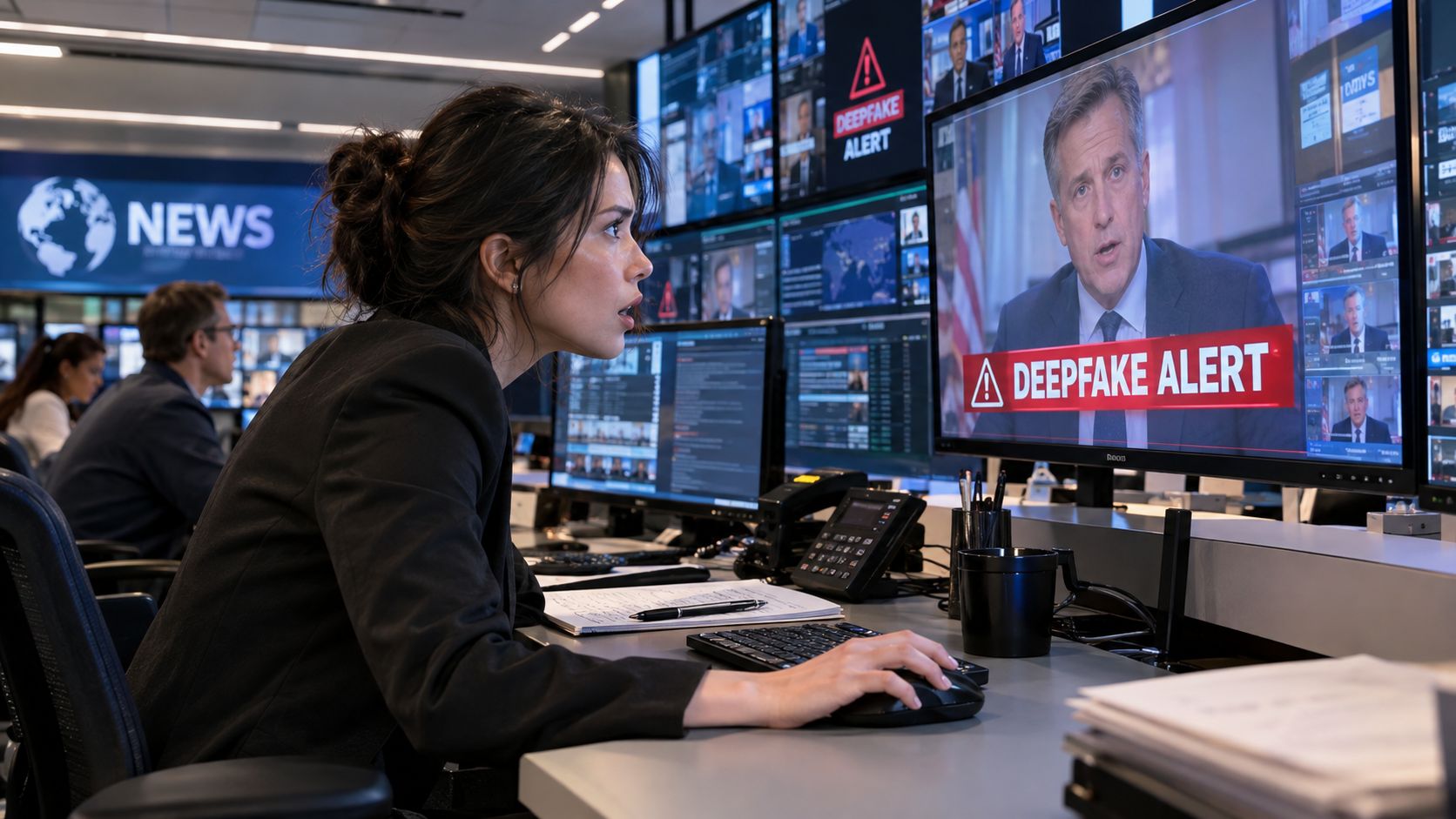
Introduction to Deepfake Video Detectors and Why They Matter Now
A suspicious clip rarely arrives in ideal conditions. It may have been downloaded from a social platform, forwarded through a messaging app, recorded from a screen, or compressed during upload. The original file may be unavailable, and the person who supplied it may not know where it came from.
That context creates two separate questions. Does the video show genuine events, and can the available file support that conclusion? A detector can help answer the first question by examining the media itself. It can't establish who recorded the video, whether the scene was staged, or whether the surrounding story is accurate.
Why visual confidence fails
Deepfake generation includes several forms of manipulation. A clip may swap one face onto another body, alter a speaker's lip movements to match fabricated audio, modify only a small facial region, or generate the entire scene synthetically. Some edits are obvious when paused on a frame. Others become visible only through motion, sound, or file history.
The benchmark Deepfake-Eval-2024 reflects why real-world testing matters. Introduced in 2025 and built from media circulated in 2024, it contains 45 hours of video, 56.5 hours of audio, and 1,975 images gathered from 88 websites across 52 languages (Deepfake-Eval-2024). Its content includes the messy conditions detectors encounter outside a laboratory, including multilingual media, platform compression, audio-video mismatches, and newer GAN and diffusion manipulations.
Who needs a detector
Newsrooms can use detection before publishing user-submitted footage or embedding a viral clip in a developing story. Legal teams and investigators can use it as one documented examination step when reviewing digital evidence. Enterprise security teams can assess suspicious executive videos, recorded calls, or impersonation material, while platforms and educators can review synthetic clips before distribution.
Practical rule: Treat a detector result as evidence about the file, not as a complete verdict about the event.
A privacy-first workflow also matters. Sensitive footage may contain private individuals, confidential conversations, or evidence that shouldn't be uploaded to a service that retains files. Look for clear handling terms, transparent processing, and a way to preserve the original artifact while analyzing a working copy.
What a Deepfake Video Detector Actually Does
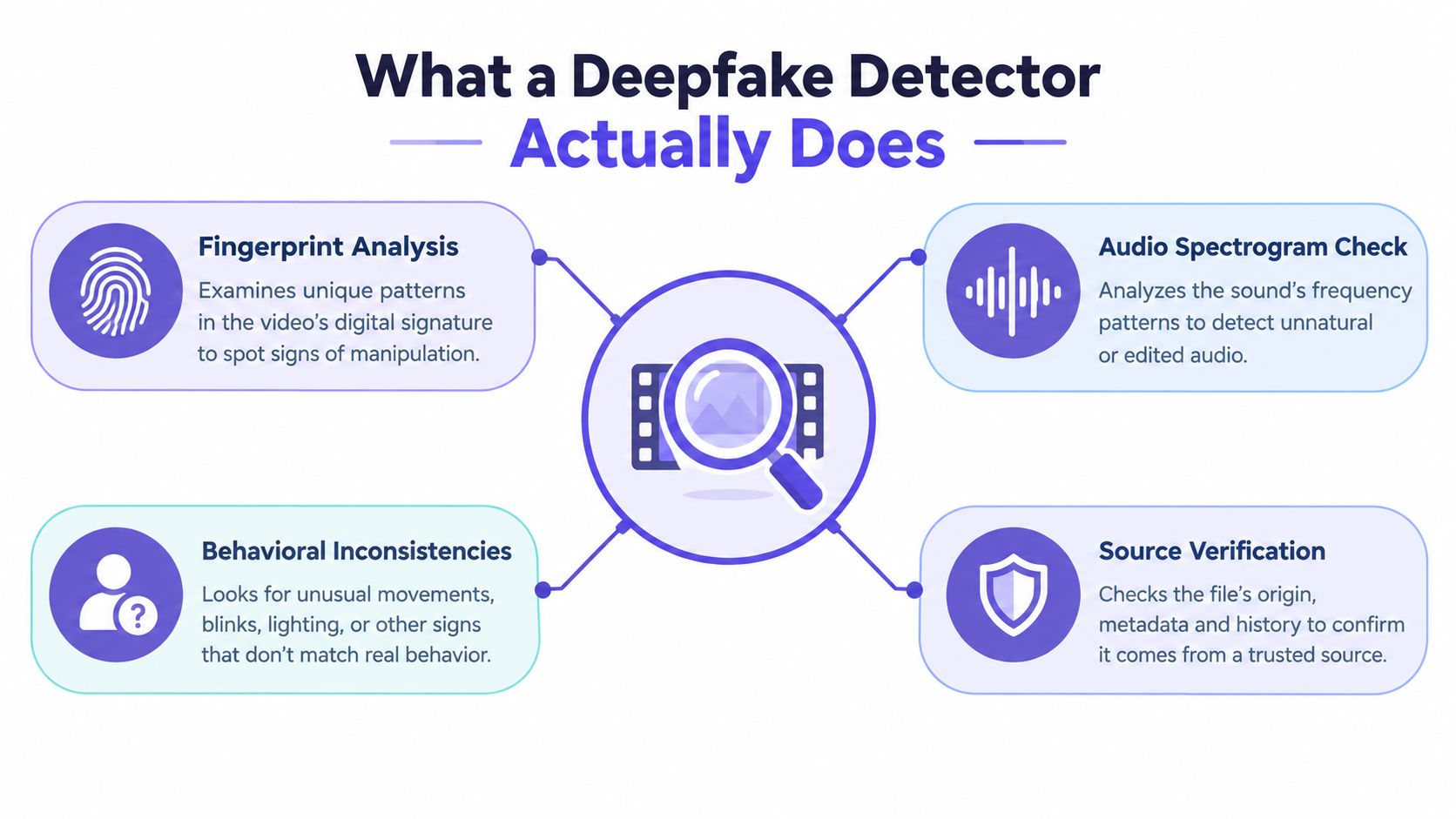
A detector works more like a digital forensic examiner than a person asking whether a face “looks strange.” It studies patterns in pixels, sound, movement, and file structure, then combines those observations into an estimate of whether the content has been manipulated or generated.
The word estimate is important. Most systems don't discover a magical label hidden inside a video. They compare observed features with patterns associated with authentic and synthetic media. The result is probabilistic, so a high score indicates stronger evidence under that system's model, not absolute certainty.
From complete synthesis to partial edits
A fully synthetic video may contain a generated face, generated background, or entirely artificial speaker. A face swap usually preserves much of the original footage but changes the identity shown. A lip-sync manipulation may leave the face, lighting, and body movements intact while altering the mouth and audio relationship.
These examples behave differently under examination. A face swap can leave blending boundaries or inconsistent skin detail. A lip-sync edit may produce timing problems between phonemes and mouth shapes. A generated scene may show unusual textures, inconsistent detail, or patterns associated with the generator that created it.
Older benchmark design demonstrates why testing conditions affect results. FaceForensics++ used four manipulation families, DeepFakes, Face2Face, FaceSwap, and NeuralTextures, across multiple compression levels. It also included a hidden test set and more than 1.8 million manipulated images (FaceForensics++). The central lesson is practical: a detector trained on clean, high-quality material may perform differently after a platform re-encodes the same clip.
Why four signals are better than intuition
A useful detector doesn't depend on one visible clue. It can inspect frame-level artifacts, audio characteristics, timing between sound and movement, and metadata that describes how the file was created or processed.
That combination doesn't make detection infallible. It makes the reasoning more resilient because one signal may remain useful when another has been damaged by compression, missing audio, screen recording, or editing. The output should therefore include both a confidence score and an explanation of the signals examined.
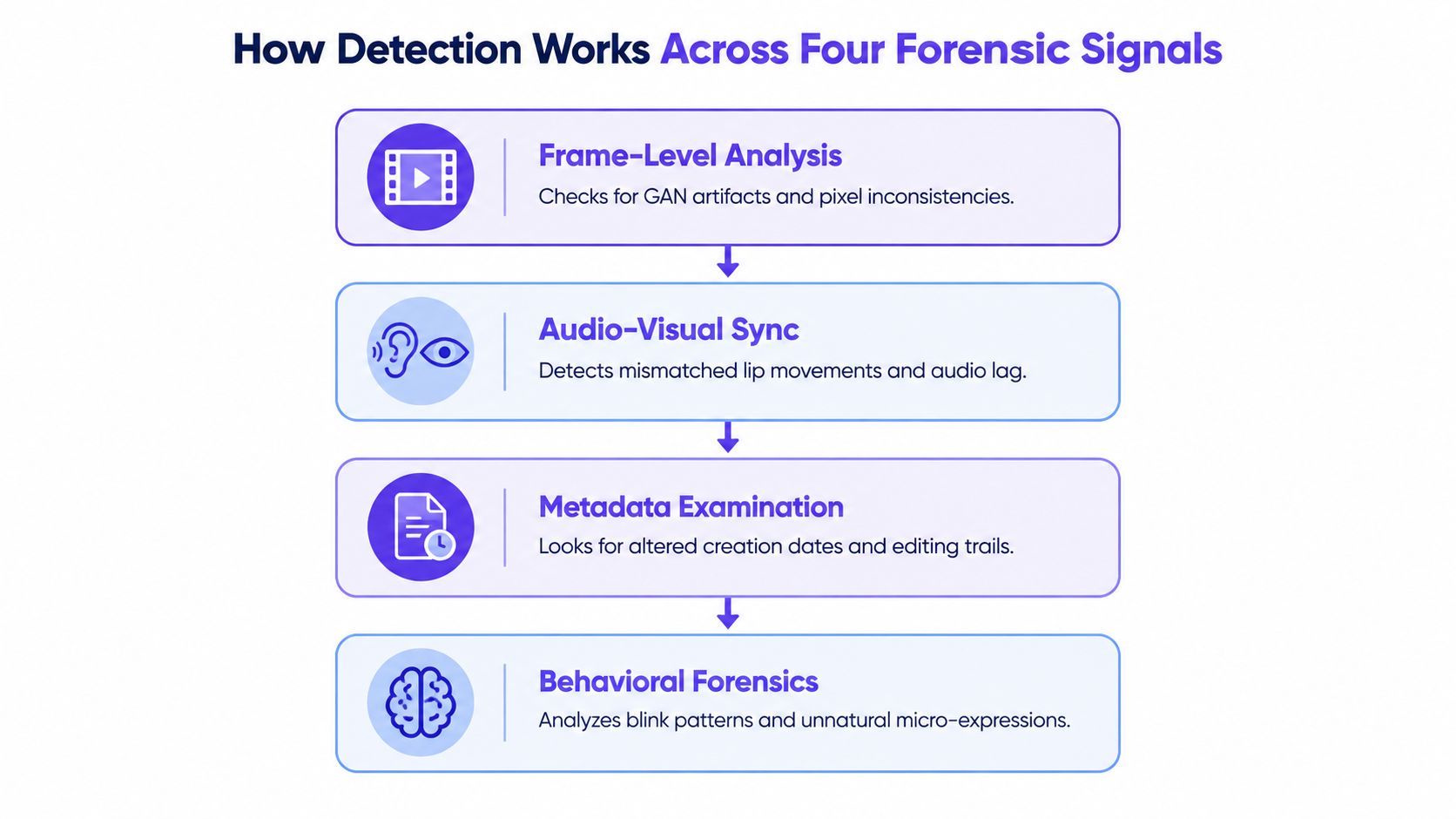
How Detection Works Across Four Forensic Signals
A deepfake video detector can be understood as a panel of independent witnesses. Each witness examines a different part of the file. One may inspect individual frames, another listens to the audio, another checks whether motion stays coherent over time, and the last reviews the file's technical history.
Frame-level analysis
Frame analysis examines individual images and small visual regions. It looks for unusual pixel relationships, blending boundaries, texture inconsistencies, and patterns associated with generative systems. GAN fingerprints can appear as repeated or unnatural image structures, while diffusion-based generation may leave different residual artifacts.
These traces aren't guaranteed to remain visible. Re-encoding, resizing, screen capture, and aggressive compression can remove fine detail or introduce new noise. That's why a detector should analyze many frames rather than relying on one suspicious still image. Readers who want a deeper technical treatment of this signal can review fingerprint features in AI video analysis.
Audio forensics
Audio analysis treats the soundtrack as a measurable signal rather than background decoration. A system can inspect frequency behavior, spectral patterns, pauses, transitions, and the relationship between speech and environmental sound. Synthetic speech may have unusual spectral regularities, while a manipulated recording may contain discontinuities that don't fit the surrounding audio.
The detector also checks whether the voice and image belong together. A speaker's mouth may move slightly before or after the corresponding sound, or the audio may contain timing that conflicts with visible articulation. A missing audio track removes this signal, so the final report should identify which tests were available.
Temporal consistency
A single frame can look convincing while a sequence reveals instability. Temporal analysis follows facial landmarks, head movement, lighting, expressions, and object boundaries from frame to frame. It searches for motion discontinuities, sudden changes in texture, or behavior that doesn't persist naturally across adjacent images.
This signal is especially valuable for subtle edits. A face may remain well blended while its edges shimmer during movement, or a lip-sync modification may align in one phrase and drift during another. Compression can hide or imitate these changes, so reviewers should inspect the confidence result alongside the source quality.
Metadata examination
Metadata can reveal encoding history, editing software traces, timestamps, device information, or inconsistencies in the file's stated origin. It rarely proves authenticity by itself. Metadata can be stripped, changed, or lost when a platform creates a new copy.
The strongest workflow treats metadata as context around the other signals. Teams can also strengthen their broader defensive posture by pairing media analysis with practical AI security guidance for DevArmor, particularly when suspicious video arrives as part of a wider impersonation attempt.
How to Choose the Right Deepfake Video Detector for Your Needs
The right detector depends less on a generic accuracy claim and more on the conditions in which your team will use it. A journalist may need rapid review of a user-submitted MP4. A legal team may prioritize retention controls, reproducible reports, and chain-of-custody procedures. An enterprise may care most about integration with incident response and protection of confidential executive communications.
Start with the file. Check supported formats, maximum upload size, audio handling, frame sampling, and whether the system can analyze short clips as well as longer recordings. Then examine the result. A score without an explanation is difficult to defend in an editorial meeting, legal review, or security investigation.
Selection criteria by audience
| Selection Criterion | Newsroom Priority | Legal and Enterprise Priority | Platform and Educator Priority |
|---|---|---|---|
| Supported media | Common social and camera formats, audio and video | Broad format support, preserved originals, reproducible processing | High-volume uploads and common classroom or platform formats |
| Processing speed | Fast triage during breaking news | Predictable turnaround with queue visibility | Efficient review before publication or distribution |
| Privacy | No unnecessary retention of unpublished footage | Clear storage, access, deletion, and audit controls | Safe handling of student, creator, or user content |
| Confidence output | Understandable score with visual evidence | Explainable report suitable for case documentation | Clear result that moderators and educators can interpret |
| Update cadence | Coverage of new manipulation styles | Versioned methods and repeatable results | Ongoing adaptation to changing synthetic media |
| Workflow fit | Browser access and easy sharing with editors | API, case management, and export options | Moderation, learning, or publishing integrations |
Compare the cost of errors
A false negative may allow manipulated footage or an impersonation attempt to proceed. A false positive may delay publication, challenge legitimate evidence, or create unnecessary escalation. Neither outcome should be evaluated in isolation.
Ask vendors how they test compressed files, screen recordings, missing metadata, multiple languages, and unseen generation methods. The Deepfake-Eval-2024 benchmark is useful context because its diversity reflects the difference between curated examples and material gathered from real websites (the benchmark's cross-platform design). Don't accept a single laboratory score as a substitute for testing your own files.
AI Video Detector is one option for uploaded recordings. Its stated workflow examines frame-level analysis, audio forensics, temporal consistency, and metadata inspection, supports common video formats up to a stated file-size limit, and is designed not to store uploaded videos. Evaluate it against your own privacy, reporting, and integration requirements rather than assuming any detector will fit every environment.
How to Use a Detector and Interpret Confidence Scores Correctly
A reliable review begins before the upload. Preserve the original file, record where it came from, and create a working copy for analysis. Don't trim, convert, or add subtitles before the first scan, because those actions can change the evidence a detector receives.
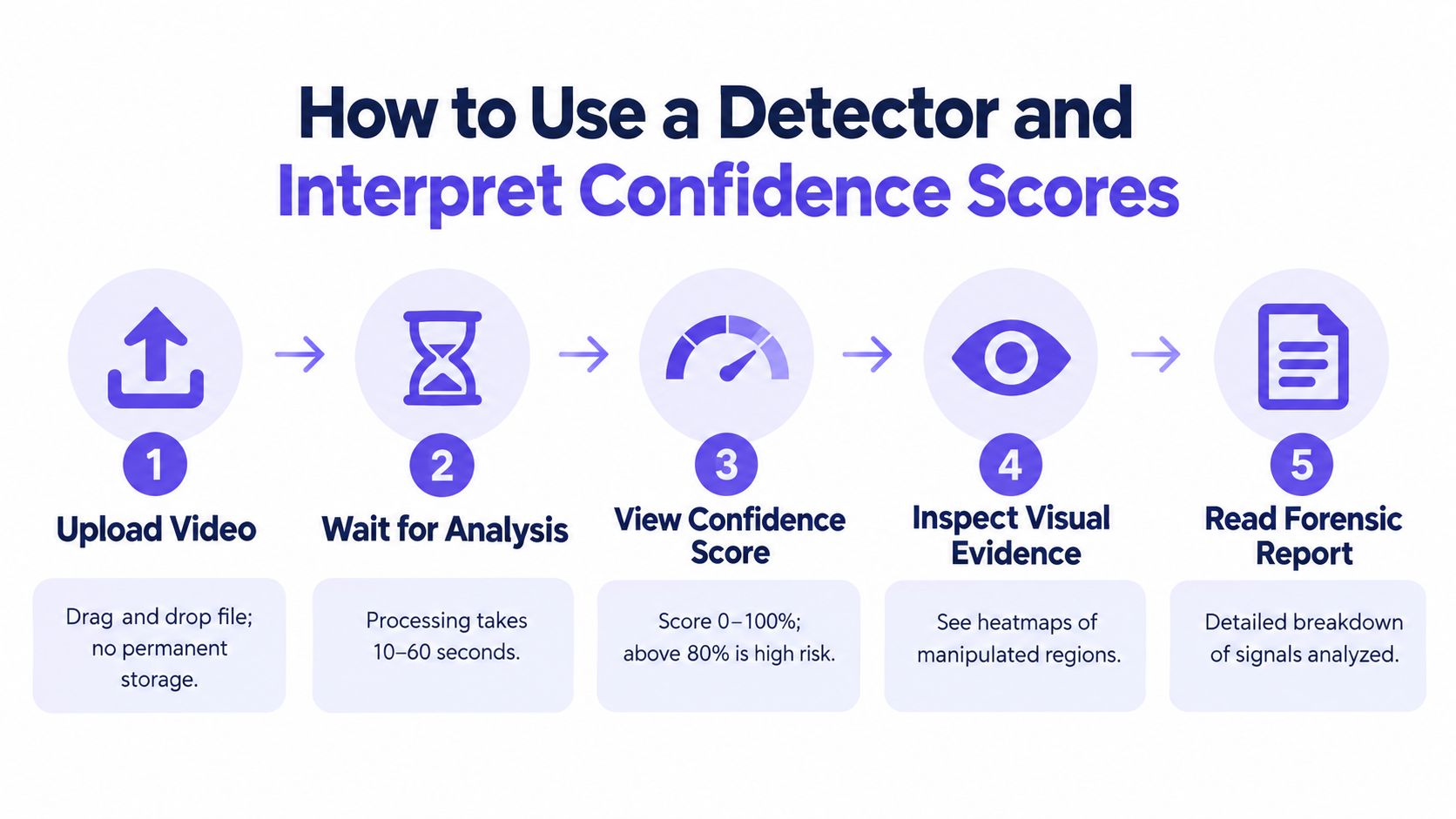
A repeatable examination
Preserve the source: Keep the downloaded or received file unchanged. Note its filename, source, transfer method, and any available context.
Check the service terms: Confirm whether the platform stores uploads, uses them for model training, restricts access, or permits deletion. Don't upload privileged evidence or confidential footage until those conditions are acceptable.
Run the analysis: Submit the working copy and wait for the system to inspect the available frames, audio, timing, and metadata. A missing track or stripped metadata should appear as a limitation, not disappear without notice.
Read the score with context: A confidence score expresses how strongly the detector's signals align with manipulation. It isn't a universal probability that the entire event is fake. A borderline result needs more investigation, while a high result should trigger corroboration rather than automatic publication or rejection.
Review the evidence: Look at flagged regions, frame examples, audio findings, timing observations, and file-history notes. A result becomes more useful when several independent signals point in the same direction.
For a deeper treatment of score reliability, see confidence calibration for detector outputs.
What to record
Create a short examination log. Include the original file identifier, the analysis date, the tool and version if available, the score, the signals examined, known limitations, and the person who reviewed the output. Save the report alongside the working copy, but keep the original protected and unchanged.
Interpretation rule: A confidence score tells you how the system assessed this file under its current conditions. It doesn't certify the speaker's identity, the event's truth, or the source's intent.
Never use human eyeballing as the final fallback. The human-performance evidence cited earlier shows why apparent confidence can exceed actual skill. A second detector, reverse-source investigation, direct contact with the alleged speaker through a known channel, or expert forensic review may be appropriate when the consequences are high.
Real World Applications for Newsrooms Legal Teams and Enterprises
A detector becomes valuable when it fits a decision, not when it sits unused in a dashboard. Different teams need different escalation paths, evidence standards, and response times.
Newsroom verification
A reporter receives user-submitted footage during a developing story. The reporter preserves the original, checks the source's account and location claims, runs a detector on a working copy, and compares the result with independent footage or direct testimony.
A suspicious result doesn't automatically settle the story. It tells the editor to pause publication, seek corroboration, and avoid presenting the clip as authentic until the evidence supports that conclusion. A low-risk result also isn't proof that the event happened. Source verification remains separate from media integrity analysis.
Legal and investigative review
Legal teams need repeatability. They should document the original artifact, every transformation, the detector report, and the limits of the examination. A detector can identify signs of manipulation, but admissibility and evidentiary weight depend on jurisdiction, provenance, expert testimony, and the complete chain of custody.
Investigators should avoid overwriting the source file during format conversion. If a copy is needed for analysis, label it clearly and preserve the relationship between the original and derivative files. When a result could affect a case, obtain an independent review rather than presenting an automated score as conclusive forensic proof.
Enterprise security
An executive impersonation video may arrive with an urgent payment or access request. The security team should treat the media scan as one control within a broader process. Employees still need to stop the request, verify it through an established independent channel, and report the interaction.
A suspicious video may be part of a larger campaign involving email, voice, messaging, and account activity. Security teams should preserve all related artifacts and inspect the delivery path, not just the video. Teams that also handle synthetic speech can consult practical tools for detecting AI audio because a video investigation may depend on the soundtrack.
Platforms and educators
Moderators can use detection to prioritize human review of high-risk clips. Educators can check lecture recordings, training material, or submitted presentations when authenticity matters. In both settings, the output should support a policy decision, such as label, restrict, escalate, or request provenance, rather than operate as an invisible automatic verdict.
Organizations can map these workflows to AI video detector use cases, then adapt the controls to their own risk tolerance, privacy obligations, and review capacity.
Building a Reliable Verification Workflow for the Future
Detection will remain a moving target. New generation systems can change the artifacts that detectors rely on, while compression and re-encoding can erase useful traces. The September 2026 benchmark report on newer AI-generated video illustrates the problem: nine state-of-the-art detectors fell from an earlier AUROC range of 75.6 to 94.3 on CelebDF++ to 44.0 to 69.7 on DF26, and one detector lost 46.1 points (benchmark report on current deepfake detection reliability). People in that evaluation judged clips as fake only 52.6% of the time, close to chance.
That finding changes procurement. Teams shouldn't ask only, “What is this tool's accuracy?” They should ask, “How does it perform on the media we receive, after the transformations our platforms and users apply?”
A durable operating model
Build the workflow around four controls:
Technology: Use a detector that examines more than one signal, explains its result, and receives meaningful updates as manipulation methods change.
Process: Require independent verification for publication, evidence acceptance, payments, access changes, and other high-consequence actions. A convincing video shouldn't override an established approval path.
People: Train staff to recognize suspicious context, but don't frame training as a promise that employees can reliably identify every fake by sight or sound. A 2026 thesis describes deepfake detection as a perceptual limitation rather than a media-literacy problem, while related research found a correlation between self-reported media literacy and perceived ability, not proof of actual accuracy (research on media literacy and perceived detection ability).
Governance: Record results, review false positives and false negatives, protect uploaded content, and define who can publish, admit, approve, or escalate a disputed file.
Re-test before trust expires
Run periodic evaluations using recent, relevant material. Include compressed clips, audio-video mismatches, localized edits, multilingual content, and files with incomplete metadata. Compare detector output with expert review and known provenance where available.
Operational principle: Confidence should accelerate a verification workflow, not replace one.
Newsrooms can add detection to their pre-publication checklist. Legal teams can include it in digital-evidence protocols. Enterprises can connect it to fraud response and executive verification. Platforms and schools can use it to prioritize review while preserving human accountability.
Adopt a privacy-first deepfake video detector workflow now. Define your approved tool, document how reviewers preserve files and interpret scores, and run a small test with representative footage before a high-stakes incident forces your team to improvise.