

Deepfake Detector Guide: Limits and How to Choose

A near-perfect benchmark score doesn't prove that a deepfake detector will identify the next video sent to your newsroom, legal team, or finance department. It shows how the system performed on particular material under particular conditions. A clip made with an unfamiliar generator, compressed by a social platform, or recorded off a screen can present a very different test.
Think of a detector as a forensic editor's first-pass tool, not a witness who can establish where a file came from. Its score can help decide what to inspect next, but it can't replace the original recording, a documented chain of custody, or human judgment. The practical question isn't “How accurate is it?” It's “How was it tested, and what should we do when its signals don't agree?”
What a Deepfake Detector Is Really Deciding
A clip arrives in a newsroom chat. Someone needs to know whether it's authentic before publishing a story. A legal team receives a video as evidence, or an employee gets a video call that appears to show an executive approving a payment. In each case, people may want a quick yes-or-no answer. A deepfake detector can't provide proof of origin in the way a chain-of-custody record can.
Instead, the system estimates whether the file resembles patterns it learned during training. That estimate can be useful, but it's not the same as a verified account of who created the media, how it was edited, or whether it has been altered. A confidence score may describe similarity to known manipulation patterns, not the probability that a court or the recipient's organization should treat the video as fake.
Familiar fakes are easier to test
A detector can perform strongly when it sees the kinds of examples used in its training and evaluation. The more difficult question is how it handles a new generator, a platform recompress, a partial clip, unusual lighting, a screen recording, or a diffusion model it hasn't encountered.
A 2025 evaluation of deepfake detectors in the wild found that fine-tuning could produce strong in-domain performance without meaningful zero-shot generalization to previously unseen generative models. A separate benchmark spanning multiple datasets also found that training on newer fakes alone doesn't guarantee reliable performance on unfamiliar material. Paired real and fake clips from the same source video can help reduce shortcut learning, because the scene and identity stay roughly constant while manipulation changes.
That's why a high score on a familiar benchmark doesn't settle the question for a new upload. The benchmark describes a test environment. Your file has its own history.
Practical rule: Treat a strong detector score as a reason to investigate, not as proof of authenticity or manipulation.
An uncertain score isn't necessarily a broken result. It can be an honest signal that the clip doesn't resemble the material the model knows well. Before using a score to publish, file evidence, or authorize a payment, ask what material the detector was tested on and whether that material resembles the clip in front of you.
How a Deepfake Detector Reads a Video
A single video still is like one page pulled from a case file. You might notice a smudged edge around a face, but the page can't tell you whether the person's movement was natural, whether the voice matched the mouth, or how the file changed before it reached you. A video is a sequence of images plus sound and file history, so useful detection examines more than one frame.
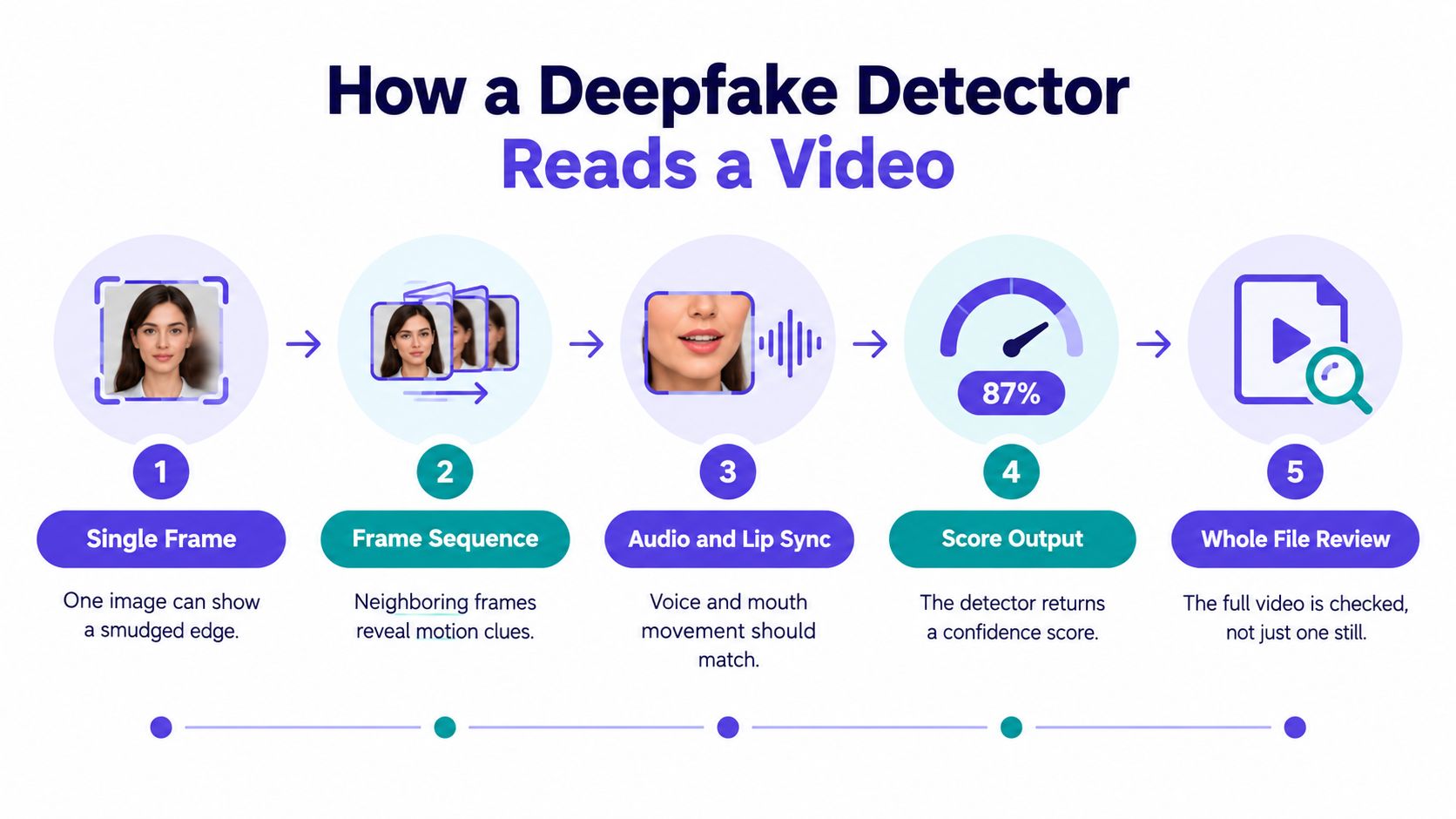
From image details to motion
Frame-level analysis looks for visual patterns that may suggest manipulation. These can include irregular textures or boundaries and artifacts associated with generative methods such as GANs or diffusion models. A detector can flag a face that looks convincing to a person if the pixels still contain patterns the model associates with synthetic media.
But a single frame leaves out what happens around it. Temporal analysis checks neighboring frames for unstable facial boundaries, identity drift, or motion that doesn't flow naturally. A frame classifier might find each still plausible on its own, while a sequence reveals a face that seems to shift as the person turns or speaks.
Sound and file history add context
Audio forensics examines the soundtrack for anomalies and compares speech with visible mouth movement. A voice that doesn't match the lips, or a mismatch between audio and video timing, gives an investigator a reason to examine the clip more closely. Neither mismatch alone proves manipulation, since edits and dubbing can also affect synchronization.
Metadata and encoding inspection looks beyond what's visible and audible. File properties can provide clues about how media was processed, although metadata may be missing or altered. Taken together, these are four evidence types: frame details, temporal behavior, audio, and file characteristics. None should be treated as the entire verdict.
The FaceForensics++ benchmark paper provides a clear example of why processing history matters. The 2019 benchmark included more than 1.8 million manipulated images and a hidden test set. In its experiments, an Xception-based detector reached 99.03% accuracy on uncompressed raw data, but accuracy fell to 95.42% with high-quality compression and 80.49% with low-quality compression. A frame-level score on a clean file, then, can't describe how the same detector will perform after ordinary file processing.
Where Deepfake Detectors Lose Accuracy
A detector may learn a clue that works in a research dataset but disappears by the time a clip reaches an investigator. That's distribution shift: the file in front of the model differs from the files it learned from. Codecs, resizing, frame-rate conversion, cropping, and screen recording can all change a video's fine detail or timing.
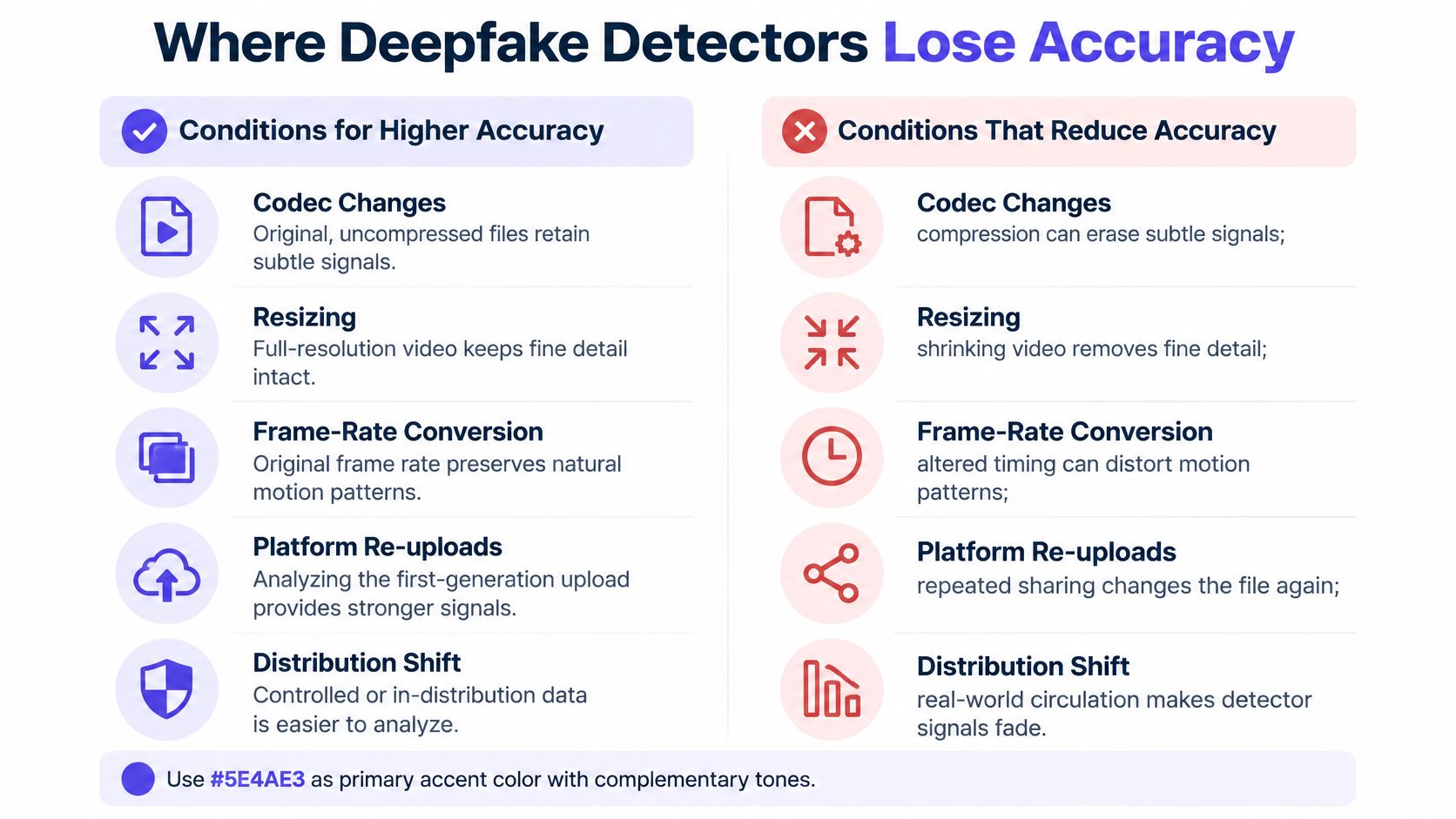
Ordinary processing changes the evidence
Social platforms often re-encode uploads. A clip may be compressed again when someone downloads, forwards, and re-uploads it. Those steps can weaken subtle image patterns, alter motion, or remove file information that a detector might use. The video may still look clear to a person while providing less useful forensic detail to a model.
For a practical inspection, compare the original file with versions processed through H.264 or H.265 bitrate changes, resolution changes, frame drops, cropping, audio resampling, and variable frame rates. A detector's result should be tested across such conditions, not only on a clean input. For more detail on what a video's file properties can and can't tell an investigator, see this guide to metadata requirements for video analysis.
Adversarial pressure is a different problem
Ordinary processing happens during routine sharing. Adversarial manipulation is deliberate. A person who knows how a detector works may alter a clip to push it across the system's decision boundary. A survey of deepfake detection research reported that performance commonly degraded by about 10% to 15% in out-of-distribution tests. It also reported that white-box attacks succeeded at rates exceeding 80% against vulnerable detectors. That finding concerns detectors susceptible to attacks where the attacker has detailed knowledge of the model, not every tool in every situation.
Keep disagreement visible rather than flattening it into one reassuring number. Strong visual flags paired with clean audio and absent metadata should prompt a request for the original file or expert review. It shouldn't be averaged into a confident verdict that hides what each signal found.
How to Evaluate a Deepfake Detector
A vendor's headline accuracy tells you little unless you know the test data and conditions behind it. Prefer evidence that shows how a deepfake detector performs across datasets, manipulation types, and the processing steps common in your own workflow.
DeepfakeBench provides a standardized way to compare 34 detectors across 10 image and video datasets. That breadth matters because a detector may learn shortcuts instead of general signs of manipulation. If real clips tend to come from one camera and fake clips from another, for example, the model could rely on camera or encoding differences rather than learning what makes a manipulation.
Independent benchmark evidence reports accuracy decreases of roughly 15% to 30% when models move from familiar training distributions to unseen test sets. The exact drop depends on the model and evaluation conditions. The broader point is that a within-dataset score can hide what happens when a tool encounters unfamiliar material.
Ask what each test reveals
| Test condition | What a pass or fail shows | Risk if it's missing |
|---|---|---|
| Leave one dataset out of training | Whether the detector generalizes beyond familiar source material | A strong score may reflect familiarity with one dataset |
| Use unseen manipulation families | Whether it can identify methods it wasn't trained on | New generators may escape detection |
| Recompress or resize test clips | Whether performance survives common changes to files | Clean-file results may not apply to shared uploads |
| Test clips resembling deployment | Whether the score reflects your actual workflow | Vendor tests may not match newsroom, legal, or enterprise media |
| Calibrate the decision threshold on representative material | Whether alerts fit the consequences of errors in your setting | A single default threshold may create poor decisions |
Training with paired real and fake versions of the same source video can help control for identity and scene differences. That makes it harder for the model to rely on background or subject characteristics as shortcuts.
When reviewing results, distinguish the detector's precision-recall trade-off: different thresholds can change how often it misses manipulations or flags authentic content. Ask for per-signal results, uncertainty, and evaluation conditions, not just a binary real-or-fake label.
Fairness Gaps Across Voices and Faces
An overall score can conceal who is more likely to receive a false flag or whose manipulated media is more likely to pass. That matters in any workflow where the video affects a person's reputation, access, employment, or legal case. A detector should be examined across the identities, languages, and media combinations it will encounter.
A 2025 fairness-oriented study reported AUC scores of 66.85% on DFDC and 91.15% on DFD for its method. AUC is a measure of how well a system distinguishes classes across different decision thresholds. The contrast shows that performance can vary substantially between datasets. It doesn't, by itself, explain the cause of the difference or establish how the method will perform for every population.
Test the whole communication, not just the face
A face swap is only one kind of manipulation. A clip may pair a synthetic face with cloned speech, dub a real speaker into another language, or preserve authentic video while changing lip movements. In these cases, a visual-only detector can miss important context.
The same study reported 80.1% AUC for the leading multimodal approach on a challenging benchmark of coordinated video-and-audio forgeries. Even a system that analyzes both modalities shouldn't be treated as a universal verdict. A strong video signal alongside inconclusive audio calls for different scrutiny from a video that shows no concern but has suspicious speech or synchronization.
Before deployment, ask for separate results by dataset or population, language, video-only versus audio-video material, and documented false positives. Newsrooms, courts, and enterprise investigators should also specify what happens when an error could harm a person. When visual evidence doesn't answer the question, seek provenance records and qualified human forensic review rather than running the same uncertain clip through another automated tool.
Choosing a Detector for High-Stakes Work
The right tool depends on the decision it will support. A newsroom checking a clip submitted by a source doesn't need the same evidence package as a court reviewing an exhibit or a fraud team responding to an executive impersonation. In each case, a score should be one part of a documented process.
Match the evidence to the job
For a newsroom, start with the original user-submitted file if available. Check the visual and audio findings separately, seek corroboration, and hold publication if the signals conflict or the file is only a compressed social copy.
For a legal or law-enforcement team, preserve the source file and record the analysis method, model version, and transformations. An automated score can help guide an investigation, but it doesn't establish origin or replace a forensic examiner's documented work.
For enterprise security, a video call that appears to show an executive authorizing a payment should trigger an independent verification step. A detector may help flag suspicious content, but payment and access decisions should not depend on a video score alone.
For educators and moderators, a tool can help prioritize a lecture or viral clip for review. If the result is uncertain, label that uncertainty and gather more context rather than deleting or endorsing content based on a single probability.
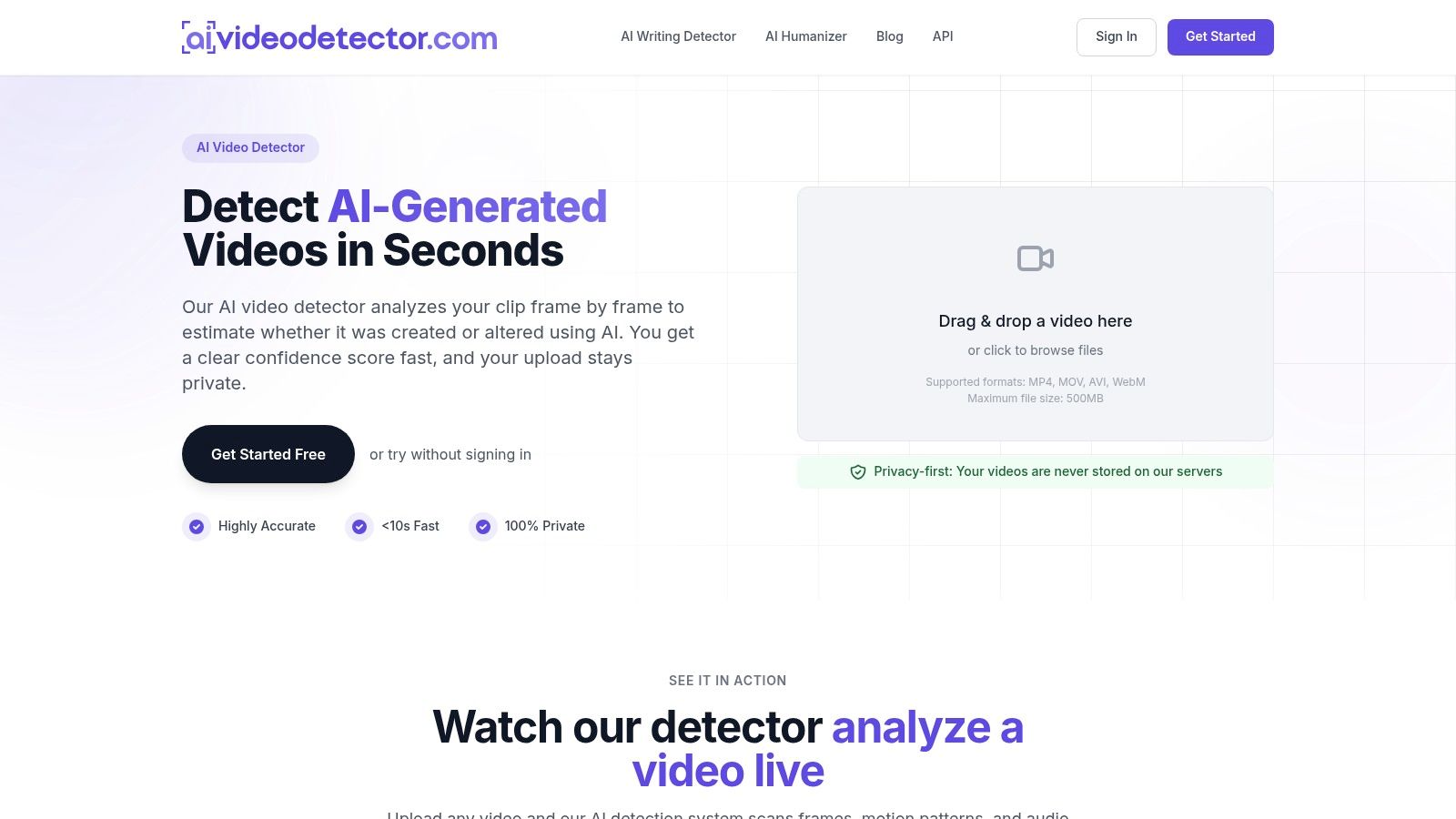
Whatever the use case, check that the tool reports more than one independent signal, shows disagreements between them, supports common file containers, states its size limits, and presents confidence without pretending it's certainty. AI Video Detector is one option described by its publisher as checking uploaded video through frame-level analysis, audio forensics, temporal consistency, and metadata inspection. The publisher lists support for MP4, MOV, AVI, and WebM files up to 500MB, says videos aren't stored, and states that basic detection doesn't require signup. Treat those specifications as product information, not independent evidence of detector accuracy.
A product overview can help clarify what the interface reports, but it can't settle whether a particular clip is genuine.
What to Do with an Uncertain Score
Ask the tool or lab to separate results by the conditions that can change what it sees. A single aggregate score can hide a clean result on pristine files and a weak one on material more like your actual case.
Request four result buckets:
- Pristine files: What happens when the input hasn't been heavily processed?
- Compressed or re-encoded uploads: Does performance hold after platform sharing or conversion?
- Cross-generator tests: Has the detector been evaluated on manipulation methods outside its familiar training material?
- In-the-wild clips: How does it handle media with real-world lighting, edits, and recording conditions?
Then set review rules according to the decision. A newsroom should pause publication when signals disagree or the clip is a recompressed social copy. A legal team should preserve the original and document the model, version, and transformations. A fraud team should verify a synthetic-looking executive video through a separate, trusted channel before money or access moves. Educators and moderators should label uncertainty instead of acting on a single probability.
Continual training on newer fakes alone may not close the generalization gap. Paired controls and testing against unknown pipelines matter too. For teams formalizing those handoffs, escalation procedures for uncertain detection results can help turn a warning into a consistent review process.
Upload the original file, not a screen recording, to a multi-signal detector such as AI Video Detector. Read each signal beside the confidence score, and escalate to human review whenever the signals conflict or the clip has been heavily recompressed.


