

Audio Forensic Analysis: A Complete Primer for Verification

Audio forensic analysis emerged as a formal discipline in the 1960s and 1970s, and it now combines classical signal examination with modern methods for detecting synthetic speech. If a newsroom receives a recording that could change a story, or a legal team must authenticate a disputed conversation, the central question is not just whether the voices sound convincing, but what the recording can prove.
A listener may hear a natural conversation. An examiner may see a discontinuity in the background noise, an unexpected spectral transition, or evidence that separate files were joined. The work turns sound into inspectable evidence, while keeping a strict boundary between what the recording shows and what an analyst infers from it.
What Audio Forensic Analysis Actually Means
Suppose a journalist receives an audio file said to capture a private conversation. The source claims it was recorded continuously on a phone, but nobody can independently confirm when, where, or how the file was created. A legal team faces a similar problem when an opposing party submits a voice recording and argues that it proves a statement was made.
Audio forensic analysis is the scientific examination of recorded sound to assess authenticity, identify possible manipulation, compare speakers, and extract evidentiary information. It isn't a single button that labels a file real or fake. It is a multi-signal examination that may include the waveform, spectrogram, background sound, recording characteristics, metadata, encoding behavior, and voice features.
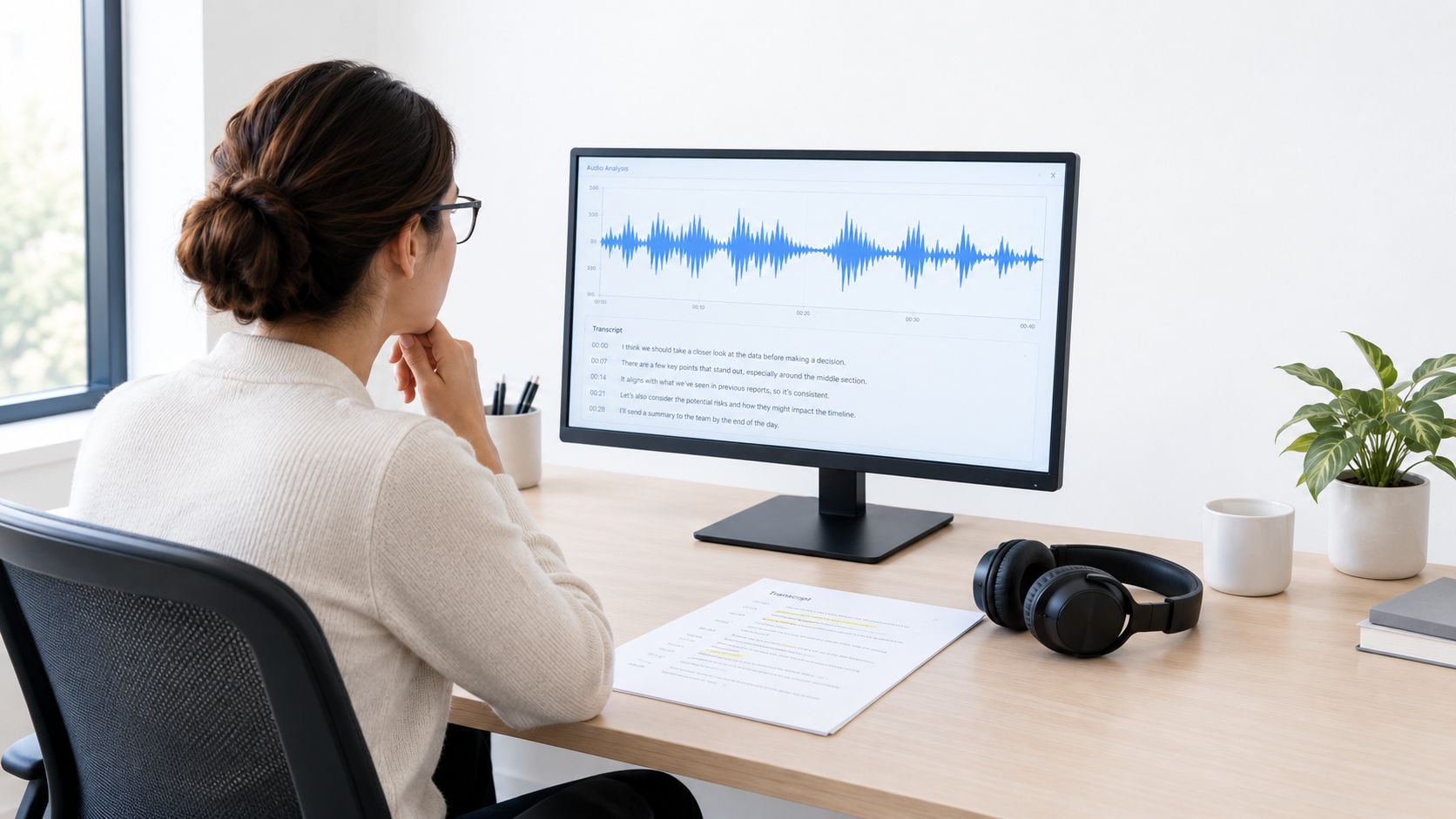
The examiner starts with questions
A responsible examination begins by defining the claim under review:
- Authenticity: Does the file appear consistent with a continuous recording, or are there signs of editing?
- Source: What recording technology, format, or processing history might explain the signal?
- Content: What speech, background sound, or timing information can be recovered without changing meaning?
- Speaker evidence: Does a questioned voice warrant comparison with known samples?
- Manipulation: Are anomalies more consistent with ordinary compression, environmental interference, splicing, or synthesis?
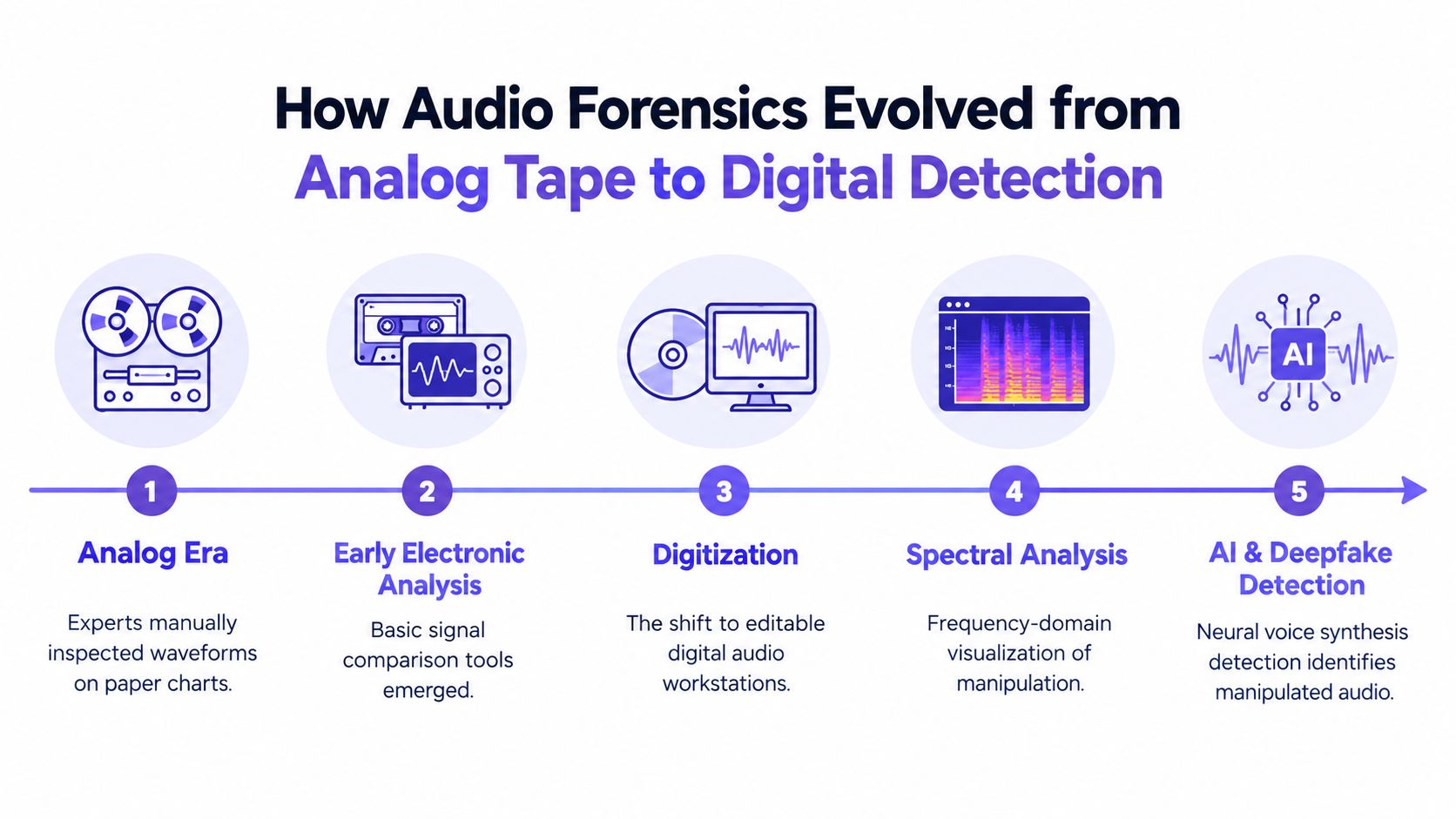
The history of the field explains why examiners use several signals at once. Earlier practitioners examined physical tape splices, speed variation, and background-noise continuity. Modern specialists can also examine codec fingerprints, quantization behavior, metadata, spectral patterns, and indicators associated with AI-generated speech. The transition from analog tape inspection to digital and synthetic-media analysis is documented by the history of audio forensics.
The practical conclusion is modest but important. Audio forensics rarely proves a broad story by itself. It can identify features that support continuity, reveal an apparent edit, challenge a claimed source, or show that further examination is necessary. A newsroom should report those findings precisely, rather than converting a technical anomaly into an unsupported accusation.
How Audio Forensics Evolved from Analog Tape to Digital Detection
A disputed recording can enter a courtroom or newsroom with one basic problem: its medium may preserve clues about how it was made. Magnetic tape exposed physical splices, speed changes, and shifts in background sound. Digital files expose different traces, including compression behavior, quantization, metadata, and processing history. Synthetic speech introduces another set of signals. The history of audio forensics is therefore a history of changing evidence, not a simple march toward better listening.
Sound capture began with a 10-second recording made in France on 9 April 1860. Later technologies created new examination problems. World War II-era signal interception raised questions about recording and transmission conditions, while portable magnetic tape recorders in the 1950s made recorded conversations easier to collect, copy, and challenge. Each medium left its own forensic signals. A tape cut could disturb continuity. A digital conversion could change the file's measurable properties. Generated speech could produce unusual relationships among pitch, timing, harmonics, and phase.
The Watergate investigation showed why those distinctions mattered in legal review. Experts examined the 18.5-minute gap in President Nixon's tapes. A federal court commissioned six technical experts in 1973, followed by a forensic report released on 31 May 1974. The dispute required more than listening to the missing conversation. Examiners had to ask how the signal was recorded, interrupted, copied, and preserved, then explain what those features could and could not establish.
From voiceprints to acoustic comparison
Speaker identification brought a separate warning about overconfident conclusions. The 1960s “voiceprint” approach was later rejected, and a 1979 National Science Foundation report concluded that voiceprints had no scientific basis. Forensic practice shifted toward more rigorous oral acoustic speaker identification methods, as described by the National Institute of Justice overview of voice identification.
That distinction remains practical. A convincing voice is not automatically an identified speaker, just as a visible waveform is not proof of an untouched file. In court or in a newsroom, analysts must connect each observed anomaly to a recording process, test competing explanations, and state the limits of the finding.
Understanding Spectral Analysis and Frequency-Domain Examination
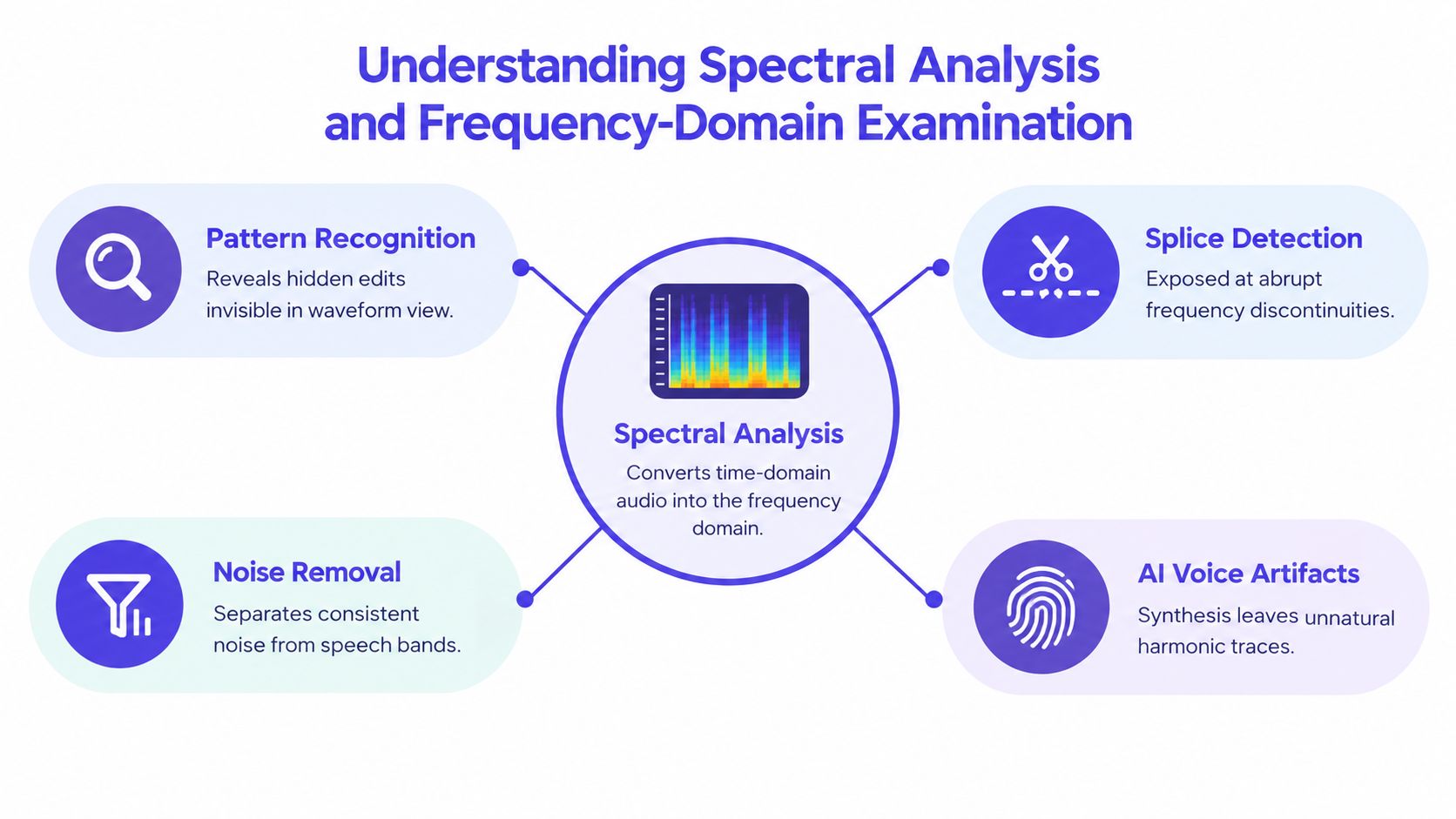
A newsroom receives an audio file containing a disputed sentence. The waveform shows amplitude changing over time, but a brief edit can hide inside an otherwise continuous trace. Spectral analysis provides another view by representing the signal through its frequency content, so an examiner can follow how energy is distributed as the recording progresses.
A spectrogram displays that information in a readable map. Time usually runs from left to right, frequency rises vertically, and color or brightness represents intensity. A listener may miss a short discontinuity. The display may reveal a sudden change in frequency structure, an inconsistent noise floor, or a sharp boundary between two segments.
Suppose the conversation was recorded in a room with a steady mechanical hum. If one sentence came from another recording, the join might appear in the waveform, yet the more informative clue could be a change in the hum's frequency pattern. The examiner compares that pattern with phase alignment, amplitude continuity, and the way speech energy interacts with the room sound.
The comparison can include several descriptors. Spectral centroid indicates where much of the sound energy is concentrated, while spectral bandwidth describes how widely that energy spreads. Zero-crossing rate helps characterize signal texture and transitions. Phase features describe the relationship and timing of waveform components. Longer-term patterns, such as rhythm, pitch movement, and speaking behavior, can expose changes that short analysis windows miss.
These measurements are observations, not verdicts. A different speaker, microphone position, room response, or background activity can produce a legitimate shift. The examiner tests whether the findings fit one recording history or support competing explanations.
For a visual introduction, read what spectral analysis reveals.
In legal review or newsroom verification, a spectrogram can identify a transition without identifying its cause. It cannot establish who edited the file, why the change occurred, or whether conversion produced the artifact. Analysts therefore preserve the original, record each processing step, and compare anomalies with the file's known technical history.
Practical rule: Treat a spectral anomaly as a finding to investigate, not as a complete conclusion.
Detecting Audio Splicing and Synthesis Fingerprints
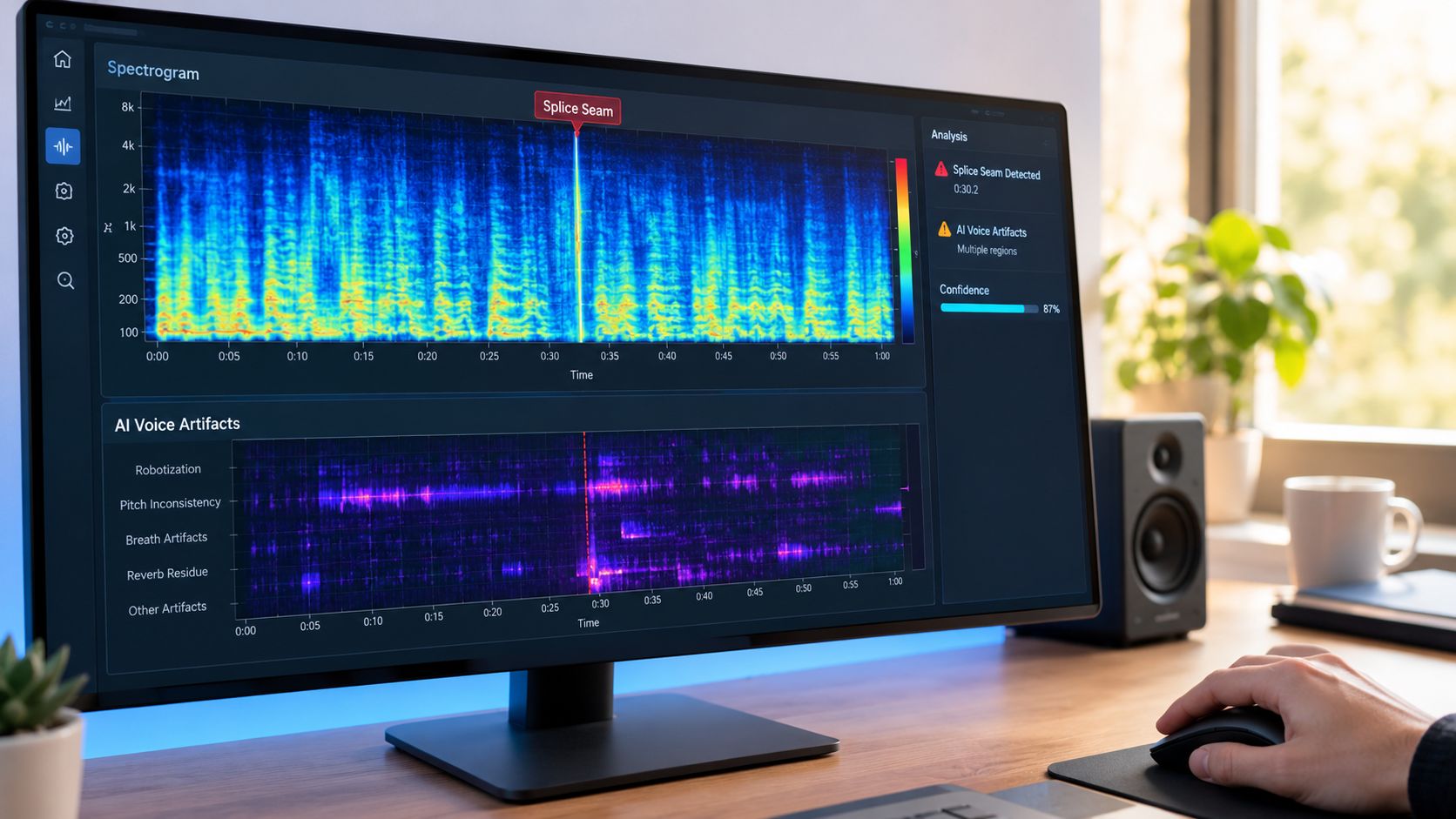
A newsroom receives a recording that appears to capture a private conversation. One sentence has cleaner background noise than the next, or a voice sounds unusually polished. Those clues justify examination, not an immediate claim of fraud. Splicing joins segments made under different recording conditions, while synthetic speech is generated or altered by a model. Both can leave evidence in spectral, temporal, or phase behavior.
For a suspected splice, the examiner compares the background-noise profile on both sides of the edit. Does the room sound continue naturally? Do encoding characteristics remain consistent? Does the waveform or spectrogram show an abrupt transition? Metadata can add context, but it cannot replace signal examination. Exporting or rewriting a file may change metadata without changing the underlying event, and may also create artifacts that resemble manipulation.
Why feature combination matters
Synthetic-speech examination is stronger when several representations point to the same passage. Field reviews describe combinations of short-term spectral measurements and longer-term prosodic cues, including MFCC, LFCC, CQCC, spectral centroid, spectral bandwidth, zero-crossing rate, and phase-based features. One evaluated system combined fundamental frequency, or F0, with real and imaginary spectrogram features and reported an equal error rate of 0.43%, as described in this review of deepfake speech detection features.
That figure belongs to the tested conditions. A detector may behave differently with another microphone, codec, language, acoustic environment, or voice-generation system. The gap between bench-study accuracy and real-fraud reliability matters in both court review and newsroom verification.
An investigator should ask two practical questions:
- Where does the recording appear unusual? Mark time-frequency regions, transitions, or voice segments for closer examination.
- What explanation best fits the evidence? Compare synthesis and splicing with compression, noise reduction, transmission effects, or an ordinary change in the recording environment.
A voice-cloning alert carries more weight when it matches localized spectral or phase evidence and a documented break in the file's known history. A detector score alone remains an indicator, not proof. For a broader technical explanation, consult this guide to deepfake audio detection.
Why Chain of Custody Matters in Digital Audio Evidence
A journalist receives a recording through a messaging app and saves it to a laptop. The file may sound unchanged, yet its evidentiary value now depends on questions that listening alone cannot answer: who supplied it, which version was examined, and whether anything happened during transfer or processing?
Digital audio makes provenance difficult because a copy can match the source in content while its history remains uncertain. Begin by preserving the received file exactly as it arrived. Create a verified working copy, record how the file was acquired, retain available metadata, and document every conversion, filter, enhancement, and export. A hash can show that the working copy corresponds to the preserved source. An access log records who handled each version and when.
The case record should make the examination traceable from receipt to conclusion:
- Acquisition: Identify the supplier, transfer channel, and information provided about the recording's creation.
- Preservation: Record where the original is stored and how access is controlled.
- Analysis: Name the software, settings, filters, and exported files used.
- Interpretation: Separate observed features from explanations that remain uncertain.
- Presentation: Provide enough detail for another qualified reviewer to understand and reproduce the work.
Chain of custody does not prove that a recording is authentic. It shows whether the examination rests on a controlled, identifiable piece of evidence.
The same discipline appears in physical-evidence work. Teams may use controlled environments and documented procedures, including lab evidence drying equipment for materials requiring careful preservation. Audio files need different safeguards, but the sequence is comparable: protect the item, document its handling, then interpret it.
Newsrooms should follow that sequence even without a pending case. Save the received file, retain the message or transfer record, document the source's account of how it was created, and keep enhanced versions separate. A chain of custody template can help a team apply those steps consistently.
Integrating Audio Forensics with Video Verification Workflows
A video submitted to a newsroom may show a genuine protest while carrying a replaced soundtrack. The reverse also occurs: authentic speech is paired with unrelated footage. A cloned voice over real images creates a composite that can pass an audio-only or video-only check.
Audio and video should therefore be examined as connected evidence. Analysts compare the timing of visible actions with expected sounds, mouth movements with speech, and room acoustics with the apparent location. File metadata and export history can also indicate whether the components plausibly originated together. These comparisons do not prove authenticity by themselves, but they can expose relationships that an isolated test misses.
Isolated checks versus combined review
| Isolated audio review | Integrated audio and video review |
|---|---|
| Examines waveform, spectrum, voice features, and file properties | Adds frame timing, lip movement, scene continuity, and cross-file metadata |
| Can identify suspicious audio transitions | Can reveal a mismatch between an authentic track and unrelated footage |
| May miss manipulation outside the audio stream | Can expose a composite attack affecting multiple signals |
| Produces findings about the soundtrack | Assesses whether the media components belong together |
For user-submitted footage, a newsroom can preserve the received video before creating working copies. Audio and frames are then examined separately, followed by a comparison of speech timing, mouth movement, visible events, and background sound. A suspected voice-cloning fingerprint is a lead for this comparison, not a final verdict.
A visible door closing should align with the corresponding sound. Speech should follow the speaker's mouth with plausible timing. Repeated ambience or an abrupt change in reverberation may suggest that the soundtrack was edited or replaced. Each observation needs to be tied to a time range so another reviewer can check it against the same file.
Legal teams apply similar checks to body-camera footage, interview recordings, and surveillance exports. They may need to establish whether the file was re-encoded, whether its audio track changed, and whether the sequence remains continuous. Enterprise security teams can use the same approach when reviewing a suspicious executive video call for cloned speech and manipulated imagery.
AI Video Detector combines frame-level analysis, audio forensics, temporal consistency checks, and metadata inspection in one workflow. Its output can help direct attention to relevant sections, while preservation, manual comparison, and expert interpretation remain necessary when the consequences are serious.
The Gap Between Lab Accuracy and Real-World Reliability
An automated detector flags a recording from a newsroom source. The result looks precise, yet the system was tested on different material. Its benchmark score answers a narrow question: how it performed on that evaluation set under those conditions. It does not establish how well it will handle a fraud-oriented deepfake made with another generator, passed through another platform, or combined with background sound.
A 2026 study reported that detectors trained on benchmarks “are not resilient” when used directly against modern fraud-oriented deepfakes, as discussed in the WACV 2026 SAFE research paper. Investigators should therefore treat an automated score as a way to prioritize examination, not as authentication. The file's origin, signal quality, and suspected manipulation region still require review.
A speech-centric blind spot
Published audio deepfake research often centers on speech, while evidentiary recordings may contain music, singing, sound effects, machinery, traffic, room ambience, or several sources at once. A detector developed mainly with clean speech may behave differently when those elements mask, alter, or supply the relevant signal.
The 2026 AT-ADD Grand Challenge was created to advance type-agnostic detection beyond speech and improve generalization across varied audio categories. That goal reflects a practical investigative problem: background noise can provide evidence. Consistent traffic, room tone, machinery, or reverberation may help assess continuity, location, or whether two passages came from the same environment. Removing it automatically can discard material needed for comparison.
Explainability sets another boundary. A useful forensic result should identify where a suspected manipulation appears in time-frequency space and indicate the likely source or process. A yes-or-no label gives an examiner little to test independently. Analysts need to compare the flagged passage with surrounding audio and the recording's documented history.
Use detection to generate questions. Then test those questions through manual inspection, source review, and comparison with other evidence.
Building a Practical Audio Forensics Workflow
A newsroom receives a recording that appears to capture a private conversation. Before anyone presses play repeatedly or applies enhancement, the investigator preserves the received file, documents its source, creates a verified working copy, and defines the claim under review. “Is this real?” is too broad. A testable question is, “Does the file support one continuous recording of the stated conversation?” or, “Does the questioned passage contain features inconsistent with the surrounding audio?” A clear question keeps technical findings tied to an evidentiary decision.
A disciplined sequence
Preserve the source. Keep the original file unchanged and record how it was obtained. Do not begin by converting it into a preferred format.
Document context. Record the alleged date, device, location, participants, transfer history, and known editing or export steps. Treat each detail as a claim to assess, not an established fact.
Inspect basic properties. Review the format, encoding information, duration, channels, and available metadata. These properties help explain the signal, but they do not authenticate it by themselves.
Listen without enhancement. Note interruptions, room-tone changes, unnatural transitions, clipping, and background events. Create a time-stamped log so later interpretation does not depend on memory.
Review the waveform and spectrogram. Examine suspicious regions at more than one scale. Compare speech, noise floor, harmonics, and transitions before and after each region. A spectrogram is a map of signal energy, not a verdict. It shows where to ask better questions.
Run automated detection cautiously. Use a detector for screening, then record the tool, version, input file, output, and stated limitations. A result from a clean benchmark may not transfer reliably to compressed, noisy, mixed, or edited evidence.
Cross-check independent signals. Compare the audio findings with video frames, transcripts, device records, messages, witness accounts, or other recordings. Agreement from separate evidence is more informative than running the same algorithm again.
Report findings precisely. Separate observations from interpretations. State what the evidence supports, what it does not establish, and what additional material could reduce uncertainty.
What a responsible conclusion sounds like
A report might state that a passage contains a localized spectral discontinuity and an inconsistent background-noise profile, findings consistent with an edit. It should not identify the person who made the edit unless other evidence supports that attribution. A synthetic-speech detector may flag a segment for examination, but the report should disclose recording conditions and the detector's limits.
Forensic discipline means narrowing the claim until the evidence can carry it.
Journalists can use this process to decide whether disputed audio merits publication and which qualifications belong in the story. Legal teams can prepare an examiner for disclosure and cross-examination. Security teams can pause a voice-cloning fraud attempt before an urgent request produces an irreversible action.
Before presenting or publishing disputed audio, preserve the original, document its provenance, and obtain an independent review of anomalies that could change the conclusion. Use spectral inspection and automated detection together, then have a qualified examiner state exactly what the evidence shows, what it suggests, and what remains unknown.


