

AI Scams: How to Spot Deepfakes and Protect Your Money

Your phone rings while you're finishing something else. The caller sounds like your child, your manager, or a supplier you know. They need you to send money, approve a payment, or open a document before a deadline. Nothing looks obviously wrong, but you're being asked to act before you can check.
That's the difficult part of AI scams: the familiar voice, polished message, or convincing video may no longer help you decide whom to trust. You don't need to become a forensic examiner to protect yourself. You need checks that work even when the impersonation looks flawless, plus a clear response if money has already left your account.
The Main Types of AI Scams at a Glance
The FBI's 2024 Internet Crime Report recorded 859,532 complaints and $16.6 billion in reported losses across internet-enabled crime, not AI scams alone. Those totals cover reported incidents, so they don't capture unreported scams or losses victims couldn't quantify.
An AI scam is fraud in which generative tools make a fake person, voice, message, or video more convincing. The criminal still needs you to do something: send money, surrender credentials, approve an account, or accept false evidence.
AI scam types, how AI is used and who is targeted
| Scam type | How AI is used | Typical target | Common loss route |
|---|---|---|---|
| Executive impersonation video call | Deepfake face and voice on a live call | Finance staff | Urgent wire transfer |
| Voice cloning | Cloned voice of a relative or executive | Families and assistants | Emergency payment request |
| AI-generated phishing | Personalized emails and messages written by chat tools | Employees and customers | Login theft or fake invoice |
| Synthetic identity fraud | AI-generated faces and documents | Lenders and platforms | Accounts or loans opened under a fake identity |
| Deepfake investment ads | Fake celebrity or expert videos | Retail investors | Deposits into fake trading platforms |
| Romance scam with AI media | Generated photos and videos presented as a real person | Dating app users | Gradual money transfers |
| Manipulated evidence | Altered video or audio used in disputes | Legal teams and newsrooms | Wrongful decisions or fake claims |
Match the scam to the decision
Executive impersonation targets someone's authority to release funds. Voice cloning targets a family member's fear or an assistant's willingness to help. AI-generated phishing can instead begin with account access, allowing the criminal to send subsequent requests from a genuine inbox.
Synthetic identity fraud works differently: the invented person becomes the applicant or account holder. Investment and romance scams cultivate confidence before asking for deposits or personal assistance. Manipulated evidence may not request payment at all, but can influence a settlement, publication, disciplinary action, or insurance decision.
The categories overlap, as this overview illustrates.
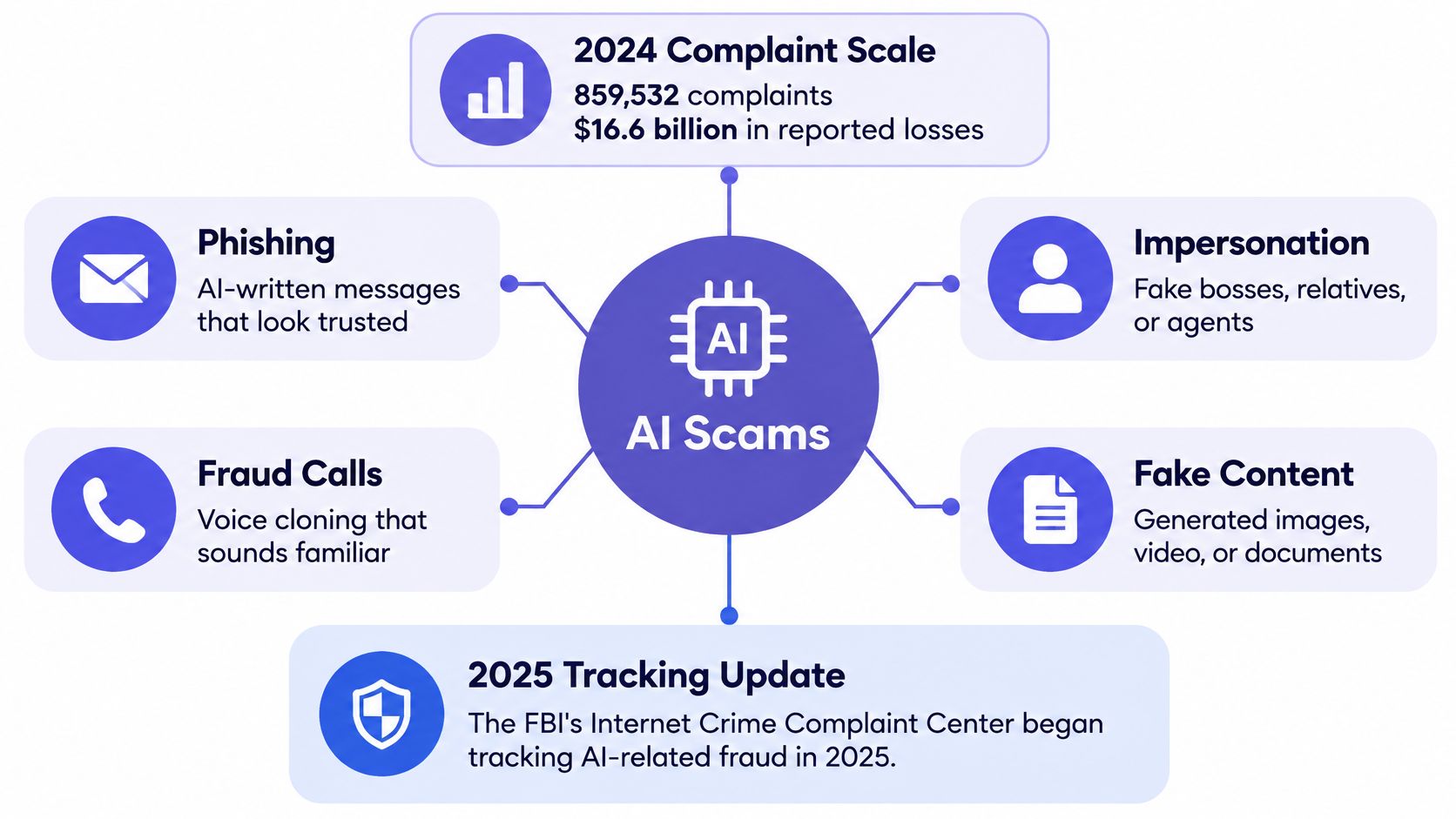
A fake rental listing, for example, might combine generated property footage, a stolen identity, and an urgent deposit request. A travel scam might use the same ingredients with a different story.
Classify the requested action, not just the media. That tells you whether you need a payment check, an identity check, an account-security response, or an evidence review.
Why AI Makes Familiar Scams Harder to Catch
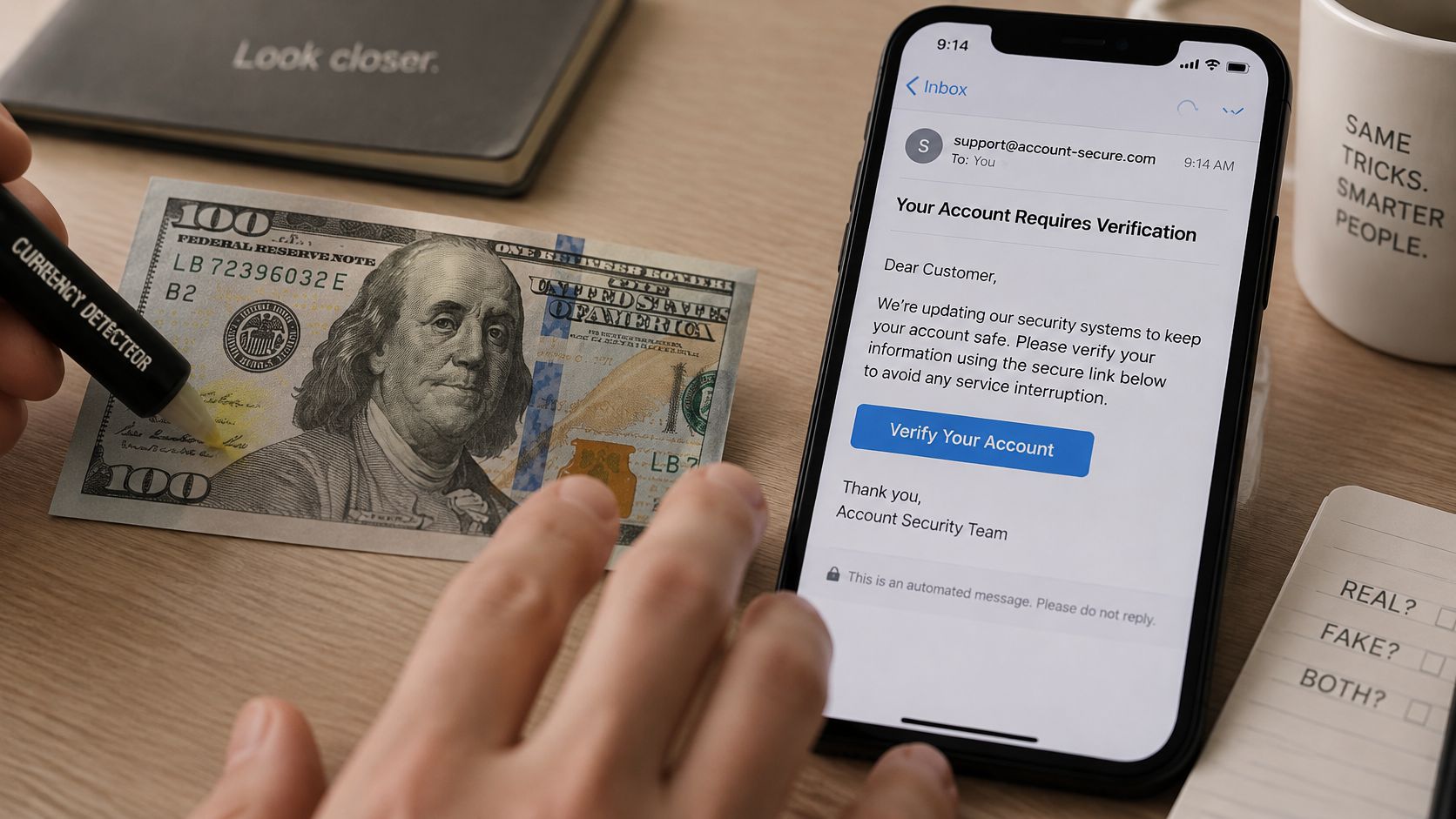
A counterfeit banknote that passes a detector-pen check hasn't become genuine. It has passed a particular test. A message with perfect grammar or a video with convincing facial movement deserves the same distinction.
The comparison matters because familiar screening habits can leave important questions unanswered.
The FBI's summary of its 2025 Internet Crime Report identifies AI-related fraud as a separately measured category, with 22,364 complaints involving artificial intelligence and nearly $893 million in reported losses. These are complaints involving an AI component, not just reports of suspicious-looking videos.
How the persuasion works
A criminal can start with public information: your job title, colleagues, published work, or a recent company announcement. A message that references the right project feels more credible than an anonymous demand, even though those details don't establish the sender's identity.
A cloned voice or face then provides apparent confirmation. You may stop examining the request because you believe you've recognized the person making it. The criminal follows with a deadline, an emergency, or a confidentiality demand that discourages consultation.
Finally, the requested payment turns mistaken trust into financial harm. Whether funds can be recovered depends on the payment method and circumstances, not on how realistic the impersonation looked.
A correct personal detail proves that someone knows the detail. It doesn't prove who they are.
Generative tools also let criminals adapt messages without manually writing every version. They can change the language, tone, professional vocabulary, or emotional appeal for different recipients. That makes personalization a weaker trust signal than it may appear.
Why polished communication isn't enough
Poor spelling still deserves attention, but good spelling shouldn't reassure you. Likewise, a familiar sender name doesn't establish control of the account, and a professional-looking investment briefing doesn't establish a legitimate investment.
For an additional explanation of the threat, this video provides another viewing format.
The useful defensive question is which action would stop the fraud even if the content were convincing? That might mean withholding approval, independently confirming a beneficiary, or requiring another authorized person to review the transaction.
You don't have to identify the generation technique. You have to prevent an unverified request from becoming an irreversible decision.
Warning Signs That Matter More Than Visual Tells
A realistic face or voice isn't proof that a request is genuine. Treat the following signals as reasons to stop and investigate, rather than clues you must combine into a technical diagnosis.
Request signals by channel and what to check
| Channel | Signal | Why it matters | Check |
|---|---|---|---|
| Video call | Request to move money during a live meeting | Live video can be faked | Confirm through a known phone number |
| Phone call | Voice asks for an urgent or unusual transfer | Voice cloning copies familiar speech | Call back on a saved number |
| Email or chat | Changed payment details or new beneficiary | Invoice fraud redirects money | Verify through a second channel |
| Any channel | Demand for secrecy or speed | Pressure discourages normal checks | Pause and escalate to another person |
| Investment offer | Celebrity or expert endorsing guaranteed returns | Deepfake ads borrow trust | Check the regulator's public warning list |
| Uploaded video or audio | Odd lip sync, flicker, or unnatural speech | Possible synthetic-media artifacts | Run detection and compare with the original source |
Examine the destination and the pressure
Use a conservative household or workplace rule: any warning signal means pause; multiple signals mean involve another person. That's a practical operating rule, not a statistical test of whether something is fraudulent.
Changed payment details deserve particular attention. A genuine invoice can be copied while its bank instructions are replaced, so confirming the amount and supplier name isn't enough. The critical question is whether the intended recipient controls the destination account.
Pressure is equally revealing. Ask what prevents normal verification. A legitimate urgent request should still allow an authorized colleague, family member, or institution to confirm it independently.
For a broader personal-finance checklist, The Coin Course's guide to protect your money from scams can help you turn warning signs into payment habits.
Check investment claims outside the advertisement
For an investment offer, search the relevant financial regulator's register and public warning list yourself. Compare the legal name, website domain, contact details, and permissions with the business approaching you. A criminal can impersonate a registered firm, so finding the name alone doesn't settle the question.
An empty warning-list search isn't an endorsement. Contact the firm through independently obtained details, and don't use the advertisement's support agent to verify the advertisement.
With uploaded media, mismatched lip movement or unnatural speech justifies further examination. It doesn't establish fraud. Equally, a smooth-looking clip shouldn't override suspicious payment instructions or an unverifiable source.
Verify Every Request and Set Standing Rules
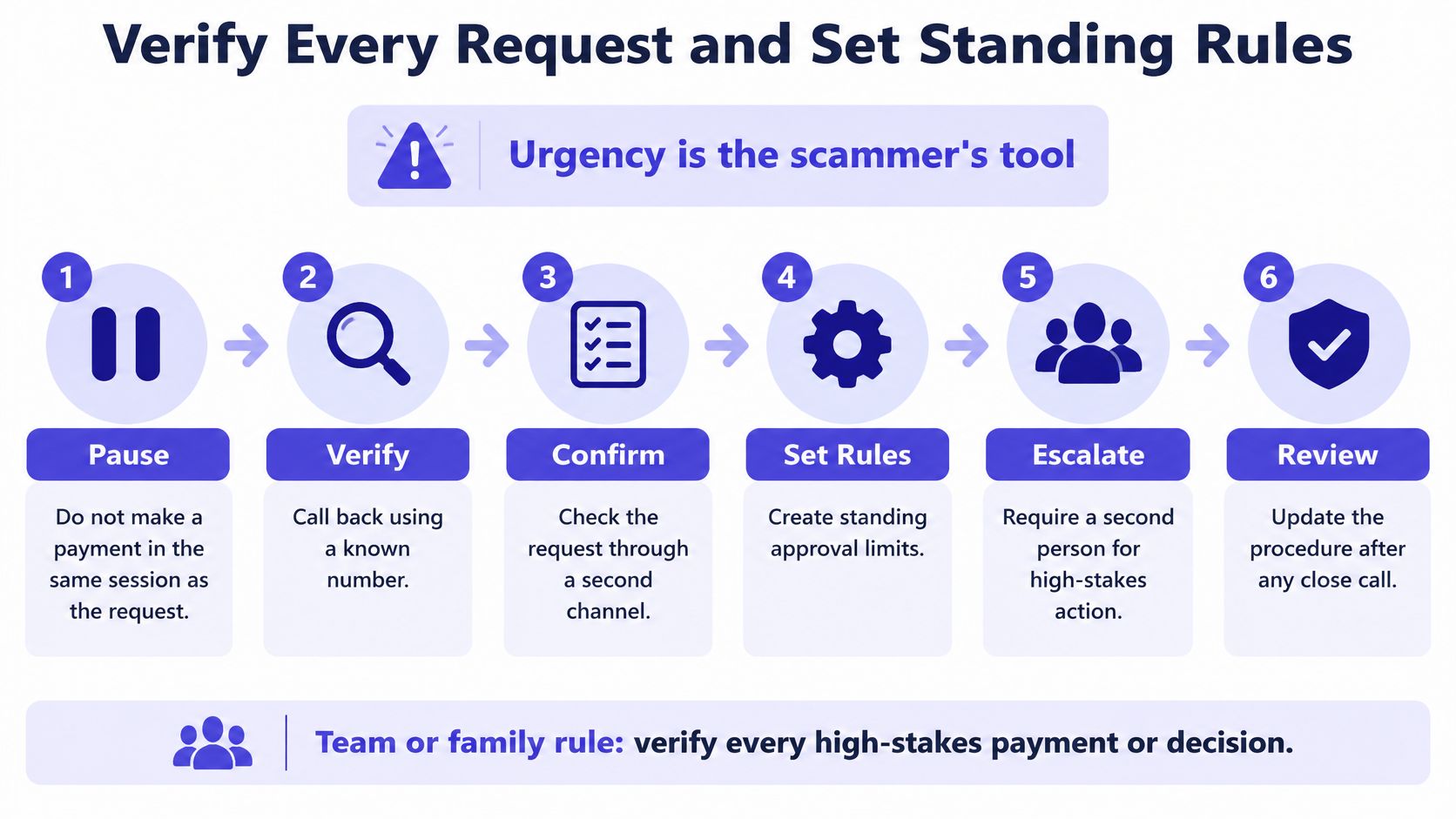
Use a repeatable procedure before a high-stakes payment or decision. The point is to make verification routine, so the person requesting an exception doesn't get to define the checks.
The HousingWire coverage of FBI cybercrime findings describes criminals using official-sounding generated messages and cloned voices to obtain payments, with reported AI-linked business-email-compromise losses exceeding $30 million in 2025. The practical response is to separate a request from authorization.
A payment verification procedure
Pause before acting. Don't make an unusual payment in the same session in which someone requests it. End the call or step away from the chat so you can assess the request without someone coaching you. The common slip is treating a senior person's apparent presence as permission to skip procedure.
Call back using information you already hold. Use your saved contact, established vendor record, or independently accessed company directory. Don't call the number supplied in the suspicious message, even if it appears beneath a familiar signature. If your existing contact details may be outdated, establish new ones through a separate trusted route.
Get an independent approver. Set an approval threshold appropriate to your organization or household, and require another authorized person above it. That person should review the underlying request and beneficiary, not merely accept your assurance that you spoke to the executive. For a major personal transfer, a trusted family member can provide the same pause for scrutiny.
Verify the payment destination. Compare the beneficiary name and account details with approved records. Treat every account change as a separate verification event, even when the invoice itself is expected. Never accept new instructions solely because someone delivered them during a convincing call or video meeting.
Examine uploaded media when it affects the decision. Work from the original file where possible, and compare automated analysis with source history, available metadata, audio, and motion. Don't upload confidential material to an external service without authorization. A technical result shouldn't substitute for confirming who supplied the file and why.
Record why you approved or declined. Note the request time, people contacted, contact channels, beneficiary checked, and evidence considered. Keep the record in the approved case-management system or shared finance log. The common slip is writing only approved, leaving no way to reconstruct what was verified.
The standing controls can be summarized visually for staff or family discussion.
Make exceptions harder to obtain
Finance teams should flag unfamiliar beneficiaries, unusual confidentiality instructions, and requests that depart from an executive's normal responsibilities. A request from the chief executive to bypass finance is a reason for more verification, not less.
Our explanation of social engineering attacks can help teams understand how authority, fear, and helpfulness are used to obtain exceptions. Practice responding to the pressure, not just identifying a suspicious face.
Families can agree on a private emergency code word, shared outside public messages and social profiles. Don't use a pet's name or another easily discovered fact. If someone can't provide it, withhold payment and make independent contact; if they can provide it, still examine an unusual request.
Standing rule: Nobody gets punished for delaying a suspicious payment to verify it.
Review the warning signals quarterly and after a close call. Include temporary staff, assistants, and anyone covering an approver's absence, because a documented rule helps only when the person handling the request knows it.
This week, adopt the control that addresses your largest exposure: independent approval for business transfers, verified bank-detail changes for suppliers, or a family emergency-payment rule. Put it in writing before someone asks you to make an exception.
What Detection Tools Can and Cannot Prove
Confidence isn't a reliable test. McAfee's December 2024 global survey, described in F-Secure's scam intelligence overview, found that 69% of respondents believed they could spot a scam, yet 43% of those confident respondents said they'd fallen victim during the previous year.
Different methods answer different questions. Use the comparison to select complementary checks, not to find a single definitive verdict.
Detection methods compared
| Method | What it checks | Strength | Limitation |
|---|---|---|---|
| Human inspection | Blinking, hands, and speech rhythm | Free and immediate | Can miss high-quality fakes or misread compressed footage |
| Automated video analysis | Frame artifacts, motion continuity, and flicker | Examines patterns throughout a clip | Can misfire on heavy compression or poor lighting |
| Audio forensics | Spectral patterns in synthetic speech | Can identify signs of cloned speech | Weaker on short clips and poor connections |
| Metadata and encoding review | File history and encoding irregularities | Can reveal editing or re-encoding | Metadata can be stripped or rewritten |
| Provenance and source checks | Original capture and trusted publisher | Strong evidence when trustworthy records exist | Often unavailable for shared clips |
| Callback verification | Claimed identity through a separate channel | Can interrupt an impersonation attempt | Requires independently trusted contact details |
Read the result as evidence, not permission
Human inspection is a useful starting point, but accents, dubbing, poor lighting, and low-bandwidth footage can make genuine media look unusual. A false positive labels genuine material suspicious; a false negative misses manipulated material.
Our AI Video Detector combines frame-level analysis, audio forensics, temporal consistency, and metadata inspection. It identifies signals including inconsistent facial micro-expressions, synthetic audio spectral patterns, and temporal flickering in AI-generated clips. Our guide to what deepfake detection is explains how to interpret that kind of analysis.
A confidence score concerns the tool's assessment of the file. It doesn't establish the speaker's authority, the honesty of an investment, or criminal intent. Even an authentic video can contain a fraudulent claim.
Verify the claim as well as the clip
Provenance can help establish where material originated, while a callback can establish whether a known person made a request. Neither automatically validates everything that person says.
For speculative cryptocurrency promotions, MemeAssist's resource to spot potential meme coin scams addresses a different layer of scrutiny: the offer itself. Don't confuse investigating a token or platform with authenticating its promotional video.
Keep the technical finding and the transaction decision separate. A suspicious result warrants investigation, while an apparently clean result never authorizes payment on its own.
Real Cases Where One Check Would Have Stopped the Loss
The following are illustrative composite scenarios, not documented individual incidents. Each shows a plausible decision point where a specific check could prevent payment or stop unverified material from driving a decision.
Illustrative case of a finance transfer
A finance clerk joins a meeting that appears to include the chief financial officer. The apparent CFO describes a confidential acquisition and requests a transfer to a new beneficiary before the meeting ends.
The clerk has an invoice and a familiar face, but no independent authorization. Calling the CFO's established number before releasing funds would expose the false instruction if the CFO denies it. The decisive check concerns the request, not the face.
Illustrative case of a family emergency
A parent hears what sounds like their child asking for emergency money. The caller says the situation is embarrassing and asks the parent not to contact anyone else.
A saved-number callback gives the parent a route outside the caller's control. If the child doesn't answer, that silence doesn't validate the emergency; the parent can contact another trusted person while withholding payment.
Illustrative case of an investment endorsement
An investor watches a respected economist apparently endorse a trading platform. The landing page includes professional graphics, testimonials, and an account manager offering help with the first deposit.
Checking registration and matching the platform's domain and contact details against official records could reveal a mismatch. A warning-list entry would be a reason to stop, but the absence of an entry wouldn't justify proceeding without further checks.
Illustrative case of a romance request
A dating contact sends attractive photos and short videos, but avoids a spontaneous conversation. After building an emotional relationship, the contact asks for help paying an unexpected bill.
A standing refusal to send money to an online-only romantic contact prevents this transfer without requiring the recipient to prove that every image is synthetic. Meeting someone or completing a live call wouldn't, by itself, establish that a later financial request is safe.
Illustrative case of workplace evidence
A manager receives a clip that appears to show an employee making a damaging statement. The sender provides no original recording and demands immediate disciplinary action.
Requesting the original file and a documented source history stops the clip from becoming an immediate finding. Metadata may assist, but it can't conclusively authenticate the event.
When a check can't resolve authenticity, the safe outcome may be to withhold judgment, not to label the media real or fake.
What to Do After an AI Scam Happens
Contact the payment provider before investigating the deepfake. Reimbursement depends on the institution, payment method, circumstances, and whether you authorized the transaction under deception.
First actions and who to notify by scam scenario
| Scenario | First action | Notify first |
|---|---|---|
| Deepfake video call transfer | Stop the transfer and request a recall | Bank and finance lead |
| Executive or voice-clone payment | Ask to freeze the payment and confirm with the real person | Bank and internal fraud team |
| Romance scam | Stop sending money and keep all messages | Bank, platform, and national reporting agency |
| Fake investment briefing | Cut contact and stop further deposits | Bank, platform, and financial regulator |
| Manipulated evidence | Preserve original files with timestamps | Legal team and hosting platform |
A 2025 U.S. consumer survey from Alloy found that 67% believed victims should be reimbursed for payments authorized under deception, while 44% of people who sought reimbursement received a partial refund or none. Expectations aren't a guarantee of recovery.
Act and preserve evidence in parallel
Stop further exposure. Cancel pending payments where possible. If credentials were disclosed, change passwords from a trusted device, revoke unfamiliar sessions, and secure the affected accounts.
Call the bank or payment provider immediately. Explain that deception caused the payment. Ask whether it can be stopped, recalled, or disputed, whether the recipient can be flagged, and what evidence is required. Obtain a reference number.
Preserve the originals. Save messages, call logs, email headers, payment records, and original audio or video with timestamps. Don't delete the conversation or edit your only copy; our evidence preservation guide explains how to organize material for review.
Report to the appropriate national authority. In the United States, report internet-enabled fraud to the FBI's IC3. For cross-border incidents, include recipient and platform details rather than trying to determine jurisdiction yourself.
Notify the platform. Report the account, advertisement, or listing, retaining its identifier and your report confirmation.
Maintain a single timeline. Record events, contacts, responses, and case references. Describe uncertainty clearly, including whether you approved the transaction.
Detection results can support that record. They don't prove intent or guarantee reimbursement, and you shouldn't delay a bank call while waiting for them.
Before your next high-stakes request, save trusted callback details and agree who can independently approve a payment. If suspicious video is involved, preserve the original and use AI Video Detector as an additional assessment, not permission to pay. If you've already sent money, call your bank now and start the evidence timeline.