

Video Evidence in Criminal Cases: From Collection to Court

Video evidence isn't self-proving. A clear image doesn't establish who created the file, whether the recording system worked reliably, whether the scene is complete, or whether an enhancement added detail that the camera never captured. A hash can show that a file stayed unchanged after acquisition, but it can't show that the event depicted really occurred.
That distinction matters because video evidence in criminal cases can materially assist investigations while still failing as courtroom evidence. The practical question isn't just whether footage exists. It's what each control proves, what it leaves unanswered, and whether investigators can explain those limits without overstating the recording.
Why Video Rarely Speaks for Itself
Clear footage does not speak independently. Its evidentiary value depends on decisions made by dispatchers, investigators, evidence technicians, forensic examiners, prosecutors, and witnesses. A failure in any of those decisions can weaken an otherwise important recording.
The Australian Institute of Criminology examined CCTV requests during investigations on the Sydney Trains rail network. Among matters where police requested footage, 24.8% were solved, compared with 21.0% where footage wasn't requested, an estimated 18% relative increase in clearance rates (Australian Institute of Criminology study). Footage was supplied for roughly 9 out of 10 requests, indicating that retrieval and access can matter as much as camera availability.
Those results show an association, not a claim that cameras solve cases. A camera count says little without relevant coverage, usable image quality, a sufficient time window, and timely retrieval before footage is overwritten or lost.
Practical rule: Treat camera presence as an investigative lead, not as proof of evidentiary value.
What usefulness means
A recording may show movement without identifying a face. It may place a vehicle at a location without proving who drove it. Audio may be missing, timestamps may be offset, and the camera's view may exclude the event that matters.
The same study found investigators regarded supplied footage as useful in practice, and matters assessed as having useful footage were more likely to be solved than matters where footage was assessed as not useful. The operational lesson is direct: relevance and quality determine what video can support.
A prosecution may use footage to corroborate a witness, establish sequence, or challenge an account. It must still establish how the file was obtained, whether it represents the relevant system output, and whether processing changed what the court sees.
A hash proves that a file remained unchanged after hashing. Metadata describes recorded file properties, not necessarily the event itself. Chain of custody documents handling and transfer. None of those controls, alone, proves that the depicted event occurred as shown. An intact file can still contain a misleading edit, a misidentified person, or a synthetic event. Video supports a proposition only when the technical findings and legal foundation support that specific proposition.
Collecting Footage and Building the Chain of Custody
A video file can be perfectly playable and still be difficult to defend. The failure usually begins before examination, when an officer films a monitor with a phone, accepts a shared cloud link, downloads a social-media clip, or exports footage without recording how the system produced it.
Identify the source first. Record the camera, recorder, body-worn-camera platform, phone, cloud service, or other system involved. Document its custodian, location, time reference, export method, and any settings relevant to the recording. A screen recording establishes what appeared on a display. It does not establish what the source system stored.
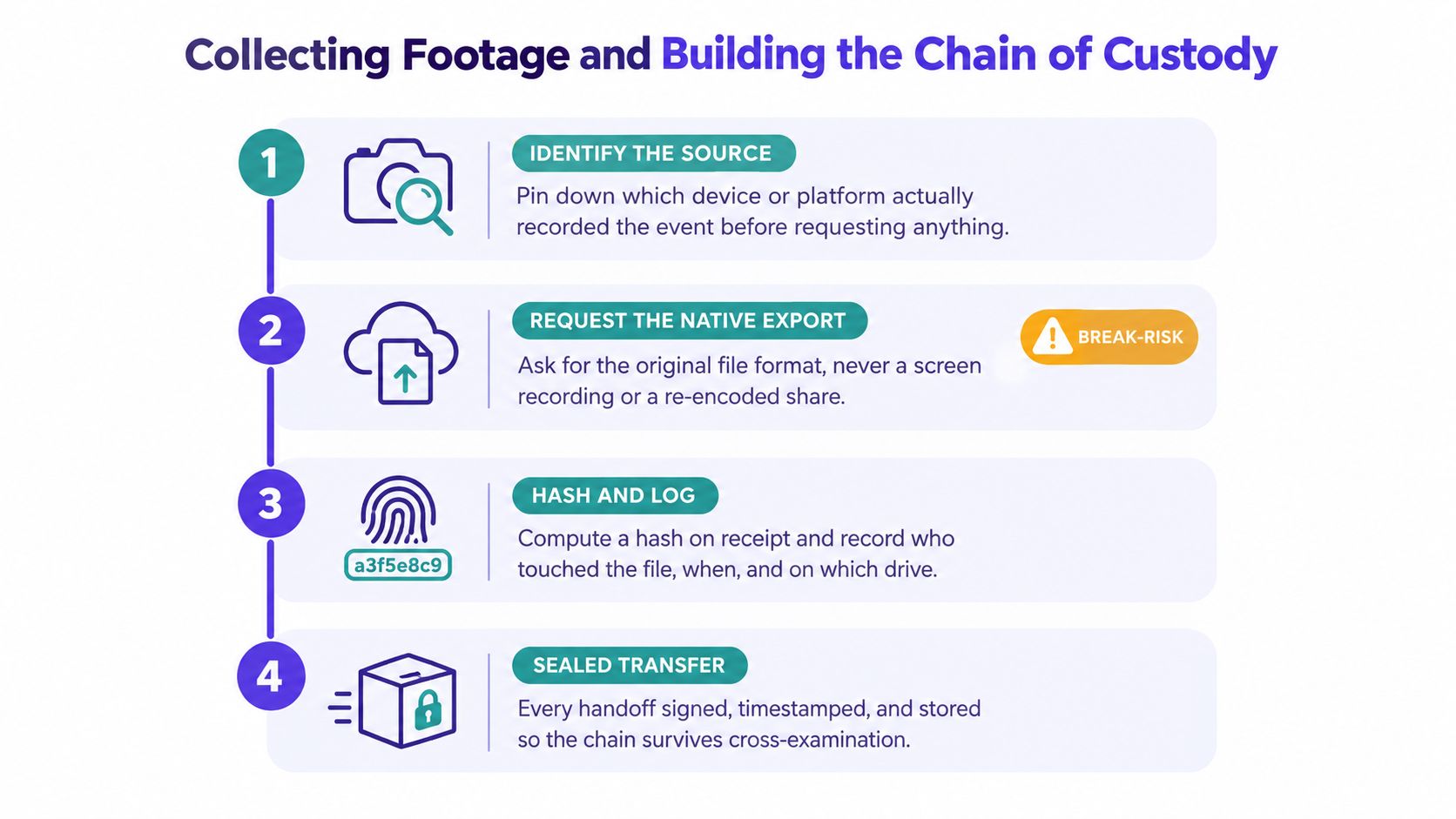
A collection procedure that survives scrutiny
Request the native export whenever possible. Preserve the media exactly as received, together with associated files, player information, export logs, and system documentation. A clip forwarded through a messaging service or downloaded from a social platform may have been compressed or transcoded. It may also lack metadata or a clear record of who supplied it.
The OSAC forensic video workflow guidance calls for preserving original media, documenting its source and custody, creating a forensic working copy, and verifying that copy with a cryptographic hash before examination or processing. A hash confirms file identity after acquisition. It does not establish that the recording was truthful, complete, or unedited before investigators received it.
A custody log should allow another person to reconstruct each meaningful handling event:
- Source identification: Name the device or platform, custodian, location, and relevant recording settings.
- Acquisition record: Record who obtained the export, when, by what method, and in which native format.
- Integrity record: Document the hash, storage medium, working-copy creation, and verification steps.
- Transfer history: List every person who accessed or transferred the exhibit, with dates, times, purpose, and signatures or equivalent records.
Legal teams can adapt this chain-of-custody template to local evidence policies and disclosure requirements. A form cannot restore a missing native file or explain an undocumented gap. It can expose those omissions while the evidence may still be recoverable.
A defensible chain records handling. It does not authenticate the event by itself. The file's source, acquisition circumstances, and later processing must support the precise proposition offered in court.
Running a Forensic Video Examination
A forensic examination isn't a request to “make the video clearer.” It starts with a question. Is the task to establish sequence, compare clothing, assess a timestamp, extract audio, locate a vehicle, or evaluate whether the file shows signs of manipulation? Without a defined question, examiners can produce attractive images that answer nothing legally useful.
The first stage is assessment. Confirm that the question is technically feasible, preserve the original, and work from the verified duplicate. An initial overview should use more than one suitable tool where practical, because software can display or interpret file properties differently.
Record before processing
Document the file's resolution, pixel aspect ratio, frame rate, codec, container properties, timestamps, audio streams, and any discrepancies between tools. Preserve screenshots or reports where appropriate, but don't confuse a player's display with the underlying source characteristics.
Processing belongs on the working copy. Deinterlacing, stabilization, frame extraction, color adjustment, denoising, and enhancement should each have a recorded purpose, tool name, software version, settings, output filename, and relationship to the original. Another trained examiner should be able to understand what was done and produce a comparable output.
If the investigation also needs a searchable transcript, use a documented transcription workflow and preserve the resulting text as a derivative, not as a replacement for the audio. A practical guide to the best way to transcribe a video can help teams structure that process, especially when they need to preserve the source recording separately from the transcript.
Separate visibility from recovered detail
Processing can improve visibility. It can't reliably recover information that the source never captured. Stabilizing a moving frame may make an existing object easier to inspect, while aggressive upscaling may create a face or number plate that appears precise but rests on generated pixels.
The final analysis should distinguish observations from interpretations. “A person enters from the left side of the frame” is an observation. “The defendant entered the premises” is an interpretation that requires identification evidence and context. This distinction prevents the examiner from turning a technical output into a conclusion beyond the recording's limits.
Authenticating Video for Admissibility
Technical clarity and legal authenticity answer different questions. A sharp file may still lack a witness or system foundation. A compressed file may remain relevant if the parties can explain its origin, limitations, and relationship to the native recording.
In U.S. criminal proceedings, one route uses a knowledgeable witness who can testify that the recording fairly and accurately represents the event. The other is commonly called the silent witness approach. Under Federal Rule of Evidence 901(b)(9), authentication may be established by describing the recording process or system and showing that it produces an accurate result. Federal Rule of Evidence 1001 also treats video within the scope of the Best Evidence Rule (scholarly legal history of video evidence).
What each foundation actually proves
A witness may establish familiarity with the scene, the event, the camera, or the accuracy of the depiction. That testimony supports fair representation. It doesn't automatically establish that the file is the native export, that the system clock was correct, or that no relevant segment was omitted.
A silent-witness foundation focuses on the system. The proponent may need records or testimony explaining the device, recording process, storage, access controls, export method, and reliability. That foundation supports confidence in the system's output. It still doesn't prove that every interpretation drawn from the images is correct.
Use a sequence that connects those questions:
- Identify the device or platform and its operator.
- Explain when and how the file was obtained.
- Preserve the native export and related system records.
- Compare timestamps with dispatch records, access-control events, phone data, or other cameras.
- Inspect continuity, gaps, edits, transcoding, and unexplained changes.
- Present a witness or system record that addresses operation and accuracy.
Common collapse points include unexplained gaps, inconsistent timestamps, undocumented transcoding, missing native files, and social-media downloads. A hash can show that the received file didn't change after acquisition. It can't establish what happened before acquisition or whether the displayed scene was synthetic from the start.
Teams handling sensitive exhibits should also protect the administrative record. A workflow for secure client PDFs with PDFWix may help organize reports and disclosures, but document security doesn't substitute for evidentiary foundation. For a more detailed treatment of the distinction, see this guide to how to authenticate video evidence.
When AI Enhancement Becomes Fabricated Evidence
The danger isn't limited to deepfakes. An investigator can start with genuine surveillance footage and create a separate evidentiary problem by using software that supplies detail the sensor never recorded.
A recent U.S. criminal proceeding illustrates the risk. A court excluded Topaz-enhanced surveillance footage because the process added potentially false image detail, relied on opaque and insufficiently validated algorithms, and lacked demonstrated reliability or general acceptance (report on the excluded Topaz-enhanced footage). The unenhanced source remained the stronger reference.
Use a two-track disclosure model
Not every adjustment creates the same legal risk. A reversible presentation change, such as brightness, contrast, color balance, or playback speed, may alter how viewers perceive existing information without claiming to create new detail. Even those changes should be documented and shown alongside the original.
Generative processing is different. Upscaling, frame interpolation, and some denoising systems may infer or synthesize pixels. The output can look persuasive while representing a model's prediction rather than a captured feature.
Use these controls before presenting an enhanced frame:
- Keep the original visible: Provide the native frame and processed output side by side.
- Name the operation: Record the software, model or algorithm where available, version, settings, and output format.
- Describe the effect precisely: Say whether the operation changed brightness, removed noise, interpolated frames, or generated detail.
- Treat new detail as a hypothesis: Require independent support from another camera, witness, device record, or physical evidence.
- Test reproducibility: Preserve the working copy and processing history so another examiner can assess the result.
An explanation of artificial intelligence for legal practices can provide broader context for responsible legal automation, but courtroom use requires a narrower question: can the examiner explain what the software changed, validate its behavior, and disclose its uncertainty? A sharper image isn't automatically a more accurate image.
Detecting Synthetic Video Before It Reaches the Courtroom
A clean chain of custody can prove that a file remained intact after investigators received it. It cannot prove that the depicted event occurred. That is the authentication gap most checklists miss.
Courts generally continue using traditional authentication practices while case law on synthetically generated evidence remains limited. A National Center for State Courts study also found that human reviewers cannot reliably detect deepfakes (legal analysis of authentication and synthetic evidence).
Ask separate questions of separate controls
File integrity asks whether the received file changed after acquisition. Hash verification addresses that question. It doesn't establish the truth of the content.
Provenance asks where the file came from. Device records, platform exports, access logs, and collection notes support origin. They don't prove that a camera captured a real event rather than a generated scene.
Corroboration asks whether independent evidence supports the event. Dispatch logs, access-control records, phone data, witness accounts, physical evidence, and other cameras can test whether the video fits the surrounding facts.
Forensic signal analysis asks whether the file contains indicators of generation or manipulation. Frame-level artifacts, audio anomalies, temporal inconsistencies, lighting conflicts, synchronization problems, metadata irregularities, and encoding traces can raise concerns. They remain signals, not a universal truth test.
A detector score should therefore be reported as one part of an examination, with the file, method, limitations, and relevant comparison material available for review. AI Video Detector is one example of a multi-signal tool that examines frame-level artifacts, audio characteristics, temporal consistency, and metadata or container irregularities. Its output can inform investigative triage, but it shouldn't replace provenance work, corroboration, or expert interpretation.
For investigators evaluating suspected synthetic media, this guide to how to detect deepfakes is useful as a starting point. The legally important conclusion is narrower: an intact file may still depict a fabricated event, and an edited file may still have probative value when its limits are disclosed.
Presenting Video Evidence and Expert Testimony
The strongest courtroom presentation makes the examiner's limits visible. Start with what the file shows, then identify what the examiner infers, and finally explain what independent evidence supports that inference. Don't ask the jury to treat interpretation as observation.
Build testimony around disclosure
Present the native file or explain why it isn't available. Identify the working copy, hash values, software versions, settings, processing history, and generated outputs. If timestamps are uncertain, say so. If the camera angle prevents identification, don't allow a polished enhancement to imply more certainty than the source supports.
Corroborate the recording with dispatch logs, access-control records, phone data, witness accounts, or other cameras. Those sources can establish sequence and context that the video alone cannot. They can also expose a timestamp error or contradiction before opposing counsel does.
The examiner's credibility depends less on claiming certainty than on showing exactly where certainty ends.
Prepare for cross-examination around the method, not only the conclusion. Counsel should be able to explain why a particular process was used, whether it created or inferred detail, whether another examiner could reproduce it, and what error rates or validation information are available. A court's decision remains jurisdiction-specific and case-specific, as prosecutor guidance emphasizes, rather than governed by a universal admissibility benchmark (video evidence primer for prosecutors).
Final pre-trial check
- Preserve the native file: Don't substitute a screen recording, social-media download, or edited clip for the source export.
- Protect the original: Conduct examination on a forensic duplicate and maintain documented custody.
- Record every transformation: Include tools, versions, settings, outputs, and reasons for processing.
- Show the comparison: Present original and processed views together when enhancement is relevant.
- Separate fact from interpretation: State visible features before identifying people, objects, or events.
- Disclose limitations: Explain gaps, compression, timestamps, uncertainty, validation limits, and possible alternative interpretations.
Video earns courtroom weight through transparency. Investigators who preserve the source, document the process, test the event against independent evidence, and resist overstating pixels give prosecutors a defensible exhibit and give courts a clearer basis for deciding what the recording proves.
If your team is collecting or reviewing video evidence in a criminal case, preserve the native files before anyone edits, exports, enhances, or forwards them. Document the source and custody immediately, create a verified working copy, and have a qualified examiner assess provenance, processing history, and possible synthetic signals before the footage becomes part of a charging or trial decision.


