

Media Literacy Education Guide for the AI Era

A student opens a video during a research activity. The speaker appears to be a well-known public figure, the voice sounds natural, and the footage shows an event that seems urgent. A classmate shares it in the group chat before anyone asks the most important question: Did this really happen?
That question has become harder because synthetic video, cloned audio, and generated images can imitate familiar people and believable settings. Traditional media literacy education taught students to examine authorship, purpose, audience, language, and visual techniques. Those skills still matter, but students now also need to authenticate reality before they interpret it.
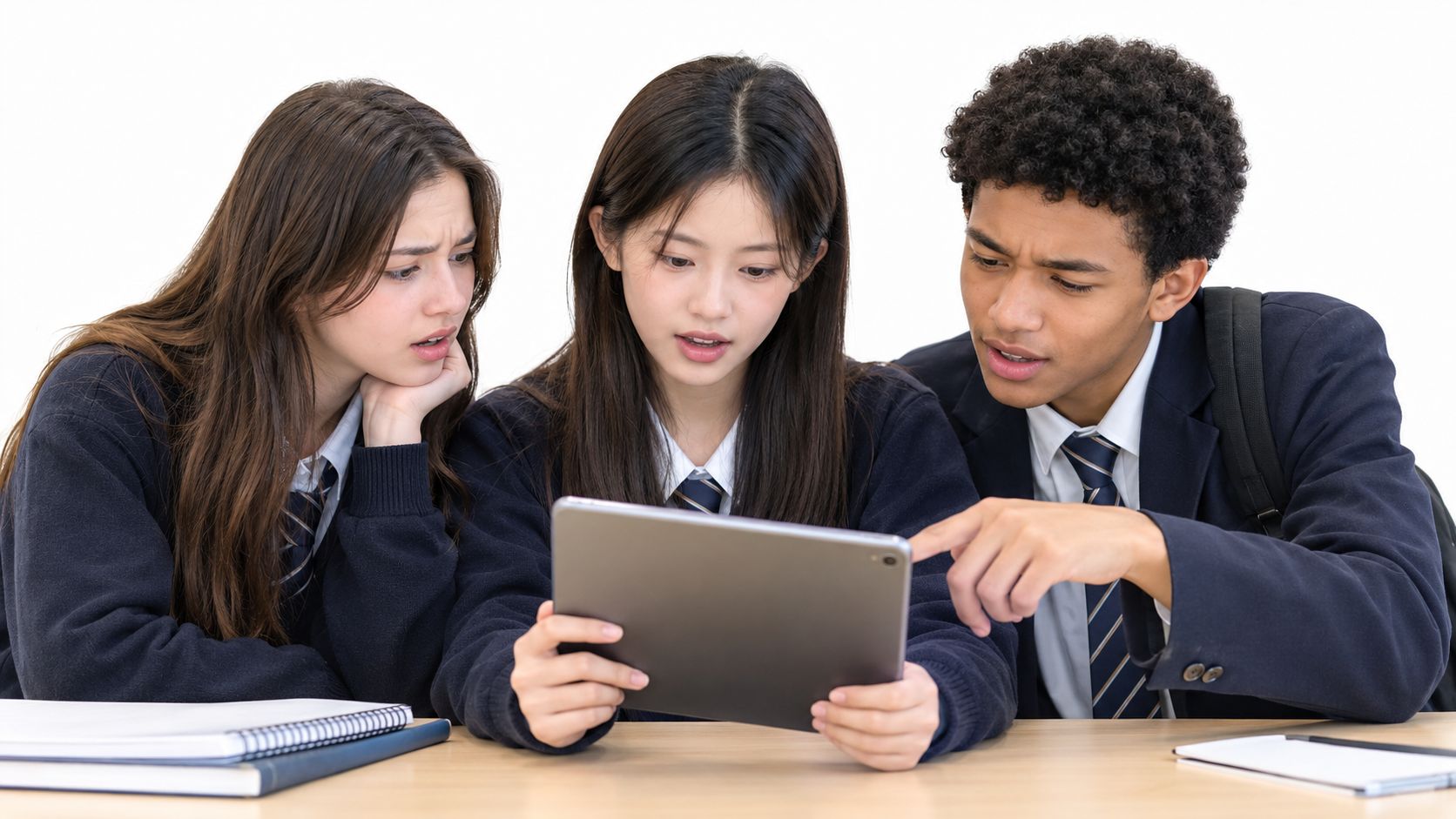
This guide is for classroom teachers, librarians, curriculum leaders, school administrators, and families who want practical ways to teach that shift. It moves from the meaning and history of media literacy education to competencies, curriculum design, classroom assessment, and responsible tool selection. The central habit is simple: slow down, inspect the evidence, and make confidence proportional to what the evidence supports.
Introduction to Media Literacy Education Today
A student doesn't need to become a forensic analyst to question a suspicious clip. They need a repeatable routine that separates observation from assumption.
Start with what the class can directly observe. What does the video show? What does the speaker say? What information is missing? Then ask where the clip came from, whether the original upload can be found, whether reputable sources describe the same event, and whether the file contains signs of editing or generation. The teacher's role isn't to announce the answer immediately. It's to model disciplined uncertainty.
That distinction matters because a convincing appearance isn't proof of authenticity. A familiar face can be placed in an unfamiliar scene. A natural-sounding voice can deliver words the person never spoke. A real recording can also be cropped, reposted with a false caption, or combined with unrelated audio. Media literacy education in the AI era must address both message analysis and reality verification.
From digital citizenship to evidence habits
Digital citizenship often focuses on conduct, safety, privacy, and respectful participation. Those responsibilities remain essential, but they don't answer every question students face in a synthetic media environment. A student may behave responsibly online and still share a false video because the content looked credible.
A stronger classroom routine treats online content like evidence in science. Students observe, form a provisional explanation, test it against independent information, and revise their judgment when new evidence appears. This approach also avoids teaching skepticism as automatic disbelief. The objective isn't to distrust every image or video. It's to earn trust through verification.
Teachers can use ordinary classroom moments to build the habit. When a student brings in a dramatic clip, pause before discussing its message. Ask students to record their first reaction, identify the claim, locate the earliest available source, and name what would change their minds. That process turns a viral moment into an authentic inquiry.
Practical rule: Students should never be graded only on whether they label content real or fake. Grade the quality of the questions and evidence they use to reach a conclusion.
The need is institutional as well as individual. UNESCO reports that 171 countries reference media and information literacy in national policy frameworks in its global overview of policy and education. The formal recognition is broad, but implementation depends on whether teachers receive clear guidance, time, training, and suitable materials.
What Media Literacy Education Really Means
Media literacy is like learning the grammar of a new language. Grammar helps you notice how words work together. Media literacy helps you notice how images, sounds, captions, layout, editing, platform design, and source choices work together to shape meaning.
A media-literate student doesn't stop at “I like this” or “I disagree.” They ask who created the message, what the creator wants the audience to think or do, which details received attention, which details were left out, and how the message might change when it moves between platforms. They also understand that making media carries responsibilities because publication can affect other people.
Media literacy is not a single trick for spotting misinformation. It is a way to ask better questions about communication.
The field combines several connected actions:
- Access: Find, open, access, and use media and information sources effectively.
- Analyze: Examine construction, language, images, editing, authorship, audience, and purpose.
- Evaluate: Judge credibility, evidence, context, bias, and the limits of a claim.
- Create: Produce media that communicates clearly, represents people fairly, and respects rights.
- Reflect and act: Consider consequences, revise understanding, and participate responsibly.
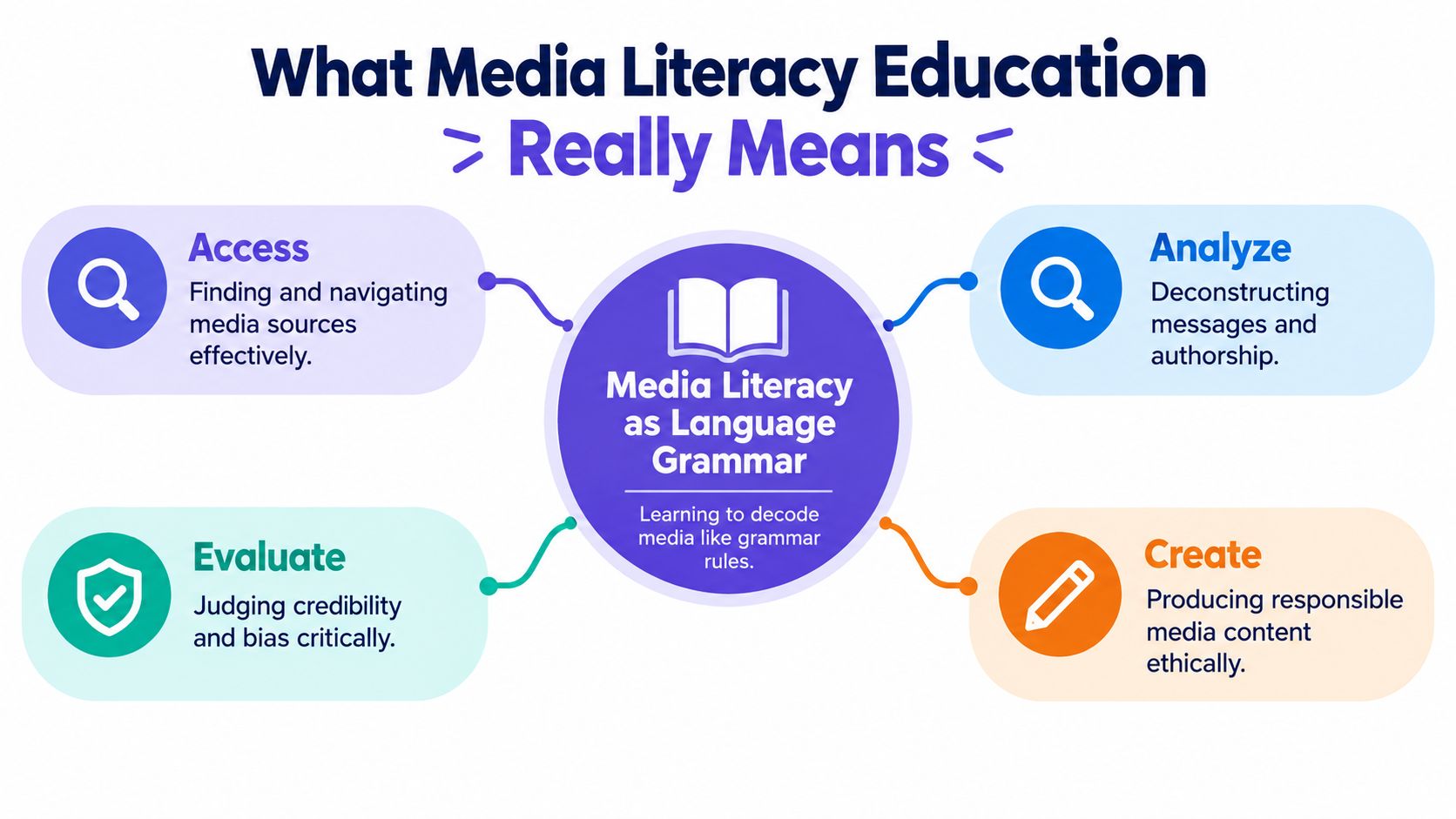
These actions work as a cycle rather than a staircase. A student may access a video, analyze its construction, evaluate its reliability, create a response, and then reflect on how that response could influence an audience. If one part is missing, the learning becomes unbalanced. Students who can search quickly but can't evaluate sources remain vulnerable. Students who can critique messages but never create them may not understand the choices and constraints involved in publication.
AI adds another layer. Students now need to ask not only, “What is this message trying to do?” but also, “How might this message have been produced?” A useful introduction can come from this plain-language explanation of AI-generated content, followed by a classroom comparison of human-made, edited, and synthetic examples.
The goal isn't to make students suspicious of technology. It's to help them understand that tools mediate communication. A camera can document, frame, crop, and persuade. An editing program can clarify or mislead. A generative system can produce convincing material without witnessing the event it depicts. Media literacy gives students a vocabulary for examining those differences.
How Media Literacy Education Evolved Over Time
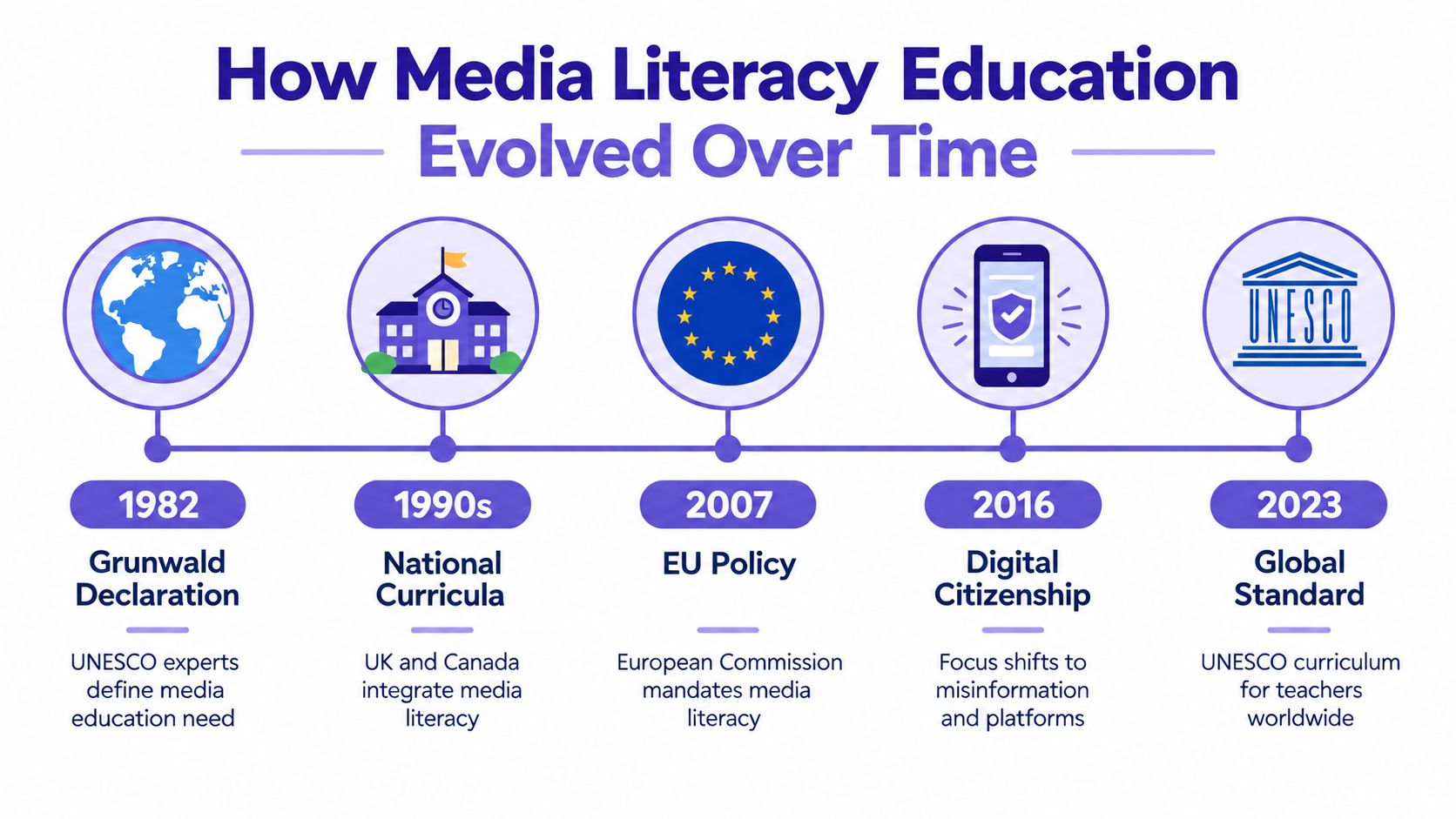
Media literacy education has a longer policy history than many school communities realize. UNESCO first convened experts on media education in Grünwald, Germany, in 1982, treating the subject as a matter of international educational concern. That early work established that learners needed more than access to media. They needed preparation to understand and participate in mediated communication.
UNESCO continued the conversation through a 1990 conference in Toulouse attended by delegates from 40 countries. The conference called for guidelines, curricula, and teaching materials, which moved the field toward practical educational systems rather than isolated discussion. These milestones help explain why current programs often combine critical inquiry, production, access, and civic participation.
From separate literacies to an integrated field
For years, media literacy and information literacy were often treated as related but separate tracks. UNESCO introduced the umbrella term “media and information literacy” in 2007, reflecting a more integrated framework. The change recognizes that students must process messages and information together. They need to understand both how communication is constructed and how evidence is found, organized, and verified.
That integration is visible in formal education policy. UNESCO reports that 171 countries reference media and information literacy in national policy frameworks. The OECD's Education 2030 curriculum mapping also found that all 16 education systems studied included media and data literacy in secondary education, although the depth varied across systems. These findings indicate that media literacy education has moved into mainstream schooling, especially at the secondary level.
The policy journey doesn't mean classroom practice is uniform. A national framework may name media literacy while leaving schools to determine who teaches it, which lessons count, how teachers are trained, and how student progress is assessed. Curriculum leaders should therefore treat history as context, not as proof that implementation is complete.
This short video can support a staff discussion about how media education has developed and why its classroom meaning keeps changing.
The current challenge is a familiar one in education. Policy can identify a priority faster than schools can build the conditions needed to teach it well. That gap becomes especially visible when teachers must address synthetic media without a shared verification routine or adequate professional learning.
Core Competencies and Frameworks That Shape Learning
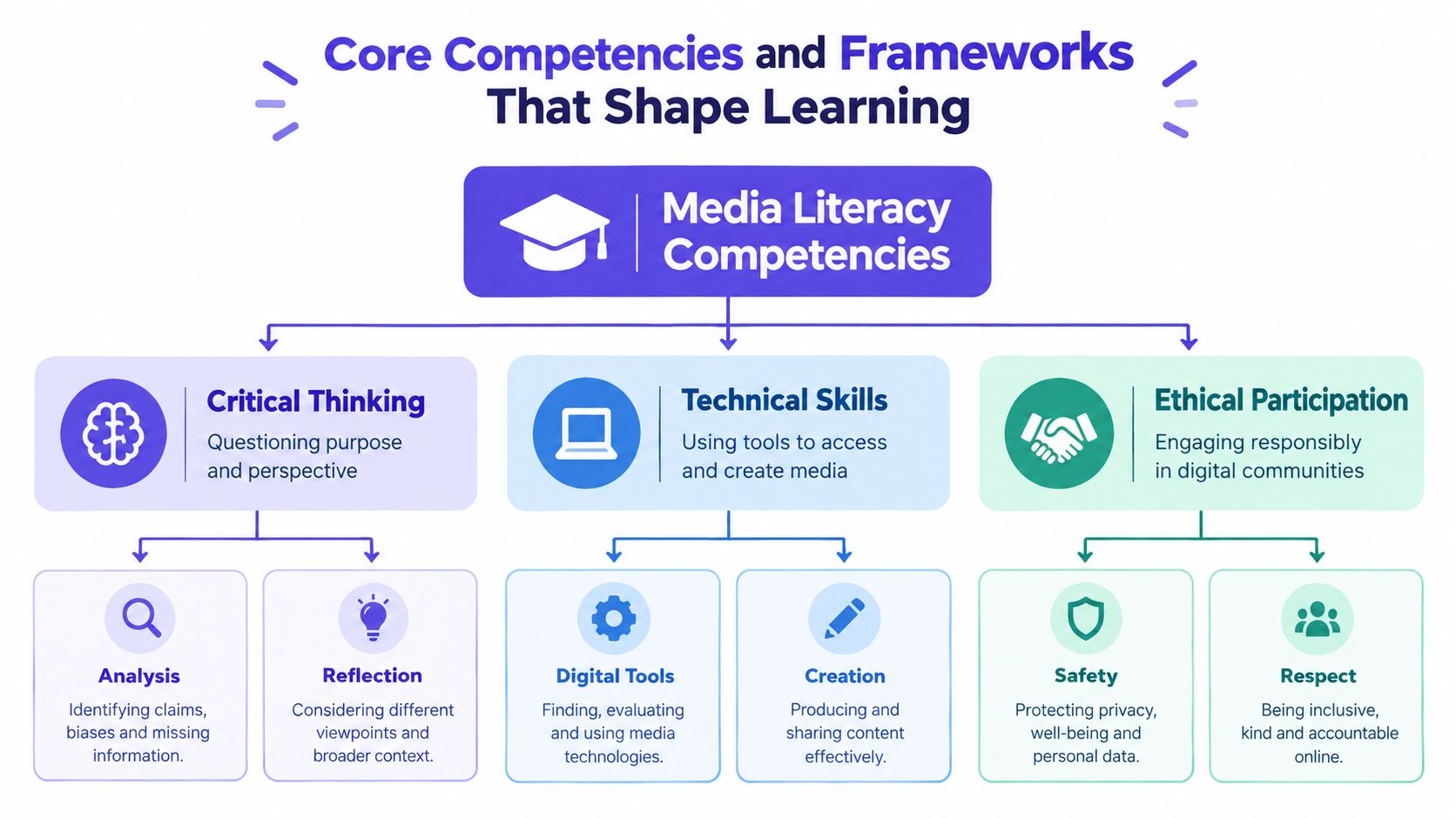
A useful framework should help a teacher answer three questions: What should students be able to do? What evidence will show that they can do it? How will the skill become more demanding over time?
The four-part access, analysis, evaluation, and creation model provides a strong foundation. Add reflection and ethical participation, and the framework becomes more complete for contemporary classrooms. Students need technical control, critical judgment, and a sense of responsibility. None of these competencies works well in isolation.
Critical thinking
Critical thinking begins with purposeful questioning. Students identify the claim, distinguish fact from opinion, examine the creator's position, and look for persuasive techniques. In a history lesson, they might compare how two outlets frame the same event. In science, they might inspect whether a dramatic claim is supported by accessible evidence.
Evaluation should be specific rather than a vague judgment of whether a source “looks professional.” Students can ask:
- Who made this?
- What evidence is visible or linked?
- Can the original material be located?
- Does another independent source confirm the central claim?
- What context might be missing?
- Is the media altered, generated, or presented in a misleading way?
Technical skills
Technical competence includes searching, opening source material, checking dates, comparing versions, reading basic metadata when available, and using creation tools responsibly. Students don't need to master every platform. They need enough fluency to investigate rather than accept the first result.
A verification lesson might ask students to trace a reposted video back through several pages, record changes in captions, and compare the clip with a longer original. The technical task supports the critical task. Students see that source evaluation often depends on practical actions.
Ethical participation
Creation changes the learner's position. A student who edits a video, designs an image, or uses an AI tool must consider consent, attribution, privacy, accuracy, and potential harm. Ethical participation also includes correcting a mistake without humiliating the person who made it.
Strong media literacy asks students to be careful producers, not only clever critics.
A curriculum map can show balance across a term. One unit might emphasize source access and search habits. Another can focus on representation and persuasion. A later task can combine analysis, verification, creation, and reflection. The framework becomes useful when each lesson names an observable action, such as “locate the earliest available version” or “explain how an edit changes audience interpretation.”
Designing Curriculum and Lesson Plans That Work
Curriculum planning works best when teachers build from a blueprint rather than collect disconnected activities. Begin with the transfer goal. For example, students might need to verify a consequential media claim before sharing or citing it. Then identify the knowledge, skills, and dispositions that support that goal.
A sensible sequence moves from visible features to hidden systems. Younger learners might begin by separating observation from interpretation. Middle-grade students can examine authorship, audience, editing, algorithms, and source trails. Older students can investigate synthetic media, data provenance, attribution, privacy, and the ethical consequences of publishing uncertain material.
Three ways to enter the work
| Entry point | Strength | Risk | Best first move |
|---|---|---|---|
| Individual classroom | Fast and flexible | Practice may depend on one teacher | Add a short verification routine to an existing research task |
| Department or grade team | Shared language and progression | Requires coordination | Agree on common terms and one performance task |
| School or district | Consistent expectations and support | Planning takes longer | Map existing standards, policies, and professional learning needs |
Integration usually beats a standalone unit. English teachers can analyze framing, rhetoric, and source use. Science teachers can connect verification to evidence and reproducibility. Social studies teachers can examine public claims, historical context, and civic consequences. Art and technology teachers can make authorship, editing, and ethical creation visible.
A practical lesson might follow this pattern:
- Notice: Students describe only what they can observe.
- Question: They identify the claim, creator, audience, and purpose.
- Trace: They locate the original post or supporting source.
- Test: They compare the claim with independent evidence and inspect the media itself.
- Explain: They write a confidence statement that names what is known, uncertain, and still needed.
- Create: They produce a responsible correction, annotation, or alternative message.
Differentiation doesn't require lowering the intellectual demand. Provide transcripts, vocabulary banks, source cards, guided question stems, and accessible examples for students who need support. Offer more complex source chains and ambiguous cases to students ready for extension.
Keep the objective measurable. “Understand misinformation” is too broad. “Compare two versions of a video and explain which evidence supports the earliest source” gives students a clear target and gives teachers something meaningful to assess.
Classroom Implementation and Assessment Strategies
Implementation begins with a routine teachers can use even when time is tight. Choose one questionable image, audio clip, post, or video and run a brief evidence check. The value comes from repetition. Students gradually learn that verification isn't an emergency response reserved for spectacular hoaxes. It's part of ordinary reading and research.
A classroom checklist can remain visible:
- Pause: Don't share or cite the material immediately.
- Describe: Separate observable details from interpretations.
- Identify: Record the claim, creator, date, platform, and intended audience.
- Trace: Search for the earliest available version and relevant context.
- Compare: Check independent reporting, original documents, or expert evidence appropriate to the subject.
- Inspect: Look for editing, mismatched audio, unusual motion, missing context, or signs of synthetic generation.
- Conclude: State a confidence level and explain the evidence.
- Act: Share, annotate, correct, or withhold the material responsibly.
The AI-era challenge deserves direct treatment. A 2026 policy report described state media literacy mandates in the United States as moving faster than support structures, while educators reported that many students still struggled to distinguish AI-generated from non-AI content. EdWeek's coverage of the policy report cites 61% of elementary educators saying students struggled “a lot” with that distinction.
Assess the process, not just the label
A multiple-choice question asking whether a clip is fake measures recognition under controlled conditions. It doesn't show whether students can investigate unfamiliar material. Stronger evidence comes from performance tasks:
- Verification log: Students record searches, source comparisons, observations, and revisions.
- Evidence memo: Students make a claim about authenticity and support it with clearly identified evidence.
- Portfolio: Students collect analyses of different formats and reflect on how their reasoning changed.
- Responsible creation task: Students make a media response that includes attribution, context, and an explanation of editing or AI use.
- Peer review: Classmates challenge the evidence and identify unanswered questions.
Teachers should avoid presenting detection tools as final authorities. A tool result is one piece of evidence, and students need to understand false confidence, uncertain results, and the importance of corroboration. For a focused classroom discussion of authenticity, academic work, and video evidence, teachers can use this resource on academic integrity and video.
Implementation barriers are practical. If teachers lack training, provide shared mini-lessons and model analyses. If curriculum time is limited, embed verification in assignments already being taught. If funding is constrained, begin with source tracing, comparison, and transparent reasoning before purchasing specialized software. The most important resource is a consistent schoolwide expectation that students explain how they know.
Policy Ethics and Tools for the Future of Media Literacy
A durable media literacy program needs more than engaging lessons. Schools should establish clear expectations for privacy, consent, attribution, AI disclosure, source use, and correction. Students need to know whether they may upload classroom material to an external service, whether faces or voices can be analyzed, and how long any submitted data may be retained.
Tool selection should follow the learning purpose. A reverse image search may help trace a picture. A platform's original-post information may reveal context. A video analysis service may provide additional signals, but its output should support human judgment rather than replace it. Review privacy terms, age requirements, accessibility, file handling, confidence explanations, and whether the tool fits the school's policies.
For one example, AI Video Detector describes a privacy-first service that analyzes uploaded video using frame-level analysis, audio forensics, temporal consistency, and metadata inspection. Teachers should still pair any automated result with source tracing, contextual research, and a student explanation of uncertainty. Schools considering content credentials can also review this guide to C2PA content credentials as part of a broader discussion about provenance and authenticity.
Ethics also applies to classroom demonstrations. Don't expose students to disturbing deepfakes to create excitement. Use age-appropriate material, explain why it was selected, and avoid re-sharing harmful content unnecessarily. Ask permission before recording students, and never treat a student's initial belief as a character flaw. A safe classroom makes it possible to revise a conclusion without embarrassment.
UNESCO's policy history shows that media and information literacy has been treated as an international priority for more than four decades, from the 1982 Grünwald meeting through later work that integrated media and information literacy. The next step belongs to schools: turn recognition into routine.
Start this week with one authentic media claim. Have students pause, trace, compare, inspect, and explain. Then add the routine to a research assignment, share it with colleagues, and build a common rubric around evidence rather than guesswork. Teach students to ask not only what a message means, but whether reality supports it, and help them practice that judgment before the next convincing synthetic clip reaches their screen.
Choose one recent image, audio clip, or video for your next lesson, download or bookmark the original context, and have students complete a verification log before discussing its message. Invite your librarian or department colleague to co-teach the activity, then save the student work as a baseline for a larger media literacy education plan.