

How to Spot a Fake Person Online and in Real Life

A 2024 systematic review of 67 studies found that people detected deepfakes with only 55.54% overall accuracy, while video detection reached 57.31%, both barely above chance. When the researchers expressed performance as odds ratios, detection accuracy fell to 39%, showing why a convincing synthetic person can pass a quick visual check. (Entrust's summary of the review)
That finding changes the question. Learning how to spot a fake person isn't about memorizing a list of strange blinking patterns. It's about deciding whether the identity, behavior, digital history, message source, and media itself support the same conclusion. When money, evidence, employment, personal safety, or a company reputation is involved, instinct should trigger verification, not end it.
Why Your Gut Feeling Fails at Spotting a Fake Person
People often trust a face that looks natural, a voice that sounds familiar, or a conversation that feels emotionally convincing. Those signals matter socially, but they're weak evidence of identity. A person can appear sincere while using stolen photographs, a cloned voice, a fabricated profile, or a manipulated video.
The evidence is sobering. The 2024 systematic review found that humans remained near chance across audio, images, text, and video, rather than showing a dependable ability to identify synthetic content. That means a polished fake doesn't need to look strange. It only needs to look ordinary long enough for someone to approve a payment, publish footage, share credentials, or continue a relationship.
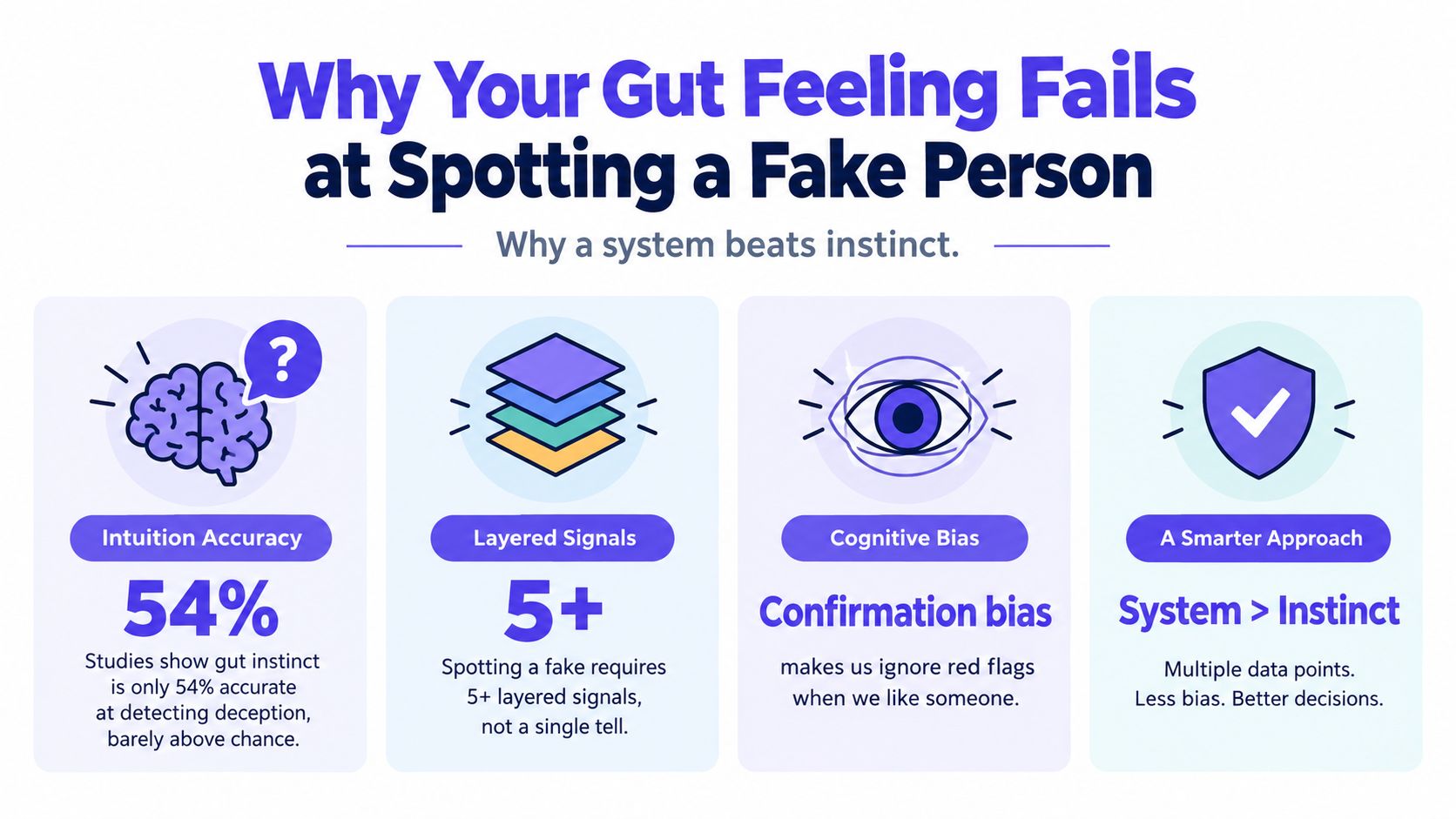
A system beats a first impression
I treat authenticity as a layered decision with three evidence groups:
- Behavior, including how the person answers questions, handles delays, and responds to reasonable boundaries.
- Digital footprint, including account history, image reuse, professional claims, and independent connections.
- Forensic verification, including file metadata, frame-level artifacts, audio analysis, and source provenance.
One red flag doesn't prove that someone is fake. A new account could belong to a genuine person who values privacy. Awkward speech could reflect anxiety, language differences, or poor connectivity. The useful question is whether several independent signals point in the same direction.
Practical rule: Treat visual suspicion as a reason to pause, never as proof that someone is deceptive.
This distinction matters in dating, hiring, newsroom verification, law enforcement evidence review, and executive impersonation. In each setting, the cost of a wrong decision differs, but the process should remain similar. Verify identity through a channel the person didn't control, compare claims with records that existed before the interaction, and preserve the original material before it disappears.
For a broader framework on evaluating manipulated claims, see this guide to mastering false information detection. The practical promise is simple: the checks ahead are designed to produce a pass, a pause, or an escalation decision without requiring you to accuse someone on sight.
Behavioral and Conversational Red Flags That Reveal a Fake Person
A fake person often reveals more through control of the conversation than through appearance. Watch how the individual manages questions, uncertainty, and boundaries. Deception isn't the only explanation for an unusual behavior, so use each signal to choose a low-friction follow-up rather than to deliver a verdict.
Most visual advice is a weak primary strategy. Evidence involving participants in the United States, the United Kingdom, and Brazil found scores of 0.07, 0.07, and 0.08 on a scale where zero represented a coin flip, underscoring how little confidence appearance-based judgment deserves. (Veriff's discussion of deepfake fraud)

Listen for control, not nervousness
Inconsistent timelines are more useful than ordinary nervousness. If someone says they worked in one city, then describes a routine that belongs somewhere else, ask for a neutral detail: “How did you usually get to work?” Genuine people may correct themselves or explain the confusion. A deceptive person may avoid the detail, change the subject, or produce another broad claim.
Evasive answers deserve a second question. Ask, “Which team handled that?” or “What was the name of the event?” Keep your tone curious. A real person may not remember, but their uncertainty usually has a stable shape. Fabricated stories often become less coherent when you request ordinary context.
Love-bombing and manufactured urgency work by narrowing your decision window. In a personal interaction, someone may push rapid intimacy, secrecy, or financial help. In a business setting, an alleged executive may insist that a transfer or document must happen immediately. Reply with a boundary: “I don't make that decision without a normal callback and written confirmation.” Their response to the boundary can be more informative than the original request.
Use small tests that don't accuse
A person who claims to be available for a live call should be able to arrange one under reasonable conditions, though technical problems can happen. Ask for a spontaneous action that doesn't expose sensitive information, such as holding up a handwritten phrase agreed during the call or answering a question tied to the current conversation. Don't treat success as conclusive. Treat refusal, repeated postponement, and pressure to use only one channel as reasons to escalate.
Mirroring can create false familiarity. Someone may copy your interests, vocabulary, or emotional tone without offering concrete experiences of their own. Ask an open question that invites detail, then see whether the answer contains a consistent personal perspective rather than polished agreement.
If a situation could become confrontational, calm communication matters. Training in de-escalation training for guards offers useful principles for keeping questions neutral, maintaining distance, and avoiding a confrontation that could increase risk. Your objective is verification and safety, not forcing a confession.
Online Profile Signals and Quick Identity Checks
A profile audit should be fast, proportionate, and privacy-respecting. You're checking whether public claims corroborate one another, not building an unauthorized dossier. Don't scrape private information, contact unrelated family members, or publish suspicions. Save only what you need to make a safe decision.
Start with the profile photo. Use a reverse image search to see whether the same image appears under another name, on a stock-photo site, or across unrelated accounts. A match doesn't automatically prove fraud because people reuse legitimate photographs, but it gives you a specific question to resolve.
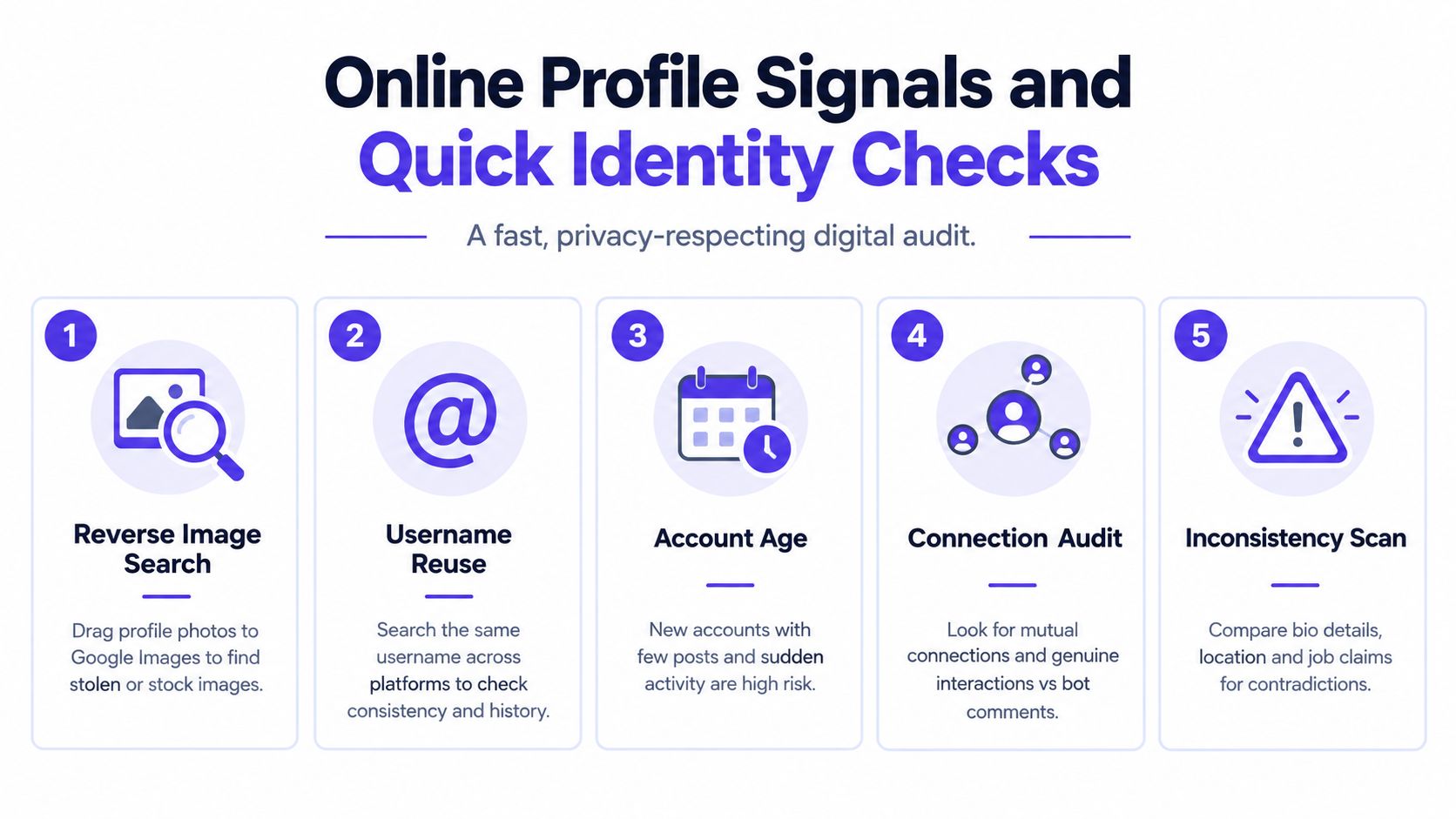
Run the audit in a fixed order
Compare usernames. Search the same handle across platforms. Look for consistent interests, writing style, locations, and activity, not identical bios everywhere. A username that suddenly appears on several new accounts deserves caution.
Inspect account history. Check whether the account has a believable progression of posts, conversations, and tagged activity. A profile created recently with a polished identity but little organic history doesn't establish who operates it.
Test the social graph. Mutual connections are useful only when they're genuine. Review whether interactions contain specific, two-way conversations or mostly generic praise and repeated comments.
Compare biographical details. Put the stated job, location, education, travel, and timeline next to one another. Contradictions matter more when they affect the purpose of the contact, such as an alleged recruiter whose company affiliation cannot be confirmed.
Confirm through a separate channel. Don't use the phone number, email address, or meeting link supplied inside the suspicious message. Find the organization's official website, published contact route, or a known colleague, then ask whether the person and request are genuine.
The separate-channel step is the strongest protection against a coordinated impersonation attempt. A scammer can control a profile and send convincing email, but they may not control the trusted phone number you already have for a colleague or the official account portal where genuine requests appear.
Decide whether to pass, pause, or escalate
A pass requires corroboration, not a clean-looking photo. A pause is appropriate when the evidence is incomplete but no immediate harm is occurring. Escalate when the person requests money, credentials, identity documents, remote access, secrecy, or an irreversible action before independent confirmation.
The scale of the threat makes this discipline necessary. In 2025, verified deepfake incidents reached 2,031 in Q3 alone, while reported deepfake-enabled impersonation scams grew more than 1,400% year over year. The same report stated that AI-linked operations generated 4.5 times the revenue at nine times the activity of non-AI operations. (Q3 2025 Deepfake Incident Report)
For photo-specific checks, this guide to fake selfie verification can help you think beyond whether a face looks plausible.
How to Verify Video and Audio When a Person Might Be Synthetic
Treat a suspicious clip as forensic evidence, not as a conversation. Preserve the original file if you can, record where it came from, and avoid relying on a repost that may have changed the encoding. A screen recording can remove useful metadata, while messaging platforms may recompress the video and create artifacts unrelated to the original manipulation.
The practical workflow has four layers.
Start with the source
Check the original uploader, upload context, file type, metadata, edit history where available, and whether an earlier version exists. Metadata can be stripped or altered, so a clean result doesn't authenticate the person. It does, however, help establish a chain of handling and can reveal inconsistencies worth investigating.
Next, inspect the video frame by frame. Look at facial boundaries, hair, teeth, glasses, earrings, hands, reflections, shadows, and background edges. A face swap may leave boundary instability, while generated footage can show changing textures or motion that doesn't remain consistent across adjacent frames. These are triage clues, not standalone proof.
Test the sound and movement together
Listen for a voice that lacks natural variation, but don't decide based on a robotic tone alone. Modern synthetic speech can sound convincing, and real recordings can sound flat because of microphones, compression, illness, or poor acoustics. Compare mouth movement, consonant timing, breathing, room sound, and changes in head position.
A useful supporting discipline is learning how speech recognition for podcasters handles spoken audio, timestamps, and recognition errors. Transcription isn't a deepfake verdict, but it can help identify words that don't align with visible mouth movement or reveal edits in a supposedly continuous statement.
Interpret detector results carefully
Benchmark performance can collapse when a model encounters unfamiliar lighting, compression, generation methods, or subjects. The benchmark literature reports models scoring about 95% to 99% on curated datasets but falling to roughly 54% to 75% on realistic unfamiliar data. One reported XceptionNet result dropped from 99.26% on FaceForensics++ RAW to 65.18% on Celeb-DF v2 and 72.34% on DFDC. (WJARR benchmark review)
That gap is why I use automated analysis to prioritize review, then seek independent confirmation. AI Video Detector is one available option. Its stated workflow combines frame-level analysis, audio forensics, temporal consistency checks, and metadata inspection, and it reports results without storing uploaded videos.
For a deeper technical workflow, review forensic audio and video analysis. The important rule is simple: a detector score can support a decision, but it shouldn't replace source verification, identity confirmation, or expert review in a high-stakes case.
Scripts Questions and Real World Scenarios to Test Authenticity
Verification becomes easier when you have words ready before pressure starts. The scripts below avoid accusations and make the requested action ordinary.
Live confirmation: “I want to make sure I'm speaking with the right person. Can we continue on a new call using the contact method I already have for you?”
Separate-channel callback: “I received a request involving money or sensitive information. I'll verify it through the company directory and call back using the published number.”
Detail check: “You mentioned working with that team. What was the project called, and who else was involved?”
Boundary test: “I don't share codes or transfer funds during an unplanned call. Send the request through the normal process, and I'll confirm it independently.”
A genuine person may be surprised, busy, or unable to answer immediately. The point isn't to demand instant perfection. The point is to observe whether they accept a reasonable control or try to remove your ability to verify.
A dating conversation
A new contact uses attractive photos, quickly becomes emotionally intense, and asks for secrecy or financial help. Don't argue about whether the photographs are stolen. Ask for a normal live call, keep the conversation on the platform, and refuse money or identity documents until the person has established a consistent identity through independent means.
If they repeatedly postpone live contact, create emergencies, or become hostile when you set boundaries, stop escalating the relationship. Save the messages, report the account, and avoid announcing every verification step.
An executive video request
A supposed senior leader appears on a video call and asks for an urgent transfer. The face and voice look familiar, but the request breaks normal procedure. End the call without approving anything, then contact the executive through a known number or ask another authorized colleague to confirm the request.
Don't use the callback details shown in the video, email, or chat. A separate channel matters because the attacker may have compromised several connected accounts.
A freelance hiring contact
A recruiter offers work, moves the interview to an unfamiliar platform, rushes the decision, and asks for documents, payment, or equipment purchases. Verify the company through its official website and contact a published representative independently. Don't install software or share financial information merely because the interviewer appears on video.
Human review cannot settle every case. An in-the-wild 2024 benchmark found 6.6% disagreement between video labelers, meaning even expert reviewers didn't consistently agree whether a clip was real, fake, or unknown. (The benchmark's findings) That uncertainty is a reason to escalate, not a reason to give a persuasive clip the benefit of the doubt.
What to Do Next When You Suspect a Fake Person
Suspicion creates two risks. You could trust an impersonator, or you could wrongly accuse a genuine person and spread private material. The safest response protects your decision first and assigns blame only when the evidence supports it.
Preserve the original message, file, profile URL, timestamps, and relevant headers or transaction details where lawful. Don't edit or annotate the only copy. Store evidence securely, limit access, and avoid publicly reposting a suspected deepfake because redistribution can amplify harm and expose personal data.
Use an independent confirmation path
Choose a trusted route that the suspected person didn't provide. For an employee, contact the colleague through the company directory or an established phone number. For a bank, employer, retailer, or platform, open the official website or app yourself. For a newsroom or legal team, preserve provenance and request the original source file before publication or evidentiary use.
A detector can help assess a video privately, while a forensic specialist may be appropriate when the material could affect litigation, employment, public safety, or a large transaction. If you need an external investigator for identity, fraud, or evidence work, a regulated service offering private detective London may be relevant, subject to local law and a clear scope of work.
Choose the response by risk
| Situation | Immediate response |
|---|---|
| Low risk | Pause the conversation, ask for ordinary confirmation, and avoid sharing sensitive information. |
| Medium risk | Preserve evidence, verify through a trusted channel, and involve platform, workplace, or account security teams. |
| High risk | Stop payment or access, contact the relevant financial or security institution, secure compromised accounts, and report the incident to the appropriate authority. |
Don't confront a suspected impersonator if doing so could expose your location, escalate threats, or destroy evidence. Don't publish a name based only on visual suspicion. If personal data, account access, or funds were shared, act quickly with the affected institution and document every step.
The practical answer to how to spot a fake person is therefore not “look harder at the face.” It's to slow the decision, separate the communication channels, compare claims with independent records, and use multimodal forensic analysis when video or audio carries real consequences. Apply that process before your next high-stakes call, hiring decision, payment request, or personal meeting, and make verification a normal condition of trust.
Before you approve a payment, share sensitive information, publish footage, or meet someone privately, pause and run the layered checks above. If the evidence remains unclear, preserve the material and seek independent verification instead of taking the risk.


