

Audio Compression Artifacts in Media Forensics

A newsroom receives an anonymous voice memo. The speaker names a public official, the message sounds urgent, and the file has already passed through a messaging app. A legal team faces a similar problem when a key smartphone recording arrives as an exported clip rather than the original capture. The words may be clear, but clarity alone doesn't establish authenticity.
The file itself carries evidence. Audio compression artifacts can reveal how a recording was encoded, whether it was transcoded, and whether different parts of the signal have incompatible histories. They won't prove, by themselves, that a voice is genuine or fabricated. They can, however, expose a timeline that doesn't fit the claimed origin and direct investigators toward deeper analysis.
The Hidden Clues in Suspicious Audio Files
The first useful question isn't, “Does this sound real?” It's, “What happened to this file before it reached us?”
A voice memo may have been recorded on a phone, exported by an app, uploaded to cloud storage, downloaded by a source, trimmed in an editor, and sent again through a platform that applied its own codec. Each operation can alter the waveform and frequency distribution. A recording can still sound perfectly understandable after those changes, while its technical history becomes increasingly visible in a spectrogram and metadata report.
That distinction matters in verification work. Compression is not proof of manipulation, and an uncompressed file isn't proof of authenticity. Analysts need to separate ordinary platform processing from edits that interrupt the expected pattern of the recording. A consistent codec signature across the entire file may fit routine distribution. A sharp change in spectral behavior around a splice deserves closer attention.
Treat the file as evidence
Preserve the received object before opening it in an editor. Record the filename, container, apparent duration, metadata, acquisition time, sender, delivery channel, and any accompanying message. Generate a cryptographic hash and work from a copy, not the original submission.
Then inspect the audio track independently of the video, if the clip is audiovisual. Audio and video can have separate encoding histories. A video may look continuous while the audio contains a codec transition, unusual silence, or a section whose frequency profile doesn't match the surrounding material.
The history of MP3 illustrates why these traces persist. MPEG-1 Audio Layer III was approved as a committee draft in 1991, finalized in 1992, and published in 1993 as ISO/IEC 11172-3, a milestone described in this codec history. The format made perceptual audio coding a consumer technology, but its design also established a recognizable artifact profile. At reduced bitrates, the encoder reshapes or removes components that listeners are less likely to notice, which can leave pre-echo, muffling, and spectral smearing.
Practical rule: Preserve the received file first. Enhancement, noise reduction, and format conversion can destroy the very traces an examiner needs.
The strongest workflow compares the suspect file with a known source, an earlier export, platform records, or a recording made under similar conditions. Audio compression artifacts become useful when they answer a provenance question, not when they're treated as a standalone authenticity verdict.
How Lossy Codecs Create Spectral Distortions
Lossy codecs don't preserve every sample. They transform the signal into a representation that lets them spend bits where listeners are most likely to notice them and spend fewer bits where masking makes detail less audible.
MP3, AAC, and Opus use variations of this principle. The encoder divides audio into analysis frames, examines frequency content, estimates masking thresholds, and quantizes components according to the available bit budget. A loud tone can hide a nearby quieter component. A dense or noisy passage can conceal quantization noise more effectively than a clean, isolated tone. The encoder uses those relationships to reduce data while maintaining an acceptable perceptual result.
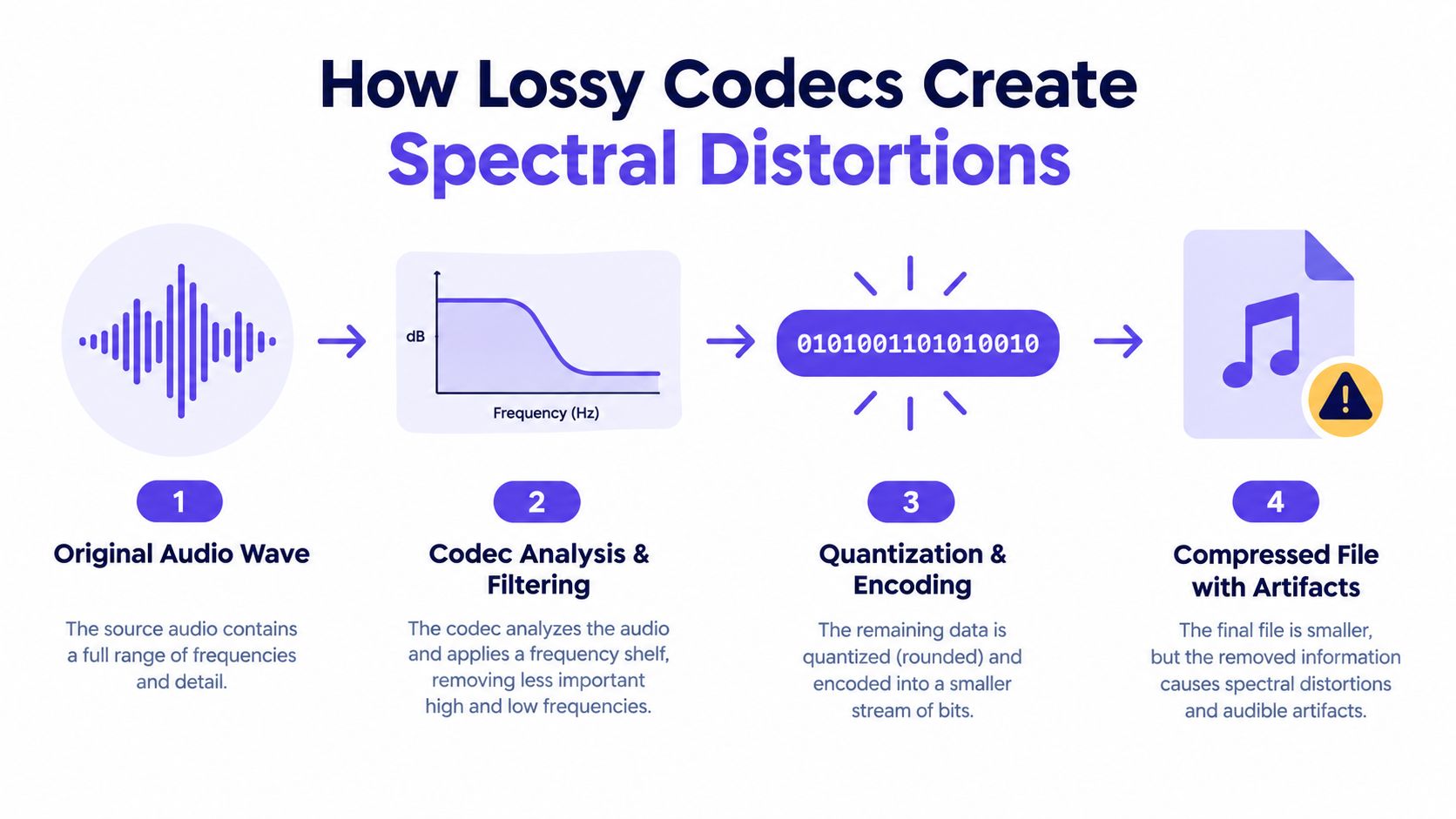
What the encoder removes
The process is easier to understand as four linked decisions:
- Analysis: The codec converts short sections of the waveform into time-frequency information. Transform methods expose energy across frequency bands, which gives the encoder a basis for deciding what to retain.
- Psychoacoustic filtering: A model estimates which components are audible and which are masked by louder or more prominent material. The model doesn't know what the recording means. It only allocates data according to perceptual assumptions.
- Quantization: Components are represented with limited precision. Small details may be rounded, weakened, or removed, while stronger components receive more accurate representation.
- Reconstruction: The decoder rebuilds a waveform from the retained information. Missing detail isn't recovered. The decoder generates the closest signal permitted by the encoded representation.
That reconstruction can produce measurable gaps and irregularities. A high-frequency boundary may become unusually clean or move with bitrate changes. Fine harmonics may lose continuity. Quantization noise may appear as scattered energy, tonal “birdies,” or a roughened background in the spectrogram.
The trade-off is visible in common MP3 settings. Engineering summaries describe 128 kbps as a design point intended to approach the quality of earlier coding at much higher bitrates, while later summaries describe 128 kbps as capable of roughly 10:1 compression and 320 kbps as about 4:1, as documented in the codec history reference. These figures aren't authenticity thresholds. They illustrate why a lower data rate generally gives the encoder less room to preserve transient detail and spectral texture.
Why a file's history matters
A single encode leaves one set of decisions. A second lossy encode operates on an already altered signal, so it can amplify or reorganize existing artifacts. Research summarized by the Audio Forensics Institute and Practitioners describes codec-specific spectral signatures and notes that forensic analysis can help infer codec family, quality setting, and repeated compression. It also identifies increased artifact energy as a measurable consequence of double compression relative to single compression.
The operational consequence is important: don't ask whether a file “has artifacts.” Ask which artifacts, where they occur, and whether the pattern is consistent with the claimed delivery path. A platform-generated export may explain a global signature. It doesn't automatically explain a local discontinuity inside a sentence.
A study on lossy perceptual coding found that codec and bitrate changes reduced the accuracy of a state-of-the-art acoustic-scene classification system by up to 57% compared with uncompressed captures, depending on the codec and bitrate (research on perceptual coding and machine analysis). That result is a warning for forensic teams: compression can change not just what humans hear, but how automated systems interpret the recording.
Identifying Common Audio Compression Artifacts
A suspicious interview clip may sound normal through speakers, yet reveal a different history in a spectrogram. Listening remains useful for triage, but it should test specific passages rather than decide authenticity on its own. Use headphones at a controlled level, then compare the disputed speech with adjacent material and any original reference.
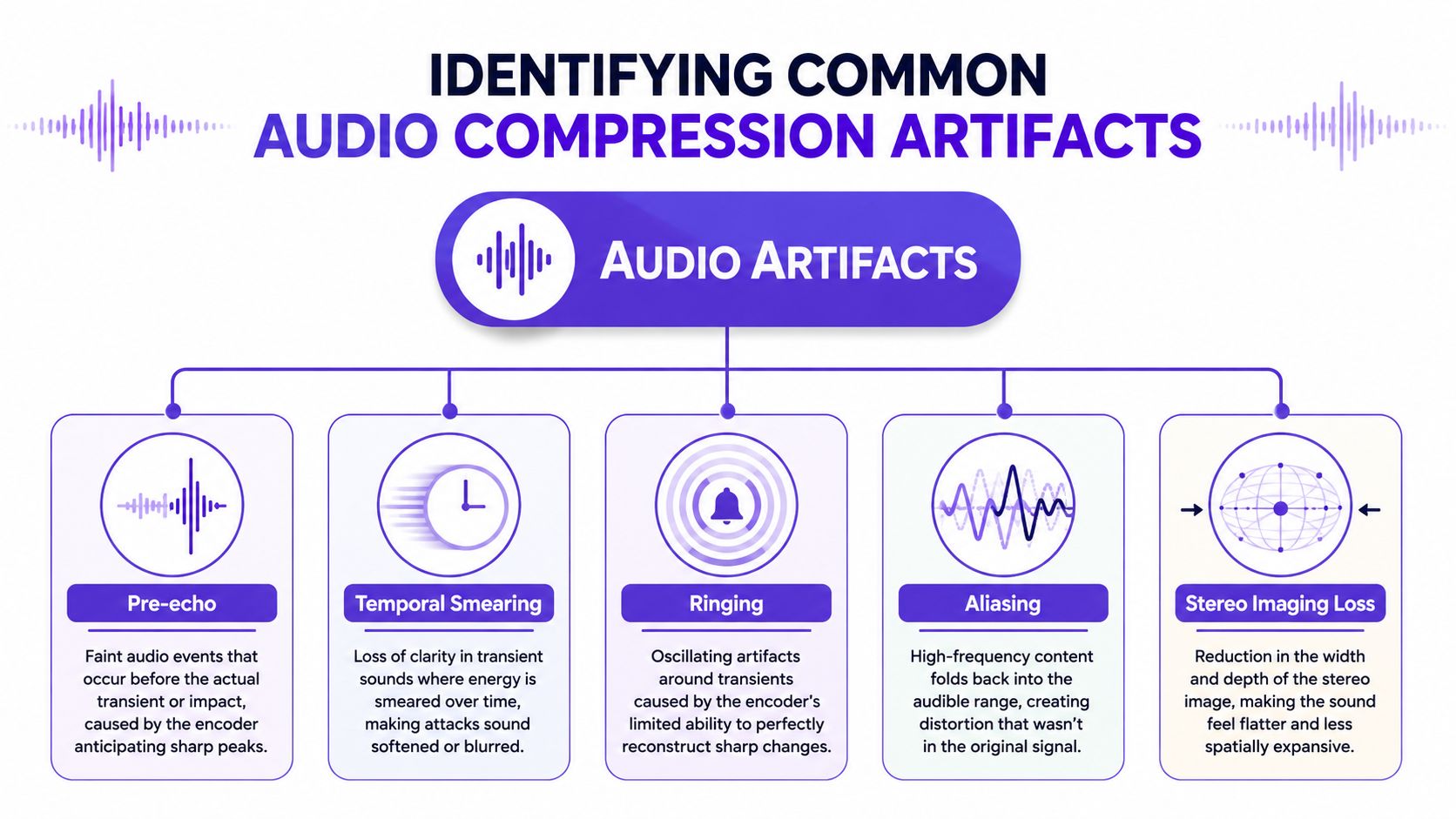
Pre-echo and temporal smearing
Pre-echo places a faint version of an attack before the event that should produce it. A sharp consonant or click may develop a soft haze leading into the transient. Inspect the time-frequency region immediately before a sudden broadband burst. Energy that rises gradually ahead of the event can indicate encoding, although microphone response, room reflections, and editing can create similar shapes.
Temporal smearing extends an event across neighboring time. A consonant loses its edge, a percussive sound becomes less focused, or a brief interruption trails into nearby material. Transform-based coders can produce both effects because quantization noise is distributed across a transform window, while backward temporal masking is weak around short attacks and abrupt spectral changes, as described in research on transient artifacts in transform coding.
These artifacts matter in authentication because a codec signature can expose processing that is absent from the stated file history.
Ringing and tonal warbling
Ringing appears as faint oscillatory energy around a sharp event. On a spectrogram, look for horizontal or curved bands that continue briefly around a transient. The audible result may resemble a metallic edge or a small resonant tail.
Warbling produces a moving, unstable tonal quality. Sustained vowels can sound watery when the codec struggles with changing background noise or limited bit allocation. In a display, narrow frequency components may flicker or wobble from frame to frame instead of preserving natural harmonic continuity.
Quantization noise is less tonal. It may sound grainy, gritty, or like a low-level fizz. A spectrogram can show a raised noise floor, scattered high-frequency specks, or energy concentrated unnaturally in particular bands. Microphone self-noise usually follows the room and hardware. Codec noise more often follows frame boundaries, bitrate behavior, or frequency-dependent coding decisions.
Bandwidth cutoffs and stereo collapse
Aggressive encoding can remove upper-frequency information, leaving a hard or unusually stable spectral ceiling. A microphone with limited response may also roll off high frequencies, but its response usually reflects the device and recording conditions. A codec cutoff can appear more abrupt, especially alongside block-like or band-limited patterns.
Stereo information may weaken as well. Stereo imaging loss narrows the apparent position of a voice or room ambience. Compare left and right channels separately, not only the combined waveform. A narrow image, mid-side imbalance, or sudden change in channel relationship can mark a processing boundary or reveal that a supposedly continuous recording passed through different workflows.
Use this guide to spectral analysis when reviewing frequency-time displays. The display cannot certify a file as authentic or fabricated. It identifies locations where the recording's claimed history needs testing, including possible AI-generated speech, deepfake processing, or later tampering.
Detecting and Measuring Audio Degradation
A defensible examination starts with reproducibility. Listening notes should identify the exact time range, playback conditions, and comparison material. Visual findings should record the spectrogram settings, frequency scale, windowing choices, channel view, and any processing applied for display.
A practical triage sequence
First, preserve and inventory. Keep the source untouched, calculate a hash, and capture container and stream metadata. Tools such as MediaInfo and FFmpeg can help extract technical details, while an editor such as Audacity, Adobe Audition, or Sonic Visualiser can provide waveform and spectrogram views. The tool matters less than maintaining an unaltered source and documenting every derivative.
Next, inspect the whole file. Don't zoom immediately into the most suspicious word. Examine the complete frequency range and note the apparent bandwidth, channel layout, silence regions, level changes, and repeated patterns. A global cutoff may fit a platform export. A cutoff that appears only after a phrase may indicate editing, though it may also reflect a change in the source environment.
Then, compare neighboring regions. Use the same display scale for speech, silence, background noise, and transients. Look for discontinuities in high-frequency texture, abrupt changes in noise-floor shape, different codec block patterns, or a new spectral ceiling. A splice can be hidden in the waveform but become visible when the surrounding ambience fails to continue naturally.
Finally, test for recompression. Compare the suspected file with files from the claimed source or platform when possible. Repeated encoding can increase artifact energy and produce mismatched signatures. That finding supports a transcoding hypothesis, but it doesn't identify who performed the transcode or establish malicious intent.
Measure before you enhance
Objective metrics can support triage, but they aren't universal truth scores. Signal-to-noise measures, loudness readings, spectral centroid, bandwidth estimates, channel correlation, and codec metadata can help sort large collections. They become misleading when teams compare files with different microphones, environments, speech content, or packet-loss histories.
A comparative study found that objective speech-quality measurement performance is significantly affected by background-noise type and level, codec choice, and packet-loss concealment strategy, as reported in the comparative speech-quality research. The practical response is to treat measurements as conditional observations. Record the conditions, preserve the raw values, and avoid turning one metric into a verdict.
For a broader tool-oriented workflow, see audio forensics software. A platform such as AI Video Detector can be included as one triage option because its stated workflow examines uploaded video through signals including audio forensics, frame analysis, temporal consistency, and metadata inspection. It should complement, not replace, preservation, source comparison, and expert review.
Clean playback also matters during human review. A resource on how to captivate listeners with clear sound can help production teams distinguish presentation problems from evidence problems, but never apply restoration to the only preserved copy.
Audio Forensics and AI Generated Content Detection
Synthetic speech changes the question from “Which traditional codec was used?” to “What process generated or reconstructed this signal?”
A neural codec may produce audio that sounds acceptable while leaving traces in regions listeners rarely inspect. Recent work on AI-compressed speech reports distinct high-frequency peak artifacts and noisy FFT patterns, according to the research summarized by the Interspeech paper on AI-compressed speech. Those traces can coexist with natural prosody and intelligible words, so a listening-only review may miss them.
A conventional lossy codec generally leaves artifacts tied to psychoacoustic masking, transform frames, quantization, and bandwidth decisions. Neural systems can add architecture-specific behavior because they encode and reconstruct audio through learned representations. The result may be a characteristic high-frequency pattern, unusual periodicity, or an FFT texture that differs from ordinary MP3, AAC, or Opus processing.
Why the audio track deserves priority
Video deepfakes can preserve facial motion convincingly enough to pass casual inspection. The soundtrack may still expose a mismatch between phonetic timing, room acoustics, speaker identity, and the visible mouth movement. Investigators should compare consonant timing, breath placement, reverberation, background continuity, and the relationship between voice energy and scene movement.
That doesn't make audio a magic detector. Noise, packet loss, microphone placement, and transcoding can create false signals. A study on neural codecs reports that systems including EnCodec, AudioCraft, AudioDec, Descript Audio Codec, LPCNet, and Lyra V2 can be distinguished through subjective quality evaluation, which supports a broader forensic principle: model and architecture traces can matter even when ordinary listeners accept the output (source research).
Teams building synthetic media should understand the same risk from the production side. Tools that let users create videos with audio prompts make synchronized audiovisual generation more accessible, but generated sound still needs provenance records and technical review when the result is presented as documentary evidence.
The embedded video below provides another way to see how automated media analysis fits into a verification workflow.
For synthetic speech review, combine spectral inspection with speaker consistency, timing analysis, metadata, and source history. The synthetic speech detection guide can help structure that review, but no detector should be treated as conclusive without examining the original file and the circumstances of capture.
Best Practices for Recording and Transcoding
The safest forensic workflow begins before an incident. Record the highest-fidelity source your equipment and storage process can preserve, and keep that source separate from files created for messaging, publishing, or transcription.
Use a stable, documented recording format and preserve the original container. If a platform requires a delivery copy, create that derivative from the preserved master. Don't overwrite the master with an edited or normalized version, and don't assume cloud synchronization preserves the original codec or metadata.
Preservation versus convenience
A useful comparison looks like this:
| Workflow | Forensic effect |
|---|---|
| Original capture retained, derivative exported for sharing | Preserves a reference for later comparison |
| Lossless working copy used for editing | Limits additional codec damage during analysis |
| Repeated lossy exports | Can add codec-specific and cumulative artifacts |
| Messaging-app forwarding | May change encoding, metadata, and channel characteristics |
| Noise reduction or voice enhancement applied to the only copy | Can remove or synthesize details needed for examination |
Messaging applications and social platforms are distribution channels, not archival systems. If a source sends a voice note, request the original capture or earliest available export in addition to the forwarded copy. Preserve the forwarded object too, because its transformation history may help explain what happened between capture and receipt.
Document the chain of custody
For each transfer, record who supplied the file, how it arrived, when it was acquired, and what software created any derivative. Note whether the file was trimmed, normalized, denoised, transcribed, or converted. Store hashes for each version and label derivatives clearly.
Voice over IP recordings add another complication because packet loss, concealment, and platform processing can affect speech quality. A practical business VoIP examples guide can help teams identify the kinds of communication systems that may have produced a recording, but the exact platform and export settings still need to come from documentation or the source device.
Don't “repair” an evidentiary file before analysis. Create a working derivative, apply one documented process at a time, and retain both the input and output. Restoration may make speech easier to understand, but it can also conceal a splice, invent plausible high-frequency content, or alter phase relationships.
Key Takeaways for Media Authentication
Audio compression artifacts are provenance clues, not automatic proof of fraud. A credible examination connects technical findings to the claimed recording and delivery history.
Use this checklist:
- Preserve first: Hash the received file, retain metadata, and work from a copy.
- Inspect the full track: Review bandwidth, channel behavior, noise floor, silence, transients, and codec indicators.
- Compare locally: Check whether adjacent speech and ambience share the same spectral texture.
- Test the history: Look for codec mismatch, repeated compression, and abrupt changes that may indicate transcoding or editing.
- Review AI-specific traces: Examine high-frequency peaks, FFT texture, timing, speaker consistency, and audio-video alignment.
- Separate enhancement from evidence: Keep restoration outputs away from the preserved original.
- Report limits: State what the artifacts support, what they don't establish, and which source records are still missing.
Quality problems don't always mean a recording is false. Research shows that codec choice, background noise, and packet-loss concealment can change both perceived quality and objective measurement results (comparative speech-quality research). The reliable conclusion usually comes from convergence, metadata, waveform and spectrogram behavior, source testimony, and independent comparison.
For a newsroom or legal team, the next step is practical. Establish a preservation checklist now, train staff to save original submissions, and require technical review before a suspicious clip is published, filed, or used to support a consequential decision.
If your team is evaluating a questionable recording, preserve the original file and its delivery context first, then document every derivative before running spectrogram, codec, or synthetic-speech analysis.


