

AI Fraud Detection Guide: Methods, Metrics and Deployment

22,364 complaints in which victims identified an AI connection produced about $893 million in adjusted losses, according to the FBI's 2025 Internet Crime Report, the first edition in nearly 25 years to carry a dedicated artificial-intelligence section. That works out to roughly $39,960 per AI-linked complaint. Investment fraud alone accounted for about $632 million, or approximately 71% of all AI-related losses. The same report puts business email compromise with an AI component above $30 million, AI-linked confidence and romance scams above $19 million, and AI-assisted employment scams, including deepfake video and voice interviews used to reach corporate systems, near $13 million in reported losses.
Those figures are money leaving accounts. A social post can be wrong and still cost nothing. A released wire cannot be unsent.
Treat the detector score as one input, the way a smoke-alarm reading is one input to a fire call. It is a probability, not a verdict, and no model is perfect on a generator it has not seen. Compare the loss if a bad payment clears against the cost of holding a good one, then set the bar where that trade-off makes sense for your book. Above the bar, pause the payment and use a callback or a second identity check. Below it, let the transfer proceed and log the score. When a new generator slips past the model, the fallback is the control, not a higher confidence number.
What AI Fraud Detection Catches and Why It Matters Now
A finance clerk joins a six-minute video call. The face is the CFO's, the voice matches, the background is the same hotel lobby from last quarter's offsite. The clerk releases a supplier payment to a new account number and confirms it by email. Everything about the interaction felt normal, and that's the design goal of the attack.
AI fraud detection is software that learns patterns from transactions, accounts, messages and media, then scores each event for risk before a human or an automated system acts on it. Think of a night-shift security guard who knows the building's rhythm: which doors open at shift change, which lift runs at 2 a.m., which corridor lights stay on. The guard doesn't memorize every face. They notice the one door that opened when it shouldn't have.
A detector works the same way across millions of events, and it answers three questions your team cares about.
- Is this transaction normal for this account? Amount, hour, payee, device and channel all feed the answer.
- Is this person who they claim to be? Device fingerprints, behavioral biometrics and voice or face checks contribute.
- Is this media real? Frame artifacts, audio spectra, temporal consistency and metadata decide whether a clip is synthetic or edited.
Detection covers more than payments. The use cases include viral misinformation, impersonation deepfakes, travel scams, dating safety, fake listings and identity fraud, which means a single control rarely spans them all. A travel booking scam and a deepfaked board memo fail in different ways.
Where crypto sits in the approval chain, a token check answers a question a media detector never will. If your treasury team buys tokens from a chat recommendation, run the contract through a Solana rug checker before anyone signs, then run any accompanying video pitch through media analysis. Two questions, two tools, one approval.
The reframe that matters: the FBI counts only incidents a victim both reported and recognized as AI-involved, so the true total sits well above the reported figure. Absence from the statistics is not absence from your queue.
For teams building this into an existing control framework, the practical starting point is enterprise fraud prevention architecture rather than a standalone classifier. Write down the three threat types your organization faces this quarter. Many teams focus on executive impersonation, payment redirection and synthetic identity, and those three drive every threshold decision that follows.
Four Detection Approaches Compared at a Glance
Many organizations don't choose between four equal options. They inherit rules, add a model, and then wonder why the combined system still misses the attack that worries them most. The table shows what each approach is good at.
| Approach | How it learns | Best for | Main weakness | Typical example |
|---|---|---|---|---|
| Rule-based screening | Hand-written thresholds such as amount limits | Simple, known patterns | Brittle; attackers adapt quickly | Blocking transfers above a fixed limit |
| Supervised classification | Learns from labeled fraud and legitimate cases | Known fraud types with a labeled history | Misses novel attacks; needs labels | Card-not-present payment fraud |
| Unsupervised anomaly detection | Learns normal behavior and flags deviations | New or unlabeled patterns | Higher false-positive rate; needs tuning | Account takeover from an unfamiliar device |
| Multi-signal fusion | Combines model scores from several sources with a decision layer | Mixed-channel and synthetic-media attacks | Harder to build, validate and explain | Executive video-call payment request |
Rules earn their place as the floor, not the ceiling. They fire instantly, they're auditable in a regulator's office, and they never drift. The problem is that a rule is a published number. Once a fraud ring learns your $10,000 transfer cap, the transfers arrive at $9,400.
Supervised models see nuance that rules can't encode, such as the fact that a 3 a.m. purchase is routine for one cardholder and alarming for another. Their ceiling is the labeled history underneath them. A model trained on card-not-present fraud has no concept of a deepfaked vendor call, because nobody labeled one.
Anomaly detection needs no fraud labels at all, which is its appeal and its cost. It generates more alerts per real case, and someone has to work those alerts. Budget for the review capacity before you switch it on.
Fusion is the only approach that handles an attack spanning voice, video, email and payments, because each channel contributes its own evidence. It's also the hardest to explain to an auditor, since the final score comes from a weighted combination rather than a single clean rule.
Practical rule: pick by two questions. Do you have reliable labels for the fraud types you actually see? Does the attack cross more than one channel? Two yeses point to fusion, one yes points to supervised, two noes point to anomaly detection with a rules floor beneath it.
If your fraud team already reports alert volumes and losses through a BI layer, banking analytics insights from Visbanking covers how those dashboards get assembled, which helps when you need to show a model is reducing loss rather than just reshuffling work.
How Anomaly Detection Flags Activity That Breaks the Pattern
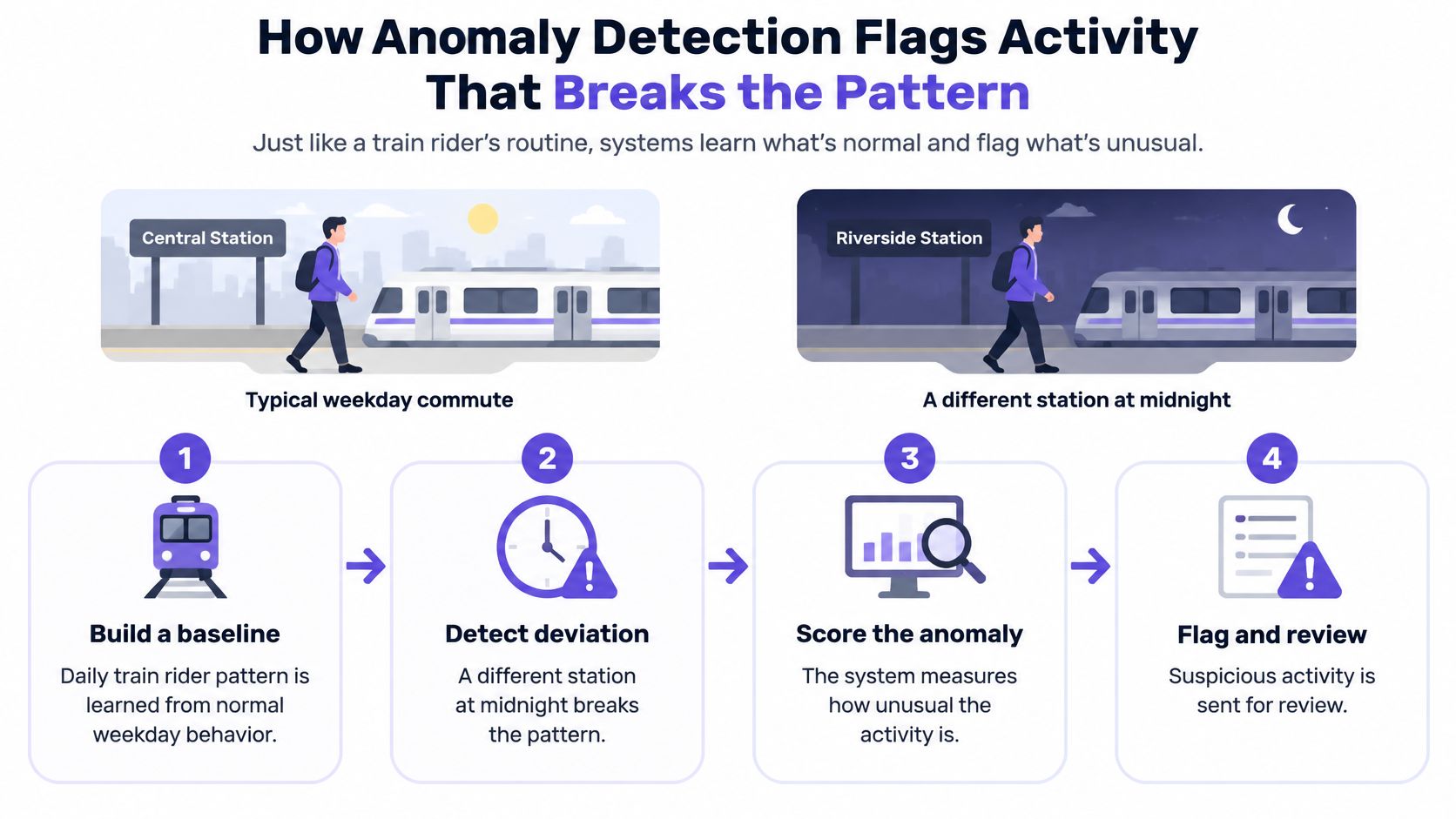
Someone who takes the same 7:42 train from the same platform every weekday notices immediately when they board at a different station at midnight. Nothing about the train is unusual. The pattern is what broke.
Anomaly detection builds that same familiarity for every customer, account and device, then measures how far each new event sits from the learned routine.
- Build a baseline. Record typical amounts, hours, locations, devices and payees per entity.
- Measure the distance. Compare the new event with that baseline across every feature you track.
- Convert distance to a score. Normalize the gap into a risk number you can threshold.
- Compare with a threshold. The cutoff comes from expected loss, not from a vendor default.
- Route the flag. Send it to review, a step-up authentication challenge, or an automatic hold.
Three methods do most of the work. Z-scores handle a single feature well, telling you how many standard deviations an amount sits from that account's norm. Isolation forests isolate unusual points quickly by splitting the data at random, which scales to large transaction sets. Autoencoders learn to reconstruct normal behavior, and a large reconstruction error on a new event signals something the network has never had to rebuild before.
Consider a login from a new device, followed by a transfer of 40% of the balance at 2:14 a.m. to a payee added minutes earlier. No single signal proves fraud. New device happens after every phone upgrade. Large transfers are routine at quarter end. Together, in that order, at that hour, they describe account takeover.
Then the arithmetic that sinks naive deployments. If 1 in 1,000 transactions is fraud and the detector wrongly flags 1% of legitimate ones, roughly 10 false alerts arrive for every real case. An analyst queue built on that ratio burns out in a month, and the team starts rubber-stamping.
The limits are just as real. A customer who travels on holiday, changes jobs, or opens their first account in a new country all look anomalous, and a brand-new customer has no baseline at all. Cold-start accounts need rules and manual review until enough history accumulates. Teams that treat behavioral context as a first-class problem usually get further; behavior anomaly detection covers the sequencing of that work.
Choosing Between Supervised and Unsupervised Models
The wrong question is which model type is better. The right one is which model type your data can support this quarter.
Work through five criteria before you commit.
- Label volume and freshness. Count confirmed fraud cases per fraud type and check how recent they are. Labels older than two quarters describe an attacker who has already moved on.
- Class imbalance. Fraud is rare by construction, so a few hundred positives against millions of negatives will shape your validation design more than your architecture choice.
- Novelty rate. If new attack types appear monthly, a purely supervised stack will always trail reality.
- Explainability demand. Analysts who can't see why an alert fired will close it without investigation.
- Retraining cadence. A supervised model is a perishable asset. If nobody owns the retraining pipeline, its accuracy decays unnoticed.
Supervised models need a labeled history that covers each fraud type you care about. Unsupervised models need something different and often harder: clean, representative data on what normal looks like, without the seasonal distortions of promotions, holidays and one-off events baked in. A hybrid usually wins. Train the supervised model on confirmed cases, and feed the anomaly score in as one more feature so the classifier learns when deviation itself is suspicious.
Here is where benchmark accuracy stops being reassuring. NIST's guidance on face-morph detection reports that single-image detectors can approach 100% detection at a 1% false-detection rate when trained on the same software that generated the morphs. Test the same detector against morphs made by unfamiliar software and performance can fall below 40%.
That gap isn't a tuning problem. It's distribution shift: the model learned generator-specific artifacts instead of a strong manipulation signature. NIST's differential comparison result points at one mitigation. Give the detector a questionable image plus a known genuine reference and best-case accuracy lands at 72% to 90% across open- and closed-source morphing tools, though that requires a trusted comparison image you have on hand.
Test plan that catches this before production does: hold out one generator the model has never seen, then re-run the evaluation after recompression, resizing, screen recording and adversarial post-processing. Require the model to report confidence and to escalate inputs outside its training distribution instead of returning a low score that reads as "authentic."
Multi-Signal Fusion Across Video, Audio, Metadata and Identity
A single detector score is not a verdict. It's one number with a confidence interval attached, produced by a model that has seen a finite set of fakes. Treat it as evidence in a decision, and the architecture changes.

For video, four independent signals carry most of the load. Frame-level artifacts show GAN fingerprints and diffusion traces that survive careless generation. Audio spectral anomalies appear when a cloned voice lacks the breath and room tone of a real recording. Temporal inconsistencies show up as motion discontinuities, flicker and micro-expressions that don't track a real face. Metadata and encoding irregularities reveal re-wrapping, stripped headers and double compression.
Fusion works by letting each signal produce its own probability, then merging them through a weighted combination or a meta-classifier trained on the joint pattern. Disagreement between signals is itself information. When the audio model says 0.9 synthetic and the frame model says 0.2, you've learned something about how the clip was made.
The score is a probability, not a certainty, and no detection is 100% perfect. A 0.7 means roughly seven in ten clips like this one turn out synthetic, which is a very different statement from "this is fake."
Then the gap that catches many teams. Detection is not authentication. A 2026 Microsoft Research report on media integrity and authentication separates three complementary approaches, namely provenance metadata, watermarking and fingerprinting, and warns that each carries both false negatives and false positives. The awkward implication is that a real camera-recorded clip can lack trustworthy provenance, while an AI-edited clip may preserve a perfectly valid record of its edit history.
C2PA-style credentials can answer where a file came from and what happened to it, but they aren't universal. Metadata gets stripped by social platforms, files get recompressed on upload, and footage submitted by the public usually arrives with nothing attached. Here's how the two failure modes look in practice.
Say a CEO video call arrives with a payment instruction. The audio spectrum passes cleanly, but the temporal model flags flicker around the jawline once the platform recompresses the stream. The right conclusion is not "deepfake." It's "inconclusive, escalate," followed by a callback to a number already on file.
Layered authentication means signed provenance, watermarking and content fingerprinting used together, with detection as one component. Keep the chain of custody intact from the first minute: capture the file hash, store the original, log who handled it and when. If your team retains frame scores, audio features and call recordings for a year, data lake and warehouse cost differences explains where that storage bill comes from before you promise retention to legal.
An inconclusive result must never become an accusation. Write the escalation path before the first case, and say plainly in the report that the analysis could not reach a conclusion.
Evaluation Metrics and Thresholds That Matter
Teams ask for the model's accuracy. That number tells you almost nothing about the decision you're about to automate. These seven metrics do.
| Metric | What it tells you | Watch it when |
|---|---|---|
| Precision | Share of alerts that are real fraud | Analyst queues are overloaded |
| Recall | Share of real fraud the detector catches | Losses are rising from missed cases |
| False-positive rate at fixed recall | Legitimate customers hit at the recall you need | Choosing a threshold for live traffic |
| Precision-recall curve | Trade-off across every threshold | Comparing two models on imbalanced data |
| Latency | Time from event to score | Real-time payments or live video calls |
| Expected loss per decision | Fraud loss avoided minus review and friction cost | Setting the action threshold |
| Robustness to compression and unseen generators | Whether accuracy survives real conditions | Before any production rollout |
The stakes justify the rigor. The FBI's annual internet crime reporting recorded 859,532 suspected internet-crime complaints and more than $16 billion in reported losses during 2024, a 33% increase from 2023, with business email compromise alone at approximately $2.77 billion. The FBI defines BEC as a scheme that can compromise email accounts and other communications channels, including virtual meeting applications, to induce unauthorized transfers. That definition places video detection squarely inside a transaction-risk pipeline rather than outside it.
Now the threshold arithmetic. Suppose a manual review costs $5 in analyst time and an average fraud case costs $400 if it goes through. A case is worth reviewing whenever the detector's fraud probability exceeds 5 divided by 400, which is 1.25%. Below that line, you're spending more on review than you save.
Change the numbers and the cutoff moves with them. Swap in a transaction worth $40,000 and the same $5 review cost clears at a far lower probability. That's the point: the threshold falls out of expected loss, not out of a vendor's recommended default.
Accuracy misleads on imbalanced data for a simple reason. If 1 in 1,000 events is fraud and the model labels everything legitimate, it's right 999 times out of 1,000. It catches nothing. Precision, recall and the shape of the precision-recall curve expose that, and the precision-recall tradeoff is the metric pair worth arguing about in the design review.
One more check before go-live. Compare false-positive rates across language, accent, device and demographic groups. A threshold that performs well in aggregate can still flag one group disproportionately, which is both a fairness problem and a legal exposure.
Deploying and Verifying AI Fraud Detection Decisions
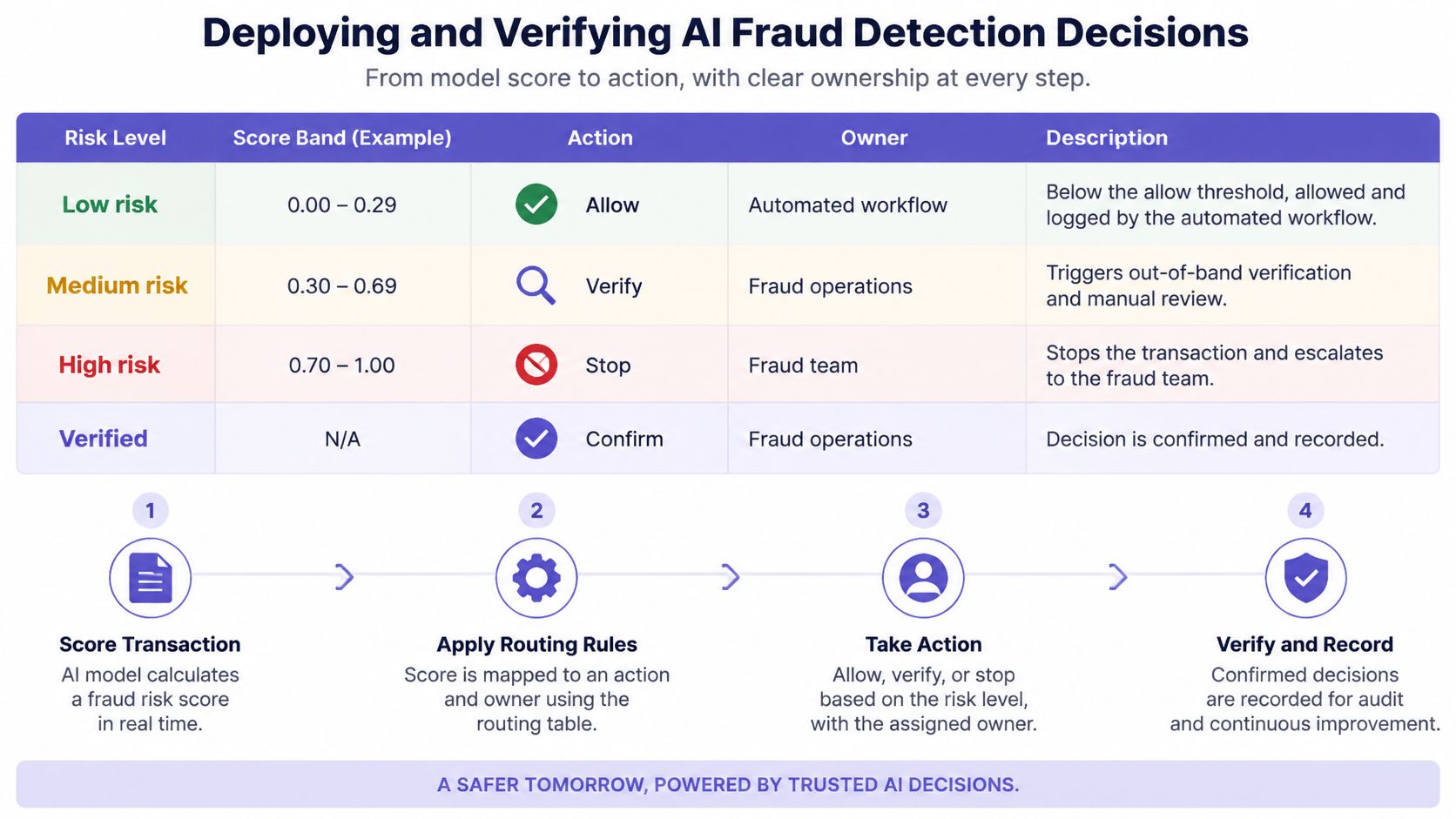
The score does nothing until it maps to an action and an owner. This routing table is the whole deployment in miniature.
| Risk band | Action | Owner |
|---|---|---|
| Low risk, below the allow threshold | Allow and log the score | Automated workflow |
| Medium risk | Out-of-band confirmation through a known phone number or callback | Fraud operations |
| High risk on payment change, credentials or legal evidence | Block or hold for manual review | Senior analyst |
| Detector unavailable or input outside its training range | Fall back to dual approval and transaction limits | Security on-call |
Three integration points that carry the load
The payment API hook runs at the moment a payee or bank detail changes, before release. It scores the request against historical payee behavior and returns allow, confirm or hold. If the detector is slow, the payment queues; it does not fail open.
The video-call step takes either the meeting recording or a submitted clip through media analysis, then pairs the result with a callback to a number already on file. A high synthetic-media score with a successful callback is a different situation from a high score alone, and the two should route differently.
The SIEM pipeline receives every score, threshold value and decision. Without that log you can't tune thresholds, answer an auditor, or explain to a customer why their transfer was held. This is also where drift shows up first.
The attack surface moved into the verification pipeline
Benchmark accuracy is the wrong comfort. A 2026 systematic review of AI fraud detection found that models exceeding 95% accuracy in controlled benchmarks still struggle with cross-dataset generalization, adversarial resistance, fairness, computational scalability and deployment outside the lab.
Attackers have noticed where the confidence sits. The same review cites an industry survey summary reporting biometric injection attacks, where a synthetic video feed is sent directly into a verification system rather than shown to a human, rising 741% year over year, with iOS attacks up 1,151% in the second half of 2025.
That reframes the design question. It isn't "can the detector spot this fake," it's "does the system hold up against manipulated, recompressed, screen-recorded, low-light, multilingual or directly injected media under adversarial conditions." Publish results broken out by source quality, codec, resolution, language, manipulation type and attack pathway, and report false positives and false negatives separately.
Candid admission worth putting in the design doc: assume the detector will fail on some future generator. Build the layer that catches the loss when it does.
Roll out in shadow mode first
Run the detector for four to six weeks without letting it block anything. Score live traffic, log the decisions, and compare them against what your analysts concluded. You'll learn your real base rate, your real alert volume and your real review cost, none of which a vendor benchmark can tell you.
Then move to graduated thresholds, where medium-risk bands trigger confirmation and only the high band blocks. Full enforcement comes last, and it comes with fallback controls already live: trusted callbacks, transaction limits, dual approval, device integrity checks and a named human to escalate to at 3 a.m.
Frame and clip analysis reads micro-expression inconsistency, synthetic audio spectral patterns and temporal flickering, which is what a media layer contributes to this pipeline. Every score is an estimate from a model, so store it as evidence, not as a verdict. When a clip lands on your desk today and you need a reading in minutes, AI Video Detector returns a frame-by-frame confidence score drawn from frames, audio, temporal consistency and metadata. It takes that score as one input to the routing table above, and the routing table still decides.
The checklist before go-live
- Confirm label coverage and the base rate for each fraud type you plan to catch.
- Test against unseen generators and recompression, and record the drop in writing.
- Set every threshold from expected loss, including review cost and the cost of delaying a legitimate payment.
- Keep callbacks and dual approval live even when the detector reports high confidence.
- Monitor drift after every major tool change, from a codec update to a new video platform in your intake path.
Start with one workflow you can measure. Take the payment-detail change process that runs through your finance team this quarter, log every detector score alongside the analyst's decision for six weeks, and compute what a $5 review against your average fraud loss justifies. That single threshold, backed by your own numbers rather than a benchmark, is the first real control you'll own. Then upload one suspicious clip to AI Video Detector and watch how a confidence score behaves on real footage before you put it in front of a payment.